
China generates approximately ₹20,000 crore annually from Feng Shui — products, consultations, certifications and exports. The Laughing Buddha on the shelf, the wind chimes at the entrance, the three-legged money frog near the cash box — these are Chinese exports that have found their way into tens of millions of Indian homes. Meanwhile, India’s own ancient spatial science, Vastu Shastra, is older, more technically structured and specifically calibrated to the Indian subcontinent’s geography — yet receives a fraction of the commercial attention that Feng Shui commands globally.
This guide compares both systems honestly — where they come from, how their core principles work, where they agree, where they directly contradict each other, and which one makes more sense for an Indian home and why. If you have been applying Feng Shui items in a Vastu-assessed home — or wondering whether you can use both — this is the complete answer.
Origins — Where Each System Comes From and Why Geography Matters
Both Vastu Shastra and Feng Shui are ancient spatial sciences rooted in the observation that the built environment affects its occupants’ health, prosperity and wellbeing. Both systems are thousands of years old, both encode practical architectural wisdom alongside spiritual tradition, and both have survived into the modern era because the outcomes they produce are observable and repeatable. Their similarities at this foundational level are genuine.
Where they differ begins with geography — and geography matters more than most comparison guides acknowledge.
Vastu Shastra originated in the Indian subcontinent more than 5,000 years ago, codified in the Manasara, Brihat Samhita and Mayamata — three primary classical texts that remain the authoritative references for Vastu practice today. The system was developed by architects and seers working in the specific geographic, climatic and magnetic conditions of the Indian subcontinent: tropical to subtropical climate, monsoon wind patterns flowing northeast to southwest, solar path that arcs from east to west through the southern sky (because India is north of the equator but south enough to receive direct overhead sun), and the magnetic field conditions of peninsular India.
Feng Shui originated in China more than 3,000 years ago, rooted in Taoist philosophy and the I Ching tradition. Its early Form School focused on reading landscape — mountains, rivers, wind patterns — while the later Compass School developed the Bagua map as a systematic directional grid. Feng Shui was calibrated to northern China’s geography: a colder climate where south-facing rooms and south-facing homes receive warmth from the winter sun, where mountains to the north provide shelter from cold northerly winds, and where the Yellow River drainage basin created specific water-energy associations.
Both systems encode local geographic wisdom in the language of spiritual principle. This is important to understand before comparing their specific rules — a rule that makes perfect geographic sense in one location may make less sense transplanted to a different climate, latitude and magnetic environment.
Classical reference: The Manasara (Chapter 1) specifically states that Vastu principles are calibrated to “Bharata varsha” — the Indian subcontinent — and acknowledges that “desha bheda” (regional variation) affects how elemental principles manifest in different geographic conditions. This is the classical Vastu acknowledgment that the system is geographically situated, not universally absolute in every application.
Master Comparison — Vastu Shastra vs Feng Shui Across 12 Dimensions
The following table is the most comprehensive side-by-side comparison available for these two systems. It covers origins, core concepts, directional prescriptions, tools and practical applications.
| Dimension | Vastu Shastra | Feng Shui |
|---|---|---|
| Origin | India — Vedic tradition, 5,000+ years | China — Taoist tradition, 3,000+ years |
| Primary texts | Manasara, Mayamata, Brihat Samhita | I Ching, Form School texts, Compass School manuals |
| Core concept | Prana — cosmic life force flowing through directional zones | Chi/Qi — life energy flowing through spaces and objects |
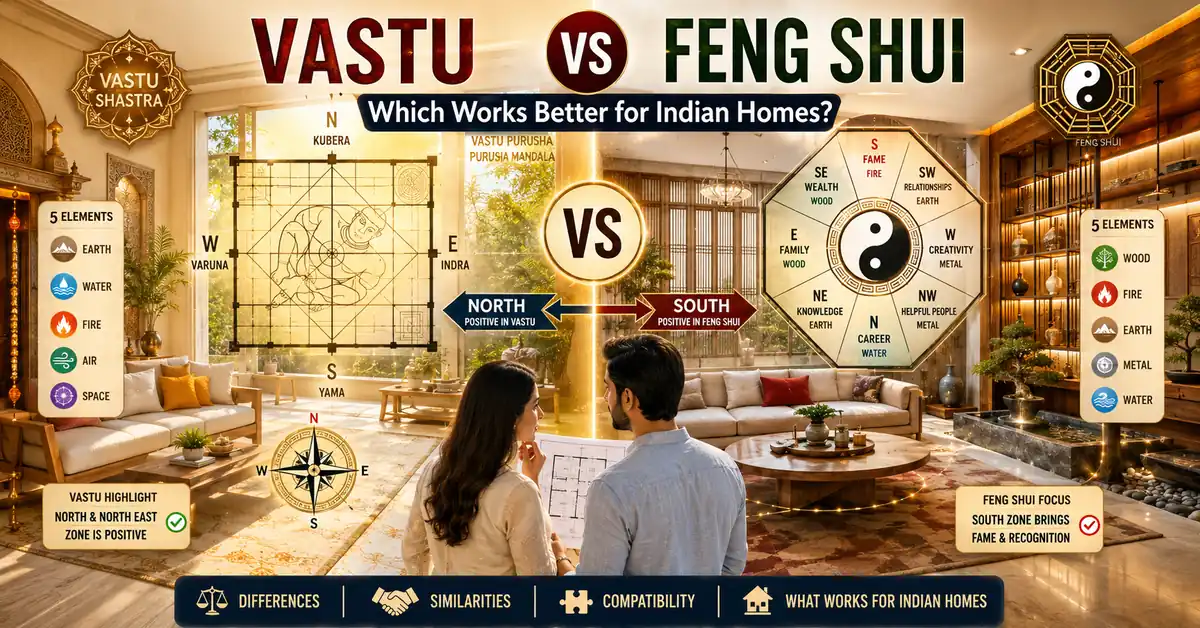
| Five elements | Earth, Water, Fire, Air, Space (Akasha) | Wood, Fire, Earth, Metal, Water |
| Energy grid tool | Vastu Purusha Mandala — fixed to absolute compass directions | Bagua map — relative to entrance (BTB school) or compass (Classical school) |
| Most auspicious direction | North (Kubera — wealth) and East (Indra — health) | South (warmth, fame) in classical Feng Shui |
| Kitchen placement | Southeast always — Agni (fire) zone | Varies — south or southwest by Bagua, never north |
| Master bedroom | Southwest — earth element, authority and stability | Southwest or west — generally aligned |
| Centre of home | Brahmasthan — must remain open and unobstructed | Ting (central hall) — must remain open, space element |
| Annual recalibration | Not required — fixed directional grid | Flying Stars — annual energy map recalculated each year |
| Application timing | Strongest at construction stage — structural rules | Applicable to existing spaces — flexible interior cures |
| Geographic calibration | Indian subcontinent — tropical/subtropical climate | Northern China — cold northern climate |
Already decided Vastu is your system? Check your home’s Directional Compliance score right now — VastuIQ’s free Vastu Calculator gives you the entrance pada score in under 2 minutes. Check your Vastu score free at vastuiq.com →
The Geographic Argument — Why Vastu’s Rules Fit Indian Homes Specifically
This is the most important section of this guide and the one most completely absent from every other Vastu vs Feng Shui comparison published online. The direction differences between the two systems are not arbitrary disagreements between ancient cultures — they reflect the specific geographic and climatic conditions each system was designed to address.
Why Vastu says North is the most open, auspicious direction
In the Indian subcontinent, the prevailing cool breeze flows from the northeast toward the southwest — specifically the Himalayan cold front air mass that moderates India’s heat, particularly in the north and northwest. Keeping the north and northeast walls lower, more open and with more windows allows this beneficial cool air to enter the home freely. This is simultaneously Vastu’s prescription and a sound bioclimatic design principle for Indian conditions.
North is also Kubera’s direction in Vastu — the lord of wealth, associated with Mercury’s commercial and intellectual energy. The north-open prescription produces homes that receive maximum cool air, maximum indirect northern light (which is the most stable and glare-free natural light for work and study) and maximum connection to the outdoor environment that commercial and intellectual activity requires. The spiritual prescription and the climatic logic converge.
Why Feng Shui says South is the auspicious, warming direction
In northern China — where temperatures in Beijing, Xi’an and the Yellow River basin regularly fall below freezing in winter — a south-facing home receives maximum winter solar warmth. The cold Siberian winds blow from the north, making mountains to the north highly desirable as windbreaks. A south-facing entrance in northern China means the home’s primary opening faces away from cold northern winds and toward beneficial solar warmth. Feng Shui’s south preference is a perfect climatic prescription for northern China.
In Chennai, Ahmedabad or Delhi, however, a south-facing building without adequate shading receives maximum afternoon heat from the summer sun — in India’s hot climate, this is a liability, not a benefit. The same principle that makes south-facing ideal in cold northern China makes it problematic in hot tropical India. This is why Feng Shui’s south-preference does not translate cleanly to Indian conditions — not because Feng Shui is wrong, but because it was not designed for India’s climate.
The solar path difference
In India (roughly 8°N to 37°N latitude), the sun rises in the east and sets in the west, arcing through the southern sky — directly overhead twice a year near the equator and always south of the zenith in the northern parts of India. East and north-east receive gentle morning light. West receives harsh afternoon sun. South receives the highest sun intensity across the day in summer. Vastu’s prescription to keep east and northeast open for light and to treat south as heavy, grounding and less ventilated reflects this solar reality precisely.
In northern China (35°N to 53°N latitude), the sun arcs through the southern sky at a much lower angle — the south face of a building receives sustained warming sunlight without the harsh overhead intensity of tropical regions. South-facing is comfortable, beneficial and actively warming in cold Chinese winters. The same solar geometry produces opposite prescriptions in the two geographic contexts.
The conclusion: For Indian homes, Vastu’s directional rules are climatically calibrated to the Indian subcontinent. Feng Shui’s directional rules are climatically calibrated to northern China. When the two systems contradict — specifically on north vs south auspiciousness — Vastu’s prescription is the correct one to follow in an Indian context, not because Feng Shui is wrong in principle, but because its directional logic reflects a different geographic reality.
The Five Elements — Where They Share Ground and Where They Diverge
Both Vastu Shastra and Feng Shui use a five-element framework as the foundational vocabulary for describing energy qualities in different zones. Three of the five elements are shared between the systems. Two differ — and those two differences explain some of the most important practical divergences between the systems.
| Vastu Element | Zone / Direction | Feng Shui Element | Zone / Direction | Shared? |
|---|---|---|---|---|
| Earth (Prithvi) | Southwest — stability, grounding | Earth | Center and SW — stability | ✓ Aligned |
| Water (Jal) | Northeast — clarity, spiritual | Water | North — flow, career | ✓ Partially aligned |
| Fire (Agni) | Southeast — transformation, cooking | Fire | South — fame, passion | ✓ Partially aligned |
| Air (Vayu) | Northwest — movement, air element | Metal | West and NW — precision, clarity | ✗ Different elements, similar zones |
| Space (Akasha) | Centre (Brahmasthan) — cosmic energy | Wood | East and SE — growth, vitality | ✗ Different elements, different zones |
The three shared elements — Earth, Water and Fire — produce broadly convergent recommendations between the systems. Both systems agree that earth-element energy suits the centre-to-southwest zone for stability, that water energy suits the north-to-northeast zone for clarity and flow, and that fire energy belongs in the south-to-southeast zone for active transformation.
The two divergent elements are more interesting. Vastu places Space (Akasha) at the centre — the Brahmasthan — prescribing an open, void centre as the cosmic energy distribution point. Feng Shui places Earth at the centre with no specific requirement for openness. Vastu places Air (Vayu) in the northwest, associated with movement and social energy. Feng Shui places Metal in the northwest, associated with clarity, precision and authority. These divergences produce different northwest-zone prescriptions — Vastu favours the northwest for unmarried adults and guests (movement, impermanence), while Feng Shui’s Metal energy makes the northwest more suitable for the patriarch or authority figure in the household.
Where Vastu and Feng Shui Directly Contradict — And Which to Follow
These are the specific prescriptions where following one system creates a conflict with the other. For Indian homeowners, the resolution for each contradiction follows the geographic argument above — where systems diverge, Vastu’s prescriptions are calibrated to Indian conditions.
| Topic | Vastu Prescription | Feng Shui Prescription | For Indian Homes |
|---|---|---|---|
| North direction | Most open and auspicious — Kubera’s wealth zone. Keep north wall low and unobstructed. | North = Water element, career zone. Not wealth-primary. Some schools recommend north wall closedness. | Follow Vastu — cool northern breeze and indirect light make north-openness climatically and energetically correct for India. |
| South direction | Heavy, grounding zone — Yama’s direction. Keep south wall higher. Not ideal for main entrance in most padas. | South = Fire, Fame energy. Auspicious. South-facing preferred in classical Feng Shui. | Follow Vastu — south-facing in India’s hot climate receives maximum afternoon heat. Vastu’s prescriptions reflect Indian solar geometry accurately. |
| Wealth corner | North zone (Kubera’s direction). Keep north wall clear, green plants, unobstructed. | Southeast corner (Bagua Wealth/Abundance area, based on entrance-relative Bagua). | Follow Vastu for structural changes (keep north wall clear). Feng Shui’s SE wealth corner can supplement without conflicting if placed in the SE zone. |
| Water features | North or northeast zone — water element in water-element direction. Never south. | North (classical) or SE (BTB Bagua) — water features activate wealth. Avoid south in many schools. | Both agree on north. Conflict arises only if a Feng Shui practitioner recommends south water feature — follow Vastu prohibition here. |
| Colours — north wall | Green (Mercury’s colour for north/Kubera zone). | Blue or black (Water element colours for north/career zone). | Both are acceptable — green and blue-green are adjacent on the colour spectrum. Minor conflict, both are water-adjacent colours. |
| Northwest zone | Air element — movement, social, suitable for guests and unmarried adults. | Metal element — precision, authority. Some schools recommend for patriarch. | Follow Vastu for room allocation. Both systems agree NW is a transitional zone, differ only on its specific energy quality. |
Where Vastu and Feng Shui Agree — The Cross-Cultural Evidence
Where two independently developed systems, originating in different cultures thousands of miles apart, arrive at the same prescription — that convergence is strong evidence of an underlying principle that transcends cultural context. These convergences are the most defensible, scientifically corroborated aspects of both systems.
1 — The centre of any home must remain open. Vastu: the Brahmasthan (centre) must be free of permanent structures. Feng Shui: the Ting (central hall) must remain open for chi to circulate. Both systems arrive at the same structural prescription through different conceptual frameworks. Modern building science agrees — an open central zone improves air circulation and natural light distribution throughout the home.
2 — Clutter blocks energy flow. Vastu: stagnant, broken, non-functional items create Vastu dosh. Feng Shui: blocked chi is the primary cause of life stagnation. Both agree that clutter — particularly broken items, accumulated non-functional objects and stored emotional baggage — disrupts the home’s energy. Environmental psychology research supports this: clutter measurably increases cortisol levels and reduces cognitive performance.
3 — The entrance is the home’s primary energy intake point. Vastu: the main door’s pada position determines 45-50% of the home’s energy score. Feng Shui: the “Mouth of Chi” (main entrance) is the most important energy feature of any home. Both systems prioritise the entrance above all other factors. This convergence strengthens the universal principle: the quality of what enters the home through its primary opening determines the quality of what circulates within it.
4 — Natural light from the east is most beneficial. Vastu: east zone should have the most openings to receive morning solar prana. Feng Shui: east is the Wood element zone — growth, vitality and new beginnings — should be bright and well-lit. Both prescribe maximum east-facing light. Circadian rhythm research confirms morning east light as the primary biological signal for healthy wake-sleep cycles and cortisol regulation.
5 — Mirrors facing the bed disturb sleep and relationships. Vastu: no mirror directly reflecting the sleeping couple — disturbs rest and relationship harmony. Feng Shui: mirrors facing the bed “bounce energy” during sleep, disturbing rest and inviting third-party relationship issues. Both arrive at the same prescription. Sleep research confirms that reflective surfaces in the sleeping environment measurably increase REM disruption through light sensitivity.
6 — Plants purify interior energy. Vastu: Tulsi in northeast, green plants in north zone, bamboo in east. Feng Shui: plants activate Wood element energy, improve chi flow and vitality in living spaces. Both systems prescribe specific plants in specific zones. Air quality research confirms that interior plants measurably reduce VOC levels, improve humidity balance and increase oxygen concentration in closed spaces.
7 — Water in the north and northeast zone is auspicious. Both systems agree: water features in the north or northeast zones bring wealth and vitality energy respectively. This is one of the most consistent cross-cultural convergences in both traditions.
Vastu Purusha Mandala vs the Bagua Map — The Two Energy Grids Compared
The Vastu Purusha Mandala and the Bagua map are the primary structural tools of their respective systems — both are energy grid overlays applied to a floor plan to identify zone assignments and energy qualities in different areas of the home.
Vastu Purusha Mandala
The Mandala is a fixed geometric grid overlaid on the floor plan with absolute compass orientation — it never rotates and does not change based on the entrance position. Each of the eight directional zones is assigned to a specific deity (Kubera north, Yama south, Indra east, Varuna west etc.) and a specific element. The Brahmasthan occupies the central zone. Zone assignments are permanent — a northeast zone is always a northeast zone regardless of which wall the entrance is on or which direction the building faces.
The Mandala’s strength is its consistency and structural clarity. Its limitation, for some modern practitioners, is its rigidity — in a compact apartment where the architect has made all structural decisions, following the Mandala’s prescriptions for room placement may require accepting significant constraints.
The Bagua Map
The Bagua has two dominant schools with important practical differences. The BTB (Black Sect Tantric Buddhist) school orients the Bagua relative to the entrance — the entrance wall is always the bottom of the Bagua, regardless of compass direction. The Classical Compass School orients the Bagua to absolute magnetic compass directions, similar to Vastu’s approach. The two schools can produce different zone assignments for the same room depending on which method is applied.
The Bagua’s strength is its flexibility — its remedies (crystals, windchimes, plants, mirrors) are movable and non-structural. Its limitation is that the BTB and Compass schools sometimes directly contradict each other, and the entrance-relative orientation of BTB removes geographic calibration entirely.
Where they agree on zones
| Zone | Vastu Mandala Assignment | Bagua Assignment (Compass School) | Alignment |
|---|---|---|---|
| North | Kubera — wealth, Mercury | Water element — career, life path | Partial — both positive, different emphasis |
| Northeast | Ishana — divine, knowledge | Earth — knowledge, self-cultivation | ✓ Strong — knowledge and wisdom in both |
| East | Indra — health, vitality | Wood — family, health, vitality | ✓ Strong — health and vitality aligned |
| Southeast | Agni — fire, transformation | Wood — wealth and abundance | ✗ Divergent — SE is fire/cooking in Vastu, wealth in Feng Shui |
| South | Yama — discipline, heavy earth | Fire — fame, reputation | ✗ Divergent — grounding vs activating energy |
| Southwest | Nairutya — earth, relationships | Earth — love, relationships, marriage | ✓ Strong — both earth element, relationships |
| West | Varuna — patience, commerce | Metal — children, creativity | Partial — different emphasis |
| Northwest | Vayu — air, movement, guests | Metal — helpful people, travel | ✓ Partial — both involve social connections |
| Centre | Brahma — space, open, prana | Earth — health, wellbeing | ✓ Both prescribe openness and health at centre |
Both systems agree most strongly on the northeast (knowledge/wisdom), east (health/vitality), southwest (relationships/earth) and centre (openness/wellbeing). The most significant divergence is the southeast zone — Vastu places cooking/fire energy here (Agni zone), while Feng Shui’s Bagua places wealth and abundance here. In an Indian home, follow the Vastu prescription for structural decisions (kitchen in southeast) and supplement with Feng Shui’s wealth energy through non-structural means (green plants, correct colours in the southeast zone).
Use VastuIQ’s free Brahmasthan Calculator to find the exact centre of your home — the one principle both systems agree on is that this central zone must remain open and unobstructed.
Feng Shui Items in an Indian Home — What Works and What Creates Conflict
This is the most practically searched aspect of the Vastu vs Feng Shui comparison for Indian homeowners. Tens of millions of Indian homes have Feng Shui items — Laughing Buddhas, wind chimes, crystal lotuses, three-legged money frogs, lucky bamboo, bagua mirrors and Chinese coins. Here is an honest, item-by-item assessment of compatibility with Vastu principles.
| Feng Shui Item | Common Placement | Vastu Compatibility | Verdict |
|---|---|---|---|
| Laughing Buddha | Near entrance, living room, facing door | No classical Vastu conflict — deity figure above door or in living room is broadly acceptable. Not a Vastu element but not contradictory. | ✓ Compatible |
| Wind chimes | Entrance, northwest zone | Northwest is Vayu (Air element) zone in Vastu — chimes resonate with air energy. Compatible in NW placement. Avoid northeast (water zone — fire/metal conflict). | ✓ Compatible in NW |
| Lucky bamboo | Entrance, north or east zone | Bamboo is also recommended in Vastu for east and north zones. Full alignment. | ✓ Fully compatible |
| Crystal lotus / crystal items | Northeast, living room | Crystals in the northeast zone align with Vastu’s water element prescription for NE. Glass and crystal carry water element quality. Compatible. | ✓ Compatible in NE |
| Three-legged money frog | Near entrance, facing inward | No specific Vastu reference to this item. Neutral — does not conflict with Vastu rules if placed near entrance. | ◯ Neutral |
| Chinese coins (tied with red string) | Cash box, entrance, wallet | Copper and metal items in the north zone (Kubera/wealth) align with Vastu’s north zone wealth prescription. Compatible. | ✓ Compatible in north |
| Bagua mirror (octagonal, convex) | Above entrance facing outward | Convex mirrors above entrances facing outward are used in Vastu too — specifically for south-facing entrances and road-arrow (Veedhi Shoola) deflection. Full alignment. | ✓ Fully compatible |
| Water fountain | Entrance, north, southeast | North zone: fully compatible (water element in north). Southeast: conflicts with Vastu — SE is the Agni (fire) zone. Water fountain in SE creates fire-water elemental conflict in Vastu. | ✓ North only — ✗ Avoid SE |
| Red lanterns / red accents | South zone, entrance | Red is Mars’s colour — suitable for south-facing doors and south zone in Vastu. Full alignment. | ✓ Compatible in south |
| Dragon figurine | East zone, living room | East zone in Vastu is Indra’s direction — associated with vitality. Decorative items in the east zone are broadly acceptable. | ◯ Neutral to compatible |
One item to specifically avoid: a water fountain in the southeast zone. The most common Feng Shui wealth placement in India involves a water fountain in the southeast “wealth corner” per BTB Bagua. In Vastu, the southeast is the Agni (fire) zone — introducing a water feature here creates the most damaging elemental conflict in the system (fire and water directly opposing). If you currently have a water fountain in the southeast, move it to the north zone where both systems agree it is beneficial.
Can You Follow Both Vastu and Feng Shui? — The Practical Framework
Yes — with a clear framework for which system governs which decisions. The key is understanding that Vastu and Feng Shui operate at different levels of the built environment, and those levels rarely conflict when each system is applied in its appropriate domain.
Use Vastu for structural and architectural decisions:
- Main entrance direction and pada position
- Kitchen zone (southeast in Vastu — structural, cannot easily change)
- Master bedroom zone (southwest)
- Brahmasthan — what is at the geometric centre
- Northeast zone — keep clear of toilet, kitchen and heavy structures
- Room allocation by family member type
Use Feng Shui for interior and decorative decisions:
- Chi flow optimisation through furniture arrangement
- Decorative object placement (crystals, plants, water features) within Vastu-compliant zones
- Colour accent choices within rooms already placed in correct Vastu zones
- Personal energy enhancement through Feng Shui-specific items
- Annual energy adjustments through Flying Stars recalibration (Feng Shui’s unique advantage)
Where they conflict — use this rule: For Indian homes, follow Vastu for any directional prescription that touches structural elements (walls, room placement, entrance position). Follow Feng Shui for interior adjustments that do not affect the structural Vastu framework. The only area requiring active choice is north vs south water feature placement — follow Vastu here (north is correct for Indian homes).
For a complete structural Vastu assessment of your home before layering Feng Shui interior adjustments, upload your floor plan to VastuIQ’s AI Floor Plan Analyzer — it gives you the complete zone-by-zone score and all structural defects identified, giving you a clear baseline to work from.
For NRI Families — Which System to Use Outside India
NRI families face a specific and underaddressed question: if Vastu was calibrated to Indian geography and Feng Shui was calibrated to Chinese geography, which system applies when you live in London, Toronto, Sydney or Dubai?
Northern hemisphere — UK, USA, Canada, Europe, UAE
Vastu’s core directional principles transfer well to the northern hemisphere with minor adjustments. Magnetic north is magnetic north regardless of location. The solar path in London or Toronto also arcs through the southern sky (both are north of the equator), making east morning light beneficial and south-facing exposure warmer — a moderate alignment with Vastu’s solar logic. The cool north breeze principle is similarly valid across most northern hemisphere locations.
Recommendation: Use Vastu as your primary system. The main adjustment needed is magnetic declination — in some parts of North America and Europe, true north and magnetic north diverge by several degrees. Use a compass app that corrects for local magnetic declination when identifying directions.
Southern hemisphere — Australia, New Zealand, South Africa
The southern hemisphere presents the most significant geographic challenge for Vastu. South of the equator, the sun arcs through the northern sky — meaning north-facing rooms receive maximum solar exposure and south-facing rooms are the cooler, shadier ones. This is the precise opposite of the northern hemisphere condition that Vastu was designed for.
Recommendation: In the southern hemisphere, swap Vastu’s north and south prescriptions. The south-facing direction in Australia receives the sun that India’s north-facing direction receives — so south-facing becomes the “warm, active” opening and north-facing becomes the “cool, receptive” opening. Maintain all other Vastu principles — the Brahmasthan, the five-element zone assignments, room placement logic — but rotate the directional energy map by 180 degrees for north-south axis rules. For NRIs in Australia, Feng Shui may actually be more practically useful because its south-preference aligns better with southern hemisphere solar geometry.
Southeast Asia — Singapore, Malaysia, Indonesia
Southeast Asia is geographically close to India and within the tropical belt where Vastu’s climatic logic (cool north breeze, overhead sun, monsoon patterns) partially applies. Indian-origin families in Singapore and Malaysia typically use Vastu; Chinese-origin families use Feng Shui. The geographic latitude (1°N to 10°N) means both north and south receive significant sun — neither system’s directional preferences are as strongly climatically driven as in more extreme latitudes. Either system is appropriate; the cultural familiarity of Vastu makes it the natural choice for Indian families in the region.
Frequently Asked Questions — Vastu vs Feng Shui
Which is better — Vastu Shastra or Feng Shui for Indian homes?
For Indian homes, Vastu Shastra is the more appropriate primary system. It was specifically calibrated to the Indian subcontinent’s geography — the monsoon wind patterns, solar path, magnetic conditions and climatic requirements of India are embedded in Vastu’s directional rules. Feng Shui was calibrated to northern China’s very different climate. Where the two systems directly contradict — particularly on north vs south directional auspiciousness — Vastu’s prescriptions align with India’s actual geographic and climatic reality. Feng Shui remains valuable as a supplementary system for interior energy and decorative adjustments.
Why does Vastu say north is good but Feng Shui says south is good?
Both prescriptions are correct for their geographic context. In India, the prevailing cool breeze flows from the northeast toward the southwest, and the sun arcs through the southern sky — keeping the north open allows cool, beneficial air to enter while the south wall appropriately retains heat. In northern China, cold Siberian winds blow from the north and south-facing rooms receive warming winter sun — making south-facing the practical preference. Both systems encode climatically accurate local wisdom; the prescriptions diverge because they were designed for different geographies.
Can I keep a Laughing Buddha in a Vastu-compliant home?
Yes — a Laughing Buddha near the entrance or in the living room creates no classical Vastu conflict. Vastu does not prohibit deity figures from other traditions. The Laughing Buddha is a neutral to positive element in a Vastu context when placed near the entrance facing inward (welcoming energy) or in the living room. The main Vastu consideration is that no deity figure — from any tradition — should be placed in the bedroom, toilet area or southeast (fire) zone.
What is the difference between the Vastu Purusha Mandala and the Bagua map?
The Vastu Purusha Mandala is a fixed geometric grid permanently oriented to absolute compass directions — north is always north, southwest is always the earth zone, regardless of entrance position. The Bagua map has two schools: the BTB school orients the Bagua relative to the entrance (entrance wall is always the “bottom” of the Bagua regardless of compass direction), and the Compass school orients it to absolute directions like the Mandala. The Mandala and Compass-school Bagua have significant zone alignment, particularly in northeast (knowledge), east (health), southwest (relationships) and centre (openness) zones.
Can I place a Feng Shui water fountain in the southeast corner for wealth?
Not recommended for Indian homes. In Feng Shui’s BTB Bagua, the southeast is the “Wealth and Abundance” corner and a water fountain there is a common recommendation. In Vastu Shastra, the southeast is the Agni (Fire) zone — the cooking and transformation direction. Placing a water feature in the fire zone creates the most severe elemental conflict in Vastu (water extinguishing fire). Place the water fountain in the north zone instead — both Vastu (Kubera’s wealth direction) and classical Feng Shui (Water element, career and abundance) agree that north is the correct zone for water features.
Does Feng Shui work in Indian homes at all?
Yes — particularly for interior and decorative adjustments. Feng Shui’s flexibility (its remedies are movable, non-structural items) makes it practically accessible for existing spaces. Where Feng Shui’s directional prescriptions conflict with Vastu (specifically north vs south preferences), follow Vastu for Indian conditions. Where Feng Shui adds value without conflicting — chi flow through furniture arrangement, crystal and plant placement, water features in north zone, windchimes in northwest — these can supplement Vastu’s structural framework without contradiction.
Which system should NRI families use outside India?
In the northern hemisphere (UK, USA, Canada, UAE) — use Vastu with minor magnetic declination adjustment for your location. In the southern hemisphere (Australia, New Zealand) — the north-south solar path reversal means Feng Shui may actually be more climatically appropriate, or Vastu with north-south direction rules swapped. In Southeast Asia — Vastu is the natural choice for Indian-origin families given geographic proximity to India’s climatic conditions.
Related Vastu Guides
Sunlight and Ventilation in Vastu — Science and Classical Guide — the complete guide to why Vastu’s light and ventilation prescriptions align with modern building science, directly extending the geographic argument in this blog.
Main Door Vastu — Direction, Colour, Pada Score and Complete Guide — where both systems agree the entrance is the primary energy intake point — the complete Vastu treatment of entrance placement and scoring.
Free Brahmasthan Calculator — Find the Centre of Your Home Online — the one principle both Vastu and Feng Shui universally agree on: the centre must remain open. Find your home’s exact centre here.
21 Vastu Remedies Without Renovation — non-structural Vastu remedies that can be combined with Feng Shui interior adjustments for a comprehensive spatial harmony approach.
Vastu Tips for Home — Complete 2026 Guide — the VastuIQ hub page covering all major Vastu factors with links to every guide and free tool.
Apply This to Your Own Property
Free AI Vastu analysis — room-by-room scores, geo-adaptive for India, UK, UAE and 50+ countries. Detailed report from ₹99.