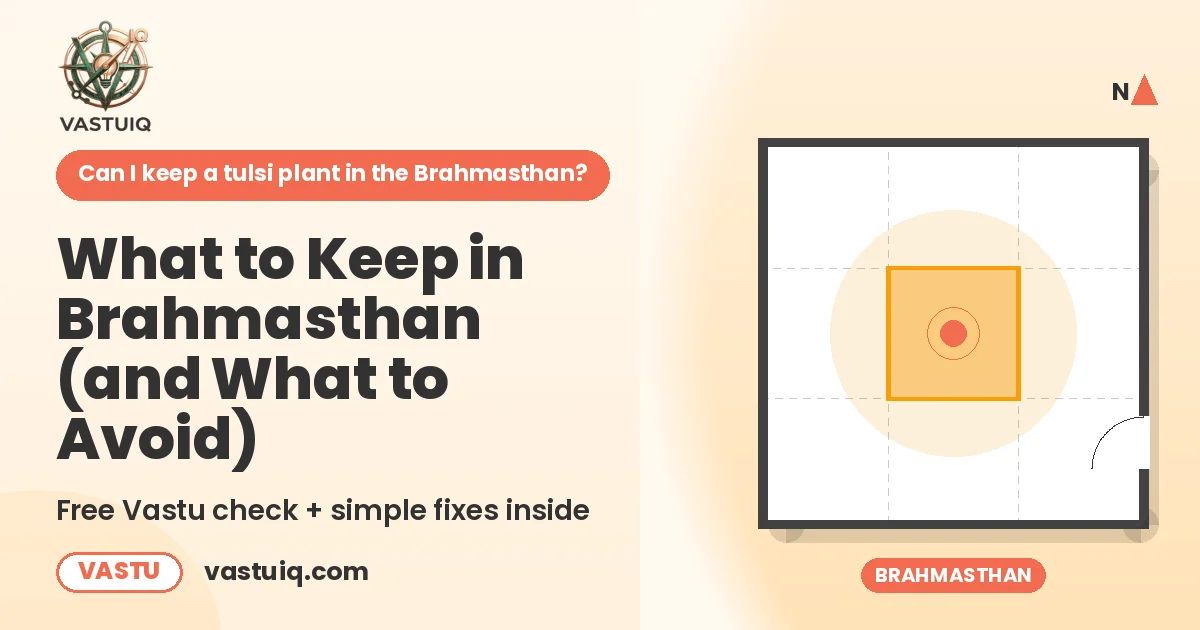
Quick answer: Keep the Brahmasthan, the central one-ninth of your home, open, clean and light. Good choices are open floor, a light rug or rangoli, soft lighting, low and light seating, a small table, or a courtyard or skylight. Avoid a toilet, kitchen, staircase, heavy storage and clutter there. This is traditional guidance, not a guarantee.
Real homes are not empty boxes. The middle of a flat is often the living room, dining area or a corridor, so something has to go there. This guide answers the practical question: what to keep in Brahmasthan, what to move out, and how to reset the space in an afternoon without breaking a single wall.
New to the idea of the Brahmasthan? Start with our main guide, Brahmasthan in Vastu: Meaning, Rules & Remedies, then come back here for the room-level choices.
First, where exactly is your Brahmasthan?
In the Vastu Purusha Mandala, the plan is divided into a grid of squares (padas). On the 81-square (9×9) grid, the central 9 squares belong to Brahma. That central block is one-ninth of the total area, so the Brahmasthan is a zone, not a single dot.
For a simple rectangle, divide the length and the breadth into three equal parts. The middle box is your Brahmasthan. For example, in a 24 × 36 ft 2BHK flat the box is 8 × 12 ft (96 sq ft), running from 8 to 16 ft across and 12 to 24 ft deep. L-shaped and irregular homes need an area-weighted centre, which our step-by-step guide to finding the centre of your house explains.
What to keep in Brahmasthan: at a glance
| Item | Good in the Brahmasthan? | How to do it |
|---|---|---|
| Open floor space | Best | Leave the largest possible part of the box empty |
| Courtyard, skylight or natural light | Best | Keep windows and skylights clean and uncovered |
| Soft ceiling light or lamp | Good | Warm, even light; the centre should never feel dark |
| Light rug, rangoli or simple floor design | Good | Thin, light-coloured, easy to clean |
| Low, light seating or a small coffee table | Acceptable | Keep it light and movable, with walking space around it |
| Dining table (in flats) | Acceptable | A light table with space around it; avoid a heavy marble top |
| Passage or circulation space | Good | Keep the walkway clear of shoes, bags and boxes |
| Heavy almirah, storage, trunks | Avoid | Move them towards the south-west or along side walls |
| Toilet, kitchen, staircase | Avoid | Not movable easily; use the no-demolition fixes below |
7 things you can keep in the Brahmasthan
1. Open floor space
The single best thing to keep in the Brahmasthan is nothing at all. Traditional Indian homes, from the Kerala nalukettu to the north Indian haveli, often had an open courtyard (angan) at the centre. In a flat, keep the middle of the living area free, and keep any passage through it clear of shoes and boxes.
2. Natural light and air
The centre is linked with the space element (akasha), so light and air matter more than objects. If the Brahmasthan has a skylight, a double-height void or a window line, keep it clean and uncovered.
3. Soft, warm lighting
Where daylight does not reach, add a soft ceiling light or a floor lamp so the centre is never the darkest part of the house. Many families light a diya at the centre during Diwali or on festival evenings; if you do, keep it on a stable brass plate and away from curtains.
4. A light rug, rangoli or simple floor design
A thin, light-coloured rug, a rangoli for festivals, or a simple inlay pattern marks the centre without weighing it down. Choose white, cream or very light tones; our room-by-room Vastu colours guide recommends only very light shades for the centre.
5. Low, light seating and a small table
If the Brahmasthan falls in your living room, you do not need to empty the room. A light sofa placed to one side, a few cane or wooden chairs, and a small round coffee table are fine. The test is simple: can you walk freely through the box, and can you move the furniture with one or two people?
6. A light dining table (in flats)
In many Indian flats the centre is the dining area. Vastu practitioners differ on whether dining belongs here. Many accept it because it is a shared family space. If yours is there, choose a light wooden or glass table, keep chairs pulled in after meals, and avoid a heavy stone top that turns the centre into a weight.
7. A small symbolic item, if it feels meaningful
Some families keep a small Brahma yantra, a plain copper or brass object, or fresh flowers near the centre. These are traditional, symbolic additions, not a substitute for steps 1 to 6. In older homes the tulsi was often grown in the open angan; in a flat, the north-east window is the usual choice, as our Vastu guide to plants at home explains.
Is your sofa, table or almirah really in the Brahmasthan? Build your layout in the Brahmasthan Calculator and see the preview free. The ₹149 measurements report (or ₹249 with floor-plan upload) marks your exact centre and zone, gives distances from each wall, and includes a guide to what to keep and avoid there.
What to avoid in the Brahmasthan
These are the items traditional Vastu reads as defects in the central zone, with the simplest fix for each. None of the fixes needs demolition.
| In the Brahmasthan | How Vastu usually reads it | Simple fix |
|---|---|---|
| Toilet or bathroom | The most serious central defect | Keep it spotless, door shut, exhaust running; see our toilet in Brahmasthan guide |
| Kitchen or stove | Serious (fire in the space zone) | Keep the area clean and uncluttered; shift the cooking slab only during a planned renovation |
| Staircase or lift shaft | Serious if exactly on the centre; beside it is usually accepted in flats | Keep under-stair space empty and well lit; see our staircase Vastu guide |
| Pillar or exposed beam | Moderate | Never remove it; keep space clear around it, use light colours, do not sit or sleep under the beam |
| Heavy almirah, trunks, storage | Weight where Vastu wants openness | Move to the south-west or along side walls |
| Closed, dark storeroom | Blocks light and air | Clear it, add light, keep the door open when possible |
| Clutter, shoes, dustbin | Easy-to-fix negative | Remove them; this is the quickest win |
| Pit, sump or borewell (plots) | Traditionally avoided at the centre | Plan water tanks and borewells away from the central box before building |
Safety note: pillars and beams in RCC buildings are usually load-bearing. Never cut, chip or remove one for Vastu reasons, and speak to a qualified structural engineer before any work near them. In a flat, take your society’s permission for any change.
Brahmasthan me kya rakhe? Flat vs independent house
If you search in Hinglish, “Brahmasthan me kya rakhe”, the answer is the same: khuli jagah, roshni aur halki cheezein. The difference is in what is practical.
- Independent house or plot: you can plan an open courtyard, a skylight or a double-height living room at the centre, and keep the staircase, toilets and water tanks out of the central box from the drawing stage.
- Flat: you analyse the centre of your own unit, not the whole tower. You usually cannot change walls, so focus on furniture, light, colours and clutter. Our Vastu guide for flats and apartments covers the rest of the layout.
Worked example: resetting a 24 × 36 ft 2BHK
Take a 24 × 36 ft flat. The Brahmasthan box is 8 × 12 ft, from 8 to 16 ft across and 12 to 24 ft deep, about 96 sq ft. Say this box covers the meeting point of the living and dining areas and holds a three-seater sofa, a glass dining table and a tall steel almirah.
- Almirah: move it to the south-west bedroom wall. This is the biggest improvement.
- Sofa: slide it back towards the side wall so that it sits on the edge of the box, not inside it.
- Dining table: keep it (it is light), but push chairs in and keep the tabletop clear.
- Add: a light cream rug and a warm ceiling light over the open part of the box.
Result: roughly two-thirds of the central box is now open floor, nothing heavy sits inside it, and the family still uses the space every day.
A 15-minute Brahmasthan reset checklist
- Measure the home and mark the central one-ninth on a sketch.
- Remove clutter, shoes, bags and dustbins from the box.
- Move heavy storage out, ideally towards the south-west.
- Make sure there is a clear walking path through the centre.
- Switch to light colours for rugs, covers and the ceiling over the centre.
- Add a soft light if the centre is dark in the evening.
- Clean the area daily, as you would a puja space.
Do’s and don’ts
| Do | Don’t |
|---|---|
| Measure and confirm what is really inside the central box | Assume anything “near the middle” is a defect |
| Keep the largest possible area open | Use the centre as a storage corner |
| Use light colours, light furniture and good lighting | Put dark, heavy stone or wood furniture there |
| Use no-demolition fixes first | Cut a pillar or beam, or break walls for Vastu |
For more simple zone-by-zone fixes, see our 21 Vastu remedies without renovation.
Frequently asked questions
What is the best thing to keep in the Brahmasthan?
Open, light, clean space is the best thing to keep in the Brahmasthan. Natural light, a skylight or courtyard, soft lighting and a light rug or rangoli all suit the centre. If furniture must be there, keep it low, light and easy to move.
Can I keep a sofa or dining table in the Brahmasthan?
Yes, in most flats this is unavoidable and acceptable. Choose light, movable pieces, keep a clear walking path through the centre, and avoid heavy marble or stone tops. Place a large sofa on the edge of the central box rather than in the middle of it.
Can I keep a mandir or puja items in the Brahmasthan?
Traditional Vastu usually places the puja room in the north-east. Some practitioners accept a small, open prayer spot at the centre because it is Brahma’s zone, while others prefer to keep it completely empty. A small, clean and uncluttered arrangement is the common middle path.
Can I keep a tulsi plant in the Brahmasthan?
In traditional homes the tulsi was often grown in the open central courtyard. In a modern flat the centre is usually indoors and dim, so a north-east or north window is the usual choice. Keep only light, healthy plants if any are at the centre.
Brahmasthan me kya rakhe aur kya na rakhe?
Brahmasthan me khuli jagah, roshni, halka rug ya rangoli aur halka furniture rakhein. Bhaari almirah, store, joote, kachra aur clutter na rakhein. Toilet, kitchen ya seedhi ho to bina tod-phod wale upay apnayein.
Related reading
- Brahmasthan in Vastu: Meaning, Rules & Remedies
- Toilet in Brahmasthan: Effects and Remedies
- How to Find the Centre of Your House or Flat for Vastu
- 21 Vastu Remedies Without Renovation
- Vastu for Plants at Home
Know exactly what sits at your centre. Preview your layout free in the Brahmasthan Calculator. The ₹149 report marks your exact centre and zone from your measurements; the ₹249 floor-plan report also shows which rooms fall in each of the 9 zones and what sits at your exact centre, with no-demolition fixes.
VastuIQ: Vastu • Astrology • Numerology. Vastu guidance is traditional and educational. It does not replace advice from a structural engineer, architect or other qualified professional, and no specific result is guaranteed.
Apply This to Your Own Property
Free AI Vastu analysis — room-by-room scores, geo-adaptive for India, UK, UAE and 50+ countries. Detailed report from ₹99.