
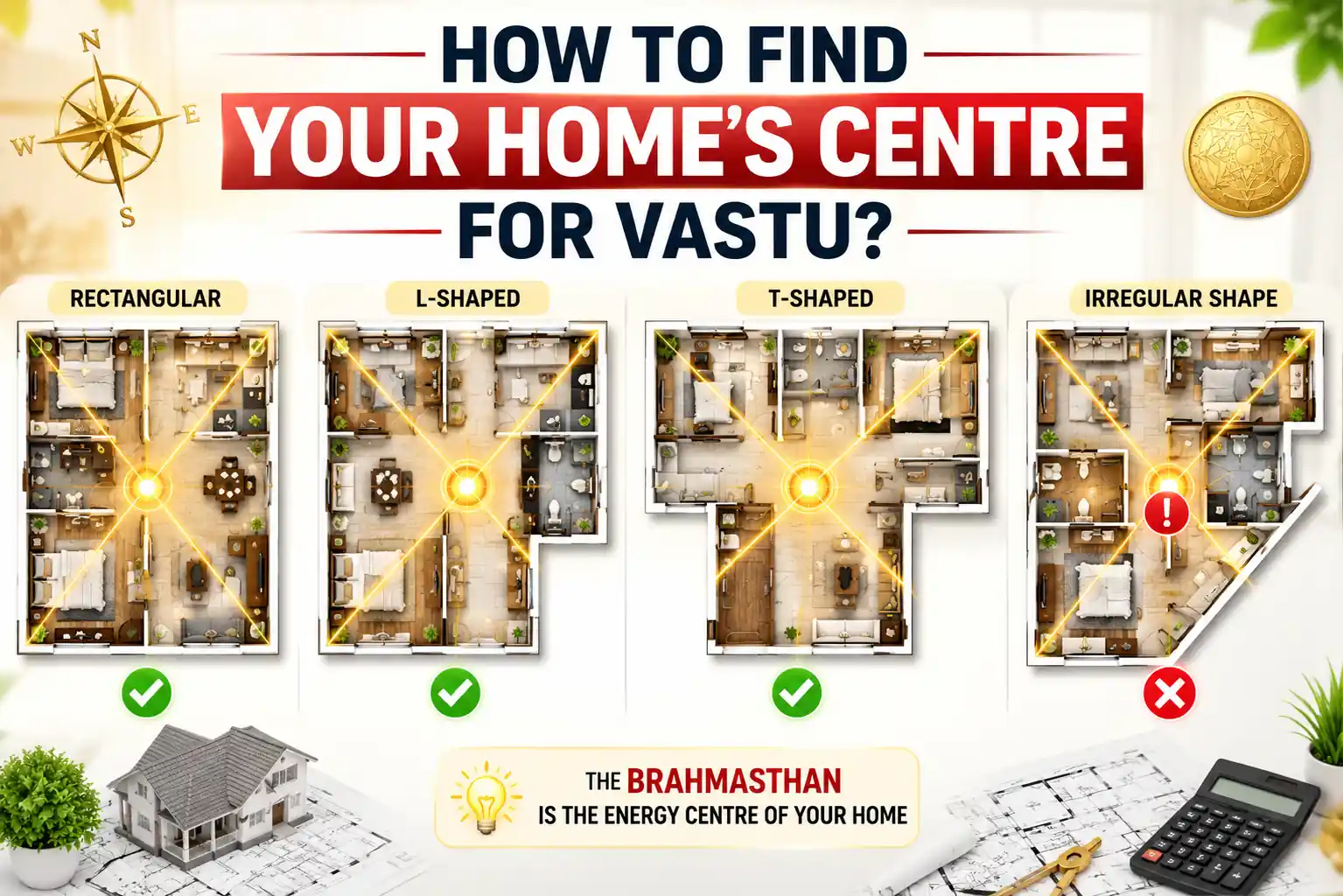
How do you find the centre of your house or flat for Vastu? Most people ask this after hearing a Vastu consultant mention the word “Brahmasthan” — the centre point of the home — and wanting to understand where it falls in their own layout and whether it is obstructed.
The answer depends on the shape of your floor plan. For a perfect rectangle it takes two minutes and a tape measure. But most Indian flats are not perfect rectangles — they are L-shaped, T-shaped, or have cut corners and extended balconies that make the geometric centre less obvious. This guide gives you the precise method for every layout type, explains why the centre matters so much in Vastu, and covers what to do when a toilet, column or staircase sits at that critical point.
The Brahmasthan — from the Sanskrit roots Brahma (creator deity) and sthan (place) — is described in classical Vastu texts including the Manasara and Brihat Samhita as the most energetically potent point in any built structure. It is the seat of Lord Brahma and the point where all eight directional energies of the Vastu Purusha Mandala converge. In practical terms, it needs to remain open, clean and unobstructed — and when it is not, the energy circulation to every other zone of the home is affected at the source.
What Is the Centre of your house in Vastu — and Why Does It Matter?
In Vastu Shastra, the centre of any home is called the Brahmasthan. The three critical requirements for the centre of a house or flat in Vastu are identical regardless of layout type:
- Open: No walls, columns, heavy permanent fixtures within approximately one metre of the centre point
- Clean: No toilet, bathroom, garbage area, heavy machinery or combustion source (stove, generator) at the centre
- Accessible: The centre should be walkable, liveable space — not sealed inside a wall, inside a cupboard, or inaccessible for any reason
When the Brahmasthan is correctly open, energy circulates freely to all zones of the home — north to Kubera, east to Indra, northeast to Ishan and so on. When it is blocked, that circulation is disrupted at the source, affecting the quality of every other zone regardless of how well they are individually configured. A home with a perfect north entrance, ideal kitchen placement and correct bedroom direction — but a structural column at the centre — still has a significant Vastu defect at its heart.
Method 1 — Finding the Centre of a Rectangular or Square Home
For any rectangular or square floor plan, the Brahmasthan is found by a simple diagonal intersection.
The diagonal method
- On your floor plan (or using measurements), identify all four corners of the home
- Draw a line from the southwest corner to the northeast corner
- Draw a second line from the northwest corner to the southeast corner
- The point where these two lines cross is the Brahmasthan
The arithmetic method (faster for rectangles)
- Measure the total interior length of your home (L)
- Measure the total interior width of your home (W)
- The Brahmasthan is at exactly L÷2 from either end, and W÷2 from either side
Example: A flat that is 36 feet long and 24 feet wide has its Brahmasthan at 18 feet from the north wall and 12 feet from the east wall. In most standard 2BHK layouts, this point falls in the middle of the living room or the dining area — which is precisely why these spaces feel like the natural centre of home life. Vastu recognised this spatial reality millennia before modern interior design.
For square homes the Brahmasthan is even simpler — it is the exact mathematical centre, equidistant from all four walls.
If you would rather skip the arithmetic, VastuIQ’s Brahmasthan Calculator finds this point instantly — enter your measurements and it returns the exact centre with a downloadable diagram.
Method 2 — Finding the Centre of an L-Shaped Flat
L-shaped flats are the most common non-rectangular layout in Indian builder apartments. They are created when a corner of the rectangle is removed — typically to accommodate a staircase core, an adjacent flat’s boundary or a structural element outside the property. If your flat has an L-shape, you cannot find the centre by simply halving the length and width — you need the bounding rectangle method below.
Step 1 — Find the bounding rectangle
The bounding rectangle is the smallest complete rectangle that would fully contain your L-shaped floor plan. Imagine filling in the missing corner to complete the rectangle. The Brahmasthan is the diagonal centre of this bounding rectangle — not of the L-shape itself.
Step 2 — Determine if the Brahmasthan falls inside or outside your actual flat
Once you have the bounding rectangle centre, check whether that point is located within your actual floor plan area or within the missing cut-off corner.
| Brahmasthan position | Assessment |
|---|---|
| Falls inside your actual flat area | Brahmasthan is accessible — assess what is there (open, furniture, structural) |
| Falls inside the missing corner zone | Brahmasthan is in the cut zone — significant defect requiring Yantra remedy |
Step 3 — Assess the missing corner direction
The direction of the missing corner carries additional zone-specific implications beyond the Brahmasthan position:
| Missing Corner | Zone Lost | Vastu Impact | Severity |
|---|---|---|---|
| Northeast corner missing | Ishan zone — divine, water, spiritual | Loss of clarity, health concerns, spiritual disturbance, blocked opportunities. Most serious missing corner in Vastu. | High |
| Southwest corner missing | Nairutya zone — earth, stability, ancestors | Instability in life decisions, financial groundlessness, frequent change. Second most serious missing corner. | High |
| Southeast corner missing | Agni zone — fire, metabolism, finances | Financial inconsistency, digestive issues among occupants, career instability. | Medium |
| Northwest corner missing | Vayu zone — air, movement, support | Reduced social support, movement and travel disruption, relationship friction. | Medium |
Worked example: A flat is 30 feet (east-west) × 24 feet (north-south) with the northeast corner cut away — specifically, the northeast 10×8 feet section is missing. The bounding rectangle Brahmasthan is at 15 feet east-west and 12 feet north-south. The actual L-shaped flat is 30×24 except the northeast cut. The Brahmasthan at 15×12 falls well within the flat’s actual area — so Brahmasthan itself is fine. But the missing northeast corner creates an Ishan zone defect that needs its own remedy, independent of the Brahmasthan assessment.
The bounding-rectangle math gets easy to get wrong once you are also checking whether the centre falls inside the missing-corner zone. VastuIQ’s Brahmasthan Calculator handles L-shaped layouts directly — enter your dimensions and cut-corner size, and it plots the exact centre for you.
Method 3 — Finding the Centre of a T-Shaped House or Flat
T-shaped layouts occur when a rectangular flat has an extension projecting from one side — common in corner units, some ground-floor homes and certain plotted house configurations.
Unlike the L-shape (which has a missing corner), the T-shape has an extra extension. The Brahmasthan is still found using the bounding rectangle method.
Finding Brahmasthan in a T-shape
- Draw the bounding rectangle around the entire T-shape including the extension
- Find the diagonal centre of this full bounding rectangle
- Check if this point falls in the main body of the T or in the extension
In most T-shaped layouts, the Brahmasthan falls in the main rectangular body — the extension is proportionally smaller. However, very wide extensions can pull the geometric centre toward the extension area.
Extension direction assessment
Unlike missing corners (which are always defects in their zone), extensions can be beneficial or problematic depending on direction:
| Extension Direction | Vastu Implication |
|---|---|
| North extension | Excellent — increases Kubera wealth energy, more open north space brings prosperity |
| Northeast extension | Best possible — expands the divine Ishan zone, highly auspicious for all occupants |
| East extension | Good — increases solar health energy and positive social connections |
| Northwest extension | Mixed — increases movement and travel energy, can bring instability if excessive |
| West extension | Neutral — gains zone, acceptable if proportional |
| South extension | Challenging — increases Yama authority energy, requires management |
| Southeast extension | Problematic — amplifies fire energy, associated with financial volatility |
| Southwest extension | Most problematic — amplifies negative Nairutya energy significantly. Avoid. |
Wide extensions can pull the geometric centre further than expected — if you want to confirm the exact point rather than estimate it, the Brahmasthan Calculator supports T-shaped layouts and calculates the precise centre from your main-bar and extension measurements.
Method 4 — Finding the Centre of an Irregular or Oddly Shaped Home
Some homes — particularly penthouse units, plotted houses on non-rectangular sites, and certain corner flats — have genuinely irregular shapes that cannot be described as simple L or T variants. Two methods work for these.
The physical balance method
This is the simplest method and is both traditionally acknowledged and geometrically accurate:
- Print your floor plan at any scale, or draw it roughly to scale on paper
- Cut along the outline of the floor plan with scissors
- Balance the cut-out on the pointed tip of a pencil
- The exact point where it balances without tipping is the centroid — which is the Brahmasthan
- Mark that point on the cut-out, then transfer it back to the actual floor plan using the scale proportions
This works because the centroid of any flat shape is the physical balance point — which is mathematically identical to the geometric centre. No calculation required.
The sub-rectangle method
For more precision on paper:
- Break the irregular floor plan into simple rectangles on paper — as many as needed to cover the whole shape
- Find the centre of each rectangle (diagonal intersection)
- Calculate the area of each rectangle (length × width)
- Multiply each centre’s X coordinate by its rectangle’s area, add all results, divide by total area — this gives the Brahmasthan X coordinate
- Repeat for Y coordinates
The sub-rectangle method is more precise for complex shapes but requires the balance method takes 2 minutes. Both give the same result — use whichever feels practical.
Irregular shapes are the hardest to calculate by hand — even the balance method needs a physical printout and a steady pencil tip. VastuIQ’s Brahmasthan Calculator handles this two ways: trace your boundary as points on a grid, or upload a photo of your floor plan and let AI detect the shape automatically. Either way you get the exact centre, the Brahmasthan zone size, and a PDF report with compass directions — no scissors required.
What Should Be at the Brahmasthan — Assessment Guide
Once you have located your Brahmasthan, check what is within approximately one metre of that centre point in your actual home:
| What Is at the Brahmasthan | Severity | Action Required |
|---|---|---|
| Open floor — living or dining area | Ideal ✅ | None — maintain as open and clutter-free |
| Light decorative element — small plant, lamp, decorative piece | Acceptable ✅ | None — keep proportional and low-height |
| Coffee table or low furniture | Acceptable ✅ | Move if very heavy; lightweight furniture is fine |
| Heavy sofa, large storage cabinet or almirah | Low defect | Relocate — easily corrected by furniture repositioning |
| Structural column or pillar | Medium defect | Cannot remove — place Vastu Devta Yantra on the column base; keep surrounding area very clean and uncluttered |
| Load-bearing wall passing through centre | Medium defect | Cannot structurally correct — copper Yantra remedy on the wall at centre height; floor wash remedy monthly |
| Toilet or bathroom | High defect | Copper Devta plate on floor, sea salt bowl weekly, no heavy items stored here, ventilation maximised |
| Kitchen with stove | High defect | Fire element at cosmic centre — copper pyramid at kitchen centre, colour correction, east-facing cooking direction mandatory |
| Staircase | High defect | Cannot relocate — Vastu Devta Yantra under bottom step, bright lighting throughout staircase, keep very clean |
| Centre falls in a missing zone (L-shaped flat) | High defect | Copper Devta Yantra at the nearest accessible point; mirror on interior wall facing the missing zone; sea salt at that boundary |
The Centre of Open-Plan Flats — A Special Case
Modern open-plan flats — where living, dining and kitchen share one continuous space — typically have excellent Vastu conditions at the centre because the central point falls in open, walkable, social space. This is actually a Vastu advantage of open-plan flat design that is rarely recognised: removing internal walls between living zones often improves the centre’s openness significantly compared to older compartmentalised flat designs with separate rooms for every function.
The challenge in open-plan flats is the kitchen island. If the layout includes a central kitchen island or breakfast bar, check whether it falls at or near the Brahmasthan. A freestanding kitchen island at the geometric centre is a moderate defect — fire element and food preparation at the cosmic centre creates energy disturbance. The solution is either relocating the island or, if that is not possible, ensuring the cooking surface faces east and placing a copper Yantra beneath it.
Multi-Storey Homes and Duplex Flats — Which Floor’s Centre?
For independent houses on two or more floors, the centre is assessed on each floor independently using the floor plan of that specific level. The ground floor centre carries the highest weight because it is closest to the earth’s energy field. Upper floor centres should also be assessed — a toilet on the first floor of a duplex flat directly above the ground floor centre compounds the defect significantly even when the ground floor centre itself is open.
For duplex and triplex flats: assess each floor independently and check vertical alignment. A clear, unobstructed centre on every floor — with nothing heavy or structurally significant in the vertical column above the ground floor centre — is the ideal condition for multi-floor properties.
Vastu Remedies for Brahmasthan Defects
Remedy for structural column at Brahmasthan
A structural column cannot be removed. Wrap the column base with copper wire or place a copper Vastu Devta Yantra against the column at floor level. Keep the entire surrounding area open and uncluttered — at minimum a 1.5-metre clear zone around the column. Place a Tulsi plant if space allows. The copper and plant combination partially neutralises the column’s obstructive effect on the centre’s energy field.
Remedy for toilet at Brahmasthan
Install a copper Vastu Devta plate face-up on the bathroom floor at the centre point. Place a sea salt bowl — changed every 7 days — just inside the bathroom door. Paint the bathroom walls light green (Ishan zone association). Ensure the toilet lid is always closed when not in use. Install the strongest possible ventilation and keep the space meticulously clean. A toilet at the Brahmasthan is one of the most severe Vastu defects and these remedies reduce its impact from High to Medium severity — structural relocation during renovation is always preferred. For detailed remedy steps see our complete guide: 21 Vastu Remedies Without Renovation.
Remedy for heavy furniture at Brahmasthan
This is the easiest fix — relocate the heavy item. Move heavy sofas, large dining tables, floor-to-ceiling bookshelves and almirahs away from the centre zone. Replace with lighter furniture or open floor space. If the room layout genuinely requires something at the centre, choose a low glass coffee table (minimal mass, non-obstructive visually) rather than heavy wood or stone pieces.
General Brahmasthan activation
Beyond defect correction: actively enhance the Brahmasthan by keeping the central area of your home well-lit with warm-white overhead lighting, clean and swept daily, and welcoming. Some Vastu practitioners place a small copper multi-pyramid grid at the floor centre as an energisation measure even when no defect is present — this can be discreet and effective. A fragrant indoor plant in the general central zone also activates Brahma energy positively.
Not sure if your Brahmasthan is clear? VastuIQ’s AI Floor Plan Analyzer identifies the geometric centre of your floor plan automatically and assesses what is present there as part of the Zone Assessment scoring. Upload your floor plan at vastuiq.com/ai-vastu-floor-plan-analyzer
Brahmasthan and Missing Corners — How They Interact
When a home has both a missing corner and a Brahmasthan defect, the two interact and the combined impact is greater than either alone. Understanding the relationship:
A missing northeast corner in an L-shaped flat means the Ishan zone is cut — divine energy is reduced. If the Brahmasthan also has a toilet, the creative centre is also compromised. The result is a property where both the divine energy input (Ishan) and the circulation centre (Brahmasthan) are defective — a compound situation that VastuIQ scores significantly lower than either defect individually.
The remedy priority in this case: address the Brahmasthan defect first, then the missing corner. The Brahmasthan affects all zones — correcting it first means the zone-specific remedy for the missing corner operates in a better-functioning energy field.
For a detailed guide on missing corners, zone analysis and pre-purchase apartment assessment, see our Vastu for Apartments: Complete Buyer’s Guide.
Frequently Asked Questions — Centre of House and Flat in Vastu
How do I find the centre of my house or flat for Vastu?
For a rectangular flat: measure the interior length and width, halve both measurements, and mark the intersection — that is the Vastu centre (called the Brahmasthan). For an L-shaped flat: draw the bounding rectangle that would complete the L-shape, halve its length and width to find the centre, then check whether that point falls inside your actual flat or in the missing corner zone. For irregular shapes: cut out your floor plan to scale and balance it on a pencil tip — the balance point is the geometric centre. VastuIQ’s AI Floor Plan Analyzer identifies the centre automatically from an uploaded floor plan image. For a dedicated tool covering all four layout types — rectangle, L-shape, T-shape and irregular — with exact coordinates and a downloadable PDF, use the Brahmasthan Calculator.
What is the centre of a home called in Vastu?
The centre of a home in Vastu Shastra is called the Brahmasthan — from the Sanskrit roots Brahma (the creator deity) and sthan (place or zone). Classical texts including the Manasara and Brihat Samhita describe it as the seat of Lord Brahma and the point where all eight directional energies of the Vastu Purusha Mandala converge. It must be kept open, clean and unobstructed. A structural obstruction, toilet or kitchen at this centre point disrupts the energy circulation to every other zone of the home.
What should be at the centre of a house or flat as per Vastu?
Ideally: open floor space — a living room, dining area or walkable hall. A lightweight decorative element or low glass table is also acceptable. What must not be at the centre: a structural column (medium defect — cannot remove but Yantra remedy helps), a toilet or bathroom (high defect — requires copper plate, sea salt and ventilation remedies), a kitchen with stove (high defect), or a staircase (high defect). Heavy permanent storage at the exact centre is a low defect that is easily corrected by simply moving the furniture.
How do I find the centre of an L-shaped flat for Vastu?
For an L-shaped flat: (1) Draw the full bounding rectangle — the complete rectangle that would contain the entire L-shape including the cut corner. (2) Find the centre of this bounding rectangle by halving its length and width. (3) Check whether this centre point falls inside your actual flat area or in the missing cut-off section. If it falls inside your flat, assess what is there. If it falls in the missing zone, place a copper Vastu Devta Yantra at the nearest accessible point inside the flat and add a mirror on the interior wall facing the missing corner direction.
What happens if there is a toilet at the centre of my flat?
A toilet at the centre of a house or flat is one of the highest-severity Vastu defects. The elimination energy at the home’s creative centre disrupts energy circulation to all other zones. Non-structural remedies: copper Vastu Devta plate on the bathroom floor at the centre point, sea salt bowl changed weekly, light green wall colour, maximum ventilation, toilet lid always closed. These reduce the impact from High to Medium severity. Structural relocation during renovation is strongly preferred. Full remedy steps: 21 Vastu Remedies Without Renovation.
Is an L-shaped flat bad Vastu?
Not automatically. The impact depends on which corner is missing and whether the geometric centre falls inside or outside the actual flat area. An L-shaped flat with the northwest corner missing has a moderate concern. One with the northeast corner missing has a more significant defect because the sacred Ishan zone is cut. Many L-shaped flats score 65–75 on VastuIQ’s compliance scale — acceptable with targeted remedies for the specific missing zone. For a complete pre-purchase assessment checklist, see our Vastu for Apartments guide.
Should the living room be at the centre of the house in Vastu?
Yes — in most correctly proportioned floor plans, the geometric centre naturally falls in or near the living room or dining area, and this is the ideal condition. The living room as the home’s social and gathering centre aligns perfectly with Brahma’s creative and sustaining energy at the Vastu centre. If your living room occupies the central zone, keep the exact centre point clear of heavy permanent furniture, well-lit with warm-white lighting, and clean. A lightweight decorative element or open floor space at the precise centre is optimal.
Apply This to Your Own Property
Free AI Vastu analysis — room-by-room scores, geo-adaptive for India, UK, UAE and 50+ countries. Detailed report from ₹99.