
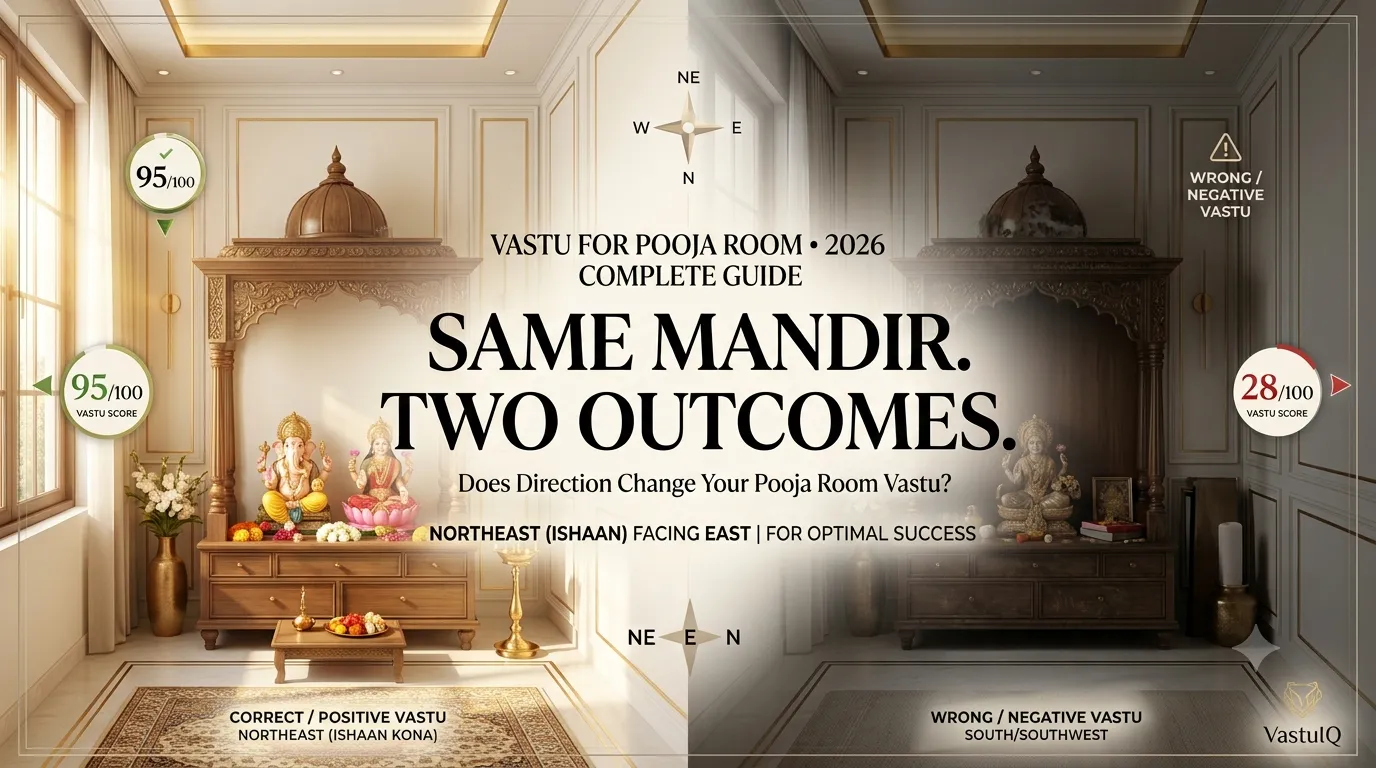
Over 85 percent of Indian homebuyers say they want a dedicated pooja room. Builder-supplied apartment plans almost never include one. The result — millions of pooja spaces improvised after move-in: a cabinet bought online, a shelf nailed above the refrigerator, a niche cut into a living room wall without knowing which direction it faces. Some of these improvised spaces are energetically excellent. Most are not. And the difference between an auspicious mandir and a defective one in your home is not the cost of the mandir, the quality of the idols or the frequency of your prayer — it is the direction the mandir faces, where the idols are placed within it and what surrounds it.
This guide covers every aspect of vastu for pooja room — the complete zone scoring for all 8 directions, the facing direction rule that most people get wrong, idol placement for 8 major deities individually, the 4-tier apartment solution for homes without a dedicated room, colours, materials, diya placement, what must never be in the mandir and the adjacent toilet problem that nobody else addresses. Every recommendation includes a VastuIQ score so you know not just what to do but exactly how much it matters.
Best and Worst Zones — All 8 Directions Scored
The pooja room’s zone placement is the one Vastu decision where every classical text, every regional tradition and every modern practitioner agrees — the northeast is the only acceptable primary answer. The Manasara, Mayamata and Brihat Samhita all prescribe the northeast corner (Ishaan Kona) as the home’s sacred zone — the dwelling place of Lord Shiva, governed by water and divine energy, receiving the first light of the morning sun. No other room placement achieves this level of unanimous classical support.
But unanimous agreement on the best does not mean all other directions are equally defective. Here is the complete scored guide:
| Zone / Direction | VastuIQ Score | Verdict | Reason |
|---|---|---|---|
| Northeast (Ishaan Kona) | 95/100 | ⭐ Best — unanimous | Sacred water-divine zone, Lord Shiva’s dwelling, first morning sunlight, maximum spiritual energy |
| East | 88/100 | ⭐ Excellent | Indra’s solar vitality direction — morning sun energises the pooja space; clarity and knowledge energy |
| North | 85/100 | ✓ Very Good | Kubera’s wealth direction — prosperity and abundance energy; excellent alternative when NE is occupied |
| West | 62/100 | ◯ Acceptable | Varuna’s direction — cosmic order energy; neutral but not specifically prescribed in classical texts for worship |
| Centre (Brahmasthan) | 58/100 | ◯ Conditionally acceptable | Lord Brahma’s zone — an open platform or yantra at centre is auspicious; enclosed room at centre is a Brahmasthan defect |
| South | 28/100 | ⚠ Significant defect | Yama’s heavy death-associated direction — worship facing Yama is specifically prohibited in classical texts |
| Southeast (Agni Kona) | 22/100 | ✗ Defect | Fire element zone — spiritual space in fire zone creates elemental conflict with the water-associated sacred energy of worship |
| Southwest (Nairutya) | 18/100 | ✗ Severe defect | Heaviest earth-demon zone — the Manasara specifically prohibits worship in the southwest; associated with ancestral heavy energy |
The critical distinction: The house facing direction and the pooja room direction are completely independent. A south-facing home still has a northeast corner inside — and that northeast corner is the correct pooja room location regardless of which direction the home faces. The house may face south, but the northeast corner inside is still the northeast corner and does not flip based on which way the front door opens. Never confuse the house facing direction with the correct interior pooja room placement.
To find your home’s exact northeast zone — the precise boundary where the NE zone falls within your specific floor plan — use VastuIQ’s free Brahmasthan Calculator. Enter your flat’s dimensions and the calculator maps all 8 directional zones precisely, including the NE zone boundary coordinates.
Classical reference: The Manasara (Chapter 14, “Devagriha Lakshana” — the science of god’s dwelling) states: “Ishane devata sthanam” — “In the northeast, the dwelling of the deity.” The Mayamata (Chapter 11) prescribes the northeast zone as “pavitratama” — the most sacred zone in any residential structure — and specifically warns against placing the cooking zone, toilet or heavy storage in the northeast for precisely the reason that this zone is reserved for divine energy. The Brihat Samhita extends this principle to the mandir specifically, prescribing northeast placement as the first and non-negotiable rule of residential worship space design.
The Idol Facing Direction — The Most Confused Vastu Rule Resolved
This is the single most searched and most misunderstood rule in all of pooja room Vastu. “Which direction should God face?” produces contradictory answers across sources because people conflate three separate and distinct concepts: the wall where the idol is placed, the direction the idol’s face points toward, and the direction the worshipper faces during prayer. These are three different directions — and all three must be correct simultaneously.
The golden rule, stated precisely: The idol should face west — meaning the idol is placed on the eastern wall of the mandir, with its face pointing west, so the worshipper faces east while praying. East is the direction of the rising sun, of Indra’s solar knowledge energy, of clarity and spiritual awakening — the most auspicious direction for the worshipper to face during prayer.
| Idol Placed On | Idol Face Points | Worshipper Faces | VastuIQ Score | Verdict |
|---|---|---|---|---|
| East wall of mandir | West | East | 92/100 | ⭐ Best — worshipper faces the rising sun direction |
| West wall of mandir | East | West | 85/100 | ⭐ Excellent — worshipper faces the setting sun; acceptable in classical texts |
| South wall of mandir | North | South | 45/100 | ◯ Borderline — worshipper faces Yama’s direction; only acceptable for specific deities |
| North wall of mandir | South | North | 78/100 | ✓ Good — worshipper faces Kubera’s wealth direction; acceptable secondary choice |
| Facing northeast (idol on SW interior) | Northeast | Southwest | 22/100 | ✗ Avoid — worshipper faces the heaviest defective direction |
The practical summary: The idol’s back should face east or south. The idol’s face should point west or north. The worshipper sitting in front of the idol should face east or north. When these three are correctly aligned, the worship configuration is energetically optimal. When any one of the three is incorrect, the worship energy is partially or fully misdirected.
What this means for the northeast pooja room: In a correctly placed northeast pooja room, the idol is typically placed on the eastern or northern inner wall of the room, facing west or south respectively. The worshipper enters from the south or west side of the room and faces north or east during prayer. This configuration achieves both the correct room zone (NE) and the correct facing direction simultaneously.
Idol Placement Rules — Height, Gap, Count and Configuration
Once the mandir direction and facing configuration are correct, the specific rules for idol placement within the mandir determine the daily quality of worship energy. These six rules are the most consistently cited classical prescriptions for idol placement:
Rule 1 — Height above the ground
Every idol in the home mandir must be placed at least 6 inches (15 cm) above the ground level. Never place idols directly on the floor — the floor carries foot-level energy, the lowest and most earthly prana in the home. The raised platform elevates the idol above this energy layer. The correct height when seated for prayer: idol at eye level or slightly above — not below eye level and not so high that the worshipper must look uncomfortably upward.
Rule 2 — Gap from the wall
Each idol must maintain at least 1 inch (2.5 cm) clearance from the back wall of the mandir. This gap allows prana to circulate around the idol — the energy field around a sacred idol extends in all directions; pressing the idol flush against the wall compresses the energy on the wall side and creates a one-directional energy flow. The gap enables the idol’s complete energy aura to be maintained.
Rule 3 — Maximum idol size
For home mandirs (as distinct from temple installations), the maximum idol height is 9 inches (approximately 23 cm) and the minimum is 2 inches. Idols larger than 9 inches carry temple-scale energy that is too powerful for residential space management — the concentrated divine energy of a large temple idol requires the architectural support of a properly constructed temple structure, not a home mandir shelf. An oversized idol in a home mandir is described in classical texts as “ati-shakti” (excess energy) — associated with difficulty managing the home’s general energy balance.
Rule 4 — No two idols facing each other
When multiple idols are placed in the same mandir, they must not directly face each other. Idol eye contact creates what classical Vastu describes as “drishti-virodha” — opposing gaze energy — which generates tension within the sacred space. Each idol should face the same direction (toward the worshipper) or be angled slightly toward the worshipper rather than toward each other.
Rule 5 — No idol directly facing the mandir entrance
An idol placed exactly on the direct axis of the mandir door or entrance — so the first thing visible upon opening the door is the idol’s direct gaze — creates “dwara-drishti” (door gaze) which is considered inappropriate in classical practice. The idol should be slightly offset from the door axis so it is visible but not in a direct confrontational gaze relationship with the door opening.
Rule 6 — Number of idols
Classical Vastu prescribes: avoid an even number of Shivlings (always keep one), avoid more than one Surya (sun) idol, avoid more than two Ganesha idols and do not duplicate any deity. A single, well-maintained mandir with 3 to 5 carefully selected deities carries more concentrated divine energy than a crowded mandir with 15 to 20 idols. Quality of energetic maintenance over quantity of divine representations is the consistent classical principle.
Deity-Specific Placement Guide — 8 Major Deities
This is the most searched and least comprehensively answered aspect of pooja room Vastu. Each major deity has specific placement preferences rooted in their directional energy associations. Here is the complete guide:
Ganesha — Obstacle remover, first worship
Placement: Northeast zone of the mandir, or slightly to the left of the central deity when viewed by the worshipper. Ganesha is always worshipped first — he should be the first deity the worshipper’s eye rests on when entering the mandir.
Facing: Idol on east wall, face pointing west (worshipper faces east).
Specific rule: When Ganesha and Lakshmi are placed together (as in Diwali worship), Ganesha goes to Lakshmi’s left from the worshipper’s perspective — Ganesha on the left, Lakshmi on the right as viewed by the seated worshipper. This is the correct Lakshmi-Ganesh configuration.
Trunk direction: Ganesha with the trunk turned to his left (the worshipper’s right) is the standard household form — calm, domestic, auspicious. Ganesha with trunk turned to his right (the worshipper’s left) is the Siddhi Vinayak form — more powerful and requiring strict daily worship protocol.
Lakshmi — Wealth and prosperity
Placement: Northeast zone or north section of the mandir — Kubera’s wealth direction.
Facing: East wall, face toward west (worshipper faces east) — the rising sun direction amplifies wealth manifestation.
With Ganesha: Lakshmi on the right from the worshipper’s perspective, Ganesha on the left.
With Vishnu (as Lakshmi-Narayan): Lakshmi on Vishnu’s left — the classical position of the divine consort in Vaishnava tradition.
Shivling — Lord Shiva’s aniconic form
Placement: Northeast corner of the mandir — the most sacred placement for the Shivling.
Facing: The Shivling’s Jalhari (water channel/spout) must always face north — the direction through which the abhishek water flows. This means the Shivling itself faces north, and the worshipper sits to the south of the Shivling facing north for abhishek (water offering).
Number rule: Only one Shivling in any home mandir. Two or more Shivlings in the same space creates contradictory divine energy — specifically prohibited in all Shaiva texts.
Nandi placement: The Nandi (bull) figure faces the Shivling — always placed in front of the Shivling, facing the linga from the south (the worshipper’s side).
Vishnu / Narayan — Preserver deity
Placement: Northeast zone of the mandir — specifically the northeast corner within the northeast room.
Facing: East wall, face toward west.
With Lakshmi: Vishnu in the centre or slightly right of centre, Lakshmi to his left (touching or near his feet in classical Vaishnava iconography).
Shaligram: If a Shaligram (natural Vishnu stone) is kept instead of or alongside the idol, it belongs in the northeast corner with its naturally formed chakra pattern visible.
Durga / Devi forms
Placement: South section of the mandir — Durga and Kali are warrior deities associated with southern protective energy. Unlike most deities, Devi forms in their fierce aspects are classically placed in the south-facing position within the mandir.
Facing: South wall, face toward north — the worshipper sits north of the Devi idol facing south.
Important note: Fierce Devi forms (Kali, Chamunda) should not be kept in the master bedroom mandir or beside gentler deity forms like Lakshmi and Saraswati in the same line of sight.
Saraswati — Knowledge and arts
Placement: East or northeast section of the mandir — the knowledge direction (east = Indra’s vitality and learning).
Facing: East wall, face toward west — morning solar energy is the most aligned with Saraswati’s domain of knowledge and clarity.
Study room placement: Saraswati is the one deity who may be placed in the study room (outside the main mandir) without creating a defect — the study room is her most energetically appropriate secondary placement.
Hanuman — Protector and devotee
Placement: South-facing wall — Hanuman faces south because the south is Yama’s direction and Hanuman is the classical protector deity specifically against Yama’s energy. Hanuman facing south is the standard protective home placement.
Entry placement: Hanuman is also placed above the main entrance of the home — inside or outside, facing outward toward the south if the entrance faces south, or facing the entrance if any other direction.
Note: Hanuman is one of the very few deities classically prescribed for south-facing placement within the mandir due to his specific protective relationship with the south direction.
Surya — Sun deity
Placement: East section of the mandir — the sun deity naturally belongs in the sunrise direction.
Facing: East wall, face toward west — the worshipper faces east toward the rising sun during Surya worship.
Number rule: Only one Surya idol in any home. Multiple Surya representations are specifically avoided.
Worship timing: Classical Surya worship is at sunrise (the east direction at the most energetically charged moment of the solar cycle) — the east-facing placement aligns the morning sunlight with the idol’s energy field.
Vastu for Pooja Room in Flat — The 4-Tier Apartment Solution
For the majority of urban Indian apartment dwellers, a dedicated northeast pooja room is a spatial luxury that the floor plan does not provide. The practical solution follows a 4-tier hierarchy — each tier is a complete and energetically functional worship space, not a compromise:
Tier 1 — Dedicated pooja room (ideal)
A separate room in the northeast zone of the flat, used exclusively for worship. Minimum size: 5 × 5 feet — sufficient for one to two people to sit comfortably for prayer. If the flat has a separate room available in the northeast, designate it as the pooja room regardless of its original intended use. VastuIQ score: 95/100.
Essential rules for the dedicated room:
- No storage of non-worship items — no medicines, no documents, no suitcases
- A threshold (wooden strip) at the entrance — bare feet always inside, footwear outside
- Two-shutter wooden door preferred over single shutter — classical prescription for mandir privacy
- Natural ventilation — northeast window is ideal; ensures fresh morning air circulates through the sacred space
Tier 2 — Wall niche or recessed mandir (excellent for flats)
A recessed niche cut into the northeast or east wall of the living area or corridor, approximately 12 to 24 inches deep and sized to house the mandir structure. This is the most Vastu-effective apartment solution when a dedicated room is not available. VastuIQ score: 88/100.
Rules for the wall niche mandir:
- The niche must be in the northeast or east section of the wall — not in any other zone
- A small wooden threshold or raised base inside the niche
- A curtain or wooden shutter door that closes over the niche — essential for maintaining the sacred space’s energy privacy during non-worship hours
- Dedicated lighting inside the niche — warm white, not blue or cool white
- The niche must not be in a wall shared with a toilet on the other side
Tier 3 — Living room mandir shelf or cabinet (most common apartment solution)
A dedicated mandir unit — freestanding or wall-mounted — placed in the northeast or east section of the living room. This is the most common and most workable solution for standard Indian 2BHK and 3BHK apartments. VastuIQ score: 78–82/100 when correctly positioned.
Rules for the living room mandir:
- Position in the northeast or east section of the living room — not against the south or southwest wall
- The mandir unit must have shutters that close — the sacred space should not be permanently open to the visual field of the entire living room
- Idol eye-level when seated on the floor for prayer — not so high that the worshipper must look straight up, not so low that the idol is at floor level
- The mandir unit must not be positioned with the television on the same wall or directly adjacent — the active screen energy conflicts with the sacred contemplative energy of the mandir
- No shoes, bags or daily-use items placed near or below the mandir unit
Tier 4 — Kitchen cabinet mandir (last resort only)
In very compact studios and bachelor flats, the kitchen may be the only available northeast space. A kitchen cabinet mandir is acceptable as a last resort with strict conditions. VastuIQ score: 55/100 — significantly lower than the other tiers but preferable to placing the mandir in the southwest or south. The kitchen mandir should be avoided for all other flat types.
Conditions for a kitchen cabinet mandir to be acceptable:
- The cabinet must be in the northeast section of the kitchen — not adjacent to the stove or sink
- A dedicated cabinet — not shared with food storage, medicines or utensils
- The mandir cabinet door must remain closed during cooking — incense smoke and cooking aromas should not mix with the sacred space
- Minimum 2 feet of clear space between the mandir shelf and any cooking surface
Find the exact northeast zone in your flat. VastuIQ’s free Brahmasthan Calculator maps all 8 directional zones from your floor plan dimensions — telling you precisely where the northeast zone falls so you can position your mandir correctly within your specific layout. Find my northeast zone free at vastuiq.com →
Pooja Room Colours, Materials and Design
Colours
The pooja room’s colours must reflect the water-divine quality of the northeast zone and create the settled, contemplative atmosphere that worship requires:
| Surface | Best Colour | Second Choice | Avoid |
|---|---|---|---|
| Walls | White or cream | Pale yellow, light blue | Dark colours, red, orange, black, grey |
| Ceiling | White — always | Very light cream | Any dark or strong colour |
| Floor | White marble or cream tiles | Light stone, pale terracotta | Dark floor tiles, black marble |
| Mandir structure | Natural wood tone (teak, rosewood) | White marble, cream stone | Metal finish, black lacquer, dark paint |
| Curtain / shutter | White or off-white cotton | Pale yellow, light saffron | Dark or printed fabrics |
Why white and pale yellow: White represents Akasha (space element) purity — the most expansive, unbounded quality that creates receptivity for divine energy. Pale yellow carries the Surya (sun) element quality — warm, illuminating and associated with wisdom and divine knowledge. Both colours also reflect light maximally in what is typically one of the smallest rooms in the home — maintaining the bright, open quality that the northeast zone requires.
Materials
Wood (teak or rosewood) — best (92/100): Natural wood carries organic earth element energy — warm, living, responsive. The classical texts prescribe wooden mandirs specifically. A dome-shaped top on the mandir structure — mimicking the gopura (temple spire) — is specifically auspicious in classical Vastu because the pyramidal shape concentrates and amplifies the divine energy within the mandir’s interior space.
Marble — excellent (88/100): White marble is the most auspicious stone for mandir surfaces — its water-element quality (cool, pure, reflective of light) aligns with the northeast zone’s water element. Marble platforms for idol placement are specifically prescribed in several classical texts.
Metal (copper, brass) — acceptable (72/100): Copper is the classical metal for worship vessels (puja thali, kalash, diya stand) — it carries purifying elemental energy. An all-metal mandir structure is less ideal than wood or marble but copper and brass accents within a wooden mandir are specifically auspicious.
Iron or steel — avoid (35/100): Metal associated with Rahu’s energy — specifically the same reason iron is discouraged for beds. For a sacred space, Rahu’s irregular, shadowy energy is particularly inappropriate.
The dome shape
Classical Vastu specifically prescribes a dome or pyramidal top for the home mandir — described as “shikhara” (spire) in the Agama texts. The dome shape creates a Faraday-like geometric concentration of energy within its interior — the same principle behind temple shikhara design at architectural scale applied to the home mandir. A flat-topped mandir cabinet misses this energy concentration benefit. When purchasing or building a home mandir, prioritise the dome or pyramidal top as a structural feature.
Pooja Room Door, Threshold and Privacy Rules
Two-shutter door: The classical prescription for a dedicated pooja room door is two shutters (two-panel door) that open outward from the mandir. This allows the worshipper to open both panels fully during worship, creating maximum openness, then close both panels between worship sessions, maintaining complete sacred privacy. A single-shutter door that swings inward is the most common defect in residential pooja rooms — it disrupts the worship flow and prevents complete enclosure.
Threshold (dehleez): A wooden threshold strip at the pooja room entrance is mandatory — it creates the physical and energetic boundary between the domestic space and the sacred space. Footwear must be removed before crossing the threshold. The threshold height of 1 to 2 inches is sufficient to create the energetic boundary without creating a trip hazard.
No idol visible directly from the main entrance: The home’s main entrance door and the mandir/pooja room should not be in direct visual alignment — an idol visible from the street or the main entrance axis receives the full impact of all entering energy (shoes, outdoor air, visitor energy) without filtration. This is specifically named in the Manasara as inappropriate for residential idol placement.
Door must not directly face idols on the same axis: This is the room-scale version of the bed-facing-door defect. The pooja room door’s opening axis should not align directly with the idol’s facing position — offset the idol from the door axis by at least 2 feet.
Diya, Lamp and Incense — The Complete Ritual Direction System
The ritual elements within the pooja room — diya placement, lamp direction and incense — have their own directional prescriptions that most guides mention in passing but never present as a complete system.
| Ritual Element | Correct Placement | Direction | Classical Basis | Never Do |
|---|---|---|---|---|
| Diya (ghee lamp) | Southeast corner of the pooja room | Flame faces east or upward | Agni zone within the sacred space — fire element in fire sub-direction | Never light diya facing south — drains finances |
| Camphor lamp | Southeast of the mandir shelf | Same as diya — SE corner | Camphor’s rapid, complete combustion = maximum spiritual purification | Never in the northeast corner — water element conflict |
| Oil lamp (deepak) | Right side of the worshipper when seated facing east | Flame facing the idol | The right side is the auspicious side in all classical ritual prescription | Never behind the worshipper |
| Incense sticks | Northeast corner of the pooja room or mandir | Smoke rising northward or eastward | Incense purifies the air element — northeast water zone benefits from air-element addition | Never directly in front of the idol — smoke impairs the sacred gaze |
| Kalash (water vessel) | Northeast section of the mandir | Opening facing east or upward | Water element vessel in water element zone — maximum elemental alignment | Never in the southeast (fire conflict) |
| Flowers | At the idol’s feet or on the mandir shelf at idol level | Fresh, never wilting | Flowers represent sattvic prana — their freshness directly reflects the mandir’s energy quality | Never keep stale or dried flowers — maximum 24-hour rule |
Prayer direction summary: Face east or north while praying. East is the primary direction — morning prayer facing east receives the rising sun’s vitality and knowledge energy. North is the excellent secondary direction — facing Kubera’s wealth zone during prayer amplifies prosperity intentions. South-facing prayer is the strongest classical prohibition for residential worship.
What Must Never Be in the Pooja Room — Complete Scored List
This is the most practically useful avoidance guide for pooja room Vastu — a scored table of everything that should never be in or immediately adjacent to the mandir:
| Item | If Present — Score | Reason | Action |
|---|---|---|---|
| Photos of deceased family members | 15/100 | Pitru (ancestral) energy directly at the worship zone — the living deity energy and ancestral energy are incompatible in the same space | Move to a separate dedicated ancestral frame outside the mandir |
| Broken or cracked idols | 18/100 | A broken idol has lost its energetic wholeness — it carries fragmentation energy that directly contradicts the mandir’s integration function | Immerse in running water or bury respectfully — replace immediately |
| War imagery, scenes of death or sorrow | 20/100 | Violent or sorrowful imagery directly adjacent to worship space imprints on the meditative state during prayer | Remove entirely from the pooja room |
| Stale or wilting flowers | 28/100 | Decaying plant matter (mrityu prana) at the mandir directly contradicts the freshness of sattvic divine energy | 24-hour fresh flower rule — remove all flowers before they begin to wilt |
| Medicines or medical supplies | 32/100 | Health-crisis energy mixed with divine energy — the illness association of medicines imprints on the sacred space | Move to bathroom or dedicated storage cabinet |
| Documents, bills and daily-use items | 35/100 | Commercial and administrative energy directly defiles the contemplative quality of the sacred space | Remove all non-worship items; dedicated worship storage only |
| Footwear near or below the mandir | 22/100 | Street-level energy from footwear is the strongest earthly impurity in classical ritual practice — strictly prohibited near worship spaces | Designated footwear area minimum 3 feet from the mandir |
| Animal images (non-divine) | 30/100 | Animal imagery (pets, wildlife) in the sacred space creates animistic energy mixed with divine sattvic energy | Remove — divine imagery only in the mandir space |
| Plastic or artificial flowers | 35/100 | Artificial items carry empty imitation energy — no prana. Classical texts prescribe fresh flowers specifically for their living energy contribution | Replace with fresh flowers or remove entirely |
| Too many idols (more than 8–9) | 40/100 | Overcrowding creates competing divine energies that cancel each other rather than amplifying. Classical: “bahudeva-sthane kalah” — too many deities creates conflict | Respectfully reduce to the most important personal deities |
| Non-vegetarian food or alcohol near mandir | 15/100 | Tamasic (heavy, rajasic) substances directly adjacent to sattvic divine energy creates the most severe energetic pollution possible in the mandir | Never bring near the mandir; dining should be in a separate zone from the worship zone |
| Dusty or unclean mandir | 25/100 | Neglect is energetically equivalent to active desecration — a dusty, unclean mandir accumulates stagnant energy in the home’s most sacred zone | Daily cleaning is mandatory — not optional |
Adjacent Toilet or Bathroom — The Unaddressed Problem
This is the most common pooja room Vastu problem in Indian apartments and the one least addressed in competitor content. Millions of apartment mandirs share a wall with a toilet or bathroom — particularly in 2BHK layouts where the bathroom-toilet complex is often adjacent to the northeast corner.
Severity by configuration
| Configuration | VastuIQ Score | Effect |
|---|---|---|
| Pooja room shares NO wall with toilet — separate zones | 95/100 | Ideal — sacred and waste energies completely separated |
| Pooja room shares a lateral wall with toilet (bathroom to the side) | 62/100 | Moderate defect — boundary transmission but not direct contamination |
| Pooja room directly above toilet (toilet below mandir) | 38/100 | Significant defect — waste energy rising upward through the floor into the sacred zone |
| Toilet directly above pooja room (mandir below toilet) | 25/100 | Severe defect — overhead waste energy pressing down on the worship space |
| Pooja room shares the back wall with toilet (idol back against toilet wall) | 18/100 | Most severe — the idol’s back energy directly contacts the toilet wall |
Remedies for adjacent toilet pooja room
- Copper plate on the mandir side of the shared wall: Mount a thin copper plate on the wall behind or adjacent to the mandir at idol height. Copper’s purifying energy creates an energetic buffer between the waste zone and the sacred zone. This is the primary classical remedy for shared wall energy transmission.
- Sea salt bowl inside the toilet: Place a rock salt bowl just inside the bathroom/toilet entrance, changed weekly. The salt absorbs waste energy at its source before it can transmit through the shared wall.
- Keep toilet door always closed: The most impactful zero-cost daily practice for any toilet adjacent to a mandir. An open toilet door creates a direct energy channel between waste energy and the sacred space.
- Maximum ventilation in the toilet: Extractor fan running during and after every use. Physical removal of bathroom air energy reduces the energy available for wall transmission.
- Camphor burning in the mandir daily: Camphor’s complete, rapid combustion produces maximum air purification in the sacred space — specifically recommended for any mandir experiencing boundary energy transmission from adjacent zones.
The mandir under staircase rule
A pooja room or mandir shelf placed under a staircase scores 22/100 — a significant defect. Classical Vastu specifically prohibits worship spaces under staircases: the constant overhead movement and structural weight of the staircase creates “upari bhara” (overhead burden energy) directly over the sacred space, and the foot traffic above the worship zone introduces street-energy into the mandir’s atmosphere. If the staircase placement is unavoidable, a false ceiling panel below the staircase structure at least creates a visual and partial energetic buffer between the stair underside and the mandir space below.
Pooja Room in Bedroom — When and How
Classical Vastu uniformly advises against placing the pooja room or mandir shelf inside the bedroom. The reasoning is straightforward: the bedroom is governed by rest energy (tamasic quality during sleep) and intimacy (rajasic quality) — both energetically incompatible with the sattvic (pure, elevated) quality of divine worship energy. The two energy qualities operating in the same space create what classical practice describes as “guna-virodha” — quality opposition.
Despite this, many urban apartment dwellers have no practical alternative — the northeast zone of their flat falls inside the bedroom, and placing the mandir in any other zone would be less auspicious.
When bedroom mandir is absolutely necessary — the conditions that make it acceptable:
- The mandir is in a dedicated alcove or enclosed cabinet with shutters that close completely during sleep hours — not visible from the bed during sleep
- A curtain or wooden screen separates the mandir area from the sleeping area during sleep hours
- No deity image directly faces the sleeping position
- The mandir is used for prayer, then completely closed before the room is used for sleep
- No romantic or intimate activities in the room when the mandir is open
What specifically must not happen in a bedroom mandir: Never sleep with the mandir open and visible. Never place the mandir directly beside the bed. Never keep a Shivling in the bedroom mandir — the Shivling’s intense Shaiva energy is specifically unsuited to the bedroom environment in classical texts. If a Shivling must be in the flat and there is no other space, it belongs in the living area mandir, not the bedroom.
Direction-by-Direction Guide for All 4 House Facings
For each house facing direction, the northeast corner’s location within the home is different — and therefore the pooja room’s accessible position changes. Here is the practical guide for each house type:
| House Facing | NE Corner Location | Best Pooja Room Position | Alternative if NE Occupied | Best Achievable Score |
|---|---|---|---|---|
| North-facing | Front-right corner from inside | Front-right zone of the home — near the main entrance on the right | East section of any room | 95/100 |
| East-facing | Front-left corner from inside | Front-left zone — to the left of the entrance | North section of living area | 95/100 |
| South-facing | Back-right corner from inside | Back-right zone — the northeast corner is at the rear of the home | East or north wall of any central room | 92/100 |
| West-facing | Back-left corner from inside | Back-left zone — northeast is at the rear-left of the home | North wall of a central room | 90/100 |
The key insight: Every home facing direction has a northeast corner. The northeast is a fixed compass direction — it does not change based on the building’s orientation. A south-facing home’s northeast corner is at the rear-right of the flat plan (when the south-facing wall is at the front). A west-facing home’s northeast corner is at the rear-left. The task is to find that corner and designate it as the pooja space — regardless of what the builder originally intended for that corner.
Daily, Weekly and Seasonal Maintenance Rules
The pooja room’s Vastu score is not a static number — it degrades with neglect and improves with consistent maintenance. The maintenance protocol is not ceremonial but energetically functional:
Daily (mandatory):
- Clean the mandir shelf and surrounding floor — removing dust, ash and wilted flowers
- Replace flowers that have begun to wilt — the 24-hour fresh flower rule
- Light the diya in the southeast corner of the mandir — minimum once daily, at sunset
- Light incense sticks in the northeast corner — the smoke purifies the air element of the sacred space daily
- Change the water in any water vessel (Kalash, water for abhishek) — stale water at the mandir is a defect equivalent to stale flowers
Weekly:
- Deep clean the mandir structure including behind and around idols
- Change the rock salt bowl in any adjacent toilet
- Check all idols for cracks, chips or damage — replace immediately if any damage is found
- Wash the mandir’s fabric elements (backdrop cloth, cushion covers) if applicable
Seasonal / festival-specific:
- Full mandir cleaning before all major festivals — Diwali, Navratri, Ganesh Chaturthi, Janmashtami
- Fresh idol installation check — festival season is the correct time to replace any idol that has developed hairline cracks during the year
- Painting or recoating the mandir walls if discoloured — maintaining the white or pale yellow wall freshness is part of the space’s energy maintenance
The broken idol rule — no exceptions: A cracked, chipped or broken idol must be replaced immediately — on the same day if possible, within 24 hours at the latest. A broken idol is not merely inauspicious — it is energetically inactive and potentially carries fragmentation energy. The respectful method for disposal: immerse in a clean river or body of flowing water (not still water and not a drain), or bury in clean soil at a temple or sacred grove.
Frequently Asked Questions — Vastu for Pooja Room
Which direction is best for pooja room as per Vastu?
The northeast direction (Ishaan Kona) is the best and only unanimously prescribed direction for the pooja room in all classical Vastu texts — scoring 95/100. It is Lord Shiva’s sacred zone, governed by water and divine energy, and receives the first morning sunlight. If the northeast is unavailable, east (88/100) and north (85/100) are the excellent alternatives. The south (28/100) and southwest (18/100) are the most severely inauspicious pooja room locations — the Manasara specifically prohibits worship spaces in the southwest.
Which direction should God face in the pooja room as per Vastu?
The deity should face west — meaning the idol is placed on the eastern wall of the mandir, with its face pointing west, so the worshipper faces east during prayer. East is the rising sun direction, associated with Indra’s solar knowledge energy and the most auspicious prayer direction. The second-best configuration is idol on the western wall, face pointing east, worshipper facing west. Never place the idol so the worshipper faces south during prayer — this is the strongest worship direction prohibition in classical Vastu.
Where should the mandir be placed in a flat without a dedicated room?
Follow the 4-tier hierarchy: (1) Wall niche in the northeast or east section of the living area (88/100). (2) Living room mandir unit in the northeast or east section with closing shutters (78–82/100). (3) Kitchen cabinet mandir in the northeast section of the kitchen as an absolute last resort (55/100). Never place the mandir in the southwest, south or southeast zone regardless of spatial constraints — an imperfect northeast placement always outperforms a perfectly designed mandir in the wrong direction.
Can we keep pooja room in bedroom as per Vastu?
Classically, no — the bedroom’s rest and intimacy energy is incompatible with the sacred sattvic energy of the mandir. However, when there is no other option, a bedroom mandir is acceptable with strict conditions: the mandir must be in a closable cabinet or alcove, with shutters or curtains that completely conceal it during sleep hours, no deity should directly face the sleeping position, and the Shivling specifically should not be in the bedroom mandir.
What should not be kept in the pooja room as per Vastu?
Twelve things must never be in the pooja room: photos of deceased family members, broken or cracked idols, war or death imagery, wilting flowers (remove within 24 hours), medicines, bills or daily documents, footwear near the mandir, animal imagery (non-divine), plastic or artificial flowers, too many idols, non-vegetarian food or alcohol near the mandir, and dust or neglect. The most critical: a broken idol must be replaced the same day — it carries fragmentation energy that is the direct opposite of the mandir’s integration function.
Can we place a Shivling in the bedroom or flat?
A Shivling should not be placed in the bedroom — the Shivling’s intense Shaiva energy is specifically unsuited to the bedroom environment in classical texts. For flat dwellers, the Shivling belongs in the main living area mandir in the northeast or east zone, never in the bedroom. In a dedicated pooja room, the Shivling goes in the northeast corner of the room with its Jalhari (water channel) facing north. Only one Shivling per home — the two-Shivling prohibition is one of the strongest single-deity rules in classical practice.
What is the correct height for idols in a home mandir?
Idol height should be between 2 inches (minimum) and 9 inches (maximum) for home mandirs. The idol should be placed at eye level when the worshipper is seated — not above the worshipper’s head and not at floor level. The platform (chowki) below the idol must raise it at least 6 inches above the mandir’s base shelf. Each idol must maintain a 1-inch gap from the back wall of the mandir. These three measurements together — 2 to 9-inch idol height, 6-inch platform, 1-inch wall gap — are the classical Agama prescriptions for residential idol installation.
Which direction should the diya face in the pooja room?
The diya should be placed in the southeast corner of the pooja room (Agni zone within the sacred space), with the flame facing east or upward. The worshipper holds or places the diya on their right side during prayer — the right side is the auspicious side in all classical ritual prescription. Never light the diya facing south — this direction is specifically described in classical Vastu as drawing financial energy away from the home when fire is directed toward Yama’s zone.
How many idols are allowed in the pooja room as per Vastu?
Classical Vastu recommends quality over quantity — 3 to 5 carefully selected deities are ideal for a home mandir. The specific count rules: only one Shivling, only one Surya, not more than two Ganesha idols, and no duplicate deities. A mandir with fewer, well-maintained idols carries more concentrated divine energy than an overcrowded mandir. The classical principle: “bahudeva-sthane kalah” — too many deities in one space creates conflict rather than amplification.
Related Vastu Guides and Tools
Find your pooja room’s exact zone:
🏛️ Free Brahmasthan Calculator — maps all 8 directional zones including the northeast from your flat dimensions
🧭 Free Vastu Calculator — complete home Vastu score including zone assessment
🏠 AI Floor Plan Analyzer — upload your floor plan to find the best available pooja room location in your specific layout
Related guides:
Brahmasthan Vastu — Complete Guide — the complete Brahmasthan guide covering the central zone and its relationship to the northeast zone in any floor plan
Vastu for Plants at Home — the correct plants for the northeast zone and pooja room surroundings
Vastu Colours for Home — the complete room-by-room colour guide including the northeast zone colour prescriptions used in this guide
21 Vastu Remedies Without Renovation — the full non-structural remedy toolkit including the adjacent toilet and shared wall remedies used in this guide
Vastu Tips for Home — Complete 2026 Guide — the VastuIQ hub page covering all major Vastu factors with the complete blog and tool library
Apply This to Your Own Property
Free AI Vastu analysis — room-by-room scores, geo-adaptive for India, UK, UAE and 50+ countries. Detailed report from ₹99.