
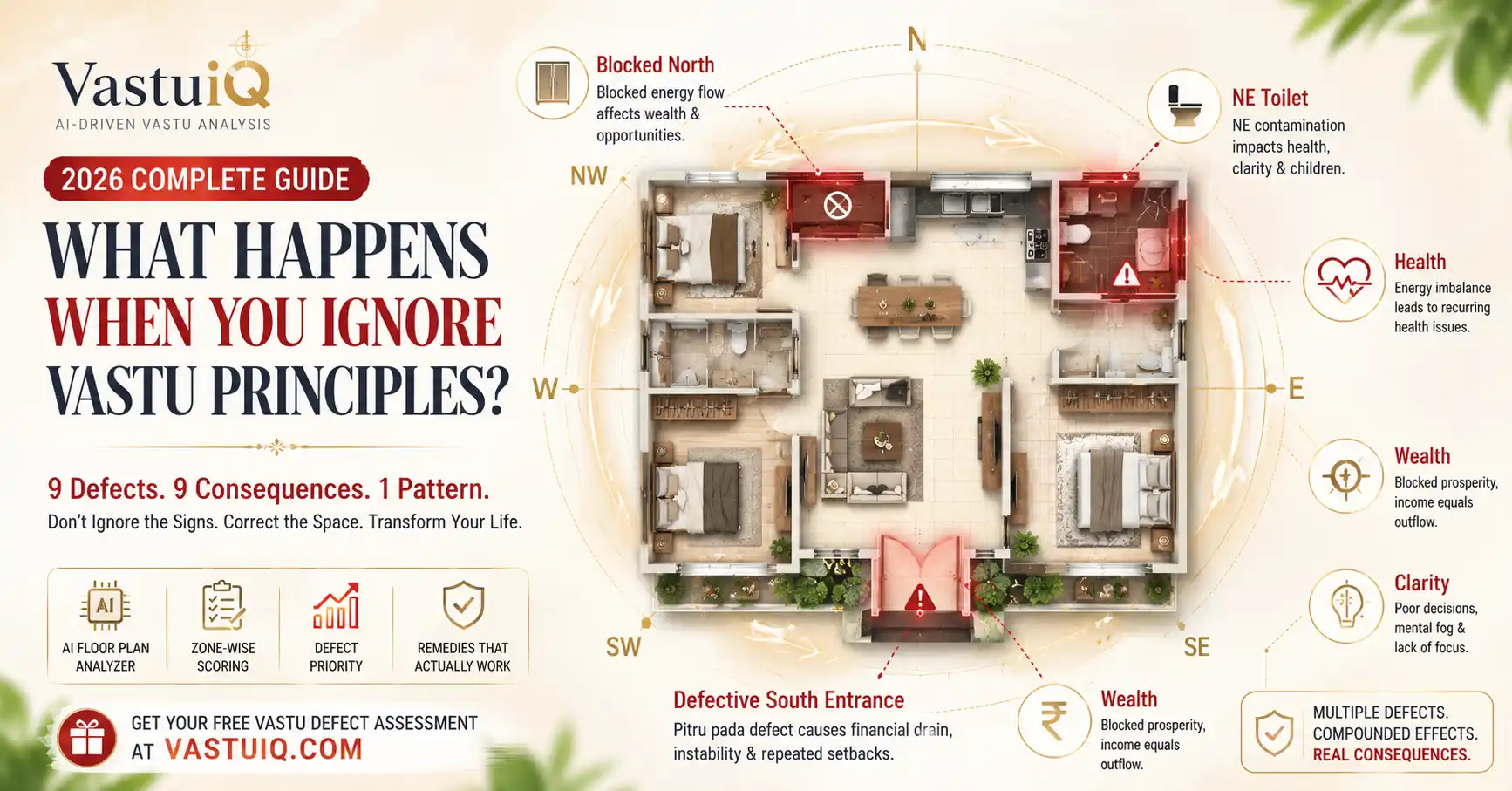
What you will learn in this guide
- What the classical texts actually say about the consequences of Vastu defects — not folklore
- 9 specific consequences linked to 9 specific defects — with the mechanism explained for each
- How multiple ignored defects compound over time into larger patterns
- The difference between a home that feels wrong and one that scores wrong — and why both matter
- What to do immediately if you recognise your home in this guide
Most people do not ignore Vastu deliberately. They ignore it by default — because they bought a flat without checking the floor plan’s zone placement, because the builder positioned the kitchen where the plumbing was easiest to run, because no one told them that the entrance door being in Pada 1 of the south wall was significant, or because they were told “south facing is bad” without being told why or what specifically makes it bad.
The consequences of these defaults accumulate. Not immediately, not dramatically, and not in ways that are obviously traceable to the spatial configuration of the home — which is precisely why they go unaddressed for years. A toilet in the northeast does not produce a crisis on day one. A blocked north wall does not close an obvious financial door on the day you place the wardrobe. A defective entrance pada does not announce itself. What these defects produce instead is a gradual, persistent pattern of difficulty — in specific life areas that correspond predictably to the Vastu zone that is compromised.
This guide names those patterns precisely. For each of the nine most commonly ignored Vastu defects, it describes the consequence the classical texts associate with it, the mechanism through which the defect operates, and what you can do about it now.
Before the List — Understanding How Vastu Consequences Work
Two things are important to understand before working through the specific defects below.
Consequences are zone-specific, not random. Vastu defects do not produce vague “bad energy” — they produce specific patterns in specific life areas that correspond to the elemental and directional function of the compromised zone. A northeast zone defect affects health, clarity and children because those are the qualities governed by the Ishaan corner. A southwest defect affects stability and the household head’s authority because that is the earth element’s domain. The specificity of the consequence is part of what makes the classical system coherent rather than superstitious.
Consequences compound when multiple defects are present. A single moderate defect in a home with otherwise strong Vastu produces a manageable, low-level pattern. Two severe defects compound each other — the combined effect is not additive but multiplicative. A home with a Pitru pada entrance (south wall, Pada 1) and a toilet in the northeast and a blocked north wall does not have three separate problems — it has one environment where financial drain, health disruption and decision-making impairment reinforce each other continuously.
Classical reference: Brihat Samhita (Chapter 53, “Vastu Dosha Phala” — consequences of Vastu defects) systematically describes the outcomes of specific construction defects: “Pitru pada dware dhana naasha” (Pitru pada entrance causes financial loss), “Ishanya sthane mala griha roga” (toilet in northeast causes disease), “Uttara avrodha dhana hani” (north zone obstruction causes wealth damage). These are not generalised warnings — they are specific defect-to-consequence mappings that have been part of the classical system for over 1,500 years.
The 9 Consequences of the 9 Most Commonly Ignored Vastu Defects
Defect 1 — Toilet in the Northeast Zone
Severity: Uttama (Severe) | VastuIQ Zone Score: 15/100
The northeast (Ishaan zone) carries water element energy — clarity, wisdom, health and spiritual receptivity. It is the most sensitive and most beneficial directional corner in any home. Placing a toilet — a waste and drainage space — in this zone does not simply introduce a minor elemental mismatch. It introduces the home’s primary waste function into its primary energy intake zone.
What happens when this is ignored:
- Health patterns: Recurring illness in the household that does not respond fully to treatment, or resolves and returns. The Brihat Samhita specifically names “roga” (disease) as the primary consequence of northeast toilet placement. Children and elderly family members, whose energy systems are most sensitive to zone quality, are often disproportionately affected.
- Mental clarity: Difficulty making clear decisions, persistent mental fog or overthinking without resolution. The northeast governs “prajna” — discerning wisdom — and its contamination manifests as impaired judgment quality in daily decisions, not just major ones.
- Children’s progress: Obstacles in children’s education, concentration difficulties and inconsistent academic or developmental progress are specifically associated with northeast zone defects in classical texts.
- Spiritual disconnection: Families with a northeast toilet frequently report that their spiritual or prayer practice feels effortful rather than nourishing — a sense that intention set in the home does not take root.
What to do: Structural relocation is the only complete solution. Non-structural remedies — sea salt bowl in the NE toilet, copper pyramid on the toilet wall, maximum lighting, Tulsi plant outside the NE zone, keeping the toilet door always closed — reduce severity from approximately 15/100 to 30–35/100. See our Toilet Zone Remedy Guide for the full treatment.
Defect 2 — Kitchen in the Northeast Zone
Severity: Uttama (Severe) | VastuIQ Zone Score: 22/100
The elemental conflict here is direct: fire (kitchen) placed in water (northeast) creates the most fundamental opposition in the Pancha Bhuta system. Unlike other misplaced rooms, which simply occupy an unsuitable zone, the kitchen actively generates the element most opposed to the northeast’s governing element — every time cooking happens.
What happens when this is ignored:
- Financial instability: Income exists but expenditure consistently matches or exceeds it. The fire-water conflict in the decision-making zone produces poor financial judgment — spending decisions feel reasonable at the time but consistently underperform in outcome.
- Health of the cook: The person who cooks most frequently in a northeast kitchen is often specifically affected — digestive issues, metabolic problems or fatigue that seems disproportionate to lifestyle factors.
- Relationship friction: Arguments that originate around practical household matters — finances, children’s schedules, domestic decisions — rather than deep relationship issues. The decision-making zone’s corruption manifests in the quality of everyday domestic coordination.
What to do: Relocate the kitchen to the southeast if structurally possible. If not: cook facing east at all times, gas hob on the east or southeast wall of the kitchen (never the north wall), terracotta or orange tones in the kitchen space, and maximum lighting. See our Kitchen Vastu Direction Guide.
Defect 3 — Defective Main Entrance Pada
Severity: Uttama (Severe) | VastuIQ Score Impact: −40 to −70 points
The entrance pada determines the quality of energy that enters the home — every day, every time someone crosses the threshold. A defective pada does not produce a single identifiable event. It produces a persistent filter on incoming opportunity, information and positive energy — the equivalent of a water inlet with a partial obstruction that reduces flow by 40 to 70 percent indefinitely.
What happens when this is ignored — by specific pada:
- Pitru pada (South wall, Pada 1): Financial drain — income equals outflow regardless of earnings. Ancestral health patterns recurring in the household. A sense that progress is made and then lost repeatedly.
- Roga pada (West wall, Pada 1): Health disruptions in the household that are difficult to diagnose or treat. Physical energy depletion that does not respond proportionately to rest and care.
- Rajayakshma pada (East or West wall, Pada 8): Slow depletion — career stagnation, gradual financial erosion, health that declines slowly rather than acutely. Often the most difficult pattern to identify because the decline is so gradual.
- Gruhakshata pada (East wall, Pada 2): Household instability — frequent changes, inability to settle, conflicts that arise from external pressures rather than internal household dynamics.
What to do: Calculate your exact pada using our Pada System Complete Guide. Apply threshold remedies — directional metal strip, correct door colour, protective deity above the entrance — from our 21 Vastu Remedies Guide. If structural door relocation is possible, it is the most impactful single change available in any home.
Defect 4 — Brahmasthan Obstruction
Severity: Uttama (Severe) | VastuIQ Zone Score Impact: −45 points
The Brahmasthan is the distribution centre of the home’s energy. When it is obstructed — a structural pillar, a permanent toilet, a fixed kitchen island or a staircase landing placed on the exact geometric centre of the home — prana cannot circulate from the entrance to the eight directional zones. The home’s individual zones may be correctly placed, but without the central distribution point functioning, the energy does not reach them effectively.
What happens when this is ignored:
- A distinctive “everything feels difficult simultaneously” pattern — finances, health, relationships and career all feel stuck at the same time, rather than any single area being specifically affected. This simultaneity across life areas is the hallmark of Brahmasthan obstruction.
- Progress that starts well and stalls repeatedly — projects begun with momentum that lose energy at the midpoint.
- A persistent sense of stagnation in the home itself — the space feels heavy or unresponsive regardless of how it is decorated or arranged.
What to do: Identify your Brahmasthan using our Brahmasthan Complete Guide. If a structural obstruction exists and cannot be removed, keep the surrounding area maximally open and brightly lit — light is the primary non-structural remedy for Brahmasthan obstruction.
Defect 5 — Master Bedroom Not in the Southwest
Severity: Madhyama (Moderate) | VastuIQ Score Impact: −25 to −35 points
The southwest is the earth element zone — stable, grounding, consolidating. The master bedroom belongs here because the household head’s rest, restoration and authority are all supported by earth element energy. When the master bedroom is elsewhere — particularly in the northeast, northwest or east — the household head’s rest quality and grounding are compromised.
What happens when this is ignored:
- Disrupted or non-restorative sleep for the couple — waking tired despite adequate hours, or frequent waking through the night without identifiable cause.
- The household head’s authority in professional and financial decisions feels undermined — not through external conflict but through internal uncertainty and inconsistency.
- Relationship friction that centres on the couple’s dynamic specifically — not external pressures but tension within the partnership, often without a clear external cause.
- Master bedroom in the northeast specifically: restlessness, hyperactivity of mind during sleep hours, and relationship tension are the most consistently reported symptoms. The northeast’s active water energy is inappropriate for the rest and consolidation function of the bedroom.
What to do: If room reassignment is not possible, apply earth element remedies within the existing bedroom — heaviest furniture in the SW corner of the room, earthy colours (beige, ochre, warm brown) on the walls, head of bed pointing south or west. See our Master Bedroom Vastu Guide.
Recognising your home in this list? VastuIQ’s AI Floor Plan Analyzer identifies exactly which defects are present in your home, scores each one by severity and delivers a prioritised remedy list — so you know which issue to address first. Get your free defect assessment at vastuiq.com
Defect 6 — North Zone Blocked or Heavy
Severity: Madhyama (Moderate) | VastuIQ Score Impact: −20 points
The north is Kubera’s wealth direction and Mercury’s intelligence direction. A blocked north wall — heavy wardrobes flush against it, a dark and enclosed north zone, a toilet on the north face, or a tall compound wall on the north boundary cutting off northern light — suppresses both financial opportunity and the mental clarity needed to recognise and act on it.
What happens when this is ignored:
- Financial opportunities that feel just out of reach — they exist in the environment but do not convert into the household’s reality.
- Professional recognition that does not arrive despite consistent, quality work.
- A sense that the home is heavier or more enclosed than its actual dimensions suggest — a spatial oppressiveness that visitors often comment on.
- In households where the primary earner works from home, a blocked north zone is specifically associated with difficulty concentrating and generating new ideas — Mercury’s intelligence function being suppressed at the source.
What to do: Remove heavy furniture from the north wall immediately. Add healthy green plants along the north wall or in the north zone. Ensure north-facing windows are unobstructed and clean. Add a Kubera yantra on the north wall if the zone has been significantly blocked for a prolonged period. All of these are same-day, zero-cost actions.
Defect 7 — Southwest Zone Light or Open
Severity: Madhyama (Moderate) | VastuIQ Score Impact: −20 points
A southwest zone that is light, empty, used as an open balcony or has large windows that release energy outward fails to perform the earth element’s consolidating function. The southwest needs weight, enclosure and permanence — its job is to hold what the home accumulates.
What happens when this is ignored:
- Wealth that is earned but does not accumulate — income is adequate but savings do not build, assets are acquired but do not hold value, financial progress is made but does not compound.
- The household head’s sense of authority and groundedness fluctuates — periods of confidence followed by periods of uncertainty without external cause.
- Physical health of the elder or primary authority figure in the household is affected — particularly joint and bone issues (earth element health associations) or a general vulnerability to fatigue.
What to do: Load the southwest zone with the heaviest available furniture. Close or reduce SW-facing windows. Use earthy colours (beige, brown, ochre) on the SW wall. If the SW is a balcony that cannot be converted, add heavy stone or concrete planters to introduce earth-element weight.
Defect 8 — Staircase in the Northeast or Centre
Severity: Madhyama (Moderate) | VastuIQ Score Impact: −30 points
A staircase in the northeast blocks the Ishaan zone’s water element energy — the upward movement of the staircase and its structural weight both suppress the zone’s light, open, receptive quality. A staircase in the centre (Brahmasthan) compounds the central zone obstruction with a structure that generates constant movement energy in the home’s most sensitive point.
What happens when this is ignored:
- Children’s education and developmental progress encounters repeated obstacles — specifically the northeast staircase pattern, because the NE zone’s clarity and wisdom energy is structurally obstructed.
- A feeling of constant motion in the household without settling — frequent relocations, job changes, lifestyle upheavals. The staircase’s movement energy in the wrong zone creates instability rather than upward progress.
- Financial progress that begins well and repeatedly hits unexpected obstacles at the midpoint — a start-stop pattern in career or business growth.
What to do: Keep the space under a northeast staircase completely clear, bright and if possible place a small water feature or healthy plant there. Ensure the staircase has clockwise rotation when ascending. Anticlockwise staircases in any position should have a mirror placed at the base to symbolically correct the rotation direction.
Defect 9 — Clutter and Broken Items Throughout the Home
Severity: Adhama (Minor but cumulative) | VastuIQ Score Impact: −5 to −15 points
Clutter is the lowest-severity individual defect — but it is the most widespread, the most consistently present alongside other defects, and the most compounding. A home with one severe defect and heavy clutter scores significantly lower than a home with the same severe defect but kept clean and functional.
What happens when this is ignored:
- Stagnation that mirrors the nature of the clutter — financial stagnation from piled financial papers, health stagnation from outdated medicines and broken health equipment, relationship stagnation from items connected to past relationships kept without purpose.
- A persistent low-level drain on mental energy — the cognitive load of living among unresolved, unprocessed items has both psychological and Vastu dimensions. The Brihat Samhita’s description of clutter as “vyadhi shakti” (disease energy) is consistent with modern research on clutter’s effect on cortisol levels and decision fatigue.
- Amplification of whatever other Vastu defects are present — a northeast toilet is bad; a northeast toilet in a cluttered, dark, poorly ventilated northeast zone is significantly worse.
What to do: Begin with the northeast and north zones — these are the highest-Vastu-priority zones and the highest-impact declutter targets. Remove broken items from any zone immediately — the Brihat Samhita is specific that broken and non-functional objects should not be retained anywhere in a home. Work through remaining zones in the defect priority order from our Vastu Dosh Guide.
How Ignored Defects Compound Over Time
The most important thing to understand about ignoring Vastu defects is the compounding dynamic. Year one in a home with two severe defects — a northeast toilet and a Pitru pada entrance — feels like a difficult year. Year three feels like a pattern. Year seven feels like the household’s fate.
This is not fatalism — it is the natural result of environmental conditions operating continuously on behaviour, decision-making quality, rest quality and physical health, compounding across time the way any persistent environmental stressor does. A home that consistently produces poor-quality sleep, degraded decision-making clarity and persistent health disruption over seven years produces life outcomes that look like fate but are actually the cumulative effect of correctable spatial conditions.
The inverse is equally true. A home with a Jayanta pada entrance, an open north zone, a correctly placed kitchen and a clear Brahmasthan does not produce miracles in year one. It produces slightly better clarity, slightly better rest, slightly better financial judgment — every day, compounding across years into outcomes that look like sustained good fortune.
This compounding dynamic is why early assessment matters more than most people realise. The earlier a defect is identified and remedied — ideally before purchase, or at least at the time of moving in — the shorter the compounding period and the more limited the accumulated effect.
Symptoms That Suggest a Vastu Assessment Is Overdue
If three or more of the following patterns are present in your household simultaneously, a Vastu assessment is strongly indicated:
- Finances feel stuck despite stable or growing income
- Sleep is consistently non-restorative or disrupted without clear medical cause
- One family member’s health fluctuates repeatedly without full resolution
- Arguments occur more frequently than external circumstances justify
- Children’s academic or developmental progress is inconsistent despite adequate support
- Career or business momentum repeatedly stalls at the same point
- A general sense that the home feels heavy, oppressive or “off” that visitors occasionally comment on
- Financial decisions that seem reasonable at the time consistently underperform
- A feeling of working harder than the results justify across multiple life areas simultaneously
None of these symptoms individually points conclusively to a Vastu defect — all have multiple possible causes. But their simultaneous presence across multiple life areas, without an obvious common external cause, is the pattern most consistently associated with significant Vastu defects operating in combination.
What to Do If You Recognise Your Home in This Guide
Three steps in sequence:
Step 1 — Assess, do not assume. Recognising a symptom pattern is not the same as identifying the defect. Before applying remedies, identify which specific defect or defects are actually present in your home. Use VastuIQ’s free Vastu calculator for a fast directional and pada score, or the AI Floor Plan Analyzer for a complete zone-by-zone assessment. Applying remedies for defects you do not have produces no benefit and may create confusion about what is and is not working.
Step 2 — Prioritise ruthlessly. If your assessment reveals multiple defects, address them in severity order: northeast zone defects first, entrance pada defects second, Brahmasthan obstruction third, southwest zone defects fourth. Do not spread effort across five minor defects while leaving one severe defect unaddressed. One severe defect remedied well outperforms five minor defects remedied partially.
Step 3 — Apply and observe. Implement the highest-priority remedy completely, then observe for 30 to 60 days before assessing results and moving to the next defect. The classical texts do not specify exact timelines for remedy effects — the honest position is that energetic changes in a space take time to manifest as observable life changes, and the observation period should be sufficient to detect a genuine pattern change rather than a day-to-day fluctuation.
Frequently Asked Questions — Ignoring Vastu Consequences
Does ignoring Vastu really cause problems, or is it just superstition?
The classical Vastu system describes specific spatial configurations that affect specific elemental energies in specific directional zones — and connects those energetic effects to specific life-area outcomes. Whether you engage with this through the classical framework or through the lens of environmental psychology (space quality affecting sleep, cognition, stress levels and behaviour), the practical finding is the same: certain spatial configurations consistently correlate with poorer outcomes in specific life areas. Calling it superstition requires dismissing both the classical framework and the observable correlations — neither of which is intellectually satisfying for anyone who has lived the patterns described above.
I have lived in my home for 10 years without problems — does Vastu not apply to me?
Two possibilities. First, your home may have strong Vastu fundamentals — a good entrance pada, correct room placement and an open north zone — in which case you have been benefiting from them without knowing it. Second, you may have defects that are partially compensated by strong factors elsewhere, or that have produced effects so gradual they have been attributed to other causes. A Vastu assessment on a home you have lived in for years is valuable precisely because it can identify which factors have been working for you and which may have been quietly working against you.
Can all Vastu defects be fixed without demolition?
Most moderate defects (southwest zone issues, blocked north wall, light southwest, staircase position) can be meaningfully improved through non-structural remedies. Severe defects (northeast toilet, defective entrance pada, Brahmasthan obstruction from a fixed structure) can be partially improved through non-structural remedies — typically reducing the zone score from 15/100 to 30–35/100 — but cannot be fully eliminated without structural correction. The complete non-structural remedy guide is at 21 Vastu Remedies Without Renovation.
How quickly do Vastu remedies show results after years of ignoring defects?
The classical texts do not specify timelines and any practitioner who gives you an exact number of days is not working from classical sources. The realistic expectation is that non-structural remedies produce observable changes in space quality within weeks, that changes in sleep quality and household atmosphere are often reported within the first month, and that financial and career effects — which depend on many more variables — take longer to observe. Defects that have been operating for many years have produced compounded effects — the remediation of those effects requires time proportionate to the accumulation period.
Should I get a professional Vastu consultation if I have multiple severe defects?
A professional consultation adds the most value when structural decisions are involved — deciding whether to relocate a door, convert a northeast toilet, or undertake significant renovation based on Vastu findings. For non-structural remedies, the guidance in this guide and the full remedy series on VastuIQ is sufficient for most standard residential layouts. Use VastuIQ’s AI Floor Plan Analyzer first to establish exactly which defects are present and at what severity — this gives you the same starting information a consultant would develop, so any subsequent consultation is focused on decisions rather than discovery.
Related Vastu Guides
Vastu Dosh — Common Defects, Symptoms and Remedies — the complete defect reference guide with severity scores, symptom patterns and full remedy pathways for every major Vastu defect category.
21 Vastu Remedies Without Renovation — the complete non-structural remedy guide for every defect listed in this article, organised by zone with classical sources cited for each remedy.
Can You Check Vastu Without Hiring Someone? — the complete self-assessment guide with a 5-check framework that identifies which of the defects above are present in your home, in under 30 minutes.
Does Vastu Actually Help With Money and Wealth? — covers the financial consequences of Vastu defects in depth, with the 7 specific wealth-affecting factors and real scored household profiles.
Apply This to Your Own Property
Free AI Vastu analysis — room-by-room scores, geo-adaptive for India, UK, UAE and 50+ countries. Detailed report from ₹99.