
What you will learn in this guide
- What Vastu Dosh actually means — classical definition versus popular misuse
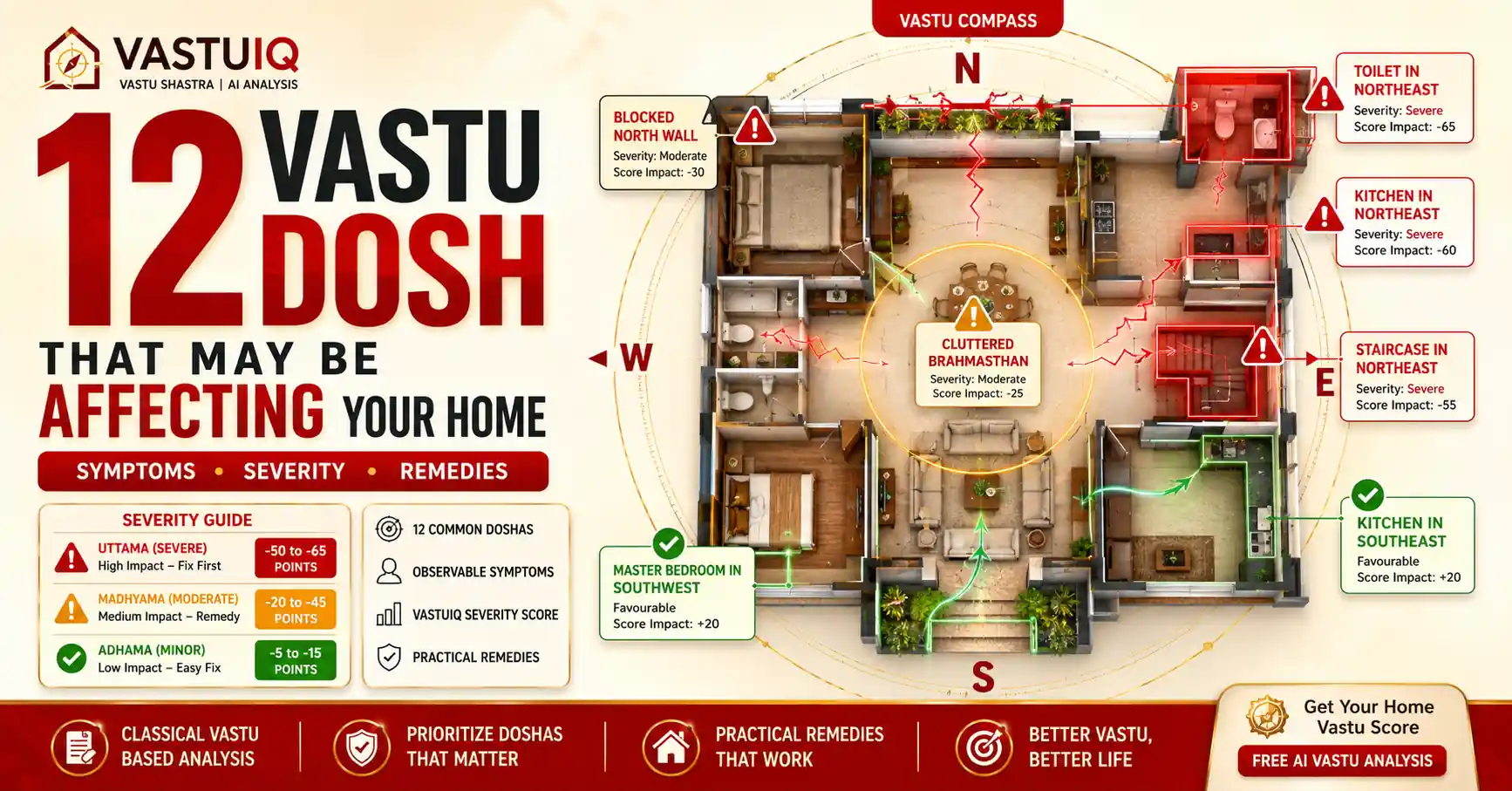
- 12 most common Vastu defects ranked by severity with real VastuIQ scores
- How to identify which dosh your home has from observable symptoms
- Specific remedies for each defect — structural and non-structural
- How multiple doshas interact and which to prioritise fixing first
Something feels off at home. Finances are stuck despite stable income. Sleep is disrupted without a clear medical reason. Arguments happen more frequently than they used to. One family member’s health keeps fluctuating. A project or business that should be progressing seems to stall repeatedly.
These are the situations that bring people to search for “Vastu Dosh.” Not an abstract curiosity about ancient texts — but a real, felt sense that the space they live in is working against them rather than with them.
The question this guide answers is: how do you know if what you are experiencing is connected to a genuine Vastu defect in your home — and if it is, which defect, how severe, and what to do about it?
What Vastu Dosh Actually Means
The word “dosh” comes from Sanskrit — it means defect, imbalance or deviation from the correct. Vastu Dosh (also written Vastu Dosha) is therefore a deviation from correct Vastu construction — a situation where a room, entrance, zone or element in a home is placed in conflict with the classical directional and elemental rules of Vastu Shastra.
Three important clarifications on the term as it is commonly used:
Not all Vastu Dosh is equal in severity. A toilet in the northeast is a severe dosh. A mirror on the south wall is a mild dosh. Popular Vastu content treats all defects as equally alarming — classical texts do not. The Brihat Samhita assigns different levels of gravity to different defects and distinguishes between doshas that require structural correction and those that respond to simple remedies.
Vastu Dosh is structural, not karmic. A Vastu defect is a physical condition of the built space — it is not a curse, not a permanent affliction and not a reflection of the occupants’ character or fate. It is an elemental imbalance in the structure that can be identified, scored and addressed. This is why VastuIQ produces a number — a score — rather than a verdict. The score reflects the severity of structural deviations from correct Vastu, nothing more and nothing less.
Vastu Dosh can co-exist with a happy life and can be remediated. Many homes with identifiable Vastu defects have occupants living well — because the defects are mild, because other strong Vastu factors compensate, or because the occupants’ life circumstances provide external resilience. Equally, identified defects can be reduced or eliminated through remedies and, where needed, structural correction.
Classical reference: Brihat Samhita (Chapter 53, “Vastu Vidya”) categorises construction defects into three grades — “Uttama dosha” (severe defects requiring structural correction), “Madhyama dosha” (moderate defects addressable with remedies) and “Adhama dosha” (minor defects with minimal life impact). This grading system is the classical basis for VastuIQ’s severity scoring model. Modern Vastu content rarely maintains this distinction, treating all defects as equally severe — which is not supported by the original texts.
The 12 Most Common Vastu Doshas — Ranked by Severity
These are the defects that appear most frequently in Indian residential properties — flats, independent houses, builder floors and villas. Each is listed with its severity grade, observable symptoms, VastuIQ zone score impact, and primary remedy approach.
Dosh 1 — Toilet in the Northeast Zone
Severity: Uttama (Severe) | Zone Score Impact: −65 points
The most damaging single Vastu defect in any residential property. The northeast is the Ishaan zone — water element, spiritual energy, clarity and wisdom. Placing a toilet in this zone introduces waste and drainage into the most sacred directional corner of the home.
Symptoms associated: Persistent health issues in the household, especially affecting children and elderly. Mental unrest, difficulty in decision-making. Stalled spiritual or educational progress. Financial leakage despite adequate income.
Remedy approach: Structural relocation is the only complete solution. Non-structural remedies — sea salt bowl in NE toilet, copper pyramids on the toilet wall, maximum lighting, Tulsi plant outside the NE zone — reduce severity from approximately 15/100 to 30–35/100 but do not eliminate the defect. See our Toilet Zone Complete Remedy Guide for direction-specific prescriptions.
Dosh 2 — Kitchen in the Northeast Zone
Severity: Uttama (Severe) | Zone Score Impact: −55 points
The northeast is the water element zone. The kitchen carries fire element energy. Fire in the water zone is the most direct elemental conflict in Vastu — these two elements are diametrically opposed in the classical elemental system.
Symptoms associated: Recurring health problems, particularly digestive and metabolic issues. Relationship friction among family members. Financial inconsistency — income exists but expenditure consistently exceeds it. The household cook’s health is often specifically affected.
Remedy approach: Relocate the kitchen to the southeast zone if at all structurally possible. If not, apply the cook-facing-east rule (face east while cooking regardless of kitchen position), place no fire source on the north or northeast wall of the kitchen, and use warm terracotta tones in the kitchen to bring fire element energy into a water zone. Reference: Kitchen Direction Vastu Guide.
Dosh 3 — Defective Main Entrance Pada Position
Severity: Uttama (Severe) | Zone Score Impact: −40 to −70 points depending on pada
The main entrance pada is the single highest-weighted factor in VastuIQ’s scoring model. An entrance in Pada 1 of the south wall (Pitru zone) reduces the Directional Compliance score by up to 70 points. An entrance in Pada 1 of the west wall (Roga zone) similarly. The entrance is where all outside energy — positive and negative — first enters the home, and an incorrectly placed entrance filters that energy unfavourably.
Symptoms associated: Varies by specific pada position. Pitru pada (S-1): financial strain, ancestral health patterns recurring. Roga pada (W-1): recurring illness in the household. Gruhakshata pada (E-2): household conflicts, instability. Rajayakshma pada (E-8 or W-8): slow depletion of health and finances.
Remedy approach: Structural door relocation to a correct pada is the ideal solution. Non-structural: directional threshold metal, correct door colour, protective deity above the entrance, raised threshold. See our Pada System Complete Guide and 21 Vastu Remedies Without Renovation for full remedy detail.
Dosh 4 — Brahmasthan Obstruction
Severity: Uttama (Severe) | Zone Score Impact: −45 points
The Brahmasthan is the central zone of the home — the energetic core from which prana distributes to all other zones. Building over it (a pillar, toilet, kitchen or permanent heavy structure in the exact centre of the home) or heavily loading it with furniture creates what the Manasara calls “Brahma Sthan Dosh” — obstruction of the central life energy.
Symptoms associated: A general sense of stagnation affecting all areas of life simultaneously — finances, health, relationships and career all feel stuck at once rather than any single area being specifically affected. This “everything feels difficult” pattern is the distinctive symptom of central zone obstruction.
Remedy approach: Keep the Brahmasthan clear of all permanent structures and heavy furniture. If a structural pillar or wall exists in the centre, ensure the surrounding area is maximally open and lit. For the measurement method and full guidance see our Brahmasthan Complete Guide.
Dosh 5 — Master Bedroom Not in the Southwest
Severity: Madhyama (Moderate) | Zone Score Impact: −25 to −35 points
The southwest is the earth element zone — the heaviest, most stable corner of the home. The master bedroom, occupied by the household head, belongs here. When the master bedroom is placed in the northeast (most damaging alternative), northwest or east, the household head is not in the stabilising zone that supports their authority, rest and grounding.
Symptoms associated: Disrupted sleep for the couple. Relationship friction without clear external cause. The head of household feels unsettled or lacks authority in professional decisions. Frequent restlessness, inability to relax fully at home.
Remedy approach: If the master bedroom cannot be relocated to the SW zone, apply earth-element remedies within the existing bedroom — heavy furniture, earthy colours (brown, beige, ochre), the head of the bed pointing south or west. Reference: Master Bedroom Vastu Guide.
Dosh 6 — Staircase in the Northeast or Centre
Severity: Madhyama (Moderate) | Zone Score Impact: −30 points
A staircase in the northeast blocks the water element energy that is supposed to flow freely through the Ishaan zone. A staircase in the centre (Brahmasthan) compounds a central zone obstruction with a heavy, movement-generating structure in the most sensitive zone of the home. Both positions are explicitly flagged as defects in the Manasara.
Symptoms associated: Obstacles in children’s education and growth (NE staircase). A sense of the household always being in motion without settling — frequent relocations, job changes, unsettled family life. Financial progress that starts well but repeatedly encounters obstacles.
Remedy approach: Structural relocation is ideal. Non-structural: keep the space under a NE staircase completely clear, bright and if possible place a small water feature or Tulsi plant there to maintain NE zone energy. Anticlockwise staircases (descending from right to left when facing up) should be avoided in any position.
Dosh 7 — Cut or Missing Zone (Irregular Plot Shape)
Severity: Madhyama (Moderate) | Zone Score Impact: −20 to −40 points depending on which zone is cut
An irregular plot or floor plan — L-shaped, triangular, or with a significantly cut corner — creates a “missing zone” in the Vastu Purusha Mandala. The missing zone’s elemental energy is absent from the home entirely. A cut northeast is the most severe missing zone. A cut southwest is also significant. A cut northwest or southeast has lower but still measurable impact.
Symptoms associated: Depends on which zone is cut. Cut NE: spiritual and health issues, children’s problems. Cut SW: instability in the head of household’s career or finances. Cut SE: recurring fire-element health issues, digestive problems. Cut NW: social isolation, guest relationships strained.
Remedy approach: For cut zones, place a mirror on the wall of the cut corner facing into the missing zone — this visually and energetically extends the zone. A bright light permanently on in the cut zone area further amplifies the effect. For plots (not flats), a compound wall completing the full rectangular boundary compensates for irregular plot shapes.
Dosh 8 — North or East Wall Heavily Blocked
Severity: Madhyama (Moderate) | Zone Score Impact: −20 points
The north wall (Kubera’s wealth direction) and east wall (Indra’s solar direction) should be the most open, light-receiving walls in any home. Heavy construction, tall compound walls, dense trees or built-over extensions on the north or east face block the incoming wealth and solar energy that these directions are specifically responsible for.
Symptoms associated: Financial opportunities that feel blocked or out of reach. Professional recognition that does not arrive despite consistent effort. A general sense that the home is dark or enclosed even when rooms are adequate in size.
Remedy approach: Maximise openings (windows, ventilation) on the north and east walls. Remove or reduce any permanent obstruction on these faces where structurally possible. Keep north and east compound walls lower than south and west walls — classical Vastu specifies that south and west boundaries should be higher and heavier than north and east boundaries.
Dosh 9 — Southwest Zone Light or Empty
Severity: Madhyama (Moderate) | Zone Score Impact: −20 points
The southwest earth zone needs weight and permanence — the heaviest furniture, the master bedroom, the most solid construction elements of the home. When the SW corner is light, empty, used as a balcony, open terrace or has a large window that releases energy outward, the earth zone’s stability function is weakened.
Symptoms associated: Financial instability despite earnings. The household head’s authority or health fluctuates. A sense that achievements do not accumulate — progress is made but does not consolidate.
Remedy approach: Load the SW zone with the heaviest available furniture. Close or reduce SW-facing windows. Use earthy colours on the SW wall. If the SW has a balcony that cannot be converted, place heavy planters or stone elements there to add earth-element weight.
Dosh 10 — Toilet Adjacent to or Sharing a Wall with the Puja Room
Severity: Adhama to Madhyama | Zone Score Impact: −15 to −25 points
A toilet sharing a wall with the puja room — or located directly above or below the puja room in a multi-storey home — creates an elemental and energetic conflict between the most sacred and the most waste-associated spaces in the home. This layout is common in compact builder flats where the NE puja room and a bathroom are on opposite sides of the same wall.
Symptoms associated: A sense that prayers or intentions set in the home do not materialise. Family members feel spiritually disconnected or ungrounded despite regular worship practice.
Remedy approach: Place a lead or copper sheet on the shared wall between the two rooms (inside the wall cavity if possible, or mounted flush on the puja room’s side of the wall). Ensure the toilet is always kept clean and the door remains closed. Maintain maximum fragrance and light in the puja room.
Dosh 11 — T-Junction Road Directly Facing the Main Entrance
Severity: Adhama (Minor) | Zone Score Impact: −10 to −15 points
A road that runs directly and terminates at the main entrance — a T-junction — is called “Veedhi Shoola” (road arrow) in classical Vastu. The directed energy of vehicular and pedestrian movement aimed straight at the entrance is considered to introduce excessive, unfiltered external energy into the home.
Symptoms associated: Frequent unexpected events disrupting household routine. A sense of exposure or vulnerability. Arguments triggered by external factors rather than internal household dynamics.
Remedy approach: A compound wall of adequate height that offsets the entrance from the direct road line. A large pot or planter placed in front of the entrance to break the direct road axis. A Hanuman idol or protective deity above the entrance facing outward toward the road.
Dosh 12 — Clutter and Non-Functional Items Throughout the Home
Severity: Adhama (Minor) | Zone Score Impact: −5 to −10 points
While not a structural dosh in the classical sense, accumulated clutter — broken items, unused furniture, dead plants, non-functional electronics — is consistently referenced in Vastu texts as a source of stagnant energy that compounds other doshas. A home with significant structural defects and heavy clutter scores lower than a home with the same structural defects but kept clean and functional.
Symptoms associated: Stagnation that mirrors the quality of the clutter — financial stagnation from financial paperwork and unpaid bills piled up, health stagnation from old medicines and broken health equipment, relationship stagnation from items connected to past relationships kept unnecessarily.
Remedy approach: Systematic decluttering is one of the highest-impact zero-cost Vastu improvements available. Begin with the northeast and north zones, then the entrance area, then work through remaining zones. Remove broken items immediately — the Brihat Samhita specifically states that broken or non-functional objects carry “vyadhi shakti” (disease energy) in a home.
Not sure which Vastu Dosh your home has? VastuIQ’s AI Floor Plan Analyzer identifies your exact defects zone by zone, assigns a severity score to each one, and delivers a prioritised remedy list. Upload your floor plan at vastuiq.com/ai-vastu-floor-plan-analyzer — results in under two minutes.
How Multiple Vastu Doshas Interact
Most homes do not have a single isolated dosh — they have several, at different severity levels. Understanding how doshas interact is important because their effects are not simply additive. They compound.
A toilet in the NE (−65 points) combined with a defective entrance pada (−50 points) does not produce a home scoring 100 − 65 − 50 = −15. It produces a home scoring in the 15–20 range because the two defects reinforce each other — a bad entrance channels poorly filtered energy into a home where the primary energy zone is already compromised.
Conversely, strong positive factors — correct master bedroom in SW, open north wall, clean northeast with Tulsi plant — compensate for moderate doshas and keep overall scores from falling as far as individual defect analysis might suggest.
The practical implication: fix your highest-severity dosh first, even if it is difficult or expensive. Addressing five minor doshas while leaving one severe dosh untouched does not produce proportionate improvement. VastuIQ’s scoring model reflects this interaction effect — improving the NE zone or entrance pada produces a score jump larger than the arithmetic sum of those individual changes suggests.
Prioritisation Order for Vastu Dosh Correction
- Toilet in the northeast — structural relocation if at all possible
- Kitchen in the northeast — structural relocation if possible, remedies if not
- Main entrance pada defect — structural door shift or threshold remedies
- Brahmasthan obstruction — clear central zone of all heavy items
- Master bedroom not in southwest — room reassignment or earth-element remedies
- Staircase in NE or centre — keep surroundings open, bright and light
- North or east wall blocked — maximise openings, reduce obstructions
- Minor doshas (clutter, T-junction, shared walls) — address last
Frequently Asked Questions — Vastu Dosh
What is Vastu Dosh and how does it affect the family?
Vastu Dosh is a structural defect in a home’s construction — a deviation from correct elemental and directional placement as prescribed in classical Vastu Shastra texts like the Brihat Samhita and Manasara. Its effect on a family depends on which zone or element is affected and how severely. A northeast toilet dosh affects health and mental clarity most directly. A defective entrance pada affects overall energy quality and financial flow. A southwest zone deficiency affects the household head’s stability and career. The effects are not superstitious — they reflect how elemental imbalances in specific zones of a living space interact with the activities and people occupying those zones daily.
How do I know if my house has Vastu Dosh?
The clearest method is a systematic zone assessment — map your home’s eight directional zones, note what is placed in each zone, and compare against classical Vastu placement rules. The three highest-priority checks are: what is in your northeast zone (toilet or kitchen there is a severe dosh), which pada your main entrance is in (Pada 1 or 9 on south/west walls are severe doshas), and whether your master bedroom is in the southwest (if not, that is a moderate dosh). VastuIQ’s free Vastu Analyzer performs this assessment from your facing direction and entrance position in under two minutes at vastuiq.com/free-vastu-analyzer.
Can Vastu Dosh be removed completely?
Structural doshas — toilet in NE, kitchen in NE, defective entrance pada — can be fully eliminated through structural correction (relocating the room or door). Where structural correction is not possible, non-structural remedies reduce the dosh’s severity from Uttama (severe) to Madhyama (moderate) in most cases — a meaningful improvement, but not a complete elimination. Minor doshas (clutter, shared walls, T-junction) can be fully addressed without structural work. The honest position is that a home’s Vastu score can always be improved — but only structural correction can fully resolve a structural dosh.
Is Vastu Dosh Nivaran puja effective?
Vastu Shanti puja — the ritual purification ceremony performed at the time of entering a new home or after identifying significant doshas — is referenced in classical texts as a complementary practice alongside structural and elemental remedies. The Brihat Samhita describes Vastu Shanti as effective for “adhama doshas” (minor defects) and as a supportive practice for “madhyama doshas” alongside physical remedies. It is not described as a replacement for structural correction of severe (uttama) doshas. A puja changes the ritual and intentional quality of the space — physical remedies and structural corrections change the elemental and directional quality. Both have their role.
Which Vastu Dosh causes financial problems?
Multiple doshas are associated with financial difficulty, but each operates through a different mechanism. A blocked north wall suppresses Kubera’s wealth energy — the most direct financial dosh. A Pitru pada entrance (Pada 1, south wall) creates financial drain associated with ancestral debt energy. A light or empty southwest zone prevents wealth from consolidating even when earned. A Brahmasthan obstruction creates general stagnation that includes finances. The most efficient approach is to identify which specific dosh is present rather than assuming all financial difficulty has the same Vastu cause — each requires a different remedy.
Related Vastu Guides
These guides provide deeper detail on the specific doshas covered above:
Toilet in the Wrong Vastu Zone — Complete Remedy Guide for All 9 Directions — the dedicated guide to Dosh 1 above, with direction-specific prescriptions for every possible toilet zone placement.
21 Vastu Remedies Without Renovation — the complete non-structural remedy guide covering metals, colours, plants, water and light remedies for all major dosh categories.
Pada in Vastu Shastra — How to Find Your Door’s Pada Position — essential for identifying Dosh 3 (defective entrance pada) with the step-by-step measurement method.
How to Find the Centre of Your Home — Complete Brahmasthan Guide — identifies and explains Dosh 4 (Brahmasthan obstruction) with the full measurement and assessment method.
Apply This to Your Own Property
Free AI Vastu analysis — room-by-room scores, geo-adaptive for India, UK, UAE and 50+ countries. Detailed report from ₹99.