
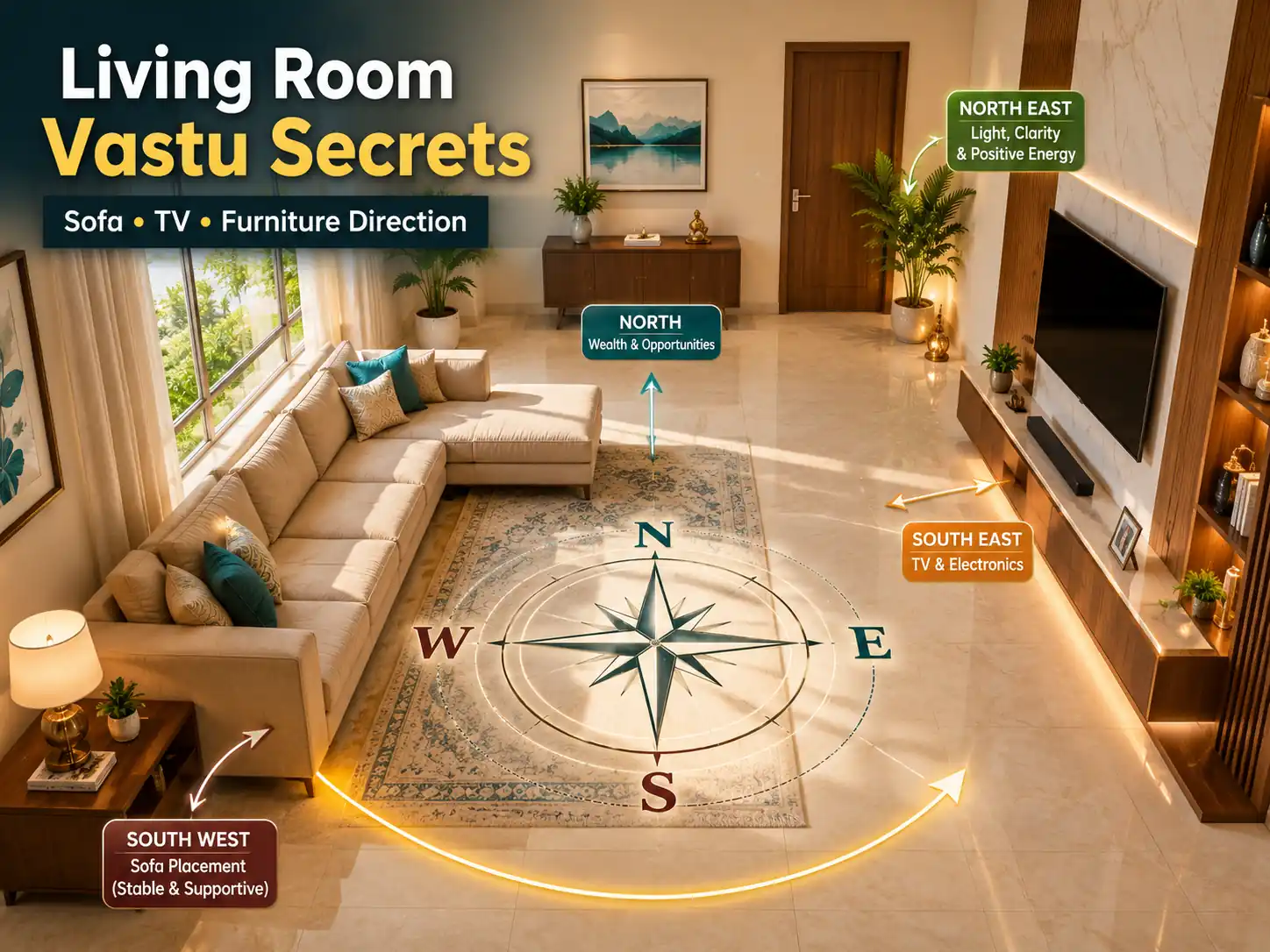
What you will learn in this guide
- The correct living room zone for every facing direction — north, south, east and west
- Sofa direction rules and why facing direction while seated matters in Vastu
- TV, mirror and electronics placement — the most commonly searched living room question
- Colour and lighting guidance specific to the living room’s social energy
- Remedies if your living room is already fixed in a less-than-ideal zone
The living room is the most lived-in, most photographed, and most frequently rearranged room in an Indian home — and also one of the most inconsistently advised on in Vastu content. Search for “living room Vastu” and you will find dozens of conflicting rules about sofa colour, TV position and furniture shape, most of them stated as universal truths with no explanation of why.
The reason for the confusion is simple: the living room does not have one fixed “correct zone” the way the kitchen (southeast) or puja room (northeast) does. Its correct placement depends on your home’s facing direction, because the living room’s function — welcoming guests, social interaction, family gathering — works best when placed in the zone that naturally receives the most energy from your specific entrance direction.
This guide removes the guesswork. It gives you the correct living room zone for each facing direction, the furniture and seating rules that apply regardless of zone, and the remedies available if your living room is already built in a less-than-ideal position.
Why the Living Room’s Correct Zone Changes by Facing Direction
Unlike the kitchen (fire element, always southeast) or the puja room (water element, always northeast), the living room is a multi-purpose social space without a single fixed elemental assignment in classical Vastu. What the texts do specify is that the living room should occupy a zone that is open, well-lit, and positioned to receive guests smoothly from the entrance without requiring them to pass through private zones like bedrooms or the kitchen.
This means the ideal living room zone is determined by where your entrance is, because the living room functions as the energetic and physical bridge between the outside world and the home’s interior. The following zone assignments are based on classical Vastu Purusha Mandala logic applied to each facing direction:
| Home Facing Direction | Ideal Living Room Zone | Why |
|---|---|---|
| North facing | North or Northeast | Living room sits near the entrance, in the wealth (Kubera) and clarity (Ishaan) zones |
| South facing | South or Southeast | Living room occupies the dynamic energy zone near the entrance wall |
| East facing | North or Northeast | Living room sits at the far end of the solar energy path, in the water-element zone |
| West facing | North or Northeast | Living room occupies the zone furthest from the entrance, keeping NE active |
Note the pattern: in three of the four facing directions, north or northeast is the ideal living room zone. This is not a coincidence — the north and northeast carry the most welcoming, open elemental energy (Kubera’s wealth and Ishaan’s clarity), which is precisely the energy a social gathering space benefits from. South-facing homes are the exception, where the living room naturally sits near the south or southeast entrance zone instead.
Classical reference: Mayamata (Chapter 7) describes the “sabha griha” or assembly room as ideally positioned to receive guests without passing through private quarters, and notes that north and east-aligned positions carry the most favourable energy for social and welcoming spaces. The Manasara associates the northeast zone specifically with clarity of thought and ease of conversation — qualities suited to a living room’s social function.
Sofa Direction — The Most Important Living Room Rule
Of all the living room Vastu questions people search for, sofa direction has the most direct, practical answer. The rule centres on which direction the primary seating faces, not which wall it is against.
Best sofa-facing directions: East or North
The primary sofa — where the head of the household or most frequent occupants sit — should face east or north when in use. This means the sofa itself is typically placed against the west or south wall, facing toward the east or north. East-facing seating aligns with solar energy and supports clarity and positive engagement. North-facing seating aligns with Kubera’s wealth energy.
Avoid sofa facing south
Seating that faces directly south while in use is the position to avoid for primary, frequently-used furniture. This applies to the main sofa and any chair where the household head regularly sits. It does not apply rigidly to occasional guest seating or secondary chairs, which have more flexibility.
Sofa placement against the wall — southwest is ideal
While facing direction matters most, the physical placement of heavy seating also has a zone preference. The southwest wall is the ideal location for the main sofa set, because the SW earth zone benefits from heavy, stable furniture. This also naturally produces east or northeast-facing seating, satisfying both rules simultaneously.
U-shaped or L-shaped sofa arrangements
L-shaped and U-shaped sofa sets are common in Indian living rooms and are fully Vastu-compatible as long as the longest, most-used section follows the facing direction rule above. Position the corner of an L-shaped sofa in the southwest corner of the room, with the two arms extending along the south and west walls — this keeps the heaviest furniture mass in the earth zone while still allowing east or north-facing seating on the primary arm.
TV, Mirror and Electronics Placement
This is consistently the single most-searched specific living room Vastu question — more searched than overall room placement itself. The reasoning behind TV placement rules in Vastu is rooted in elemental conflict and energy disruption, not superstition.
Best TV wall: Southeast or South
Televisions, being electronic devices that generate heat, are classified under the fire element in modern Vastu interpretation — extending the classical Agni (fire) principle to electrical appliances. The southeast wall, being the fire zone, is the most appropriate location for the television. The south wall is also acceptable.
Avoid TV on the northeast wall
This is the rule most commonly violated in Indian living rooms, because the northeast wall is often the most visually prominent wall when entering the room. Placing a heat-generating electronic device in the water-element northeast zone creates a direct elemental conflict. If your TV is currently mounted on the NE wall, relocating it to the SE or S wall is one of the highest-impact living room remedies available without any structural work.
Mirror placement — north or east wall only
Mirrors in the living room should be placed on the north or east wall, where they amplify the zone’s natural energy and visually expand the space. Avoid mirrors on the south or southwest wall — in these zones, mirrors are believed to amplify instability rather than positive energy. A mirror directly facing the main seating area, regardless of wall, should also be avoided, as it is believed to double tension and conflict during family conversations.
Wi-Fi router, set-top box and electronic clutter
Keep electronic equipment clustered in the southeast corner of the living room rather than scattered across multiple walls. This concentrates the fire-element electronic energy in its correct zone and avoids spreading minor elemental disruptions throughout the room.
Want to know if your living room layout matches your home’s facing direction correctly? Upload your floor plan to VastuIQ’s AI Floor Plan Analyzer for a full zone-by-zone score, including furniture and seating direction analysis. Check your home free at vastuiq.com
Furniture Arrangement and Shape
Furniture shape — rectangular and square preferred
Rectangular and square furniture is preferred over round, oval or irregular shapes for primary living room pieces — sofas, centre tables and side tables. Sharp, irregular or excessively rounded furniture shapes are considered less stable in classical Vastu’s elemental logic, which favours grounded, geometrically stable forms for furniture intended for long use.
Centre table — never directly over the Brahmasthan
If your living room contains the centre of the home (the Brahmasthan), avoid placing a heavy centre table or any furniture directly over that exact central point. The Brahmasthan should remain as open as possible regardless of which room it falls within. If you are unsure whether your living room contains your home’s central point, see our complete Brahmasthan Guide for the measurement method.
Avoid broken or damaged furniture
This is a simple but classically supported principle — damaged, cracked or broken furniture anywhere in the home, but especially in the frequently-occupied living room, is associated with stagnant or negative energy. Repair or replace broken furniture rather than continuing to use it, particularly seating that is regularly used by the household head.
Furniture spacing and clutter
Leave adequate open space in the centre of the living room. Overcrowded furniture arrangements that leave no central open area restrict the free flow of energy through the room — a principle that applies across all rooms but is particularly relevant in the living room given its high foot traffic and social function.
Colours for the Living Room
Living room colour should align with the zone the room occupies, following the same elemental colour logic used throughout Vastu room guides.
| Living Room Zone | Recommended Colours | Avoid |
|---|---|---|
| North or Northeast | Light green, light blue, white, cream | Dark red, black |
| South or Southeast | Light terracotta, peach, cream with warm accents | Dark blue, black |
| Southwest | Beige, light brown, earthy tones | Bright blue, white |
| Northwest | White, light grey, off-white | Dark, heavy tones |
Regardless of zone, very dark colours (black, deep maroon, navy as a dominant wall colour) are generally avoided for living rooms in Vastu guidance because the living room is meant to carry light, welcoming energy that encourages conversation and connection. Light and neutral base tones with one accent wall in the zone-appropriate colour is the most commonly recommended approach.
Lighting and Natural Light
The living room should be the most naturally well-lit common area in the home, after the entrance itself. Adequate natural light supports the social, welcoming function of the room and is considered essential for positive Vastu energy regardless of zone or facing direction.
- Maximise east and north-facing windows in the living room — these bring in the most beneficial morning and ambient light.
- Avoid heavy, dark curtains that block natural light during the day. Light, sheer fabrics that filter rather than block light are preferred.
- Artificial lighting should be warm and adequate, avoiding both overly dim corners and harsh, cold lighting that disrupts the room’s welcoming quality.
- Northeast corner of the living room should never be the darkest corner — if your living room’s NE corner is naturally shadowed, compensate with a dedicated light source in that corner.
Common Living Room Vastu Mistakes
- Sofa with back to the main door — Seating where the back faces the entrance, particularly for the household head’s regular seat, is considered to leave occupants energetically exposed and is best avoided where the room layout allows an alternative.
- Heavy beam directly above the main seating — A structural beam running directly above where people regularly sit is considered to create downward pressure energy. If unavoidable structurally, a false ceiling panel below the beam is a common non-structural remedy.
- Staircase visible directly from the main seating area — An internal staircase in direct line of sight from the primary sofa is considered to create a sense of energy “draining” from the room. Where possible, arrange seating so the staircase is not the first thing visible.
- Toilet door opening directly into the living room — A common layout issue in compact flats. If unavoidable, keep the toilet door closed at all times and consider a decorative screen or curtain as a partial visual and energetic buffer.
- Cactus or thorny plants inside the living room — Thorny plants are associated with tension and conflict in classical Vastu and are best kept outside the home or in the garden rather than in the social heart of the house.
Worked Example — Living Room Assessment
3BHK East-Facing Apartment, Pune
Living room located in the north zone, adjacent to the entrance. Sofa set placed against the south wall, facing north — correct. TV mounted on the southeast wall — correct. Centre table positioned slightly off the exact room centre, away from the Brahmasthan — correct. Northeast corner of the living room kept clear with a small indoor plant and good natural light — correct.
Living Room Zone Score: 88/100 — Strong compliance. This layout demonstrates how a single room, when assessed independently using the rules in this guide, can score well even within a home that has other zone considerations elsewhere.
Frequently Asked Questions — Living Room Vastu
Which direction should the sofa face in the living room?
The primary sofa should face east or north when in use, meaning it is typically placed against the west or south wall. East-facing seating aligns with solar clarity energy, while north-facing seating aligns with Kubera’s wealth energy. Avoid south-facing seating for the household head’s regular seat. The sofa itself should ideally be placed against the southwest wall for maximum stability, which naturally produces correct facing direction.
Where should the TV be placed in the living room according to Vastu?
The television should be placed on the southeast or south wall of the living room. The southeast is the fire (Agni) zone, and electronic devices that generate heat are classified under this element in modern Vastu interpretation. The northeast wall should always be avoided for TV placement, as it creates a direct conflict between the water-element NE zone and the fire-element electronic device.
Which zone is best for the living room based on home facing direction?
For north-facing, east-facing and west-facing homes, the north or northeast zone is the ideal living room location. For south-facing homes, the south or southeast zone near the entrance works best. This is because the living room functions as the social bridge between the entrance and the home’s private zones, and benefits most from the open, welcoming energy of the north and northeast in most facing configurations.
What colours are best for a living room in Vastu?
Living room colours should match the elemental zone the room occupies — light green or light blue for north/northeast zones, peach or terracotta tones for south/southeast zones, earthy beige for southwest zones, and white or light grey for northwest zones. Regardless of zone, very dark dominant wall colours are generally avoided in living rooms since the space is meant to carry light, welcoming, social energy.
Can the living room be in the same zone as the puja room?
The living room and puja room can occupy the same general quadrant of a home (both in the northeast area, for example) but should not be the same physical room unless space constraints make this unavoidable. If a puja corner must exist within the living room, place it specifically in the room’s northeast corner, keep it visually and physically distinct from the seating area, and ensure the TV and electronic devices are positioned away from the puja corner to avoid placing fire-element devices near the worship space.
Related Vastu Guides
These guides connect directly to the topics covered above and are recommended reading alongside this living room guide:
Master Bedroom Vastu — Direction, Bed Placement & Colours — the companion private-zone room guide, covering the southwest bedroom placement that complements correct living room arrangement.
Vastu for Kitchen Direction — Why the SE Rule Matters — essential reading since the kitchen and living room both interact with the southeast fire zone discussed in TV placement above.
21 Vastu Remedies Without Renovation — practical fixes for living rooms already built in a less-than-ideal zone, including mirror, colour and lighting remedies covered in this guide.
How to Find the Centre of Your Home — Complete Brahmasthan Guide — necessary for confirming whether your living room’s centre table placement avoids the home’s Brahmasthan.
Apply This to Your Own Property
Free AI Vastu analysis — room-by-room scores, geo-adaptive for India, UK, UAE and 50+ countries. Detailed report from ₹99.