
What you will learn in this guide
- The correct zone for a home office or study room — and why north and northeast are not the same choice
- Which direction to face while working — the single highest-impact desk placement decision
- Desk placement rules, screen position and what to avoid behind you while seated
- Colours and lighting that support focus, memory and productivity according to Vastu
- Remedies if your home office or study room is already in a less-than-ideal zone
The shift to work-from-home has created a Vastu challenge that the classical texts never specifically anticipated — a room that functions simultaneously as a professional workspace, a creative environment and sometimes a learning space, all within a home whose zone placement was designed around sleep, cooking and family life.
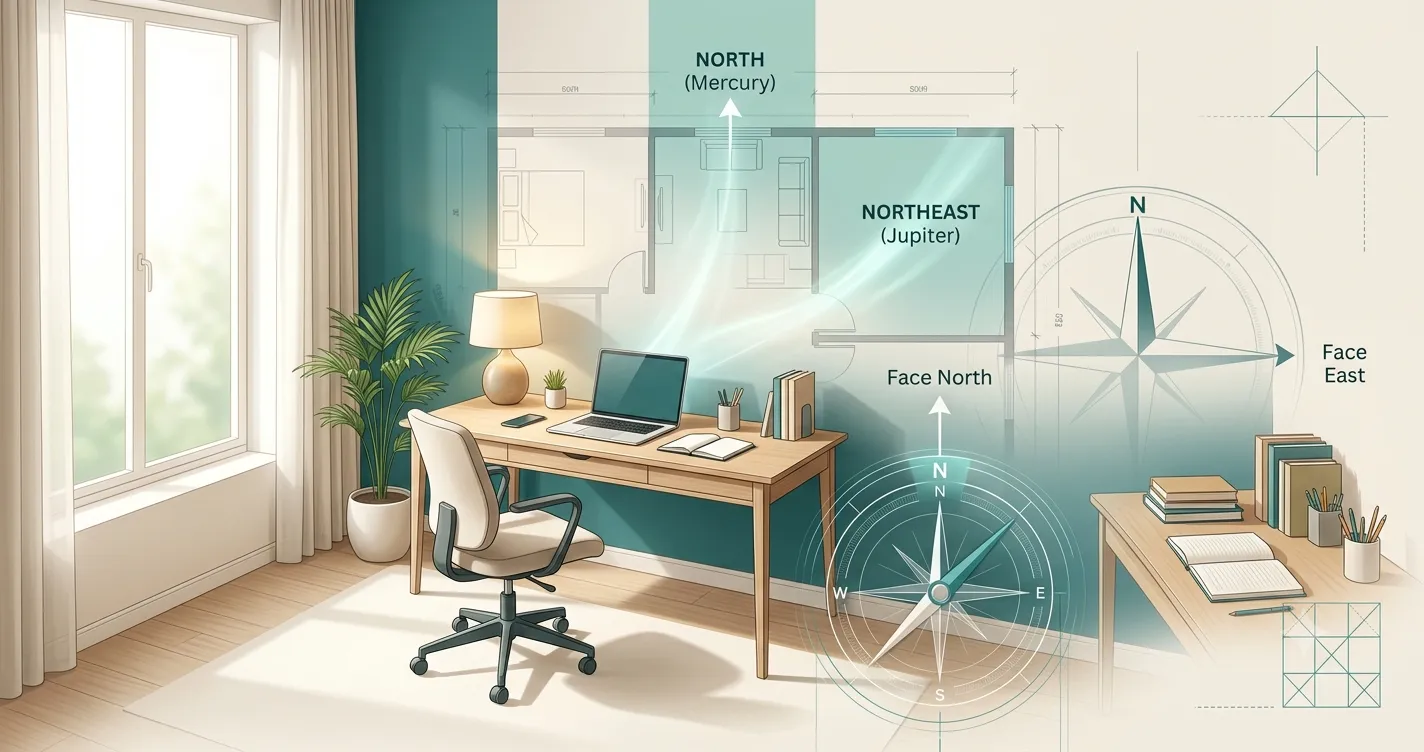
The good news is that Vastu Shastra’s directional logic applies to workspaces as precisely as it applies to bedrooms and kitchens. The north direction is Mercury’s domain — the planet of intelligence, commerce and communication. The northeast is Jupiter’s zone — wisdom, learning and discernment. The east is the sun’s direction — clarity, energy and new beginnings. These three directions provide the strongest possible Vastu foundation for any work or study space. This guide tells you exactly how to use them — and what to do when your home office is already fixed in a different zone.
The Correct Zone for a Home Office or Study Room
Unlike the kitchen (always southeast) or pooja room (always northeast), the home office and study room share two strong zone options — each suited to a different type of work. Choosing between them depends on whether your primary work is commercial or intellectual.
| Zone | Element / Planet | Best for | VastuIQ Zone Score |
|---|---|---|---|
| North | Water / Mercury | Business, commerce, sales, financial work, client communication | 88/100 |
| Northeast | Water + Space / Jupiter | Study, research, writing, teaching, creative intellectual work | 85/100 |
| East | Solar / Sun | Leadership, decision-making, professional authority roles | 80/100 |
| Northwest | Air / Moon | Acceptable — suits roles involving movement, networking, social media | 65/100 |
| West | Night Water / Saturn | Marginal — suits patient, detail-oriented, administrative work | 58/100 |
| Southeast | Fire / Venus | Avoid — fire zone disrupts sustained intellectual focus | 38/100 |
| South | Fire / Mars | Avoid — activating energy disrupts concentration and patience | 35/100 |
| Southwest | Earth / Rahu | Avoid — earth zone suppresses mental agility and creative flow | 30/100 |
Practical guidance: If your work is primarily commercial — business development, sales, finance, trading, client management — the north zone is your strongest option. North is Mercury’s direction, and Mercury governs commerce, communication and financial intelligence. If your work is primarily intellectual — writing, research, teaching, studying, programming, design — the northeast is slightly stronger because Jupiter’s wisdom energy directly supports the quality of concentrated, discerning thought that intellectual work requires.
For students and children, northeast is always preferred over north. Jupiter governs learning and scholarship in classical Vastu — a study room in the northeast zone is the most educationally supportive placement available.
Classical reference: Manasara (Chapter 7) describes the “vidya griha” (learning room) as ideally placed in the northeast, associating the Ishaan zone with “prajna” — discerning wisdom and intellectual clarity. The Brihat Samhita connects the north zone to “Budh” (Mercury) and describes it as the direction of commerce, communication and financial intelligence. These two distinct classical associations for north and northeast are the basis for the zone differentiation between commercial and intellectual workspaces described in this guide.
The Single Most Important Decision — Which Direction to Face While Working
Of all the home office Vastu factors, the direction you face while seated at your desk has the highest day-to-day impact. You spend hours in this position. The directional energy you are oriented toward during sustained intellectual and creative effort affects the quality of that effort — through concentration, decision clarity and the ease or difficulty of generating ideas.
Best facing directions while working: North or East
Facing north while working is the strongest position for most professional work. You are oriented directly toward Kubera’s wealth direction and Mercury’s intelligence direction. Your back is to the south — which classical Vastu considers a stable, supportive backing position (Yama’s consolidating energy behind you). Ideas flow more freely, commercial decisions feel clearer and communication tasks feel less effortful from this position. This is the most consistently recommended working direction across all classical and modern Vastu treatments.
Facing east while working is the strongest position for leadership, authority-based decisions and creative work requiring energy and inspiration. The morning solar energy entering from the east supports active, expansive thinking. East-facing work is particularly strong for entrepreneurs, managers and anyone whose work requires presenting, persuading or leading others. For students, east-facing study is specifically prescribed in the Manasara — solar energy supporting the activation of new learning.
Acceptable facing directions: Northeast and West
Facing northeast combines north and east energy and is excellent for research, writing and analytical work requiring both logical rigour and creative synthesis. The slight disadvantage compared to pure north or east is that northeast-facing positions often place the desk in the corner of a room, which can create spatial constraints — but where the layout allows it, northeast-facing is a strong working position.
Facing west is acceptable for administrative, detail-oriented and review-based work — the kind of work that requires patience and thoroughness rather than creative generation. Facing west while working means your back is to the east, which is not ideal for highly energetic or creative tasks but suits sustained, methodical work.
Avoid these facing directions while working
Facing south while working places your back to the north — turning away from Kubera’s wealth and Mercury’s intelligence simultaneously. This is the most consistently identified problematic working orientation in classical Vastu. South-facing work positions are associated with impaired decision quality, mental fatigue and reduced professional effectiveness.
Facing southwest while working orients the worker toward the earth element’s heavy, grounding energy — which supports rest and consolidation, not active intellectual or commercial work. Sustained south-west facing work is associated with mental heaviness and difficulty generating momentum.
Desk Placement Rules
Beyond the direction you face, where the desk is physically positioned in the room carries its own Vastu significance.
Desk against the south or west wall — preferred
The desk should ideally be placed against the south or west wall of the room, with the worker facing north or east respectively. This positions the heaviest furniture element (the desk, usually) in the more stable, grounded zones of the room — south and west — while keeping the north and east zones of the room open and energetically clear. The north and east zones in a workspace should be as open and uncluttered as possible.
Never face a wall directly while working
A desk pushed flush against a wall so that the worker sits with their nose 30 centimetres from the wall while working is a common compact-home arrangement that Vastu consistently flags as problematic. The wall directly in front creates an energetic dead end — there is no forward space for ideas and vision to expand into. If the room’s dimensions require the desk against a wall, ensure there is at least a window, a mirror or meaningful artwork directly in front to provide visual and energetic depth.
Avoid sitting with your back to the door
A worker seated with their back to the room’s entrance door is in a position of energetic vulnerability — the primary energy entry point of the room is behind them, outside their awareness. This is associated with a sense of being caught off-guard, difficulty concentrating, and a persistent low-level alertness that interferes with deep focus. If the room’s layout makes a back-to-door position unavoidable, place a mirror on the wall in front of the desk so the door is reflected and visible from the seated position — this is a widely used and classically supported partial remedy.
What should be behind you while working
The wall or element behind the worker’s back should be solid, stable and supportive. The best backing while working is a solid wall — not a window, not an open bookshelf, not a glass partition. A solid wall at your back provides the “support” energy that classical Vastu describes as essential for sustained professional effort. A window directly behind the seated worker is specifically flagged as a concentration-disrupting configuration — it places the worker’s back toward open, outward-moving energy rather than solid, inward-supporting energy.
Want to know if your home office is in the right zone? VastuIQ’s AI Floor Plan Analyzer maps all eight directional zones of your home and scores every room — including your study or home office — against classical placement rules. Check your home free at vastuiq.com
Study Room Vastu for Children and Students
The study room for a child or student has specific Vastu requirements that differ slightly from those of an adult home office — because the primary function is learning retention and concentration rather than professional productivity.
Zone: Northeast or North
Northeast is the classical first choice for a children’s study room. Jupiter’s wisdom energy in the Ishaan zone is specifically associated with educational progress, memory retention and examination performance in classical texts. North is the second choice — Mercury’s intelligence direction supports learning as well as commerce.
Facing direction: East for students
East-facing study is the most consistently prescribed student position across classical Vastu sources. Morning solar energy entering from the east activates new learning and supports the absorption of new information. The Manasara specifically prescribes the “Purva disha” (east direction) for students and those engaged in study. Where east-facing is not possible in the room’s layout, north-facing is the next best option.
Study table position: Against the south or west wall
The study table should be against the south or west wall, with the student facing east or north respectively. Ensure the student is not sitting under a beam — a structural beam running directly above a study position is associated with mental pressure and concentration difficulty. A false ceiling or fabric canopy below the beam is the common remedy where relocation is not possible.
No bed in direct line of sight from the study table
A bed visible from the study position — particularly if the study table and bed are in the same room — is consistently associated with difficulty sustaining study focus. The bed’s rest energy competes with the table’s active-study energy. Where both must be in the same room, position the table so the bed is not in the direct forward line of sight while seated, and use a bookshelf or curtain as a visual separator between the two zones.
Colours and Lighting for the Home Office and Study Room
Best wall colours by zone
| Room Zone | Best Wall Colour | Why | Avoid |
|---|---|---|---|
| North zone | Light green, sea green | Mercury’s colour — enhances commercial intelligence and communication | Red, dark orange |
| Northeast zone | White, cream, light yellow | Jupiter’s clarity colours — enhance focus and wisdom energy | Dark colours, black |
| East zone | Light orange, saffron, warm cream | Solar colours — enhance energy, leadership and inspiration | Blue, black |
| Northwest zone | White, off-white, light grey | Air element — keeps the mind fresh and mobile | Heavy dark tones |
For study rooms specifically, white or very light yellow is the most universally recommended colour regardless of zone — these tones create the visual and mental spaciousness that sustained studying requires. Bright, saturated or dark wall colours in a study room are consistently associated with mental restlessness and difficulty settling into deep focus.
Lighting
The home office and study room should be the most brightly lit functional rooms in the home after the entrance area. Specific guidance:
- Natural light from the north or east is ideal — morning east light activates energy, ambient north light provides steady, non-distracting illumination throughout the day.
- Avoid working with a window directly behind the screen — the contrast between a bright window and a screen creates eye strain and disrupts concentration. The window should be to the side — ideally the left side — of the work position.
- Task lighting should be warm white (3000–3500K) — cool blue-toned lighting (5000K+) increases alertness in the short term but creates fatigue over sustained work sessions. Warm white provides adequate illumination without the cortisol-activating effect of blue-spectrum light during long working hours.
- No overhead light directly above the head while working — a single overhead light positioned exactly above the seated worker’s head creates downward pressure energy. Offset the primary light source to illuminate the work surface rather than the crown of the head.
What to Keep and What to Avoid in the Home Office
Keep in the home office
- A small green plant in the north corner of the room — Mercury’s green energy for commercial and communication work. Money plant or any healthy leafy green plant.
- A Saraswati image or idol in the northeast corner of the study room — Saraswati governs learning, knowledge and skill. Her presence in the wisdom zone of the study room is the most classically aligned sacred element for educational spaces.
- A crystal or glass paperweight on the desk — clear quartz or glass objects on the north or northeast corner of the desk amplify the water-element clarity energy of these zones.
- Clutter-free desk surface — a clear desk with only current work items visible supports the mental spaciousness that productive work requires. The Vastu principle of keeping work zones free of stagnant, unprocessed material directly supports the modern understanding of how physical environment affects cognitive performance.
Avoid in the home office
- No mirror directly facing the desk — a mirror that reflects the worker while seated is associated with doubled mental effort and difficulty making firm decisions. Mirrors in the home office should be on the north or east wall, angled to reflect the room rather than the worker directly.
- No religious idols or pooja items on the work desk — sacred items belong in the northeast pooja corner, not on the commercial work surface. Mixing the sacred and commercial energy on the same surface is considered to weaken both.
- No water features directly behind the seated position — water features in the home office belong in the north zone of the room, not behind the worker’s back. Water energy behind the seated position creates instability rather than flow.
- No bills, unpaid invoices or financial stress paperwork visible from the primary work position — unresolved financial items in the visual field during work suppress the clear, forward-moving energy that productive work requires. File or remove these from the desk surface during working hours.
Worked Example — Home Office Assessment
2BHK East-Facing Flat, Mumbai — Home Office in Northwest Zone
Home office located in northwest zone (air element — acceptable). Desk placed against the south wall, worker facing north — correct facing direction. North wall of the room has a small window kept clear — north energy intake open. Green plant in north corner of room. White walls. Good natural light from west-facing window to the right of the seated position.
Home Office Zone Score: 68/100 — Acceptable
Northwest zone is not the ideal zone for a commercial home office (north would score 88/100) but the correct facing direction (north) compensates significantly. The clear north wall, green plant and correct desk position produce a workspace that functions well despite not being in the strongest zone. Primary improvement available: relocate the home office to the north zone of the flat if a room swap is possible.
Frequently Asked Questions — Vastu for Home Office and Study Room
Which direction should I face while working from home according to Vastu?
North is the strongest facing direction for most professional work — it orients you toward Kubera’s wealth direction and Mercury’s commercial intelligence, with the stable south energy supporting you from behind. East is the strongest direction for creative, leadership and student work — solar energy activates inspiration and new learning. Avoid south-facing work positions — they turn your back on both wealth and intelligence directions simultaneously and are consistently associated with reduced professional effectiveness and decision quality.
Which room is best for a home office according to Vastu?
The north zone is ideal for commercial, business and financial work. The northeast zone is ideal for intellectual, research and study-based work. The east zone works well for leadership and decision-making roles. Avoid placing a home office in the southwest zone — the earth element’s heavy, grounding energy suppresses the mental agility and creative flow that productive work requires. If your home office is already fixed in a non-ideal zone, the correct facing direction while seated compensates significantly for the zone’s limitations.
Is it good to work facing north according to Vastu?
Yes — facing north while working is the most consistently recommended working position across classical Vastu sources. North is Mercury’s direction, governing intelligence, communication and commerce. Facing north while working orients your mental and professional energy toward the direction that classical texts associate with career success, financial gain and effective communication. The backed-by-south position this creates — solid Yama energy supporting from behind — adds a quality of stability and authority to the work posture.
Can I have my study table in the bedroom according to Vastu?
Yes — a study table in the bedroom is acceptable and is one of the most common compact-home arrangements in India. The key rules: place the table against the south or west wall with the student facing east or north, ensure the bed is not in the direct forward line of sight from the study position, and use a bookshelf or visual separator between the study and sleep zones if possible. A study table in the southwest corner of the bedroom facing northeast is one of the strongest compact bedroom-study configurations — it uses the desk’s weight to reinforce the SW zone while providing a northeast-facing study position.
What colour is best for a study room according to Vastu?
White or very light yellow are the most universally recommended study room colours — these tones create mental spaciousness and support the clarity and focus that sustained study requires. For study rooms in the north zone, light green reinforces Mercury’s intelligence energy. For northeast zone study rooms, white or cream reinforces Jupiter’s wisdom energy. Avoid bright saturated colours (electric blue, bright orange, strong red) as primary wall colours in study rooms — they activate rather than focus mental energy, creating restlessness rather than sustained concentration.
Related Vastu Guides
Vastu for Living Room — Furniture, TV and Sofa Direction — if your home office shares space with the living room, this guide covers the zone and placement rules for both functions in a shared space.
Vastu Colours for Home — Room-by-Room Colour Guide — the complete colour guide covering north and northeast zone colour prescriptions in detail, with the elemental logic behind each recommendation.
21 Vastu Remedies Without Renovation — remedies for home offices already fixed in less-than-ideal zones, including mirror placement, plant placement and desk orientation corrections.
Vastu Dosh — Common Defects, Symptoms and Remedies — if your home office occupies the northeast zone and displaces the pooja room or living area, this guide covers the zone conflict severity and remedy options.
Apply This to Your Own Property
Free AI Vastu analysis — room-by-room scores, geo-adaptive for India, UK, UAE and 50+ countries. Detailed report from ₹99.