
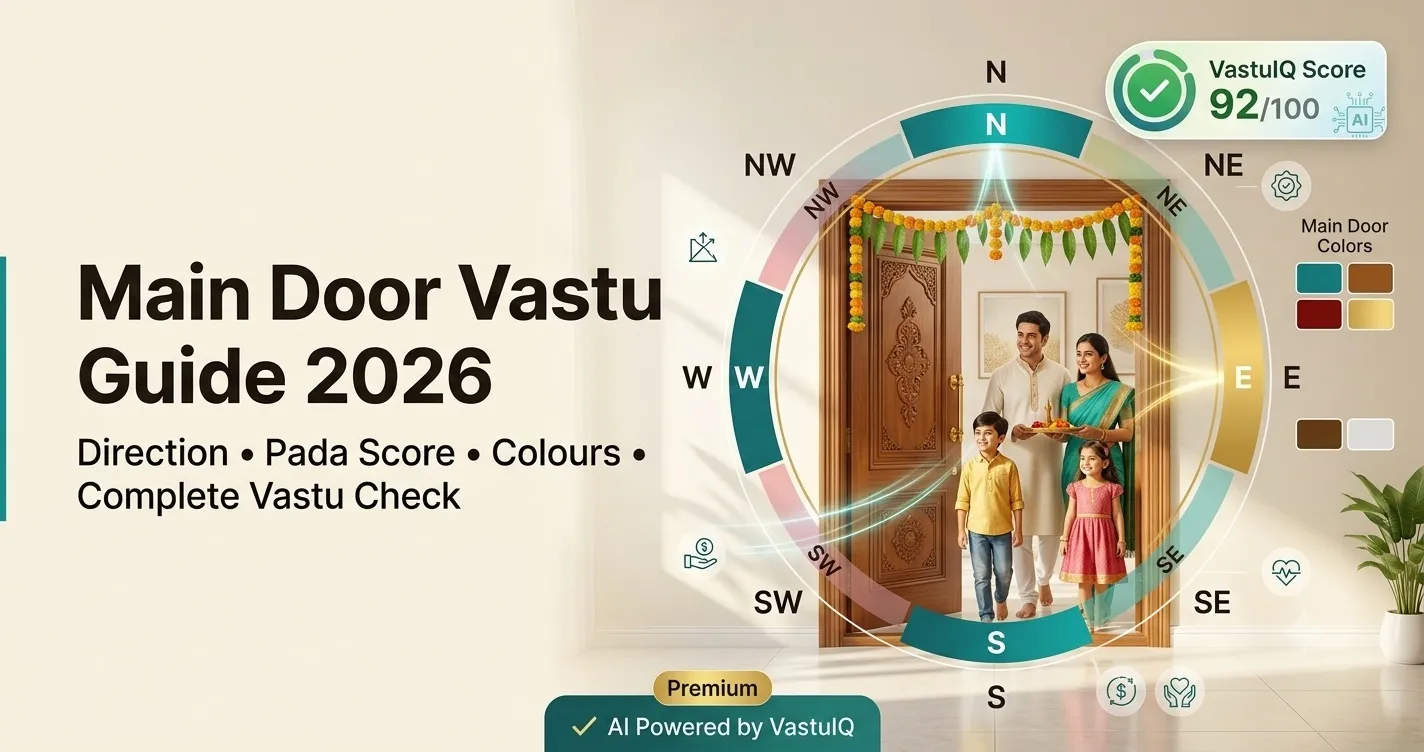
In Vastu Shastra, the main door is the most important single element in any home. Not the bedroom. Not the kitchen. Not the facing direction alone. The main door — its direction, its position within that direction, its colour, its material and its condition — determines how energy enters your home every single day.
Get it right and the home works with you. Get it wrong and no amount of interior arrangement fully compensates. This guide covers everything — direction scores, pada positions for all four walls, correct colour by direction, material rules, height, threshold, toran, nameplate and the remedies available when the door cannot be moved.
Main Door Vastu Quick Score — Check Your Entrance in 60 Seconds
Before reading the full guide, run this quick diagnostic. Find your facing direction and approximate door position in the table below to get your estimated Directional Compliance score. For the exact pada calculation see Section 3.
| Facing Direction | Door Position on Wall | Pada Zone | VastuIQ Score | Verdict |
|---|---|---|---|---|
| North | Centre of north wall | Pada 4–5 (Soma / Bhallat) | 88–92/100 | ⭐ Excellent |
| North | Right side of north wall (NE end) | Pada 7–8 (Mukhya) | 76–80/100 | ✓ Good |
| North | Left side of north wall (NW end) | Pada 1–2 (Roga) | 24–32/100 | ✗ Defect |
| East | Centre of east wall | Pada 4–5 (Jayanta / Aditya) | 88–92/100 | ⭐ Excellent |
| East | Left side of east wall (SE end) | Pada 1–2 (Vitatha / Gruhakshata) | 36–44/100 | ✗ Defect |
| South | Centre of south wall | Pada 4–5 (Vitatha / Pushpdant) | 74–78/100 | ✓ Good |
| South | Right side of south wall (SW end) | Pada 1 (Pitru) | 22–28/100 | ✗ Severe defect |
| South | Left side of south wall (SE end) | Pada 9 (Rogah) | 22–26/100 | ✗ Severe defect |
| West | Centre of west wall | Pada 5–6 (Sugriva / Pushpdant) | 78–84/100 | ⭐ Excellent |
| West | Right side of west wall (SW end) | Pada 8–9 (Asura / Shosha) | 30–38/100 | ✗ Defect |
| West | Left side of west wall (NW end) | Pada 1 (Roga) | 22–26/100 | ✗ Severe defect |
Key insight from this table: Your facing direction is not your Vastu score. A south-facing door in Pada 4 (74–78/100) outscores a north-facing door in Pada 1 (24–32/100). The position of the door within the wall — the pada — determines the actual outcome. This is the single most important fact in main door Vastu and the one most commonly ignored by homebuyers who simply check the facing direction and stop there.
Why the Main Door Is the Most Important Vastu Factor in Any Home
Classical Vastu texts use a consistent metaphor for the main entrance: “mukha” — the mouth of the home. Just as the human body receives its primary nourishment through the mouth, the home receives its primary energy through the main door. Every other Vastu factor in the property — bedroom zone, kitchen placement, brahmasthan openness — operates on the energy that enters through this single point.
This is why VastuIQ’s scoring model weights the entrance pada at approximately 45–50% of the total Directional Compliance score. A home with perfect room placement, correct colours and an open northeast zone, but with the main entrance in the Pitru pada (south wall, Pada 1), will score significantly lower than a home with several room placement issues but a strong entrance pada. The entrance is not one factor among many — it is the primary factor that determines the quality of everything that follows inside.
Classical reference: Manasara (Chapter 9, “Dwar Lakshana” — characteristics of the entrance) states: “Dwarasya sthiti eva grihasya prana pravesh niyamaka” — “The position of the entrance alone determines the regulation of life-force entry into the home.” The Brihat Samhita (Chapter 53) dedicates more text to the entrance than to any other single architectural element, listing specific pada positions and their consequences across all four walls. The Mayamata (Chapter 7) names the main entrance as “griha mukha” — the home’s face — and prescribes that it be neither in the corners of the wall nor in the extreme ends.
The Complete Pada System for Main Door — All Four Walls Scored
Each of the four walls is divided into 9 equal padas (divisions), counted from a specific starting corner. The pada your main door’s centre falls in determines your Directional Compliance score. This is the technical core of main door Vastu — and the section that separates a genuine Vastu assessment from a generic direction check.
How to calculate your main door pada (step by step)
- Measure the interior width of your entrance wall — corner to corner.
- Divide by 9. This is your pada width.
- Find the correct starting corner for your wall:
- North wall: start from the Northeast corner, count toward Northwest
- South wall: start from the Southwest corner, count toward Southeast
- East wall: start from the Southeast corner, count toward Northeast
- West wall: start from the Northwest corner, count toward Southwest
- Measure from the starting corner to the centre of your main door.
- Divide by pada width and round up to get your pada number.
Quick example: East-facing home. East wall = 18 feet. Each pada = 18 ÷ 9 = 2 feet. Door centre is 8 feet from SE corner. 8 ÷ 2 = 4. Pada 4 = Jayanta zone = 92/100. Excellent result.
For the complete worked examples across all four walls with a full scoring table for all 36 pada positions, see our dedicated Pada System Complete Guide.
The best and worst pada positions — all four walls
| Wall | Best Pada(s) | Deity / Energy | Score | Worst Pada(s) | Score |
|---|---|---|---|---|---|
| North | 4–5 (Soma, Bhallat) | Kubera wealth zone | 88–92/100 | 1 (Roga) | 22/100 |
| East | 4–5 (Jayanta, Aditya) | Indra solar zone | 88–92/100 | 2 (Gruhakshata), 8 (Rajayakshma) | 28–36/100 |
| South | 4 (Vitatha) | Dharma, stability | 74–78/100 | 1 (Pitru), 9 (Rogah) | 22–28/100 |
| West | 5–6 (Sugriva, Pushpdant) | Commerce, abundance | 78–84/100 | 1 (Roga), 9 (Shosha) | 22–34/100 |
Universal rule across all four walls: The extreme corners — Padas 1 and 9 on every wall — are the weakest entrance positions regardless of facing direction. The centre zone (Padas 4–6) consistently produces the strongest scores. When buying a property or planning new construction, always target the centre zone of the entrance wall for the main door.
Not sure which pada your main door falls in? VastuIQ’s free Vastu calculator identifies your exact pada and Directional Compliance score from your facing direction and door position — in under 2 minutes, no registration needed. Check your main door score free at vastuiq.com
Main Door Colour as per Vastu — Complete Direction-Wise Guide
The colour of your main door is one of the highest-impact, lowest-cost Vastu improvements available in any home. It takes one afternoon and a tin of paint. Classical Vastu texts prescribe specific colours for each direction based on the elemental and planetary correspondence of that wall. The colour reinforces the directional energy at the threshold — the boundary point where outside energy first meets the home.
| Door Facing Direction | Best Colour(s) | Acceptable | Avoid | Elemental Reason |
|---|---|---|---|---|
| North | Green, dark green, forest green | Blue-green, teal, sage | Red, bright orange, maroon | Mercury / water element — green amplifies Kubera’s wealth direction |
| Northeast | Yellow, cream, light gold | White, light orange, pale saffron | Black, dark blue, dark grey | Jupiter / space element — clarity and divine energy tones |
| East | Saffron, orange, golden yellow | Warm white, copper bronze | Blue, black, deep grey | Sun / solar fire — sunrise colours aligned with Indra’s energy |
| Southeast | Orange-red, coral, terracotta | Brick red, warm copper | Blue, dark green, white | Venus / fire element — Agni corner colours strengthen the fire zone |
| South | Red, maroon, deep terracotta | Dark coral, brick red | Blue, black, pure white | Mars / fire — Yama and Mars energy reinforced by Mars-red spectrum |
| Southwest | Beige, warm brown, earthy ochre | Sandy yellow, light terracotta | Bright blue, black, white | Rahu / earth element — stability colours for the earth zone |
| West | Navy blue, indigo, deep blue-grey | Silver-grey, slate blue | Bright red, orange, yellow | Saturn / water (night) — Varuna’s colours of depth and patience |
| Northwest | White, off-white, silver-white | Light grey, cream | Dark heavy tones, black | Moon / air element — lunar clarity and air-element lightness |
Important note on south-facing doors and red: A common hesitation is painting a south-facing main door red because of the direction’s reputation. This hesitation reverses the correct logic. The south wall is governed by Mars — red is Mars’s colour. Painting the south-facing door in the correct Mars-red spectrum is precisely how classical Vastu addresses south-facing entrances — the colour reinforces the directional correspondence and acts as an elemental alignment at the threshold. A south-facing door painted blue or black introduces an elemental conflict (water and void colours on a fire-direction wall) that compounds any defect in the pada position.
Main Door Direction — The Complete Verdict for All 8 Directions
Beyond pada position, the overall facing direction of the main door creates a baseline energy profile for the home. Here is the complete classical verdict:
North-facing main door — Kubera’s wealth direction
North is governed by Kubera (lord of wealth) and Mercury (commerce and intelligence). A north-facing main door in the correct pada zone (Padas 4–5) is one of the two strongest entrance configurations in Vastu, scoring 88–92/100. The north entrance channels financial opportunity and commercial intelligence directly into the home. Best for: professionals, business owners, anyone with wealth accumulation as a primary household goal. Key rule: keep the north compound wall lower than the south wall — the north face must remain as open and accessible as structurally possible.
East-facing main door — Indra’s solar vitality
East is governed by Indra (king of the devas, lord of health and vitality) and the Sun. An east-facing main door in Padas 4–5 (Jayanta and Aditya) is the highest-scoring entrance configuration in VastuIQ’s model at 88–92/100 — tied with the best north entrance positions. Morning solar energy enters through the east entrance, charging the home with prana at the most energetically potent time of day. Best for: families with children and students, health-focused households, those in reputation-dependent professions. For the complete east-facing guide see our East Facing House Vastu Guide.
South-facing main door — misunderstood, not inauspicious
South is governed by Yama (lord of dharma and justice) and Mars. A south-facing door is not inherently bad — it is pada-dependent. In Pada 4 (Vitatha — dharma energy), a south-facing entrance scores 74–78/100 — a strong result. In Pada 1 (Pitru — ancestral debt energy), it scores 22–28/100 — a severe defect. The south-facing direction suits: business owners, lawyers, administrators and those in authority-based professions where Yama’s discipline energy is professionally aligned. The fear of south-facing homes is a misreading of Vastu — the pada position, not the direction, determines the outcome. See our South Facing House Vastu Guide for the complete analysis.
West-facing main door — Varuna’s patient prosperity
West is governed by Varuna (cosmic order and patience) and Saturn. A west-facing door in Padas 5–6 (Sugriva and Pushpdant — commerce and abundance) scores 78–84/100 — one of the strongest commerce and trade entrada configurations. West-facing entrances suit: traders, business families, government employees and those whose wealth comes from patient, consistent effort. Most undervalued entrance direction in Indian real estate — west-facing properties are systematically underpriced because of directional fear, not because of actual Vastu defects in the correct pada zone. See our West Facing House Vastu Guide.
Northeast-facing main door — spiritually strongest
Northeast is the Ishaan zone — the most spiritually potent corner of the Vastu Purusha Mandala. An entrance in the northeast is considered the most auspicious single position across all classical texts, specifically for homes oriented toward spiritual practice, education and family harmony. However, in apartment buildings the northeast entrance is rare — most northeast-facing flat doors open onto internal corridors.
Southeast, Southwest and Northwest-facing main doors
These diagonal directions are generally avoided for main entrances in classical Vastu. Southeast (Agni corner) creates an aggressive fire-energy entrance. Southwest (Nairutya) is the most consistently flagged problematic entrance in classical texts — it is the earth zone, and an entrance here causes energy to drain from the home’s most stabilising corner. Northwest is mixed — acceptable for guests and movement-oriented occupants but not ideal for the primary household entrance.
Main Door Material, Size and Height — Classical Rules
Material — wood first, always
Wood is the universally prescribed material for the main door in classical Vastu. The Manasara specifically lists teak (sagwan), neem and sandalwood as the highest-quality door materials. Wood carries the earth element’s stability and the living-material quality of trees — it is considered an active, prana-positive material. Modern alternatives:
- Teak wood: Best material — dense, stable, long-lasting, correct elemental quality. Premium but worth the investment for the most Vastu-important door in the home.
- Solid wood (pine, oak, sheesham): All acceptable — same principle applies. Solid wood over veneer always preferred.
- WPC (Wood Polymer Composite): Acceptable as a modern alternative — carries some wood-element quality and is more durable than pure wood in humid conditions.
- Full metal doors: Avoid for the main entrance. Metal disrupts the natural energy flow at the threshold in classical Vastu. Metal accents, handles, knockers and hinges are fine — a full metal door is not.
- Full glass doors: Avoid for the main entrance. Glass does not provide the threshold-energy filter that wood provides — it creates an excessively open boundary with no energetic containment. Frosted or partially glazed wooden doors are acceptable.
- PVC or plastic doors: Not recommended — synthetic materials carry no elemental quality and are specifically flagged in modern Vastu assessments as energy-neutral at best.
Size — main door must be the largest door in the home
Classical Vastu prescribes that the main entrance door be taller and wider than every other door in the home. This is both an energetic and a practical principle — the primary prana intake point of the home should be its most generous opening. Standard Indian apartment doors are 7 feet × 3 feet. Where structurally possible, a main door of 7.5 to 8 feet height and 3.5 feet width is the classical recommendation.
If changing the door size in an existing apartment is not feasible, compensate visually and energetically by: adding a decorative door frame surround that extends above the door lintel, placing a toran above the frame that draws the eye upward, and ensuring the entrance area is more grandly finished than any other door in the home — better material, better hardware, better lighting.
Opening direction — always inward
The main door must open inward — into the home — not outward onto the street or corridor. A door that opens outward is considered to push energy away from the home at the point of entry rather than welcoming it in. This is one of the most universally consistent rules across all classical Vastu texts and is also aligned with building safety codes in most Indian states.
Single vs double door
A double-leaf (two-panel) main door is preferred over a single-leaf door in classical Vastu, specifically because it provides a more generous opening width that maximises prana entry. Where a double door is not structurally possible, a single door with decorative side panels or fixed sidelights achieves a similar energetic effect visually and functionally.
Main Door Threshold — The Dehleez Rules
The threshold — “dehleez” or “dehri” in Hindi — is the strip of material at the base of the main door that separates the inside of the home from the outside. Classical Vastu prescribes a raised threshold for the main entrance, with specific material recommendations:
- Height: The threshold should be raised 2 to 4 inches above floor level. This physical step creates an energetic filter — slowing external energy and requiring a deliberate step over the boundary. The Manasara specifically prescribes a raised threshold for all main entrances.
- Material: Marble, granite or teak wood are the preferred threshold materials. Stone thresholds are considered more grounding and permanent — the earth element at the boundary point. Metal thresholds are acceptable for structural purposes but not as the primary material.
- Direction-specific metal underlays: A thin metal strip beneath or within the threshold material can reinforce the directional energy. North entrance: copper underlay. South entrance: lead or iron underlay. East entrance: copper or brass underlay. West entrance: silver or stainless steel underlay. These are referenced in the Brihat Samhita as “dwar dhatu” (threshold metals) for directional energy reinforcement.
- Rangoli or kolam: A daily rangoli or kolam pattern at the threshold is one of the oldest Indian entrance practices and is specifically referenced in classical Vastu as a threshold purification practice. Beyond its cultural significance, it also signals that the threshold is actively maintained and tended — an energetic quality that compounds over time.
Toran, Nameplate, Lighting and Entrance Decor
Toran
A toran — the decorative hanging placed above the main door frame — is one of the most universally prescribed main door Vastu elements. Classical texts reference door decorations made of mango leaves, ashoka leaves and marigolds. The specific Vastu function of a toran is twofold: it marks the boundary of the entrance zone as auspicious and actively tended, and the plant material — particularly mango leaves — is believed to emit a purifying energy that cleans the prana entering the home.
Fresh leaf torans should be replaced regularly — dried, darkened or wilted torans are specifically noted in Vastu practice as reversing the protective effect they were placed to achieve. Brass or copper torans are a permanent alternative that require no replacement and carry the metal’s own directional energy quality.
Protective deity above the entrance
A protective deity image or idol above the main entrance — facing outward — is one of the most classically referenced main door Vastu elements:
- Ganesha facing outward: universal — removes obstacles at the threshold for all entrance directions
- Hanuman facing south: specifically for south-facing entrances — facing Yama’s direction as the primary protector
- Surya (sun symbol) above the door: for south-facing and southeast entrances — the brass sun disc is one of the most commonly recommended south-entrance remedies
- Swastika symbol: ancient Vastu protective symbol for all directions — placed in copper or brass above the door or on the door frame
Nameplate
The nameplate is the home’s identity at the threshold. Classical Vastu treats the nameplate as the entrance’s primary identity marker — it should be clearly visible, correctly spelled, in good condition and placed at eye level on the right side of the door (as you enter, the right side is the auspicious side). Material: wood, brass or copper nameplate is preferred over plastic or cheap metal. A nameplate that is faded, damaged or illegible is considered to weaken the home’s identity energy.
Entrance lighting
The main entrance area must be the most well-lit transition point in the home. A dark entrance — whether due to poor natural light, inadequate artificial lighting, or obstruction from trees and structures — is one of the most commonly identified Vastu defects in Indian homes. Classical principle: light is prana. A dark threshold suppresses the prana entry at the home’s primary intake point. Practical rule: the entrance area should be brighter than any interior corridor or hallway it connects to. Warm white lighting (3000–3500K) is preferred over cool or blue-toned LED at the entrance — it creates a welcoming, energy-positive threshold quality.
What Not to Keep Near the Main Door
These are the most consistently cited main entrance Vastu prohibitions — items and conditions that block, drain or corrupt the prana entering through the main door:
- Shoe rack directly inside or immediately outside the main door: Footwear carries street-level energy — the dust, activity and external prana of the world outside. A shoe rack at the threshold introduces this external energy back into the home’s primary intake point. Keep shoes at least one room’s distance from the main door, or in a closed cabinet if space forces proximity.
- Dustbin near the main entrance: One of the most energetically damaging entrance conditions. Waste energy at the prana intake point suppresses every positive factor in the home’s Vastu. Remove immediately.
- Broken or damaged door: Squeaky hinges, cracked panels, peeling paint, a door that does not close fully — all are considered defects that indicate neglect of the home’s primary energy intake. The condition of the main door is a Vastu factor. A well-maintained, well-oiled, properly closing door signals prosperity; a neglected door weakens it.
- Clutter in the entrance area: Boxes, stored items, bicycles, construction materials — any permanent clutter in the space immediately inside or outside the main door restricts the free flow of prana from the threshold into the home’s interior.
- Mirror directly facing the main door: A mirror positioned so it reflects the main door is considered to push incoming energy back out before it can enter and settle inside the home. Mirrors in the entrance area should be on side walls, not directly facing the door.
- Toilet visible from or adjacent to the main door: The first visual from the entrance should not be a toilet door. Where the flat layout places a toilet near the entrance, a screen, curtain or tall plant between the entrance and the toilet door is the practical remedy.
Main Door Vastu for Apartments and Flats
Apartment Vastu for the main door has specific considerations that differ from independent houses:
The flat entrance is your relevant direction — not the building’s facing. In a multi-storey building, your individual flat’s main door direction is assessed independently of the building’s overall facing direction. Many flats in north-facing buildings have east or west-facing flat doors opening onto internal corridors. Use a compass app at your flat’s main door facing outward — that reading is your effective facing direction for Vastu assessment purposes.
The flat entrance door that faces a lift lobby: A main door directly facing a lift is considered to create an energy-draining configuration — the lift’s mechanical movement continuously draws energy away from the flat entrance. Remedy: a thick door curtain, a tall potted plant between the door and the lift lobby, and a toran above the door frame all help reduce this effect.
The flat entrance door that faces a staircase: A door opening directly toward a staircase — particularly one where the stairs descend immediately in front of the entrance — is considered to create downward-draining energy at the threshold. A physical screen, plant or level change between the door and the staircase reduces this effect.
Shared corridor entrances: Many apartment flat doors open onto shared corridors where maintaining a rangoli, toran and nameplate feels impractical. The recommendation: maintain at minimum a toran above the door frame, a Ganesha or Swastika on the door itself, and adequate lighting immediately outside the flat door. These three elements are fully compatible with corridor environments and respect shared space conventions.
Main Door Vastu Remedies — When the Door Cannot Be Moved
If your main door is in a defective pada position and structural relocation is not possible, these non-structural remedies reduce the defect’s severity:
- Correct directional door colour: The single highest-impact non-structural main door remedy. Paint the door in the correct colour for its facing direction (see colour table above). Takes one afternoon and costs a tin of paint. In VastuIQ’s model, applying the correct directional colour improves the entrance energy score by 8–12 points regardless of pada position.
- Direction-specific threshold metal: A thin copper, lead, iron or silver strip (depending on direction) embedded under the doormat or threshold. References: Brihat Samhita Chapter 53 “dwar dhatu” prescriptions. Direction-to-metal guide: North → copper; South → lead/iron; East → copper/brass; West → silver/steel.
- Protective deity above the entrance: Ganesha or direction-specific deity (Hanuman for south) placed above the door frame facing outward. Classical texts consistently cite this as the most universally applicable entrance protection across all pada positions.
- Raised threshold (dehleez): Adding or raising the threshold creates an energetic filter at the boundary point — slowing external energy and partially compensating for an incorrect pada position. Specifically prescribed in the Manasara for defective entrance positions.
- Bright entrance lighting: Light is prana. Maximum lighting at the entrance — including a permanently lit lamp or diya — is one of the most consistently referenced non-structural entrance remedies across classical texts. A dark entrance in a defective pada position compounds both defects.
- Fresh toran replaced regularly: A fresh mango or marigold toran at the entrance is the most accessible, lowest-cost, most frequently cited classical remedy for entrance purification. Its effect is maintenance-dependent — a fresh toran is beneficial; a dried, darkened toran is not.
Frequently Asked Questions — Main Door Vastu
Which direction is best for main door as per Vastu?
North and east facing main doors in the correct pada position (Padas 4–5 on both walls) produce the highest scores in VastuIQ’s model at 88–92/100 — the strongest entrance configurations available. However, the facing direction alone does not determine the Vastu outcome — the pada position within that direction is the deciding factor. A north-facing door in Pada 1 (Roga zone) scores 22/100 — worse than a south-facing door in Pada 4 (Vitatha zone) at 74–78/100. Always check both the direction and the pada position before assessing a main door.
What colour should the main door be as per Vastu?
The correct main door colour depends on the facing direction: green for north, saffron or orange for east, red or maroon for south, navy blue or indigo for west, yellow or cream for northeast, beige or earthy brown for southwest, white or off-white for northwest. These colours correspond to the planetary and elemental energy of each direction and reinforce the threshold’s directional correspondence. Applying the correct directional colour is the single highest-impact, lowest-cost main door Vastu improvement available — it takes one afternoon and significantly improves the entrance energy quality regardless of pada position.
Is south-facing main door good or bad in Vastu?
South-facing is not universally bad — it is pada-dependent. A south-facing main door in Pada 4 (Vitatha — dharma and stability energy) scores 74–78/100 on VastuIQ’s model — a strong result and better than many north or east-facing doors in poor pada positions. The same south-facing door in Pada 1 (Pitru — ancestral debt energy) scores 22–28/100 — a severe defect. The direction creates the context; the pada determines the actual outcome. South-facing is a manageable direction when the pada is correct — our South Facing House Vastu Guide covers this in full detail.
What should not be kept near the main door as per Vastu?
The most important prohibitions near the main door: shoe racks immediately at or inside the entrance (carry street-level energy), dustbins or waste receptacles near the entrance (waste energy at the prana intake point), mirrors directly facing the main door (push incoming energy back out), broken or neglected door hardware (neglect signals and compounds energy weakness), clutter immediately inside the entrance (restricts prana flow into the home interior), and toilets visible from the main door (introduce waste-zone energy at the primary entrance).
What material is best for the main door as per Vastu?
Solid wood — preferably teak — is the universally prescribed main door material in classical Vastu texts. Wood carries the earth element’s stability and the living-material quality of trees. Full metal doors are specifically avoided as they disrupt natural energy flow at the threshold. Full glass doors are also not recommended as they create an insufficiently filtered boundary. Metal accents, handles, knockers and decorative elements on a wooden door are fully acceptable and directionally beneficial when in the correct metal for the entrance direction.
How do I check if my flat’s main door is Vastu compliant?
Two steps: First, identify your flat door’s actual facing direction using a compass app — stand at your flat’s main door facing outward and note the compass reading. Second, identify your entrance pada using the measurement method in this guide or use VastuIQ’s free Vastu calculator which calculates your Directional Compliance score from your direction and door position in under 2 minutes. For a complete floor plan assessment including all rooms, zones and the Brahmasthan alongside your entrance, use VastuIQ’s AI Floor Plan Analyzer.
Related Vastu Guides
Pada in Vastu Shastra — How to Find Your Door’s Pada Position — the complete technical guide to calculating your exact pada number with worked examples for all four walls and the full 36-position scoring table.
South Facing House Vastu — Myths, Facts and Complete Guide — the dedicated guide for south-facing entrances covering all 9 south wall padas with individual scores and the complete south-entrance remedy system.
Vastu Dosh — Common Defects, Symptoms and Remedies — covers the Pitru pada and Roga pada entrance defects in detail, including severity scores, observable symptoms and the complete structural and non-structural remedy pathways.
21 Vastu Remedies Without Renovation — the complete non-structural remedy guide covering all six main door remedies (colour, threshold metal, deity, dehleez, lighting, toran) in full classical detail with material specifications.
Apply This to Your Own Property
Free AI Vastu analysis — room-by-room scores, geo-adaptive for India, UK, UAE and 50+ countries. Detailed report from ₹99.