
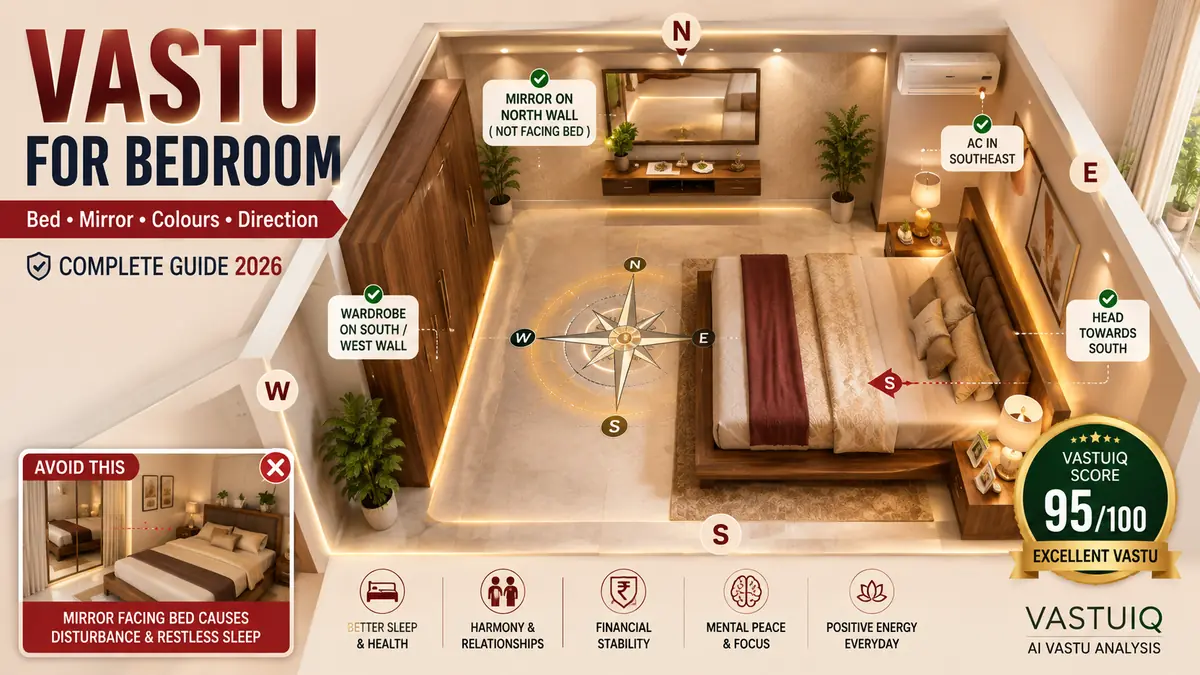
You spend approximately 8 hours every night in your bedroom — more than in any other room. One third of your entire life. During those 8 hours, you are lying still in a fixed position, facing a specific direction, absorbing the directional energy of the zone you are sleeping in, completely unfiltered by the movement, activity and conscious attention that moderates energy effects during waking hours. Vastu for bedroom is not the most spiritually significant application of Vastu Shastra — it is the most sustained, the most biologically direct and the most immediately correctable.
This guide covers every interior decision in the bedroom — which zone the room should occupy, bed placement on which wall, sleeping direction, the complete mirror rules, wardrobe placement, colours by direction, the TV in bedroom debate resolved with scores, AC and electronics placement, beam overhead remedies, attached bathroom impact and the specific rules for couples. Every recommendation is scored with VastuIQ data so you know not just what to do but how much each decision matters.
Master Bedroom Zone — Which Direction Is Best
Before any interior arrangement can be assessed, the most important bedroom Vastu decision is which zone of the home the bedroom occupies. This is the structural context within which all other improvements operate — and the factor most likely to be permanent once the home is constructed or purchased.
| Bedroom Zone | Best For | VastuIQ Score | Primary Effect | Verdict |
|---|---|---|---|---|
| Southwest (Nairutya) | Household head, married couple | 95/100 | Maximum authority, financial stability, relationship consolidation, deepest rest | ⭐ Best |
| South | Household head (if SW occupied) | 82/100 | Strong grounding, discipline, professional stability — excellent second choice | ✓ Excellent |
| West | Adults, professionals | 70/100 | Commerce and patience energy — suitable for businesspeople and traders | ✓ Good |
| Northwest | Unmarried adults, guests | 85/100 | Movement and social energy — excellent for guests (encourages timely departure), good for unmarried adults | ✓ Good for NW occupant type |
| North | Young children (with parent nearby) | 60/100 | Wealth direction but poor grounding — restless sleep for household heads | ◯ Acceptable for children |
| East | Students, young children | 65/100 | Solar vitality — active, learning-oriented energy; good for students, not ideal for rest | ◯ Acceptable for students |
| Southeast | Nobody ideally | 45/100 | Fire zone — reactivity, short-temperedness, heat-associated health issues | ⚠ Avoid if possible |
| Northeast | Nobody — sacred zone | 18/100 | Divine water zone — not appropriate for sleep; decisions instability, financial friction | ✗ Serious defect |
The southwest bedroom for the household head is the single highest-scoring room placement in VastuIQ’s entire model — 95/100. Earth element stability, maximum authority and relationship consolidation energy make it the ideal sleeping zone for the primary decision-maker and breadwinner. If you currently have the largest bedroom in the northeast or east because it has a better view or more floor space, changing to the southwest room — even if smaller — is the single highest-impact structural bedroom Vastu correction available.
For the complete family member room allocation guide covering all 9 person types across all 8 directions with worked 3BHK and 4BHK examples, see: Vastu Room Allocation for Family Members — Who Should Sleep Where?
Check your bedroom’s zone score. Use VastuIQ’s free Vastu Calculator — enter your home’s facing direction and get the complete directional compliance score including bedroom zone assessment in 2 minutes. Check free at vastuiq.com →
Bed Placement — Which Wall, Which Position in the Room
The sleeping direction (which way your head points) is one bedroom Vastu decision. The bed position within the room — which wall it rests against, how it is oriented relative to the door, windows and other furniture — is a separate and equally important set of decisions. Classical Vastu is specific about both.
Which wall should the bed headboard rest against
| Headboard Against | Head Points Toward | VastuIQ Score | Effect |
|---|---|---|---|
| South wall | South (head) — feet north | 92/100 | Best — magnetic alignment, deepest rest, authority, health |
| West wall | East (head) — feet west | 85/100 | Excellent for students and children — learning, clarity, morning vitality |
| East wall | West (head) — feet east | 62/100 | Moderate — acceptable, but west-head sleeping has mixed classical support |
| North wall | North (head) — feet south | 18/100 | Worst — magnetic misalignment, disrupted sleep, health issues over time |
Note: The above table assumes the bedroom is in the southwest zone. In other zones the ideal headboard wall shifts — the principle is always “head points south or east,” which means the headboard goes against the south or west wall of the room regardless of which zone the bedroom itself occupies.
Bed position rules — the 6 critical placements scored
| Bed Position | VastuIQ Score | Effect | Action |
|---|---|---|---|
| SW corner of room, headboard on south wall | 95/100 | Maximum earth element grounding at sleep position — ideal | Target this position |
| Headboard against solid wall, not facing door | 88/100 | Strong — psychological and energetic security from solid wall backing | Correct |
| Headboard against wall with window above | 58/100 | Window above headboard creates energy drain — prana exits during sleep | Relocate if possible; heavy curtains as partial remedy |
| Bed in centre of room — no wall contact | 32/100 | No grounding — floating energy creates restlessness, insecurity, relationship instability | Move against wall immediately |
| Bed under beam | 28/100 | Overhead structural pressure — mental heaviness, headaches, decision difficulty | Relocate or install false ceiling panel |
| Coffin position — feet pointing directly at door | 22/100 | Classical prohibition — “mrityu shayana” (death sleeping position) — severe sleep and health disruption | Rotate bed immediately — highest priority fix |
The coffin position explained: When the bed is positioned so the feet point directly at the open bedroom door — and the door aligns with the bed on the same axis — it replicates the classical Hindu funerary position where the deceased is carried feet-first through the door. Classical Vastu (Manasara, Chapter 17) specifically names this “dwara-pada shayana” as an inauspicious sleeping configuration associated with health decline and psychological unease. Modern sleep science partially corroborates this — the visual stimulus of the door opening on the foot axis creates a subconscious vigilance response that reduces sleep depth. This is the easiest bedroom defect to fix — rotate the bed 90 degrees so the feet no longer point at the door.
Essential bed placement rules
- Always against a solid wall: The headboard must rest against a solid, unperforated wall — not against a window, glass panel or curtained opening. The solid wall behind the sleeping person’s head provides what classical Vastu calls “pristha raksha” (back protection) — the energetic and psychological security of knowing there is something solid and protective behind you during sleep.
- Leave 2 to 3 inches from the wall: The headboard should not flush completely against the wall — a small gap (2 to 3 inches) allows air to circulate behind the sleeping area, preventing dampness and ensuring prana flows around the sleeping position rather than being compressed between the mattress and wall.
- Never in the room’s geometric centre: A bed placed in the exact centre of the bedroom occupies the room’s mini-Brahmasthan — the distribution point of that room’s energy. An occupied Brahmasthan creates the same elemental compression at the room scale that a blocked house Brahmasthan creates at the home scale.
- Never under a window: A window directly above the headboard allows the sleeping person’s head energy to exit through the opening at the most energetically vulnerable point of the sleep cycle. Minimum one meter clearance between window bottom and headboard top is the classical prescription.
Sleeping Direction — The Head Direction Reference
Sleeping direction is covered in full depth in the dedicated guide. Here is the essential reference:
- South-head: 92/100 — primary recommendation for all adults. Aligns body’s positive magnetic polarity with Earth’s south magnetic pull. Best for deep rest, authority and health.
- East-head: 85/100 — ideal for students and children. Morning solar energy, learning orientation, vitality.
- West-head: 62/100 — acceptable. Associated with vivid dreams; classically linked to wealth but less restful than south.
- North-head: 18/100 — strongly avoid. Positive poles repelling — associated with chronic health issues, sleep disruption and financial irregularity over time.
→ For the complete sleeping direction guide with person-type matching, the science basis and what to do when the bed cannot be repositioned: Best Sleeping Direction as per Vastu — South, East or West?
Mirror Rules — The Most Searched Bedroom Vastu Topic
Mirrors in the bedroom are the single most frequently searched bedroom Vastu question — and the one where competitor content is simultaneously most abundant and most incomplete. Every source says “don’t place mirrors facing the bed.” Very few explain why, where mirrors should go, what to do with dressing tables and how to handle the modern TV screen as a reflective surface. Here is the complete mirror guide.
Why mirrors facing the bed create a Vastu defect
Two converging explanations — classical and modern:
Classical Vastu basis: The Manasara describes a mirror as a “darpana” — a reflective energy amplifier. During sleep, the human body enters its most energetically receptive state — the protective barriers of conscious attention are lowered. A mirror facing the sleeping person reflects and amplifies the sleeper’s own energy back at themselves in an uncontrolled feedback loop. Classical practice describes this as “nidra prana virodha” — opposition to the life force during sleep. Specific symptoms associated with this defect: disturbed sleep, nightmare tendency, relationship friction between bed partners and morning fatigue despite adequate sleep hours.
Modern sleep science basis: A mirror facing the bed creates visual stimulation when the sleeper partially wakes during REM sleep. The reflected movement (the sleeper’s own) triggers a threat-detection response in the brain’s amygdala — a subconscious startle that prevents deep sleep completion. Multiple sleep studies have identified reflective surfaces in the sleep environment as a measurable factor in REM disruption. The Vastu and the neuroscience produce the same prescription through different reasoning.
Complete mirror placement scores
| Mirror Position | VastuIQ Score | Effect | Verdict |
|---|---|---|---|
| North wall of bedroom — does not face bed | 85/100 | Best bedroom mirror position — Kubera’s wealth direction; reflects light toward wealth zone | ⭐ Ideal |
| East wall of bedroom — does not face bed | 80/100 | Excellent — solar vitality direction; morning light reflected across bedroom | ⭐ Excellent |
| Inside wardrobe door — closed at night | 88/100 | Best practical solution — mirror fully functional, fully concealed during sleep | ⭐ Best practical |
| South wall — does not face bed | 62/100 | Acceptable — south wall mirror on lateral side of bed is not facing the sleeper | ◯ Acceptable |
| Covered with cloth at night | 72/100 | Good remedy for unavoidable facing mirror — covering eliminates the reflection defect | ✓ Remedy |
| Lateral wall beside the bed — does not face sleeper directly | 75/100 | Good — the mirror is present but not on the facing axis of the sleeping position | ✓ Acceptable |
| Directly facing the bed — any wall | 22/100 | Severe defect — cover or reposition immediately | ✗ Defect |
| On ceiling above bed | 12/100 | Extreme defect — overhead reflection during sleep is the most severe mirror defect | ✗ Severe |
The dressing table dilemma
The dressing table is the most common bedroom mirror problem in Indian homes — because it is a fixed piece of furniture that many modular bedroom designs place facing the bed as the focal wall element. The three solutions in priority order:
- Reposition the dressing table to the north or east wall — best solution. A dressing table on the north or east wall of the bedroom, with the mirror facing south or west respectively, does not face the bed and scores 80–85/100.
- Choose a dressing table with a hinged or closable mirror — the second-best solution. Close or angle the mirror away from the bed every evening. This is the most practical solution for fixed modular bedroom setups.
- Cover the mirror with a cloth or curtain at night — the minimum remedy. A cotton or linen cloth draped over the dressing table mirror from bedtime to morning eliminates the reflection defect entirely. Free, immediate and completely effective.
TV screen as a reflective surface
A switched-off television screen is a mirror. This is the most overlooked mirror defect in modern Indian bedrooms — a TV mounted on the wall facing the bed creates the same reflective surface defect as a dressing table mirror, particularly in the dark when the screen’s glass panel reflects the sleeping couple clearly. See H2 7 for the complete TV placement guide.
Wardrobe and Storage Placement
The wardrobe is the bedroom’s heaviest permanent furniture item. Its weight and earth-element quality must be matched to the zones that can support it — the south and southwest sections of the bedroom.
Correct wardrobe placement
- South wall of the bedroom: The most common and energetically correct wardrobe position. The south wall (Yama’s direction — earth element, weight and discipline) suits heavy, permanent storage furniture. Score: 85/100.
- West wall: Second best — Varuna’s stable, patient zone. Score: 78/100.
- Southwest corner: Excellent for the wardrobe if the bed is already against the south or west wall — the heaviest corner reinforced with the heaviest furniture maximises earth element energy in the bedroom. Score: 88/100.
Wardrobe placement to avoid
- Northeast corner: The most damaging wardrobe placement — heavy earth-element furniture in the sacred water-element zone suppresses the bedroom’s divine clarity energy. Score: 25/100. If your bedroom wardrobe is in the northeast corner, relocate it to the south or west wall as the single highest priority furniture change.
- Directly facing the bedroom door: A wardrobe that faces the door from the opposite wall creates a visual blockage at the room’s primary energy intake point. The door’s incoming energy hits the solid furniture face rather than circulating through the room.
- Above the sleeping area: Overhead storage (loft, overhead cabinets) directly above the bed creates the same overhead pressure defect as a structural beam. Never install loft storage above the bed position.
Inside the wardrobe
Vastu applies inside the wardrobe as much as outside it. A cluttered, overstuffed wardrobe in even the correct position creates stagnant energy within. Two internal wardrobe rules: keep the wardrobe organised and clutter-free — particularly the southwest section of the wardrobe’s interior, which should hold the heaviest items (financial documents, jewellery, valuable items) since this sub-section within the wardrobe reinforces the earth element’s stability and preservation quality.
Bedroom Colours by Direction — Zone-Wise Guide
Bedroom colours must match the elemental energy of the zone the bedroom occupies. A southwest bedroom in blue is an elemental conflict — water element colour in the earth zone. A northeast bedroom in orange amplifies the fire-water conflict that already makes the zone defective for sleeping. Here is the zone-wise colour prescription:
| Bedroom Zone | Best Wall Colour | Best Accent Colour | Avoid | Effect |
|---|---|---|---|---|
| Southwest (master) | Warm cream, beige, peach, soft gold | Earthy ochre, warm terracotta accents | Blue, black, white (too cool) | Earth element stability — deepens grounding and consolidation energy |
| South | Warm terracotta, cream, light coral | Warm red accents (not dominant) | Blue, green — water element suppresses Mars | Mars discipline and structure — reinforces professional authority |
| West | Blue-grey, slate, warm white | Silver, cool grey accents | Bright orange — over-activates in Saturn zone | Saturn patience and commerce — reinforces steady wealth accumulation |
| Northwest | Off-white, cream, very light grey | Pale lavender, white | Heavy earth tones — conflict with air element | Air element movement — reinforces social and transitional energy |
| North | Light green, sea green | Forest green accents | Red, orange — fire element in wealth zone | Mercury wealth and intelligence — reinforces study and intellectual clarity |
| East | Light orange, pale saffron, warm yellow | Warm yellow accents | Blue, dark green | Solar vitality — reinforces morning energy, learning and growth |
| Southeast (avoid sleeping) | Light cream — neutralise fire excess | No warm accents — cool the zone | Red, orange — amplify fire defect | Fire element — cool colours reduce over-activation of Agni in sleep zone |
| Northeast (defective) | White, pale blue, light green | Water element colours reduce conflict | Orange, red — amplify fire-water conflict | Water-divine zone — coolest, most neutral palette reduces defect impact |
Universal bedroom colour rules
- Ceiling: always white or very light cream — regardless of bedroom zone. The ceiling represents the sky element (Akasha) and should always be the lightest surface in the room. A dark ceiling in a bedroom creates an oppressive overhead energy that suppresses the room’s natural height energy.
- No black in the bedroom: Black is the space element’s extreme — associated with Saturn’s heaviest, most stagnant energy. In a room where rest and rejuvenation are the primary functions, black walls or dominant black accents create an oppressive stillness that impedes recovery. Small black accents in a predominantly light palette are acceptable; black as a primary bedroom colour is not.
- No deep red as primary colour: Especially in the master bedroom and couple’s bedroom. Deep red is Mars’s most intense colour — associated with passion and energy but also with aggression, restlessness and arousal. In a sleeping space, dominant red prevents the nervous system from downregulating for sleep. Light coral or warm pink — the softer Mars spectrum — is appropriate and beneficial for couples.
- Soft, matte finishes over glossy: Glossy paint finishes create micro-reflective surfaces throughout the bedroom — the same mirror defect at reduced intensity, across the entire room. Matte or eggshell finishes absorb light rather than reflecting it, creating the settled, non-stimulating environment that deep sleep requires.
TV in the Bedroom — The Honest Vastu Framework
The classical Vastu prescription is unambiguous: a television does not belong in the bedroom. The bedroom is a space of rest, intimacy and rejuvenation — a television introduces dynamic visual stimulation, electromagnetic radiation, and (when switched off) a mirror-equivalent reflective surface. Despite this, the majority of Indian bedrooms in 2026 have a television. Here is the honest, scored framework for managing this reality:
| TV Configuration | VastuIQ Score | Effect | Action |
|---|---|---|---|
| No TV in bedroom | 100/100 | Best — bedroom energy fully preserved for rest and relationship | Ideal |
| TV on SE wall, covered when sleeping | 72/100 | Fire element appliance in fire zone — minimum conflict. Screen covered eliminates mirror defect. | Acceptable with covering discipline |
| TV on east wall, covered when sleeping | 68/100 | Solar wall — active energy, but covered screen eliminates mirror defect | Acceptable with covering |
| TV on south wall, covered when sleeping | 65/100 | Earth wall — heavy energy; covered screen removes mirror defect | Acceptable with covering |
| TV on any wall, screen NOT covered while sleeping | 28/100 | Mirror defect active throughout sleep — screen reflects sleeper, disturbs REM | Cover immediately — cloth, curtain or screen cover |
| TV directly opposite the bed, uncovered | 18/100 | Full mirror defect on sleeping axis — most severe TV bedroom placement | Relocate TV or cover — highest priority |
The practical rule: If you have a TV in the bedroom, cover the screen every night before sleeping. A simple cotton cloth, a dedicated screen cover or a pull-down fabric panel achieves this. This single habit upgrades any uncovered bedroom TV from 18–28/100 to 65–72/100 — a 40-point improvement for the cost of a piece of fabric and 10 seconds of daily attention.
The TV wall prescription: If the TV must be in the bedroom, place it on the southeast wall — the fire element zone is the least conflicting position for an electronic appliance. Viewers watching TV on the SE wall face northwest — air element direction, which suits receptive entertainment viewing without creating the active northwest restlessness in a sleeping space.
AC, Electronics and Charging Station Placement
Modern bedroom reality includes multiple electronic devices — air conditioner, mobile phones, laptops, tablets and Wi-Fi routers — all of which have Vastu implications that classical texts could not have anticipated but that the elemental framework can address.
Air conditioner (AC)
The AC is a fire-adjacent electronic appliance — it generates heat (compressor) while producing cold air. Its correct placement is the southeast or northwest wall of the bedroom:
- Southeast wall (best — 82/100): Fire element zone for a heat-generating appliance. The cold air exit facing northwest ensures the air element direction receives the cooling — a beneficial fire-to-air energy flow.
- Northwest wall (good — 78/100): Air element zone for air-circulating appliance. This is the second-best position and the one most modular bedroom layouts accommodate naturally.
- Never on the north or northeast wall: North is Kubera’s wealth direction — an AC blowing cold air toward the wealth direction sends the home’s wealth energy into a refrigerated state (classical: “shitala Kubera” — frozen wealth, no flow). Northeast AC placement creates cold air entering the sacred Ishaan zone — a specific defect associated with health irregularity.
Mobile phone and tablet charging
The most significant electromagnetic radiation exposure during sleep comes from devices charged at the bedside — specifically within 30 cm (1 foot) of the sleeping head. Vastu’s position on this aligns with current electromagnetic hygiene research:
- Charge on the northwest side of the room — air element direction for mobile devices is the classical prescription. Northwest suits transitional, communicative technology.
- Minimum 1 metre from the head — the minimum distance at which modern research indicates measurable EMF reduction during charging.
- Never charge on the northeast side of the room or directly beside the head — EMF from charging devices at the most sacred bedroom zone and at the sleeping position’s most energetically sensitive point (the head) are both defects the classical framework would specifically prohibit.
Laptop in the bedroom
Working from the bedroom creates a specific Vastu conflict: the bedroom’s primary energetic function is rest and intimacy; work carries the active, problem-solving energy of the north and east zones. When work happens in the bedroom regularly, the room’s energy begins carrying both functions simultaneously — classical Vastu calls this “karma-ksetra-misrana” (mixing of activity zones) and associates it with difficulty separating work stress from rest, relationship friction and poor sleep quality.
Practical solution: If the laptop must be in the bedroom, use it only on the northeast or north side of the room during work hours, and move it to a closed cabinet or outside the bedroom before sleeping. Never work in bed — the physical association between the bed and work activity gradually trains the nervous system to remain alert in the space where it should be winding down.
Wi-Fi router
Ideally, the Wi-Fi router should not be in the bedroom. Place it in the northwest zone of the living area or a common corridor — the air element zone suits the router’s wireless signal transmission function, and the distance from the sleeping position reduces EMF exposure during the 8 hours of sleep. If structural wiring makes a bedroom router unavoidable, place it on the southeast wall of the bedroom (fire zone for electronic equipment) and position it as far from the bed as the room allows.
Beam Above the Bed — The Overhead Pressure Defect
A structural beam or load-bearing element running directly over the bed is one of the most consistently cited bedroom Vastu defects in classical texts — and one of the most practically verifiable. The specific complaint pattern associated with this defect is distinctive: persistent headaches on waking, difficulty making decisions that sleep on, oppressive feeling in the bedroom specifically (not in other rooms), chronic tension without identifiable cause.
Why beams over the bed create this defect: The beam is a heavy, downward-pressing structural element. In classical Vastu, any permanent heavy element pressing downward over the sleeping position creates “upari bhara” — overhead burden energy — that the sleeping occupant absorbs throughout the night. Unlike a heavy wardrobe (whose weight is on the floor, below the occupant) the beam’s weight is above, creating a pressure sensation that operates during the most energetically receptive sleep state.
Beam severity by position
| Beam Position | VastuIQ Score | Effect |
|---|---|---|
| No beam above bed | 100/100 | Ideal — no overhead pressure |
| Beam above foot of bed (not head) | 72/100 | Mild — overhead pressure on feet; sleep quality less affected than head position |
| Beam running parallel to the bed — not directly above | 75/100 | Acceptable — lateral beam does not press directly on sleeping position |
| Beam above the body — not head | 52/100 | Moderate — oppressive energy on the midsection; digestive and chest-related symptoms |
| Beam directly above head position | 22/100 | Severe — maximum overhead pressure on the most energetically sensitive sleep point |
Remedies for beam above bed
- Relocate the bed — the most effective solution. Move the bed so the sleeping position is no longer under the beam. Even shifting the bed 2 to 3 feet may be sufficient to move the head position out of the beam’s direct overhead path.
- Install a false ceiling panel — a dropped ceiling panel directly below the beam, covering the beam visually and creating a buffer space between the beam and the sleeping position. The false ceiling panel should be at least 8 inches below the beam to create adequate energetic separation. This remedy improves the score from 22/100 to approximately 55–60/100 — a meaningful improvement for a permanent structural defect.
- Flute the beam with fabric — wrap the beam in light-coloured natural fabric (cotton, linen) to visually soften the heavy element above the sleeping position. Less effective than a false ceiling but a zero-cost partial remedy.
- Two bamboo flutes hung from the beam — classical Vastu remedy specifically prescribed for the beam overhead defect. Two hollow bamboo flutes hung diagonally from the beam (one at each end of the sleeping position, angled upward) redirect the downward pressing energy upward through the hollow centre. Traditional remedy with consistent classical support.
Attached Bathroom — Impact on Bedroom Energy
The attached bathroom is standard in most Indian 2BHK and 3BHK apartments. It creates a specific Vastu configuration that is almost entirely absent from competitor bedroom guides — yet affects millions of Indian homeowners every night.
The shared wall defect
The most significant attached bathroom Vastu defect occurs when the shared wall between the bedroom and bathroom is the same wall against which the headboard rests. In this configuration, the sleeping person’s head is on one side of a wall that has a toilet or bathroom on the other side. This is classical Vastu’s “mala-sthana sparsha” — contact with waste energy at the sleep position’s most sensitive point.
Severity by configuration:
- Headboard against the bathroom-shared wall — direct toilet on other side: 18/100 — severe defect
- Headboard against the bathroom-shared wall — shower/bathing area on other side (no toilet): 38/100 — moderate defect
- Bathroom on lateral wall — not headboard wall: 62/100 — acceptable with remedies
- Bathroom on foot-of-bed wall: 55/100 — mild defect
Remedies for attached bathroom bedroom
- Move the headboard to a different wall — the most effective solution. If the bedroom has an alternate wall for the headboard that does not share the bathroom boundary, move the bed there immediately.
- Keep the bathroom door always closed — an open attached bathroom door allows bathroom energy to flow directly into the bedroom sleep zone. This is the most impactful zero-effort daily habit for an attached bathroom bedroom.
- Rock salt bowl inside the bathroom — place a bowl of rock salt just inside the bathroom entrance, changed weekly. This is the most consistently prescribed remedy for toilet energy in any adjacent zone.
- Copper plate on the bedroom side of the shared wall — a thin copper plate mounted at headboard height on the bedroom side of the bathroom-shared wall. Classical remedy specifically prescribed for boundary energy transmission between rooms.
- Maximum ventilation in the attached bathroom — ensure the bathroom has a functioning exhaust fan running during and after use. Physical removal of bathroom air energy reduces the energy transmission through the shared wall.
- Never leave wet towels or clothing on the floor between the bathroom and bed — wet items on the bedroom floor adjacent to the bathroom create a moisture-energy pathway that compounds the shared wall defect.
Bedroom Door — Direction and Positioning
The bedroom door is the room’s primary energy intake point — what applies to the home’s main entrance at the macro level applies to the bedroom door at the room level. Its position and the direction it opens both have Vastu implications.
Bedroom door position on the wall
- North or east wall of the bedroom: Best positions for the bedroom door — both are auspicious intake directions at the room level (88/100). A north-wall bedroom door brings Kubera’s wealth and intellectual energy into the sleep space. An east-wall door brings Indra’s solar vitality.
- South or west wall door: Acceptable — earth and Saturn energy entering the bedroom reinforces stability (72–75/100).
- Southwest wall bedroom door: Specifically to avoid — the household head’s master bedroom should not have its primary entrance in the southwest, as this introduces exit energy into the zone most associated with consolidation and authority (42/100).
The door must not directly face the bed
The coffin position (feet pointing directly at the door) is already covered in the bed placement section. The additional rule: the door must not open to directly reveal the bed’s sleeping surface from the corridor. A door that opens to expose the sleeping position to the corridor — even partially — creates an energetic exposure during the most vulnerable sleep hours. If the bedroom layout makes this unavoidable, a bedside screen or curtain between the door and the bed’s sleeping area provides the necessary energetic privacy.
Two-door bedrooms
Some Indian bedroom layouts — particularly in older constructions — have two doors: one to the main corridor and one to the attached bathroom or balcony. When two doors are present:
- Use the north or east-wall door as the primary bedroom entrance
- Keep the secondary door (particularly the bathroom door) consistently closed
- Never allow both doors to be directly aligned on the same axis — a “through-draft” energy line through the bedroom on the sleeping axis creates a specific Vastu defect associated with instability in the bedroom’s consolidating function
Bed Material, Mattress and Headboard Rules
The bed itself — its material, shape and headboard design — carries elemental energy that affects the quality of sleep energy it provides.
| Bed Element | Best Choice | Score | Avoid | Score |
|---|---|---|---|---|
| Frame material | Solid wood (teak, sheesham, mango wood) | 92/100 | Iron or steel metal frame | 38/100 |
| Bed shape | Rectangular or square | 88/100 | Round, oval or irregular | 35/100 |
| Mattress | Single double mattress for couples | 90/100 | Two single mattresses side by side | 45/100 |
| Headboard | Solid wood panel — closed, no bars | 88/100 | Barred or open headboard design | 52/100 |
| Storage under bed | Empty or minimal — no heavy items | 82/100 | Heavy steel boxes, large storage | 40/100 |
Why wood over metal: Wood is the earth element’s organic expression — it carries growth, stability and warmth. Metal (iron or steel) is associated with Rahu’s energy in classical Vastu — specifically linked to disrupted sleep, restlessness and relationship friction when used as the primary sleep structure. Modern research on electromagnetic fields supports this — metal frames can amplify ambient EMF in the sleep environment. Solid wood frames neither amplify EMF nor carry the classical elemental disruptions of metal.
Why single double mattress for couples: Two separate mattresses on the same bed frame create a physical and energetic division between the sleeping couple at the centre point of their shared sleep surface. Classical Vastu describes this as “yoga-bheda” — a division at the point of energetic union. A single, unified sleeping surface reinforces the couple’s energetic coherence during the most intimate shared daily experience. This is the one bedroom Vastu rule that is simultaneously a classical prescription, a relationship psychology insight and a practical comfort recommendation.
The open headboard defect: A headboard with bars, slats or open spaces does not provide the “pristha raksha” (back protection) that a solid headboard offers. The sleeping person’s head energy passes through the gaps in an open headboard rather than being contained and supported by the solid surface. A solid wood panel headboard — high enough to extend at least 30 cm above the sleeping person’s head — provides the maximum energetic and psychological protection at the most sensitive sleep point.
Bedroom Vastu for Couples — Specific Rules
The master bedroom for a married couple has specific Vastu applications beyond those of a single occupant’s bedroom. The bedroom’s function expands to include relationship harmony, intimacy, reproductive health and mutual energetic coherence — each with specific classical prescriptions.
Couple-specific rules
- Single double mattress — never two singles: Already covered above. The unified sleeping surface is the highest-priority couple-specific bedroom Vastu rule.
- No images of single people, lonely scenes or sorrowful imagery: Classical Vastu prescribes that the couple’s bedroom should have imagery of pairs — birds in pairs, flowers in pairs, the couple’s own photographs — rather than single figures. Imagery of single individuals in the master bedroom is associated with loneliness energy entering the relationship zone.
- No cactus or thorny plants in the bedroom: The cutting energy (Virya) of thorny plants is specifically associated with relationship friction and sharp communication between bed partners. See the plants guide for the full bedroom plant recommendation.
- Warm relationship colours: Light pink, peach, warm coral and soft rose — the gentle Mars-spectrum colours — are the most supportive hues for the couple’s bedroom. These tones carry passion without aggression, warmth without over-stimulation. The southwest master bedroom benefits from these warm undertones layered over the primary cream or beige base.
- No religious idols or puja items in the bedroom: The bedroom is a space of rest and intimacy — not worship. Religious imagery placed in the bedroom creates a specific energy conflict: the presence of divine consciousness (sattvic prana) in the space of physical intimacy (tamasic prana). Classical Vastu specifically prohibits puja items in the bedroom. If a personal spiritual practice requires proximity to sacred items, a small private meditation corner outside the bedroom is the correct solution.
- Keep the southwest corner of the bedroom consolidated: The couple’s bedroom should have its heaviest, most stable items in the southwest corner — the wardrobe, solid furniture, the headboard wall. Avoid any openings, windows or light fixtures in the southwest corner of the master bedroom. The southwest bedroom’s consolidating earth element must be reinforced at its own strongest sub-point within the room.
- Rose quartz or paired crystals in the northwest: Classical Vastu’s prescription for relationship enhancement in the bedroom uses paired items — two rose quartz crystals, two paired birds in artwork, two candles — placed in the northwest section of the bedroom. The northwest’s air element governs social connection and movement between people; paired items here reinforce the couple’s bond within the bedroom’s social energy zone.
Frequently Asked Questions — Vastu for Bedroom
Which direction is best for bedroom as per Vastu?
The southwest direction is best for the master bedroom — scoring 95/100 on VastuIQ’s model. The earth element of the southwest provides maximum stability, authority and relationship consolidation for the household head. The south direction is the excellent second choice (82/100). For children and students, the east or north bedrooms are preferable (65/100 and 60/100 respectively). The northeast is the worst bedroom zone (18/100) — its sacred water element is completely misaligned with sleep energy requirements.
Where should the bed be placed in bedroom as per Vastu?
The bed should be placed in the southwest corner of the bedroom with the headboard against the south wall — scoring 95/100. The headboard must always rest against a solid wall (never against a window, glass panel or curtained opening). The feet must never point directly at the bedroom door (coffin position — 22/100). The bed must never be placed in the centre of the room or directly under a structural beam. A 2 to 3-inch gap between the headboard and wall allows air circulation and is preferred over flush contact.
Can we keep mirror in bedroom as per Vastu?
Yes — mirrors in the bedroom are acceptable when correctly placed. The mirror should never directly face the sleeping position — this is the primary mirror rule (facing mirror scores 22/100). The best bedroom mirror positions are: on the north wall (85/100), on the east wall (80/100), inside a wardrobe door that is closed at night (88/100) or covered with a cloth at night (72/100). The dressing table should be positioned on the north or east wall of the bedroom so its mirror faces south or west rather than the bed.
Which colour is best for bedroom as per Vastu?
The best bedroom colour depends on which zone the bedroom occupies. For the southwest master bedroom: warm cream, beige, peach or soft gold. For an east bedroom (students): light orange or pale saffron. For a northwest bedroom (guests): off-white or light grey. Universal rules for all bedrooms: white or cream ceiling (mandatory), no black as primary colour, no deep red as dominant colour. Matte or eggshell paint finishes are always preferred over glossy in bedrooms — glossy creates micro-reflective surfaces that disturb sleep energy.
Is TV in bedroom good as per Vastu?
Ideally no — a bedroom without a TV scores 100/100 for bedroom energy quality. If a TV is present, place it on the southeast wall (72/100 with screen covered at night) and cover the screen with a cloth every night before sleeping. A TV screen that is not covered functions as a mirror — reflecting the sleeping couple and creating the same REM disruption as a facing mirror. A TV directly opposite the bed with screen uncovered during sleep scores 18/100 — a severe bedroom defect that the simple habit of covering the screen at night can improve to 65–72/100.
Should we sleep with head towards south or east as per Vastu?
South-head sleeping is the primary recommendation (92/100) — it aligns the body’s positive magnetic polarity with Earth’s south magnetic pull, producing the deepest, most restorative sleep. East-head sleeping is the best choice for students and children (85/100) — solar vitality energy, learning orientation and morning alertness. North-head is the strongest prohibition in all of Vastu Shastra (18/100) — positive poles repelling creates measurable sleep disruption, health effects and financial irregularity over time. See the full guide: Best Sleeping Direction as per Vastu.
Where should the wardrobe be placed in bedroom as per Vastu?
The wardrobe should be placed on the south or west wall of the bedroom (82–85/100) — the earth and Saturn zones that match its heavy, static, storage function. The southwest corner is excellent for the wardrobe if the bed is already against the south wall (88/100). Never place the wardrobe in the northeast corner (25/100) — heavy earth-element furniture in the sacred water zone suppresses the bedroom’s clarity and health energy. Never install overhead loft storage directly above the sleeping position — this creates the same overhead pressure defect as a structural beam.
What should not be in the bedroom as per Vastu?
Ten things to avoid in the bedroom: mirror directly facing the bed, TV screen uncovered while sleeping, iron or metal bed frame, two separate single mattresses for couples, religious idols or puja shelf, cactus or thorny plants, images of single lonely figures, wardrobe in the northeast corner, bed in the centre of the room (not against a wall), and mobile phones charging within 1 metre of the sleeping head. The most impactful immediate corrections: fix the coffin position (feet toward door), cover any facing mirror or TV screen at night, and move heavy items out of the northeast corner.
Can we place puja in bedroom as per Vastu?
No — religious idols, puja items and sacred images should not be placed in the bedroom in classical Vastu practice. The bedroom is a space of rest and physical intimacy (tamasic and rajasic energy). The presence of divine consciousness (sattvic prana) in this space creates an energy conflict — the occupants cannot fully relax into sleep energy in the presence of sacred objects that demand a different quality of consciousness. Place the puja shelf or mandir in the northeast zone of the home — outside the bedroom — as the classical texts uniformly prescribe.
Related Vastu Guides and Tools
Complete the bedroom trilogy:
Best Sleeping Direction as per Vastu — South, East or West? — the dedicated sleeping direction guide covering all head directions with person-type matching, science basis and what to do when the bed cannot be repositioned.
Vastu Room Allocation for Family Members — Who Should Sleep Where? — which family member belongs in which zone across all 9 person types with worked 3BHK and 4BHK examples.
Check your bedroom’s Vastu score:
🧭 Free Vastu Calculator — directional compliance score including bedroom zone assessment in 2 minutes
🏠 AI Floor Plan Analyzer — complete home assessment including bedroom zone, direction and all major factors
🏛️ Brahmasthan Calculator — identify your home’s geometric centre to confirm which zone your bedroom occupies
Related guides:
Vastu for Plants at Home — the complete CAM photosynthesis bedroom plant guide covering which plants are safe for bedroom use and which to avoid.
21 Vastu Remedies Without Renovation — the full non-structural remedy toolkit for all bedroom defects including beam, mirror, attached bathroom and zone corrections.
Vastu for Small Apartments — the compact bedroom guide covering multi-purpose sleeping spaces, Murphy beds and sofa-bed direction rules for studio and 1BHK flats.
Vastu Tips for Home — Complete 2026 Guide — the VastuIQ hub page with all Vastu factors, blog library and complete tool links.
Apply This to Your Own Property
Free AI Vastu analysis — room-by-room scores, geo-adaptive for India, UK, UAE and 50+ countries. Detailed report from ₹99.