
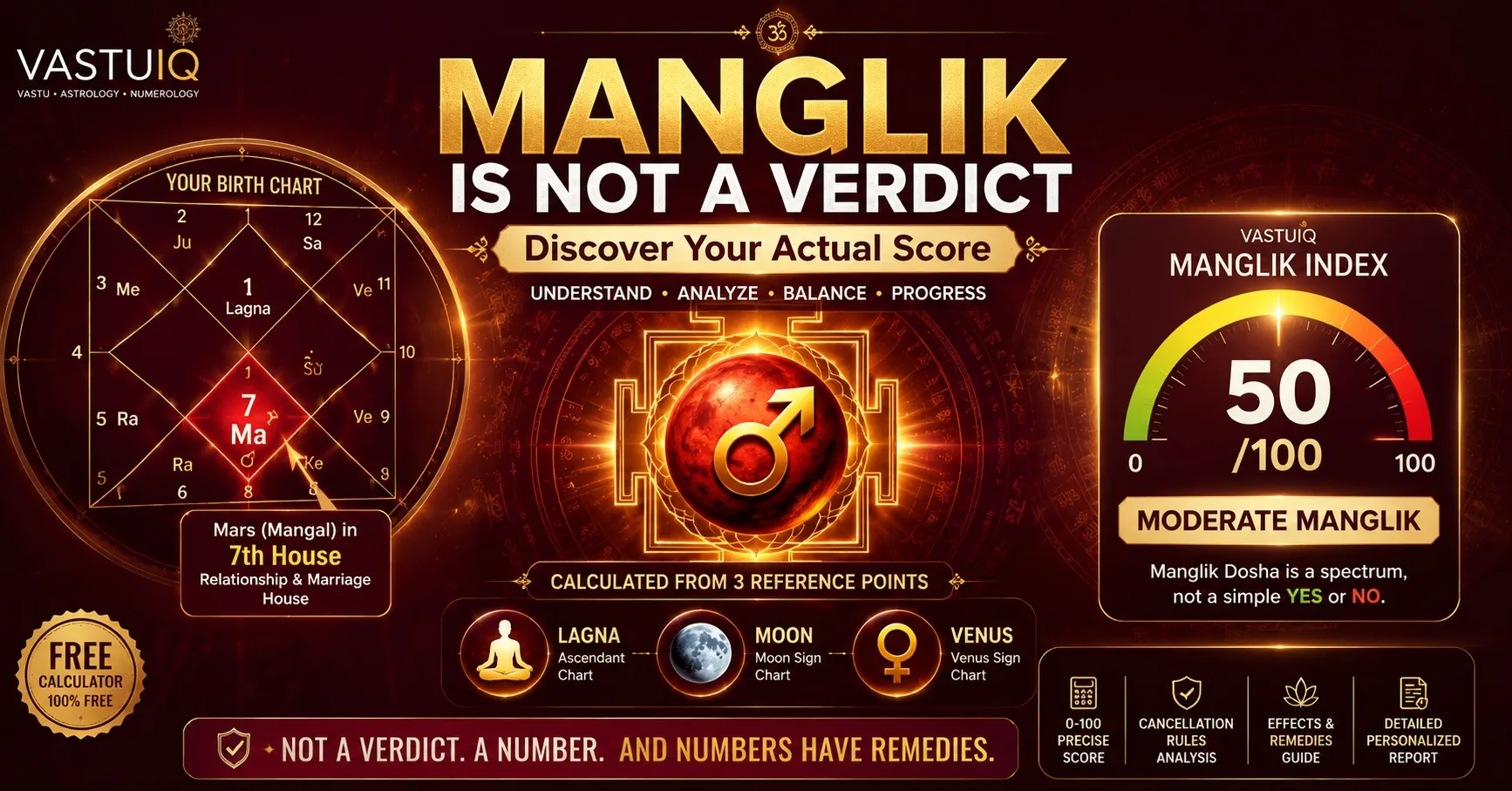
Approximately 40 to 50 percent of all Indians have some form of Manglik Dosha in their birth chart. If the most feared consequence attributed to this condition — that a Manglik person’s spouse will face harm — were true, Indian marriage as an institution would have collapsed generations ago. It has not. What Manglik Dosha actually represents is the placement of Mars in specific houses of the birth chart — a planetary position that shapes temperament, relationship energy and communication style in ways that are measurable, understandable and, in most cases, manageable. This guide covers everything: what Manglik Dosha is, which houses create it and at what severity, the critical North India versus South India variation, how the VASTUIQ Manglik Index scores your individual chart from 0 to 100, cancellation rules, realistic effects and what to do about it.
🪐 Check your Manglik score before reading further
VastuIQ’s free Manglik Calculator checks your birth chart from all three classical reference points — Lagna, Moon and Venus — and gives you a precise 0–100 score, not a binary yes/no. Enter your date of birth, time of birth and place of birth for an accurate result.
→ Check My Manglik Score Free No registration. Free. Precise Vedic astronomical calculation.
What Is Manglik Dosha — Complete Definition
Manglik Dosha (also written Mangal Dosha, Mangal Dosh or Mangalik Dosha) is a Vedic astrology condition that occurs when the planet Mars (called Mangal in Sanskrit and Hindi) occupies certain sensitive houses in a person’s birth chart (kundali). The word “dosha” in Sanskrit means defect, blemish or imbalance — in this context, an energetic imbalance caused by Mars’s placement in houses associated with marriage, family, longevity and domestic life.
A person with this planetary placement is called a Manglik. Both men and women can be Manglik — the dosha does not discriminate by gender, though historically Indian marriage customs placed greater emphasis on checking Manglik status in women.
All the regional names for Manglik Dosha
Manglik Dosha is known by different names across India’s regional astrological traditions — all referring to the same planetary condition:
| Name | Region / Tradition | Language |
|---|---|---|
| Mangal Dosha / Mangalik Dosha | North India (Hindi belt) | Hindi / Sanskrit |
| Kuja Dosha | South India (general) | Sanskrit (Kuja = Mars) |
| Chevvai Dosham / Sevvai Dosham | Tamil Nadu, Kerala | Tamil |
| Angaraka Dosha | Karnataka, Andhra Pradesh | Kannada / Telugu |
| Bhauma Dosha | Classical Sanskrit texts | Sanskrit (Bhauma = son of Earth, name for Mars) |
| Bhom Dosha | Gujarat, Rajasthan | Gujarati / Rajasthani |
Classical reference: The foundational text for Manglik Dosha is the Brihat Parashara Hora Shastra (BPHS) — the most authoritative classical text in Vedic astrology, attributed to the sage Parashara. Chapter 81 of the BPHS, “Stri Jataka” (female horoscopy), specifically addresses the effects of Mars in the dosha houses in the context of marriage. The Brihat Samhita of Varahamihira also references Mars’s influence on marital harmony. VastuIQ’s Manglik Calculator is built on the classical Parashari house-placement rules using precise sidereal (Lahiri/Chitrapaksha ayanamsa) astronomical computation.
What makes someone Manglik
A person is considered Manglik when Mars is placed in the 1st, 2nd, 4th, 7th, 8th or 12th house of the birth chart — specifically from the Ascendant (Lagna), the Moon sign or the Venus sign. The reason these six houses are significant is that each one governs an aspect of personal, domestic or marital life where Mars’s fiery, aggressive, high-energy nature creates friction:
- 1st house (Lagna): Self, personality, physical body — Mars here shapes an assertive, dominant, sometimes combative personal nature that affects how one relates to a partner
- 2nd house: Family, speech, accumulated wealth — Mars here affects family dynamics, the quality of speech (sharpness, directness) and financial management within the family unit
- 4th house: Home, domestic happiness, mother — Mars here affects domestic tranquility, property matters and the quality of home life
- 7th house: Marriage, partnership, spouse — the most direct marital house; Mars here has the most immediate bearing on the spouse and married life quality
- 8th house: Longevity, sudden events, transformation, inheritance — Mars here carries the most intense classical associations with spouse welfare and life transformation through marriage
- 12th house: Losses, expenditure, bed pleasures, foreign — Mars here affects marital intimacy and the emotional quality of the relationship’s private dimensions
The 6 Houses That Create Manglik Dosha — Why Each House Matters
Understanding why these specific houses create Manglik Dosha requires understanding what Mars does energetically and why these six houses are the ones where that energy most directly affects marital and domestic outcomes.
Mars is the planet of energy, aggression, assertion, passion and conflict. In a horoscope, Mars governs willpower, physical vitality, courage and the ability to act decisively. These are positive qualities — Mars is not inherently malefic. The issue arises when this high-energy, assertive planetary force is placed in houses that govern the gentler, cooperative energies of partnership (7th), home life (4th) and family (2nd). The result is what classical astrology describes as a mismatch of energetic quality — a fiery planet in tender zones.
| House | What This House Governs | How Mars Affects It | Primary Life Area Affected |
|---|---|---|---|
| 1st house | Self, personality, appearance, general outlook | Makes the native assertive, dominant, high-energy — can come across as aggressive in partnership contexts | Personal temperament in relationship |
| 2nd house | Family, speech, accumulated wealth, food habits | Sharp speech, financial friction in family, direct communication that can wound | Family harmony and communication |
| 4th house | Home, domestic happiness, mother, property | Domestic restlessness, property disputes, difficulty creating peaceful home environment | Domestic tranquility and property |
| 7th house | Marriage, spouse, partnerships, open relationships | Direct marital tension — the spouse may experience the native as overpowering, demanding or conflict-prone | Marriage quality and spouse relationship |
| 8th house | Longevity, sudden events, inheritance, transformation | Transformative marriage — intense, often crisis-driven partnerships; classical associations with spouse welfare | Transformation through marriage |
| 12th house | Losses, expenditure, foreign travel, bed pleasures | Strain on marital intimacy, financial leakage in relationship context, potential for emotional distance | Marital intimacy and emotional quality |
House-by-House Manglik Severity — All 6 Houses Scored
Not all Manglik Dosha placements carry equal weight. The intensity of the dosha varies significantly depending on which house Mars occupies. The 7th house placement is traditionally considered the most direct marital dosha because it sits exactly in the marriage house. The 8th house carries the most intense classical associations. The 2nd house is the mildest and is the subject of the North-South variation discussed below.
| House | VastuIQ Severity | Index Contribution (per chart) | Primary Observable Pattern | Classical Severity |
|---|---|---|---|---|
| 7th house | ⭐ Highest | 50 points | Direct spousal tension, partner feels dominated, conflict-prone marriage dynamic | Most significant — Mars directly in marriage house |
| 8th house | ⭐ Highest | 50 points | Transformative marriage, intense emotional experiences, classical spouse welfare concern | Most intense — 8th governs longevity and crisis |
| 1st house | High | 50 points | Native’s own temperament creates friction — assertiveness perceived as aggression by partner | High — aspects 4th, 7th and 8th simultaneously |
| 4th house | Moderate-High | 50 points | Domestic restlessness, property disputes, difficulty settling into peaceful home life | Moderate — affects home life and 7th by aspect |
| 12th house | Moderate | 50 points | Marital intimacy strain, emotional withdrawal, financial leakage in relationship context | Moderate — affects intimacy and private relationship quality |
| 2nd house | Mild | 50 points (South India model) / 0 points (North India model) | Sharp family communication, speech-related friction, financial management disputes in family | Mildest — debated between North and South traditions |
Important nuance from the table: While all houses contribute 50 points equally to the VASTUIQ Manglik Index base score (the 50 points represent the placement regardless of house), the observable life-area effects differ significantly by house. A Mars in the 7th house Manglik and a Mars in the 12th house Manglik are both “Manglik” — but their relationship challenges manifest in completely different life areas. VastuIQ’s detailed PDF report specifies which house Mars occupies and gives house-specific guidance accordingly.
North India vs South India — The Critical Variation Resolved
The single most confusing aspect of Manglik Dosha for most Indians is the regional variation in how the dosha is defined. People who are told they are Manglik by one astrologer are sometimes told they are not by another — not because one is wrong, but because they are using different regional traditions. Here is the definitive comparison:
| Aspect | North India Model | South India Model (Kuja / Chevvai Dosham) | VastuIQ Unified Model |
|---|---|---|---|
| Houses that create dosha | 1st, 4th, 7th, 8th, 12th (5 houses) | 2nd, 4th, 7th, 8th, 12th (5 houses, different set) | 1st, 2nd, 4th, 7th, 8th, 12th (all 6 houses assessed) |
| 1st house (Lagna) | Yes — creates Manglik Dosha | No — 1st house not included in Chevvai Dosham | Included — assessed from Lagna chart |
| 2nd house | No — not included in standard North Indian assessment | Yes — specifically included as Chevvai Dosham house | Included — assessed at reduced weight |
| Reference charts used | Primarily Lagna chart; some also use Moon chart | Lagna, Moon and Venus charts commonly assessed | All three: Lagna, Moon and Venus (BPHS-compliant) |
| Regional names | Mangal Dosha, Mangalik Dosh | Chevvai Dosham (Tamil), Sevvai Dosham (Kannada), Kuja Dosha (Telugu) | Manglik Dosha (unified) |
| Estimated Manglik population | ~40% (5 houses from Lagna only) | ~40-50% (different 5 houses from Lagna only) | Up to 50% when all 3 charts assessed across all 6 houses |
VastuIQ’s approach: Rather than choosing one regional tradition over another, VastuIQ’s Manglik Calculator assesses all 6 houses across all 3 reference charts (Lagna, Moon, Venus) using the classical Parashari methodology from the BPHS. This produces the most comprehensive and regionally inclusive Manglik assessment available in any online tool. A person who is not Manglik under the North Indian 5-house model may still have a partial Manglik score under VastuIQ’s unified model — and this partial score carries real, if reduced, significance for marriage compatibility assessment.
The Three Reference Points — Lagna, Moon and Venus Charts
This is the most technically misunderstood aspect of Manglik Dosha assessment, and the one that most significantly affects the accuracy of any online calculator’s result. Most basic online tools check only the Lagna (Ascendant) chart. VastuIQ’s calculator checks all three.
What “checking from three charts” means
In Vedic astrology, a birth chart is not a single fixed wheel — it is a set of perspectives, each centred on a different reference point. The three most important reference points for Manglik Dosha are:
- Lagna chart (Ascendant chart): The chart as seen from the Ascendant — the zodiac sign rising on the eastern horizon at the exact moment of birth. This is the primary chart. Mars in the dosha houses from the Lagna affects the native’s own personality and life energy.
- Chandra chart (Moon chart): The chart as seen from the natal Moon sign — the zodiac sign the Moon occupied at birth. Mars in the dosha houses from the Moon affects the native’s emotional responses and domestic happiness, making this chart specifically relevant to home life and the quality of emotional bonds in marriage.
- Shukra chart (Venus chart): The chart as seen from the natal Venus sign — the zodiac sign Venus occupied at birth. Venus is the planet of love, marriage and partnership. Mars in the dosha houses from Venus directly affects the native’s capacity for romantic partnership and marital harmony — making this the most marriage-specific reference point of the three.
How the three charts affect the VASTUIQ Manglik Index
| Mars placement in dosha houses | Charts affected | VASTUIQ Manglik Index (before cancellations) | Classical classification |
|---|---|---|---|
| No dosha houses from any chart | None | 0/100 | Non-Manglik |
| Dosha house from 1 chart only | 1 of 3 | ~33–50/100 | Anshik / Partial Manglik (Low Manglik Dosha) |
| Dosha house from 2 charts | 2 of 3 | ~66–75/100 | Moderate-High Manglik Dosha |
| Dosha house from all 3 charts | 3 of 3 | 75–100/100 | Full / High Manglik Dosha (Purna Manglik) |
Why birth time matters for accurate results: The Lagna (Ascendant) changes approximately every 2 hours as the Earth rotates — different birth times on the same day produce completely different Lagna positions and therefore different house assignments for every planet. A person born at 6:00 AM and another born at 10:00 AM on the same date may have completely different Manglik scores because their Lagnas are in different signs, assigning Mars to different houses. This is why VastuIQ’s calculator asks for birth time and place — without these, the result is based only on the Moon and Venus charts, producing a less complete assessment.
🪐 Free Manglik Calculator — Check All Three Charts
VastuIQ’s calculator checks Mars placement from Lagna, Moon and Venus simultaneously — giving the most complete Manglik Dosha assessment available online. Enter your date of birth, time and place for the full result including cancellation deductions and your personalised VASTUIQ Manglik Index score.
→ Check My Manglik Score Free
Precise sidereal calculation using Lahiri/Chitrapaksha ayanamsa
Free Manglik Calculator — How VastuIQ Calculates Your Score
VastuIQ’s Manglik Calculator at vastuiq.com/astrology/manglik-calculator is built on a different technical foundation from most online Manglik tools — and the difference matters significantly for result accuracy.
The astronomical engine
Most online Manglik tools use pre-computed lookup tables — they find the approximate zodiac sign of Mars for a given date and apply house rules from there. VastuIQ’s calculator uses a live astronomical computation engine: a Cloudflare Worker running the MIT-licensed astronomy-engine package, computing precise sidereal planetary positions using the Lahiri/Chitrapaksha ayanamsa — the ayanamsa standard adopted by the Indian government for the Indian National Calendar and used by the majority of North Indian Vedic astrologers. The result is a Mars placement accurate to within 0.01° — versus the 1 to 3° errors common in lookup-table tools, errors that can incorrectly assign Mars to an adjacent house and produce a completely wrong Manglik assessment.
What the calculator checks
- Mars position from Lagna chart — which house does Mars occupy from the Ascendant?
- Mars position from Moon chart — which house does Mars occupy from the natal Moon?
- Mars position from Venus chart — which house does Mars occupy from natal Venus?
- Cancellation conditions — is Mars in its own sign (Aries or Scorpio)? Is Jupiter conjunct with Mars? Does Jupiter aspect Mars? Each cancellation condition reduces the base score by a specific deduction.
- VASTUIQ Manglik Index calculation — base score from qualifying reference points minus cancellation deductions = final score from 0 to 100.
What you get from the free calculator
- Your VASTUIQ Manglik Index score (0–100)
- Which of the three charts show a dosha placement
- Which house Mars occupies in each chart
- Which cancellation conditions apply (if any)
- Your Manglik severity tier (Non-Manglik / Partial / Moderate / High)
- Summary of key effects associated with your specific house placement
- Remedy overview — detailed in the paid PDF report
Understanding Your VASTUIQ Manglik Index Score
The VASTUIQ Manglik Index is VastuIQ’s proprietary 0–100 scoring framework for Manglik Dosha — the first continuous scoring model for this condition available in any online astrology tool. Here is exactly how to read your score:
How the score is calculated
| Component | Effect on Score | Explanation |
|---|---|---|
| Mars in dosha house from Lagna chart | +50 points | Each qualifying reference point adds 50 points to the base score |
| Mars in dosha house from Moon chart | +50 points | Second reference point — adds another 50 points |
| Mars in dosha house from Venus chart | +50 points | Third reference point — adds the final 50 points |
| Mars in own sign (Aries or Scorpio) | −60 points | Mars in its own sign is comfortable and its malefic quality is significantly reduced — the most powerful single cancellation |
| Jupiter conjunct with Mars | −25 points | Jupiter’s expansive, benefic energy directly moderates Mars’s aggressive quality |
| Jupiter aspecting Mars | −20 points | Jupiter’s aspect (vision) softens Mars’s energy from a distance |
Score interpretation tiers
| Score Range | Tier | Interpretation | Marriage Guidance |
|---|---|---|---|
| 0 | Non-Manglik | No Mars placement in dosha houses from any of the three reference charts | No Manglik compatibility matching required |
| 1–25 | Anshik / Partial Manglik | Mild placement or placement significantly reduced by cancellations | Minimal concern — standard compatibility assessment sufficient |
| 26–50 | Moderate Manglik | One strong reference point with partial cancellations, or two weaker points | Advisable to check partner’s score for rough compatibility — scores within 20 points of each other are considered compatible |
| 51–75 | Significant Manglik | Multiple reference points, few cancellations — Mars’s influence on relationship is meaningful | Partner’s Manglik score should be checked — comparable scores reduce the differential impact |
| 76–100 | High / Purna Manglik | All three reference points qualify with minimal cancellations — the strongest Manglik configuration | Partner’s Manglik assessment is important — full remedial measures recommended before marriage |
Worked score examples
Example 1 — Moderate Manglik: Mars in the 7th house from Lagna (50 points). No dosha placement from Moon or Venus. No cancellations. Score = 50/100. Tier: Moderate Manglik. This person has one strong Manglik placement — the most directly marital house — but from only one chart. Standard compatibility review recommended.
Example 2 — Cancelled Manglik: Mars in the 7th house from Lagna (50 points) and from Moon chart (50 points). Mars is in Aries (own sign) — cancellation deduction of −60 points. Jupiter conjunct Mars — additional deduction of −25 points. Score = 100 − 85 = 15/100. Tier: Anshik/Partial Manglik. Despite two qualifying placements, the strong cancellation conditions reduce this to a very mild score. Many astrologers would consider this effectively cancelled.
Example 3 — High Manglik: Mars in the 8th house from Lagna (50 points), 8th house from Moon chart (50 points), and 7th house from Venus chart (50 points). No cancellation conditions. Score = 150 points, capped at 100/100. Tier: High/Purna Manglik. All three reference points show strong Manglik placements with no cancellations. Full remedial measures strongly recommended.
Manglik Dosha Cancellation — When the Dosha Is Neutralised
This is the most practically important and most underexplained section of Manglik Dosha guidance. A significant portion of people who are technically Manglik have charts with cancellation conditions that substantially reduce or eliminate the dosha’s effects. Understanding cancellations is the difference between informed astrology and unnecessary anxiety.
The three primary cancellation conditions in VastuIQ’s model
1. Mars in its own sign — the most powerful cancellation (−60 points): When Mars occupies its own signs — Aries (Mesha) or Scorpio (Vrischika) — it is in a position of strength and comfort. A strong, comfortable Mars expresses its energy with confidence rather than with the frustrated aggression of a debilitated or uncomfortably placed Mars. The classical principle: a planet in its own sign has full authority over its house and expresses its qualities directly rather than distortedly. VastuIQ’s −60 point deduction for Mars in own sign reflects this powerful cancellation — it is the single most effective cancellation condition in the model.
2. Jupiter conjunct with Mars — strong moderation (−25 points): When Jupiter (Guru/Brihaspati) — the planet of wisdom, expansion and spiritual guidance — occupies the same house as Mars, its benefic energy directly moderates Mars’s aggression. Jupiter’s philosophical, measured energy sits alongside Mars’s fire and prevents its most harmful marital expressions. This is described in classical texts as “Guru-Mangal yoga” when the combination is in certain houses — a combination that can produce exceptional energy, drive and wisdom simultaneously.
3. Jupiter aspecting Mars — gentle moderation (−20 points): Jupiter aspects the 5th, 7th and 9th houses from its position. When Mars is in a house that receives Jupiter’s aspect (Jupiter’s “drishti” — gaze), the benefic influence reaches Mars from a distance, moderating rather than eliminating its energy. This is a softer cancellation than direct conjunction — Mars still expresses its nature, but within Jupiter’s philosophical framework.
Additional classical cancellation conditions
Beyond VastuIQ’s three primary scored conditions, classical Vedic astrology texts describe several additional cancellation scenarios that an experienced astrologer would assess in a full chart reading:
- Mars in the 1st house in Aries — Mars in its own Lagna is considered self-contained, the assertiveness directed toward self-development rather than outwardly at the partner
- Mars aspected by Venus — love and beauty (Venus) softening aggression (Mars) — classical “mitigation by natural benefic aspect”
- Mars in the 12th house in Pisces (Jupiter’s sign) — Jupiter’s sign placement in the 12th reduces Manglik effect
- Both partner and native are Manglik of comparable strength — the traditional belief that two Manglik charts cancel each other’s negative effects when the Mars energy is comparable on both sides
- Marriage after age 28 — widely cited, partially supported classically (Mars matures with age, its most reactive phase being the first Saturn cycle of 29.5 years), though the placement in the chart does not change
VastuIQ’s free calculator scores the three primary conditions. The paid PDF report includes a fuller classical cancellation analysis for your specific chart configuration.
Effects of Manglik Dosha — What It Actually Means
The most damaging thing in Manglik Dosha discourse is the distance between what the condition actually means and what folklore has made people believe it means. Here is the accurate, calibrated picture.
What Manglik Dosha actually produces
Temperament effects: Mars is the planet of energy, assertion and passion. A Manglik individual — particularly one with Mars in the 1st or 7th house — tends toward directness, high energy, strong opinions and a low tolerance for perceived injustice. These traits are not defects: they are Martian qualities that, in the right context, produce excellent leaders, athletes, surgeons, military officers and entrepreneurs. In a marriage context, these same traits can generate conflict when the partner does not have complementary energy — not because the Manglik person is flawed but because the energy differential creates friction.
Communication style effects: Mars in the 2nd house specifically affects speech — producing direct, sometimes sharp communication that can wound without the speaker intending it. The Manglik person with 2nd house Mars often says exactly what they think, without the social filtration that protects feelings. In family life, this creates recurring friction even when the intent is honest rather than cruel.
Domestic life effects: Mars in the 4th house affects home life — producing restlessness, a desire for action rather than domestic settling, and sometimes property-related disputes. This person may genuinely find it difficult to create the still, harmonious home environment that many partners expect.
Marital tension effects: Mars in the 7th house creates direct pressure on the marriage house. The native may project Martian qualities — dominance, assertion, high expectations of the partner’s performance — onto the spouse relationship specifically. This does not mean the marriage fails; it means the marriage requires conscious management of these energy dynamics.
What Manglik Dosha does NOT mean
It does not mean the spouse will die. This is the most persistent and most harmful folklore around Manglik Dosha. A common notion is that if there is a Mangal Dosha in a Horoscope, the partner will die — this is absolutely not supported by classical texts. The BPHS does not make this claim in its primary Manglik chapters. The death-of-spouse association is a later folk accretion — not a classical prescription. If this were true, and 40–50% of the Indian population is Manglik, widowhood would be statistically epidemic. It is not. Millions of Manglik individuals around the world are in stable, loving, long-term marriages.
It does not mean marriage is forbidden. The classical prescription is for careful compatibility matching — not prohibition. The traditional guidance is that a Manglik marrying another Manglik of comparable strength creates balance, because both partners carry the same Martian energy and neither is overwhelmed by the other’s assertiveness.
It does not mean the same thing for everyone. A score of 15/100 and a score of 90/100 are both “Manglik” in the binary sense but represent completely different astrological realities. A person with significant cancellations may effectively have no Manglik effect at all. A person with all three charts qualifying and no cancellations is in a genuinely different situation. This is precisely why the binary yes/no result is inadequate — and why the VASTUIQ Manglik Index was created.
Manglik Dosha Remedies — Overview
When Manglik Dosha is significant in a chart — particularly at scores of 50/100 and above with few cancellations — classical Vedic astrology prescribes several remedial measures. These are addressed in full depth in the dedicated Manglik Dosha Remedies Complete Guide. Here is the essential overview:
| Remedy | Type | Classical Basis | Best For |
|---|---|---|---|
| Kumbh Vivah (ritual marriage to a pot or tree) | Symbolic ritual | Pre-marriage ritual that classically “absorbs” the first marriage’s dosha energy before the real wedding | High-score Manglik individuals before marriage |
| Mangal Shanti Puja | Ritual / fire ceremony | Specific Vedic homa to propitiate Mars — reduces the malefic quality of the Mars placement | All significant Manglik scores |
| Tuesday fasting (Mangalvar Vrat) | Discipline / devotion | Mars governs Tuesday — fasting on this day is the classical weekly Mars propitiation | Ongoing maintenance for any Manglik score |
| Red coral gemstone (Moonga) | Gemstone therapy | Red coral is Mars’s classical gemstone — wearing it strengthens Mars and channels its energy constructively | Moderate to High Manglik scores — must be prescribed by a qualified astrologer for the specific chart |
| Hanuman devotion — Hanuman Chalisa recitation | Devotional practice | Hanuman is classically described as the deity who can calm and redirect Martian energy | All Manglik scores — accessible, daily practice |
| Shiva Puja / Rudrabhishek | Ritual | Lord Shiva is the deity who governs and transforms Mars’s energy in its highest expression | High-score Manglik individuals |
The paid PDF report from VastuIQ’s Manglik Calculator provides a personalised remedy plan based on your specific score, house placement and cancellation conditions — not a generic remedy list but a chart-specific prescription. Access the calculator and report here.
Can a Manglik Marry a Non-Manglik?
This is the question that every Manglik person’s family eventually asks — and it deserves a direct, calibrated answer.
The classical position: Classical texts advise that a high-Manglik person should ideally marry another Manglik of comparable strength — because the matching Martian energies create balance rather than imbalance. When both partners are assertive, high-energy and direct, neither is overwhelmed by the other’s nature. The friction predicted by the dosha arises most acutely when only one partner carries significant Martian energy while the other is gentle, sensitive or conflict-averse.
The practical reality in 2026: Rigid Manglik-only-marry-Manglik rules are increasingly softened by most qualified astrologers, for several reasons:
- With 40–50% of the population carrying some Manglik placement, the pool of compatible matches is large
- A Manglik individual with a score of 50/100 and a non-Manglik individual with a strong, Mars-compatible chart can be genuinely well-matched
- The complete chart assessment — not just Manglik status — determines compatibility; a non-Manglik with a difficult 7th house may create more marital friction than a moderate Manglik with a strong Jupiter
- Remedial measures can significantly moderate the dosha’s expressed effects
VastuIQ’s guidance: Check both partners’ VASTUIQ Manglik Index scores. If the scores are within approximately 20 points of each other, the Manglik differential is manageable. If one partner scores 90/100 and the other scores 0/100, the differential is significant and warrants fuller astrological consultation. The Manglik Calculator allows both partners to check their scores independently — compare the numbers and assess the differential directly.
For the complete compatibility guide covering all scenarios — high-high Manglik pairs, high-zero pairs, partial Manglik scenarios and chart-specific factors — see: Manglik and Non-Manglik Marriage — Complete Compatibility Guide.
Manglik Dosha and Vastu — The Connection Only VastuIQ Makes
VastuIQ is the only platform that combines Vedic astrology analysis with Vastu Shastra assessment — and the connection between Manglik Dosha and home Vastu is more direct than most people realise.
Mars governs the south direction in Vastu Shastra. The south zone of the home — the zone of Yama, discipline, authority and Mars’s own elemental territory — is considered the most Mars-energised directional zone in the floor plan. For a Manglik individual, the south and southwest zones of the home carry amplified Martian energy. This creates specific Vastu implications:
- Master bedroom placement for Manglik individuals: The southwest master bedroom (95/100 in VastuIQ’s room scoring model) places the Manglik person in the earth-stability zone that grounds and contains Martian energy — exactly the right placement for someone whose Mars energy needs structural support rather than amplification
- Avoid red or aggressive Mars colours in the northeast: For Manglik individuals, the fire-element red and orange tones in the sacred northeast zone (Ishaan Kona) create a specific Vastu-astrology amplification — the Mars energy of the chart interacts with fire-element amplification in the sacred zone, potentially heightening Martian temperament expression
- Copper as a Mars-harmonising metal: Copper is Mars’s classical metal in both Vastu Shastra and Vedic astrology. For Manglik individuals, copper threshold strips, copper vessels in the kitchen and copper-accented mandir elements serve both Vastu and astrological functions simultaneously
- Tuesday Hanuman puja in the northeast mandir: The Tuesday Mars propitiation practice (classical Manglik remedy) is most potent when performed in a correctly placed northeast mandir — combining the astrological remedy with the energetically correct Vastu zone
For the complete Vastu assessment of your home including how your birth chart’s planetary placements interact with your home’s directional energy, use VastuIQ’s AI Floor Plan Analyzer.
Frequently Asked Questions — Manglik Dosha
What is Manglik Dosha in simple terms?
Manglik Dosha is a Vedic astrology condition that occurs when the planet Mars occupies the 1st, 2nd, 4th, 7th, 8th or 12th house in a person’s birth chart, specifically from the Ascendant, Moon sign or Venus sign. Mars is a fiery, assertive planet, and its placement in these marriage and family-related houses is believed to create friction in marital and domestic life. It is also called Mangal Dosha, Kuja Dosha (South India), Chevvai Dosham (Tamil Nadu) or Angaraka Dosha. Approximately 40–50% of people have some form of this condition, making it the most common significant dosha in Vedic astrology — and the most misunderstood.
Am I Manglik? How do I check?
To check if you are Manglik, you need your date of birth, time of birth and place of birth. Enter these into VastuIQ’s free Manglik Calculator — it will check your Mars placement from all three classical reference charts (Lagna, Moon and Venus), apply any cancellation conditions and give you a precise VASTUIQ Manglik Index score from 0 to 100. This takes approximately 2 minutes and is free. The result tells you not just whether you are Manglik but how significant the dosha is — information that a binary yes/no answer cannot provide.
What is the difference between Manglik and non-Manglik?
A Manglik person has Mars placed in the 1st, 2nd, 4th, 7th, 8th or 12th house of their birth chart from the Ascendant, Moon or Venus. A non-Manglik does not have Mars in any of these houses from any of the three reference charts. In practice, the distinction is not binary but a spectrum — a person with Mars barely qualifying from one chart with strong cancellations (score: 10/100) is meaningfully different from a person with all three charts qualifying with no cancellations (score: 100/100), even though both would technically be called “Manglik.” The VASTUIQ Manglik Index captures this spectrum.
Does Manglik Dosha really cause the spouse to die?
No. This is the most persistent and most harmful myth about Manglik Dosha. Classical texts — including the Brihat Parashara Hora Shastra, the foundational text for this condition — do not make this claim in their primary discussions of Manglik Dosha. The death-of-spouse association is a later folk accretion. If 40–50% of the Indian population is Manglik and this outcome were real, widowhood statistics in India would be dramatically different from what they are. Millions of Manglik individuals worldwide are in stable, long-term, happy marriages. The realistic effects of Manglik Dosha are temperament-based — assertiveness, directness, domestic restlessness — not the dramatic outcomes of popular mythology.
Does Manglik Dosha end after age 28?
There is a popular belief that Manglik Dosha ends or is significantly reduced after age 28. The classical basis for this is that Mars completes significant developmental cycles in the early years, and its most reactive, externally aggressive phase tends to moderate as the native matures. However, the planetary placement in the birth chart does not change — Mars remains in the same house it occupied at birth throughout the native’s life. What changes with age is the native’s relationship to their Martian energy: most Manglik individuals develop better tools for channelling assertiveness constructively as they mature. Marrying after age 28 is therefore considered beneficial not because the dosha disappears but because the native has typically developed more self-awareness around their Mars energy.
What is the difference between full Manglik and partial Manglik (Anshik)?
Full Manglik Dosha (Purna Manglik) occurs when Mars is placed in the dosha houses from all three reference charts (Lagna, Moon and Venus) with minimal cancellation conditions — producing a VASTUIQ Manglik Index score above 75/100. Partial Manglik Dosha (Anshik Manglik) occurs when Mars qualifies from only one or two charts, or when significant cancellation conditions reduce the base score — typically producing scores below 50/100. Anshik Manglik carries real but mild effects that are usually well within normal relationship management and rarely require the most intensive remedial measures.
What is double Manglik Dosha?
Double Manglik Dosha (also called Triple Manglik Dosha) occurs when Mars is placed in a dosha house along with additional malefic planets — typically Saturn, Rahu or Ketu. This compounds Mars’s disruptive quality: Saturn adds restriction and delay, Rahu adds obsession and unpredictability, Ketu adds disconnection and spiritual intensity. The VASTUIQ Manglik Index does not automatically add points for planetary conjunctions (that analysis requires the full paid report), but the qualitative effects of Mars with malefics in the dosha houses are addressed in VastuIQ’s PDF report for each specific combination.
What are the best Manglik Dosha remedies?
The most effective Manglik Dosha remedies depend on the specific score and house placement. For all Manglik individuals: Tuesday fasting (Mangalvar Vrat) and Hanuman Chalisa recitation are the most accessible and consistently prescribed practices. For moderate to high scores: Mangal Shanti Puja, Rudrabhishek and red coral gemstone (prescribed by a qualified astrologer for the specific chart). For high-score Manglik individuals before marriage: Kumbh Vivah ritual. The most personalised remedy guidance comes from VastuIQ’s paid PDF report from the Manglik Calculator — it provides a chart-specific remedy plan based on your exact score, house and cancellation profile.
Is Manglik Dosha the same in North and South India?
No — there is a significant regional variation. North Indian astrologers typically use the 1st, 4th, 7th, 8th and 12th houses (5 houses, no 2nd house) from the Lagna primarily. South Indian astrologers — using the Kuja Dosham / Chevvai Dosham system — include the 2nd house but sometimes exclude the 1st house, and typically assess all three reference charts (Lagna, Moon, Venus) more consistently. VastuIQ’s calculator uses a unified model covering all 6 houses from all 3 reference charts — the most comprehensive approach that is inclusive of both regional traditions.
Can the Manglik Dosha be completely cancelled?
Yes — in some chart configurations, the cancellation conditions are strong enough to effectively neutralise the dosha. The most powerful cancellation is Mars in its own sign (Aries or Scorpio), which deducts 60 points from the VASTUIQ Manglik Index. A person with only one qualifying reference point (50 points base) and Mars in its own sign (−60 points) would produce a score of 0 — effectively cancelled. Jupiter conjunct Mars (−25 points) and Jupiter aspecting Mars (−20 points) are additional significant cancellations. Many people who are told they are “strongly Manglik” by a basic binary tool discover on VastuIQ’s calculator that their score is actually low due to cancellation conditions that the basic tool did not assess.
How accurate is an online Manglik calculator?
Accuracy depends heavily on the calculation methodology. Most basic online calculators use approximate planetary lookup tables that can have errors of 1–3°. At certain points in the zodiac — particularly near house cusps where the difference of 1° can place Mars in a completely different house — this error produces wrong results. VastuIQ’s calculator uses live sidereal astronomical computation (astronomy-engine package, Lahiri ayanamsa) accurate to 0.01°, making it significantly more reliable than lookup-table tools. Additionally, VastuIQ checks all three reference charts (Lagna, Moon, Venus) rather than just the Lagna — which most basic tools assess alone. The result is a more complete and more accurate assessment.
Is the VASTUIQ Manglik Index score the same as a traditional astrologer’s assessment?
VastuIQ’s VASTUIQ Manglik Index provides a rigorous, standardised, reproducible score based on classical Parashari rules and precise astronomical computation. A traditional astrologer’s assessment may additionally consider the strength of Mars (exaltation, debilitation, planetary war), the overall chart context, the Dasha periods and many additional nuances that the standardised scoring model cannot fully capture. VastuIQ’s score is the most accurate starting point available online — for significant life decisions involving high Manglik scores, it is advisable to also consult a qualified Vedic astrologer for the full chart context.
🪐 Free Manglik Calculator — Get Your Score Now
India’s most precise online Manglik Dosha calculator. Checks all three classical reference charts using sidereal astronomical computation. Get your VASTUIQ Manglik Index score (0–100), cancellation analysis and remedy overview — free. Paid PDF report available with personalised remedy plan and house-specific guidance.
Vastu tools that complement your Manglik assessment:
🧭 Free Vastu Calculator — check your home’s directional compliance score
🏠 AI Floor Plan Analyzer — complete 25-factor home assessment
🏛️ Brahmasthan Calculator — find your home’s exact geometric centre
🚪 Pada Calculator — check your main entrance’s Vastu score
Apply This to Your Own Property
Free AI Vastu analysis — room-by-room scores, geo-adaptive for India, UK, UAE and 50+ countries. Detailed report from ₹99.