
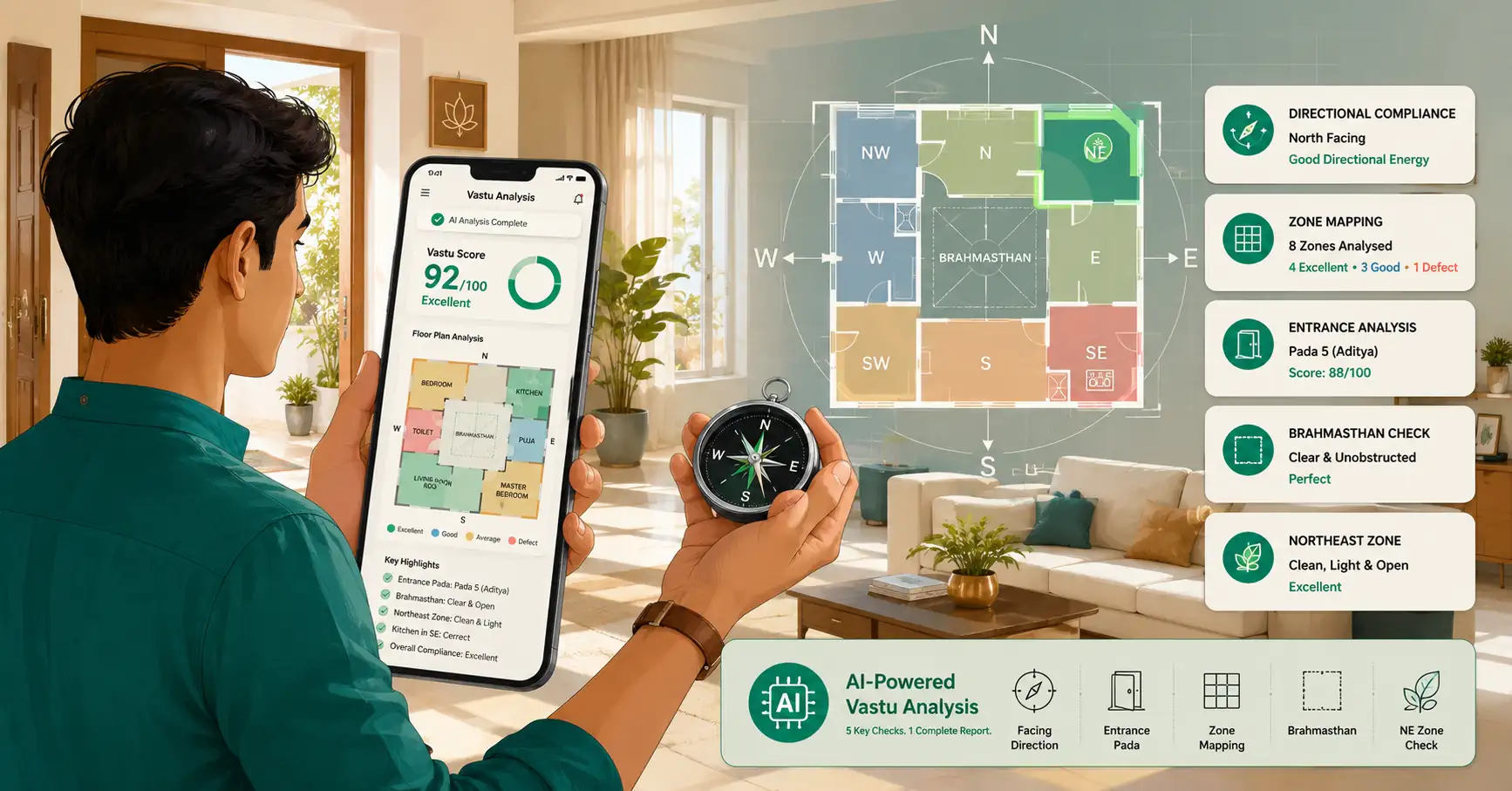
What you will learn in this guide
- The 5 Vastu checks you can do yourself in under 30 minutes — no consultant needed
- Free online tools that automate the technical parts of a Vastu assessment
- What a DIY check can and cannot tell you — honest limits clearly stated
- When hiring a consultant actually adds value beyond what a self-check covers
- A step-by-step self-assessment sequence starting from the most important factor
The short answer is yes. You can check your home’s Vastu without hiring anyone — and in most cases, a well-done self-assessment using the right tools and this guide will tell you everything a standard consultant visit would tell you about your property’s directional compliance, zone placement and primary defects.
This is not a popular thing for the Vastu consultation industry to say. But it is accurate, and it is important — because the fear that Vastu is too technical, too esoteric or too dependent on an expert’s intuition has kept millions of Indian homeowners from accessing information that directly affects how their living space functions for them.
Vastu Shastra is a system. It has rules, measurements, calculations and a scoring framework that can be learned, applied and verified. A trained consultant applies this system — but so can you, with the right guidance and the right tools. This guide gives you both.
What a Vastu Self-Assessment Actually Covers
Before starting, it helps to know exactly what you are assessing. A complete Vastu self-assessment covers five areas — listed here in order of their impact on your home’s overall score:
- Entrance pada position — which of the 9 divisions of your entrance wall the main door sits in. This single factor accounts for approximately 45–50% of your home’s total Vastu score.
- Facing direction — which direction your entrance opens toward. Sets the directional context for all other factors.
- Zone mapping — what room occupies each of the eight directional zones of your home. Kitchen in southeast is correct. Kitchen in northeast is a severe defect.
- Brahmasthan check — whether the central zone of your home is open and unobstructed.
- Northeast zone check — whether the most sensitive corner of your home is correctly used (open, light, no toilet, no kitchen, no heavy storage).
These five checks, done in this order, cover the factors that determine 80–85% of a home’s overall Vastu score. Everything else — colours, minor zone refinements, plant placement, wind chimes — operates within the framework these five establish. Get these five right and your home has a strong Vastu foundation regardless of the finer details.
Check 1 — Your Facing Direction (5 minutes)
Your home’s facing direction is the direction your main entrance opens toward when you stand inside and face outward through the front door.
How to find it:
- Stand at your main entrance door on the inside of your home.
- Face outward — as if you are about to step outside.
- Open the compass app on your phone (built into both Android and iPhone — search “compass” if you cannot find it).
- Note the direction you are facing. That is your home’s facing direction.
What to look for: The eight possible directions are North, Northeast, East, Southeast, South, Southwest, West and Northwest. Most homes fall clearly into one — if your compass reads between 337.5 and 22.5 degrees, you are north-facing. If it reads between 22.5 and 67.5 degrees, you are northeast-facing, and so on in 45-degree segments.
What it means: Your facing direction tells you which deity and element govern your home’s primary energy intake. North (Kubera — wealth), East (Indra — health and recognition), South (Yama — discipline and accountability), West (Varuna — patience and accumulated prosperity). Each direction is assessed in detail in our facing direction guide series — see the Related Guides at the bottom of this post.
Check 2 — Your Entrance Pada Position (10 minutes)
This is the most important check in any Vastu self-assessment and the one most people skip because it sounds technical. It is not — it requires a measuring tape and one division calculation.
How to find your pada:
- Measure the interior width of your entrance wall — the full length of the wall your main door is set in, from corner to corner.
- Divide by 9. The result is the width of each pada.
- Identify the correct starting corner for your wall direction:
- North wall: count padas from East corner toward West
- South wall: count padas from Southwest corner toward Southeast
- East wall: count padas from Southeast corner toward Northeast
- West wall: count padas from Northwest corner toward Southwest
- Measure from the correct starting corner to the centre of your main door.
- Divide by pada width and round up to get your pada number.
Example: East-facing home. East wall interior width = 18 feet. Each pada = 18 ÷ 9 = 2 feet. Door centre is 9 feet from the Southeast corner. 9 ÷ 2 = 4.5 → Pada 5 (Aditya — solar health energy, scores 88/100). Strong result.
For the complete pada guide with worked examples for all four directions and a full scoring table see our Pada System Complete Guide.
Faster option — use the free calculator: If the manual calculation feels like too many steps, VastuIQ’s free Vastu calculator takes your facing direction and entrance position (left, centre or right of wall) and calculates your Directional Compliance score automatically in under two minutes.
Classical basis: The Manasara (Chapter 9) and Brihat Samhita (Chapter 53) both treat the entrance pada as the primary factor in any residential Vastu assessment — the “prana pravesh” or quality of life-force entry. Vastu was designed to be a measurable, calculable system applicable by any trained person, not an esoteric gift available only to initiates. The measurement-based pada system is evidence of this — it is an engineering specification, not a mystical interpretation.
Check 3 — Zone Mapping (10 minutes)
Zone mapping means identifying which of the eight directional zones of your home each room occupies. This is what determines whether your kitchen, bedroom, bathroom and living room are correctly placed according to classical Vastu rules.
How to map your zones:
- Draw or print a rough floor plan of your home — it does not need to be to scale, just proportionally representative.
- Find the centre of the plan (fold it diagonally both ways to find the intersection point).
- Draw a compass rose from the centre with North pointing in your home’s actual north direction.
- Divide the plan into eight equal 45-degree segments from the centre. Each segment is one directional zone.
- Note which room falls in each zone.
What to check immediately:
- Northeast zone — should be open, light, possibly puja room or living room. No toilet, no kitchen, no heavy storage.
- Southeast zone — should be kitchen. If it is a bedroom or toilet, note as a defect.
- Southwest zone — should be master bedroom. If it is open, a balcony or a toilet, note as a defect.
- Northwest zone — suitable for guest bedroom, toilet or storage. Acceptable for most uses.
Faster option — upload your floor plan: VastuIQ’s AI Floor Plan Analyzer does this zone mapping automatically from a photo of your floor plan — identifying every room’s zone, scoring each one against classical rules and listing defects with severity grades. What takes 10 minutes manually takes under 2 minutes with the tool.
Check 4 — Brahmasthan Check (3 minutes)
The Brahmasthan is the central zone of your home — the point from which all eight directional zones radiate. It should be open, unobstructed and free of permanent heavy structures.
How to find and check it:
- Find the geometric centre of your floor plan using the method in our Brahmasthan Complete Guide — for a rectangle, it is simply the intersection of the two diagonal lines from corner to corner.
- Mark this point on your floor plan.
- Check what is physically at this point in your actual home. Is it open floor space? A piece of furniture? A wall? A structural pillar? A toilet?
Pass: Open space, light furniture that can be moved, a clear passage area.
Defect: A permanent structural pillar, a fixed toilet, a heavy kitchen island bolted in place, a staircase landing, or any immovable structure directly on the home’s centre point.
Check 5 — Northeast Zone Detailed Assessment (5 minutes)
The northeast deserves its own standalone check because defects here have the highest single-zone impact on a home’s overall Vastu score — up to −65 points for a toilet in this zone. After completing the zone map in Check 3, revisit the northeast zone specifically.
Northeast zone checklist:
- Is there a toilet in the northeast? If yes: severe defect, highest priority remedy.
- Is there a kitchen in the northeast? If yes: severe defect, second highest priority.
- Is there a staircase in the northeast? If yes: moderate defect.
- Is there heavy furniture or permanent storage in the northeast corner? If yes: moderate defect.
- Is the northeast corner dark, enclosed or poorly ventilated? If yes: minor defect.
- Is the northeast receiving natural light and kept relatively clear? If yes: pass.
For the full northeast zone assessment and all available remedies see our Vastu Dosh Complete Guide.
Want all 5 checks done automatically? VastuIQ’s AI Floor Plan Analyzer covers all five checks in one upload — zone mapping, pada scoring, Brahmasthan identification, northeast assessment and defect prioritisation — in under 2 minutes. Try it free at vastuiq.com
Your Self-Assessment Score — How to Combine the 5 Checks
Once you have completed all five checks, combine your findings using this simple framework:
| Check | Result | Score Impact |
|---|---|---|
| Facing direction | North or East | Strong baseline (+) |
| Facing direction | South or West | Neutral — depends on pada |
| Entrance pada | Best pada for your direction | High positive weight (+45 to +50%) |
| Entrance pada | Defective pada | High negative weight (−40 to −70 pts) |
| Zone mapping | Kitchen SE, bedroom SW, toilet NW | Correct placement (+) |
| Zone mapping | Kitchen NE or SW, toilet NE | Severe defect (−35 to −65 pts) |
| Brahmasthan | Open and clear | Pass (neutral) |
| Brahmasthan | Toilet, pillar or fixed structure | Severe defect (−45 pts) |
| Northeast zone | Light, open, correct use | Pass (neutral) |
| Northeast zone | Toilet or kitchen present | Severe defect (−55 to −65 pts) |
If all five checks pass cleanly, your home has strong Vastu fundamentals. If one severe defect is present, that single factor is your priority — address it before anything else. If multiple severe defects are present, address them in the order listed above (northeast zone first, then pada, then zone mapping).
The Three Free Tools That Automate Your Self-Assessment
VastuIQ offers three free tools that automate different parts of the self-assessment described above. Used together, they cover the complete five-check framework without any manual calculation.
Tool 1 — Free Vastu Calculator
Covers Checks 1 and 2 — facing direction and entrance pada position. Takes under 2 minutes. No floor plan needed. Returns your Directional Compliance score out of 100 with your pada identification and a summary of what it means.
Best for: Quick first check, comparing multiple properties fast, when you do not have a floor plan available.
Try the free Vastu calculator →
Tool 2 — AI Floor Plan Analyzer
Covers all five checks simultaneously. Upload a photo of your floor plan and the AI maps your zones, calculates your pada, identifies the Brahmasthan, checks the northeast zone and returns a complete defect list with severity scores and remedies.
Best for: Complete assessment, comparing shortlisted properties before purchase, getting a prioritised remedy list.
Try the AI Floor Plan Analyzer →
Tool 3 — DishaAI Vastu Chatbot
For specific questions that arise during your self-assessment — “my kitchen is in the northwest, what does that mean specifically for my home?” or “my entrance is in Pada 3 on the south wall, is that acceptable?” — DishaAI provides instant, conversational answers tailored to your specific situation rather than generic guidance.
Best for: Follow-up questions after completing checks 1–5, specific defect clarification, remedy selection for unusual layouts.
Self-Assessment vs Consultant — An Honest Comparison
This guide would be incomplete without an honest answer to the follow-up question: if I can do this myself, when should I still hire a consultant?
| Factor | DIY Self-Assessment | Professional Consultant |
|---|---|---|
| Cost | Free | ₹3,000 to ₹50,000+ depending on consultant and property |
| Time | 30 minutes manual or 5 minutes with tools | Site visit + 1–7 days for report |
| Accuracy for standard layouts | High — same classical rules applied consistently | High — plus experiential judgment |
| Irregular or complex properties | Moderate — tools handle most cases | Higher — in-person reading of unusual situations |
| Remedy prescription | Rule-based remedies from classical texts | Personalised remedies with practitioner intuition |
| Ritual component (puja) | Not available | Available if required |
| Family authority | Self-generated finding | Third-party validation carries more weight in family decisions |
| Best for | Initial screening, regular checks, pre-purchase comparison | Major decisions, complex defects, renovation planning |
The honest recommendation: use a self-assessment first, always. It is free, immediate and covers the majority of what a standard consultation covers for a typical Indian residential property. If your self-assessment reveals severe defects requiring major structural decisions — or if family dynamics require a third-party authority figure to validate findings before action is taken — a professional consultation on that specific issue is a worthwhile next step, now informed by data rather than starting from zero.
What a Self-Assessment Cannot Replace
In the interest of complete honesty, there are three things a DIY Vastu assessment does not cover:
Muhurat selection. The timing of auspicious activities — Griha Pravesh (housewarming), starting construction, moving furniture — requires jyotish (astrological) calculation that goes beyond Vastu spatial assessment. A consultant who combines Vastu and jyotish expertise provides this; the tools and guides on VastuIQ do not.
Highly irregular properties. L-shaped plots with multiple missing zones, properties with unusual split levels, or buildings where determining the true Brahmasthan requires professional geometric judgment — these benefit from in-person assessment. VastuIQ’s AI Floor Plan Analyzer handles most standard irregular layouts, but there are edge cases where human expert judgment adds meaningful value.
Personal birth chart integration. Some Vastu practitioners integrate the occupant’s birth chart (janma kundali) into their property assessment — checking compatibility between the household head’s birth nakshatra and the property’s entrance pada. This personalised layer is not part of a standard spatial Vastu assessment and is not covered by self-assessment tools.
Frequently Asked Questions — Vastu Self-Assessment
Can I really get an accurate Vastu assessment without a consultant?
Yes — for the spatial and directional components of Vastu, which account for the large majority of any property’s overall compliance score. The entrance pada calculation, zone mapping, Brahmasthan check and northeast zone assessment are all rule-based, measurement-based processes that produce the same result whether done by a trained consultant or a homeowner following this guide carefully. The tools available on VastuIQ — free Vastu calculator and AI Floor Plan Analyzer — apply the same classical framework a consultant would use, at a speed and consistency that manual assessment rarely matches.
Is the free Vastu calculator as accurate as a paid assessment?
For the factors it covers — facing direction and entrance pada position — yes. The free calculator applies the same classical pada scoring table a trained consultant would reference, without the variability that comes from different practitioners weighting factors differently. For a complete property assessment including zone mapping and all room placements, the AI Floor Plan Analyzer provides the depth a paid consultation would cover for a standard residential layout.
What if I find a severe defect during my self-assessment?
A severe defect — toilet in the northeast, defective entrance pada, kitchen in the northeast — is important information, not a reason for panic. Knowing the defect exists is the first step toward addressing it. Check our Vastu Dosh Guide for the severity grading of your specific defect and the available remedy pathways. Our 21 Vastu Remedies Guide covers the non-structural options available for every major defect category.
How often should I reassess my home’s Vastu?
A full self-assessment is most valuable at three specific moments: before purchasing a property (to compare options), after moving into a new home (to establish a baseline and identify priorities), and after any significant renovation that changes room layouts or the entrance. For ongoing monitoring, the free Vastu calculator can be used whenever you want a quick directional compliance check — for example, if you have changed your main entrance door position or shifted the entrance gate on a plot.
My family does not believe in Vastu — should I still do a self-assessment?
A Vastu self-assessment produces concrete, measurement-based information about your property’s spatial alignment regardless of anyone’s belief in the system. The pada position of your entrance is a measurable physical fact. The zone your kitchen occupies is a measurable physical fact. Whether you interpret these facts through the lens of classical Vastu or simply as useful spatial planning information is a personal choice. Many people who start a self-assessment as sceptics find the structural logic of the classical system more compelling once they understand the elemental reasoning behind it — rather than encountering it as a set of arbitrary rules.
Related VastuIQ Tools and Guides
Everything referenced in this guide is available free on VastuIQ:
Tools — start your self-assessment here:
Free Vastu Calculator — instant Directional Compliance score from your facing direction and entrance position. Covers Checks 1 and 2 above. Under 2 minutes, no registration.
AI Floor Plan Analyzer — complete zone-by-zone assessment from your floor plan image. Covers all 5 checks simultaneously. The fastest path to a full Vastu score.
DishaAI Vastu Chatbot — ask specific questions about your self-assessment findings for instant personalised guidance.
Guides — understand what your results mean:
Pada System Complete Guide — the full manual method for Check 2, with worked examples for all four directions and complete pada scoring tables.
Vastu Dosh — Common Defects, Symptoms and Remedies — what to do if Checks 3, 4 or 5 reveal a defect, with severity scores and full remedy pathways.
21 Vastu Remedies Without Renovation — non-structural remedy options for every major defect category identified in your self-assessment.
Apply This to Your Own Property
Free AI Vastu analysis — room-by-room scores, geo-adaptive for India, UK, UAE and 50+ countries. Detailed report from ₹99.