
What you will learn in this guide
- How specific Vastu defects create the conditions for relationship friction — the mechanism explained
- 8 Vastu factors that directly affect relationship harmony, in order of impact
- The bedroom rules couples most commonly get wrong — and what to correct first
- Which Vastu defects are associated with specific relationship patterns — arguments, distance, intimacy issues
- Practical remedies that can be applied today without renovation or major expense
Relationship problems rarely announce their source. Arguments feel like they are about money, or about parenting decisions, or about who said what last Tuesday — but the frequency and persistence of friction, when it exceeds what external circumstances justify, often has an environmental dimension that goes unexamined.
Vastu Shastra is specific about this. The classical texts do not treat relationship harmony as a metaphysical concept — they treat it as a function of the spatial environment the couple shares, specifically the quality of rest they get, the elemental energy of the zone they sleep in, and whether the home’s primary stability zone (the southwest) is correctly activated or compromised. When these factors are wrong, the home creates conditions for friction that would not exist — or would resolve more easily — if they were right.
This guide identifies the eight Vastu factors most directly connected to relationship quality, explains the mechanism behind each one, and gives you specific, actionable remedies — most of which require no demolition and no significant expense.
The Classical Framework — Why Vastu Affects Relationships
The connection between Vastu and relationships is not mystical — it is environmental. Three classical principles establish why the spatial configuration of a home affects the relationship quality of its occupants:
Principle 1 — Rest quality determines patience capacity. A couple sleeping in the wrong directional zone — particularly the northeast, where active water element energy disrupts deep rest — consistently gets lower-quality sleep than the hours suggest. Chronically poor rest reduces emotional regulation capacity. The threshold for frustration drops. Responses that would be measured with adequate rest become reactive without it. The Vastu factor is the bedroom zone; the relationship effect is an erosion of patience that looks like a personality problem but is a sleep problem.
Principle 2 — The southwest zone governs stability and the household head’s groundedness. When the southwest is weak — an open balcony, a light room, or the master bedroom placed in a different zone — the earth element’s consolidating, grounding energy is absent from the home’s primary stability zone. The classical texts connect southwest zone weakness to instability in the primary relationship: the couple’s dynamic becomes unsettled without obvious external cause.
Principle 3 — Elemental conflicts in key zones corrupt the quality of domestic interaction. A kitchen in the northeast creates a fire-water elemental conflict in the home’s clarity and wisdom zone. The practical effect is that domestic decisions — financial, parenting, household — are made with reduced clarity, increasing the probability of decisions that create friction afterward. The argument is not about the kitchen’s position; it is about the quality of the decision that the corrupted NE zone enabled.
Classical reference: Mayamata (Chapter 7) describes the “dampati griha” — the couple’s room — as requiring southwest zone placement, south or west head direction for sleep, and freedom from northeast placement. It states that a couple sleeping in the northeast zone will experience “kalaha” — conflict and discord — as a direct consequence of the zone’s active, unsettling energy being incompatible with the rest and intimacy that the bedroom requires. The Brihat Samhita connects southwest zone weakness to “dampati viyoga” — separation of couples — as one of the named consequences of a compromised earth zone.
The 8 Vastu Factors That Directly Affect Relationship Harmony
Factor 1 — Master Bedroom Zone (Highest Impact on Relationship Quality)
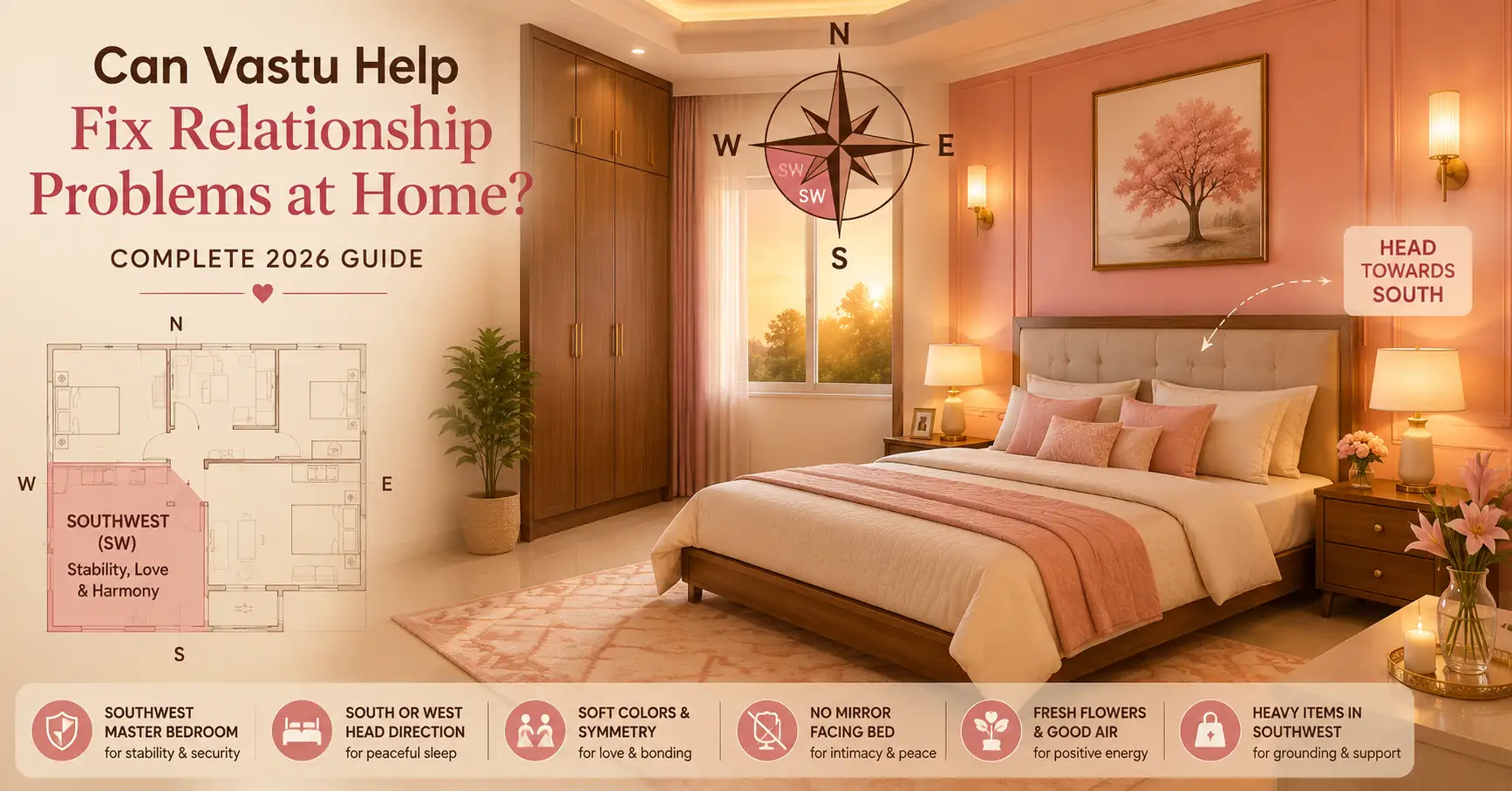
The zone the master bedroom occupies is the single highest-impact relationship Vastu factor. Each zone produces a distinct relationship pattern when the master bedroom is placed there:
| Bedroom Zone | Relationship Pattern | VastuIQ Score |
|---|---|---|
| Southwest (Correct) | Stability, groundedness, mutual support. Disagreements resolve without escalating. | 85/100 |
| Northwest | Frequent change, restlessness. One or both partners feel pulled toward independence or external activity. Relationship feels unsettled without external cause. | 58/100 |
| Southeast | Arguments that feel heated and disproportionate. Fire element energy in the couple’s sleep zone increases reactivity and reduces the ability to let things go. | 42/100 |
| Northeast | Mental restlessness, disrupted sleep, overthinking. Intellectual friction rather than emotional warmth. Distance that looks like philosophical incompatibility but is a zone energy problem. | 35/100 |
| North | Financially focused tension. Arguments centre on money, resources and practical decisions. The couple’s dynamic becomes transactional. | 48/100 |
The southwest pattern is the only zone where the master bedroom consistently produces settled, supportive relationship energy. This is the earth element’s natural function — holding, consolidating, providing stable ground for the people within it.
Factor 2 — Sleeping Direction (Head Position)
The direction the head points during sleep determines which directional energy the sleeper’s brain is oriented toward during the hours of deepest rest. This is among the most immediately actionable relationship remedies because it requires no structural change — only repositioning the bed or changing which end the couple sleeps at.
| Head Direction | Effect on the Sleeper | Relationship Implication |
|---|---|---|
| South (Best) | Deep, restorative sleep. Sense of groundedness on waking. | Both partners wake with emotional reserves intact. Patience and warmth are easier to maintain. |
| East (Good) | Energised, alert waking. Active, optimistic morning energy. | Positive morning dynamic. Both partners more receptive and forward-looking. |
| West (Acceptable) | Adequate rest. Dreams may be vivid or active. | Neutral to slightly restless. Acceptable if south or east positioning is not possible. |
| North (Avoid) | Disrupted sleep. The head facing north creates a magnetic conflict — the body’s own electromagnetic polarity (positive pole at the head) opposes the earth’s north magnetic field. Waking tired, headaches, vivid disturbing dreams. | Both partners wake depleted. Emotional regulation is impaired from the first waking moment. The day starts with a deficit that relationship interactions must navigate. |
The north-head sleeping position is the most common and most correctable relationship Vastu problem in Indian homes. Many couples have their beds positioned against the south wall as a space-saving measure, which places the head at the south end — correct. But beds against the north wall place the head facing north — the most disruptive sleeping direction. Check your bed position tonight and correct it if needed. This is the single fastest relationship Vastu improvement available in any home.
Factor 3 — Mirror in the Bedroom
A mirror that directly reflects the sleeping couple is one of the most consistently cited relationship Vastu problems in classical and modern Vastu guidance. The classical principle is that mirrors amplify the energy they reflect — and during sleep, when the couple’s energy is at its most vulnerable and receptive, a mirror reflecting the bed amplifies both the couple’s own energy and any disruption in the sleep zone.
Specific mirror rules for the bedroom:
- No mirror directly facing the bed — the most important rule. Cover or reposition a mirror that reflects the sleeping couple.
- No mirror on the wall at the foot of the bed — this position reflects the couple’s sleeping forms and is specifically flagged in classical texts as “kalaha karak” (conflict-causing).
- Mirrors on the north or east wall of the bedroom are acceptable when they do not directly face the bed.
- Dressing table mirrors should be angled or covered at night — a simple fabric drape over the mirror during sleep hours is a widely practiced and effective partial remedy.
Factor 4 — Southwest Zone Quality
The southwest is the earth element zone — the home’s primary stability anchor. Its condition directly affects the couple’s relationship stability in the way a foundation affects a building. When the southwest is strong (heavy, enclosed, master bedroom present), the couple’s relationship has energetic ground beneath it. When the southwest is weak (open balcony, light room, toilet, or empty), the relationship operates without this ground — minor friction escalates more easily, and recovery from disagreements takes longer.
Southwest zone relationship audit:
- Is the master bedroom in the southwest? If yes — strong foundation.
- Is the southwest the heaviest zone in the home? If yes — earth energy correctly reinforced.
- Is there an open balcony, large windows or a toilet in the southwest? If yes — earth zone is draining rather than consolidating. This is a significant relationship stability defect.
- Is the southwest corner of the bedroom itself kept heavy and grounded? Even if the full SW zone of the home has issues, ensuring the SW corner of the couple’s bedroom is the heaviest, most grounded part of the room provides partial compensation.
Factor 5 — Clutter and Non-Functional Items in the Bedroom
The bedroom carries the couple’s most intimate shared energy. Clutter in this space — old clothes, broken items, items from previous relationships, pending work brought into the bedroom, exercise equipment that is not being used — introduces stagnant, non-relationship energy into the couple’s primary shared zone.
Specific clutter patterns and their relationship associations:
- Items from previous relationships (gifts, photographs, correspondence) stored in the bedroom are specifically identified in Vastu and in several traditional Indian household practices as introducing a “third energy” into the couple’s space. Remove or relocate these outside the bedroom.
- Work items in the bedroom — laptops, files, pending documents — introduce professional stress energy into the rest and intimacy zone. The bedroom’s function is rest and relationship; work items reframe the space as a professional environment.
- Broken items in any part of the bedroom — broken furniture, non-functional electronics, damaged soft furnishings — carry the stagnant, non-functional energy the Brihat Samhita calls “vyadhi shakti.” In the bedroom specifically, this energy is associated with relationship stagnation — a sense that the partnership is not evolving or growing.
Want to know if your bedroom zone and placement are contributing to relationship friction? VastuIQ’s AI Floor Plan Analyzer identifies your bedroom’s zone, sleeping direction compatibility and key relationship Vastu factors from your floor plan. Check your home free at vastuiq.com
Factor 6 — Colours in the Master Bedroom
Bedroom colour affects the quality of rest, the emotional tone of the space and the energy available for relationship interaction. The colour prescriptions for the master bedroom are specific to its zone — southwest — and to its function as a space of rest, intimacy and emotional renewal.
Best relationship colours for the master bedroom:
- Light pink or rose tones: Venus’s colour associations — warmth, affection, receptivity. Specifically recommended for enhancing intimacy energy in the bedroom. Light and soft, not saturated.
- Warm cream or off-white: Neutral, restful, creates a sense of spaciousness without elemental conflict. The safest choice when other factors are uncertain.
- Light peach or apricot: Warm, nourishing tones that combine the cream’s restfulness with a gentle activation of warmth energy. Well-suited to southwest zone bedrooms.
- Beige and warm earthy tones: Earth element colours for the earth element zone — stable, grounding, consolidating. Particularly strong for couples whose relationship challenge is instability or restlessness rather than distance.
Colours to avoid in the master bedroom:
- Dark red or maroon as a dominant wall colour: Fire element tones in a rest space increase reactivity and reduce the capacity for patient, measured interaction.
- Electric blue or deep navy as dominant colours: Water element tones in the earth zone conflict elementally with the SW zone’s grounding function.
- Black: Suppresses and heavies any zone. In the bedroom specifically, black walls or dominant black furnishings are associated with emotional withdrawal and relationship distance.
- White only, clinical and cold: Pure white in the bedroom without warm accent tones creates an emotionally sterile environment. White as a base with warm accents is good; white alone in a large bedroom reads as cold and impersonal.
Factor 7 — Kitchen Placement and Decision Quality
The connection between kitchen placement and relationship harmony operates through the decision-making mechanism described in the classical framework section above. A kitchen in the northeast creates a fire-water elemental conflict that specifically degrades the quality of domestic decisions — the mundane, daily choices about finances, scheduling, parenting and household management that are the primary territory of couple friction.
Couples who consistently argue about practical household matters — rather than deep value differences or significant external stressors — often have a kitchen placement issue rather than a relationship issue. The decisions feel clear at the time and wrong in retrospect; the arguments feel disproportionate to the actual stakes. This is the cognitive pattern associated with a compromised northeast zone.
Remedy without relocation: cook facing east at all times, gas hob off the north wall, terracotta or orange tones in the kitchen space. See our Kitchen Vastu Direction Guide for the complete treatment.
Factor 8 — Entrance Pada and the Overall Energy Quality of the Home
The entrance pada determines the quality of energy that enters the home — and the home’s overall energy quality sets the baseline for every interaction that happens within it. A defective entrance pada does not specifically target the relationship — but it reduces the overall energy quality of the home environment, which means relationship interactions happen on a depleted foundation rather than a supported one.
Specific pada patterns and their relationship dimension:
- Pitru pada (South wall, Pada 1): Financial drain creates practical stress that constantly enters relationship territory. Arguments about money are arguments about the Pitru pada’s energy effect.
- Roga pada (West wall, Pada 1): Health issues in one or both partners create caregiving stress and the inevitable relationship strain that accompanies chronic health difficulty.
- Gruhakshata pada (East wall, Pada 2): “Household instability” pada — specifically associated with instability in the domestic relationship. Frequent changes, inability to settle, couple friction that appears connected to every external change.
The Relationship Vastu Bedroom Checklist
Run through this checklist for your master bedroom — it covers the highest-impact relationship Vastu factors in under ten minutes:
- Zone check: Is the master bedroom in the southwest zone? If not, which zone? (See table in Factor 1 for the pattern associated with your zone.)
- Head direction: Which direction does your head point while sleeping? South or east — correct. North — the most urgent correction available.
- Mirror check: Is there a mirror directly reflecting the bed? If yes — cover or reposition immediately.
- SW corner of bedroom: Is the heaviest furniture (wardrobe, large bedside units) in the southwest corner of the bedroom? If not — rearrange.
- Colour check: Are the bedroom walls in warm, restful tones (cream, light pink, peach, beige)? Or are they dark, cold or electrically bright?
- Clutter check: Are there items from previous relationships, broken items or work materials in the bedroom? If yes — remove.
- Electronics: Is there a television directly facing the bed? Television in the bedroom is acceptable in Vastu when it is not directly facing the sleeping couple — cover the screen at night or angle the set so it is not the dominant visual from the bed.
Remedies for Common Relationship Vastu Problems
These are the most impactful, most immediately actionable relationship Vastu remedies — all non-structural, all applicable today:
- Reposition the bed so the head points south. The single highest-impact relationship remedy available. If the bed currently has the head pointing north, reverse it. If reversing is not possible due to room layout, shift the bed to a wall that allows a south or east head position.
- Cover or remove mirrors that directly face the bed. A simple fabric drape over a dressing table mirror or a repositioned wall mirror. Takes five minutes.
- Place a pair of rose quartz crystals on the southwest corner of the bed or bedside table. Rose quartz is the most widely referenced crystal for relationship energy in both classical and contemporary Vastu practice. In pairs — representing the couple — placed in the earth element corner of the bedroom.
- Paint or add warm tones to the bedroom. If a full repaint is not possible, warm-toned cushion covers, a peach or rose throw on the bed, or warm-toned lampshades shift the bedroom’s colour energy without painting.
- Remove all work items from the bedroom. Laptop, files, work phone — charge them in another room. The bedroom’s energy is rest and relationship; professional items reframe it as a workspace.
- Load the southwest corner of the bedroom. Move the heaviest wardrobe or storage to the southwest corner if it is not already there. Earth element weight in the earth corner reinforces stability.
- Fresh flowers or a living plant on the north or east side of the bedroom. Living, flowering plants introduce growth and renewal energy. Avoid dried flowers — classical Vastu consistently identifies dried, dead plant material as carrying stagnant energy in the relationship zone.
Frequently Asked Questions — Vastu for Relationships
Can Vastu really help with relationship problems?
Vastu does not resolve relationship problems that are fundamentally about values, communication or compatibility — those require the couple’s own effort and, where needed, professional support. What Vastu addresses is the environmental layer: whether the space the couple shares supports or undermines the quality of rest, the groundedness and the decision-making clarity that healthy relationship interaction requires. Correcting a north-head sleeping position, removing a mirror that reflects the bed, and placing the bedroom in the southwest zone will not resolve deep relationship issues — but they consistently improve the baseline conditions from which those issues are navigated.
Which direction should the couple sleep for better relationship harmony?
The head should point south or east during sleep. South-head sleeping is the most strongly prescribed position in classical Vastu for the master bedroom — it produces the deepest, most restorative sleep quality, which directly supports the emotional regulation and patience capacity that relationship harmony requires. North-head sleeping is the most disruptive position and is specifically associated with relationship friction in classical texts. If your current bed position has the head pointing north, repositioning is the single most impactful relationship Vastu change available to you.
Is a mirror in the bedroom bad for relationships according to Vastu?
A mirror that directly reflects the sleeping couple is considered the most relationship-relevant bedroom Vastu defect after incorrect zone placement and north-head sleeping. The classical principle is that mirrors amplify the energy they reflect — in the bedroom, this amplification during sleep hours introduces a doubling of the couple’s energy that disturbs rest and is associated with conflict and distance. Mirrors on the north or east wall that do not directly face the bed are acceptable. The immediate remedy for a directly facing mirror is to cover it at night with a cloth — a simple, zero-cost action with an immediate effect on the bedroom’s energy quality.
What colours should be avoided in the bedroom for relationship harmony?
Dark red, deep maroon and strongly saturated fire-element colours as dominant wall tones increase reactivity and reduce the capacity for patient, measured interaction between partners. Black as a dominant bedroom colour is associated with emotional withdrawal and relationship distance. Electric blue and deep navy conflict elementally with the southwest zone’s earth energy. The colours to favour are warm, soft and restful — light pink, warm cream, peach, soft apricot and earthy beige tones consistently support the intimacy, warmth and groundedness that a healthy relationship bedroom requires.
Can Vastu help with a troubled marriage?
Vastu can improve the environmental conditions in which a marriage is operating — rest quality, decision-making clarity, the groundedness of the couple’s shared space and the stability energy of the southwest zone. These environmental factors affect the baseline quality of daily interaction, which over time influences the trajectory of the relationship. A troubled marriage needs more than Vastu — but a troubled marriage navigated from a spatial environment that undermines rest, clarity and stability is harder to repair than one navigated from a space that supports these qualities. Applying the remedies in this guide is a reasonable parallel action alongside whatever other support the couple is engaging with.
Related Vastu Guides
Master Bedroom Vastu — Direction, Bed Placement and Colours — the complete bedroom guide covering southwest zone placement, sleeping direction rules and colour prescriptions in full detail.
Vastu Dosh — Common Defects, Symptoms and Remedies — covers the specific doshas most associated with relationship and domestic harmony issues, including northeast zone defects, southwest weakness and entrance pada patterns.
21 Vastu Remedies Without Renovation — the complete non-structural remedy guide, including the mirror, colour, crystal and clutter remedies referenced in this article.
Vastu Colours for Home — Room-by-Room Colour Guide — the complete bedroom colour guide with zone-specific prescriptions and the elemental logic behind each recommendation for relationship-supportive bedroom tones.
Apply This to Your Own Property
Free AI Vastu analysis — room-by-room scores, geo-adaptive for India, UK, UAE and 50+ countries. Detailed report from ₹99.