
What you will learn in this guide
- The classical Vastu rules for sunlight and ventilation — zone by zone, direction by direction
- Why Vastu’s light and air prescriptions align closely with modern building science and health research
- Which rooms need the most natural light, and which windows matter most for Vastu compliance
- How airflow direction affects zone energy — and the classical prescription for cross-ventilation
- Practical steps to improve sunlight and ventilation in your existing home without structural changes
One of the most common questions from people encountering Vastu for the first time is whether it is just common sense with classical vocabulary attached. Nowhere is this question more pointed than in Vastu’s prescriptions for sunlight and ventilation — because these rules, when examined closely, align so precisely with modern building physics, environmental health research and bioclimatic design principles that the question almost answers itself.
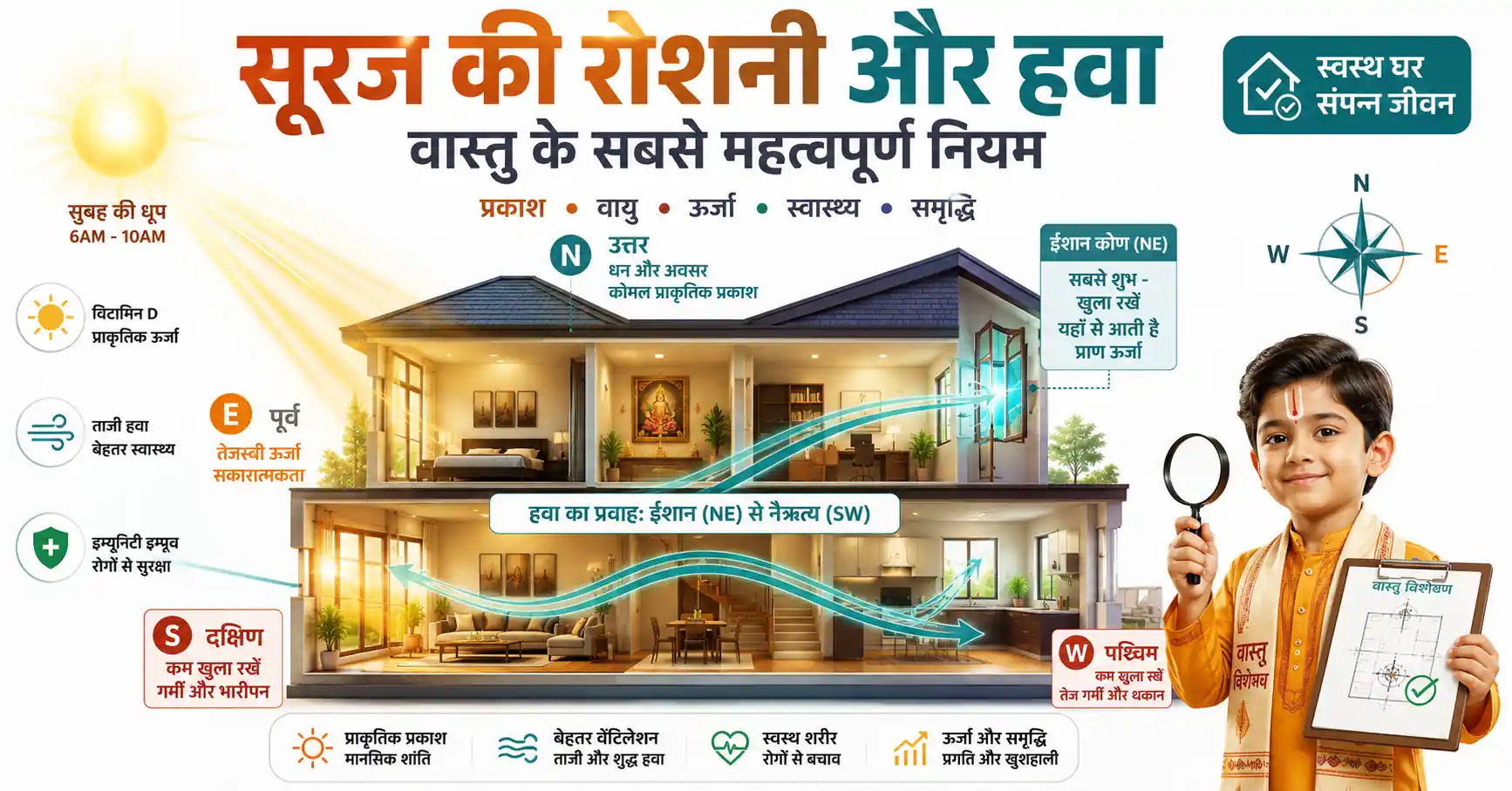
The classical Vastu texts prescribed morning sunlight in living areas, maximum openings on the north and east walls, minimum openings on the south and west walls, and cross-ventilation pathways running from northeast to southwest — all before modern science had the vocabulary to explain why these configurations reduce cortisol levels, improve circadian regulation, support immune function and reduce pathogen load in interior spaces.
This guide covers both dimensions: the classical Vastu prescriptions for light and air, and the modern evidence that explains why they work. Understanding both makes the rules more meaningful and the implementation more motivated.
The Classical Framework — Prana, Vayu and Surya in Vastu
Classical Vastu uses three Sanskrit concepts to describe the role of light and air in a home’s energy quality:
Prana — life force energy, carried primarily by moving air and natural light. A home that receives adequate natural light and has good air circulation is described as “prana yukta” (filled with life force). A home that is dark, stagnant and poorly ventilated is described as “prana heen” (depleted of life force). This is the classical framework’s most fundamental statement about light and air — they are not merely physical requirements, they are the primary carriers of the energy that makes a home life-supporting.
Vayu — the air element, governing the northwest zone specifically but present as a quality in every zone. Vayu in the classical system is associated with movement, freshness, social vitality and health. A home where Vayu circulates freely is healthy. A home where Vayu is obstructed — sealed rooms, blocked windows, poor cross-ventilation — accumulates what the Brihat Samhita calls “dushit vayu” (corrupted or stagnant air), which is associated with respiratory issues, low vitality and a general sense of heaviness.
Surya — solar energy, not just light but the complete spectrum of solar influence including ultraviolet radiation, infrared warmth and the circadian signals carried by the shifting quality of daylight through the day. The east wall is “Surya mukha” — the solar face — and receives the most spiritually and physically potent light of the day: the pre-sunrise dawn light and the early morning sun that carries the highest UV-B index of the day, the primary driver of vitamin D synthesis.
Classical reference: Manasara (Chapter 4, “Bhoomi Lakshana” — land and site qualities) states that a site receiving “purva surya” (eastern sun) and “uttara vayu” (northern wind) is the most auspicious for residential construction. The Mayamata (Chapter 3) prescribes that the north and east faces of a home should have “bahu dwara” (many openings) while the south and west faces should have “alpa dwara” (few openings). These prescriptions predate modern bioclimatic design by approximately 1,500 years and align precisely with the passive cooling and health-light principles that contemporary building science has independently established.
Sunlight Zone by Zone — The Classical and Scientific Picture Together
East Wall — Morning Sun (Most Valuable Light)
Classical prescription: The east wall should have maximum openings — large windows, ventilators, or a primary entrance — to allow the full benefit of morning solar energy into the home. The Manasara describes the east as “arogya pradayak” (health-giving) specifically in relation to the morning sun’s qualities.
Modern alignment: Morning sunlight (6–10 AM) carries the highest UV-B index of the day in most Indian latitudes — the specific wavelength band that triggers vitamin D synthesis in the skin. It also carries the strongest circadian entrainment signal — the blue-spectrum morning light that resets the suprachiasmatic nucleus (the brain’s circadian clock), reducing cortisol levels, improving sleep quality that night and regulating mood throughout the day. A home that receives morning sun through east-facing openings into regularly occupied spaces is giving its occupants the most health-relevant light exposure available.
Practical implication: The living room, kitchen or primary sitting area should ideally have an east-facing window. A bedroom with an east-facing window is not the Vastu ideal (the bedroom needs rest energy, not activation), but an east-facing window in the living area or entrance zone is among the highest-value architectural features a home can have from both classical and modern perspectives.
North Wall — Ambient Diffused Light (Steady and Non-Disruptive)
Classical prescription: The north wall should have generous openings — second only to the east wall in the number and size of windows prescribed. The north is Kubera’s direction and the water element’s zone; the Brihat Samhita associates north light with clarity, calmness and steady prosperity.
Modern alignment: North-facing light in the northern hemisphere (India’s latitudes) is diffused, indirect and relatively consistent throughout the day — the sun never shines directly from the north in locations north of the Tropic of Cancer (which includes all of North India, where classical Vastu was primarily codified). This diffused north light is particularly valued in architecture for spaces requiring visual clarity without glare — studios, offices, reading rooms. It does not create the harsh shadows or heat gain of direct south or west sun. A north-facing window provides the most visually comfortable, thermally stable natural light available in an Indian home.
Practical implication: Study rooms, home offices and living areas benefit most from north-facing light. Keep north-facing windows large, clean and unobstructed by heavy curtains or external compound walls.
South Wall — Afternoon Sun (Managed, Not Maximised)
Classical prescription: The south wall should have “alpa dwara” — few openings, smaller windows, limited glass area. The south carries Mars energy and the afternoon sun’s qualities — which classical Vastu describes as activating and intense rather than nourishing.
Modern alignment: South-facing windows in Indian latitudes receive direct sunlight from late morning through afternoon — the hottest, highest-glare period of the day. South-facing glass is the primary source of solar heat gain in Indian homes, contributing significantly to cooling load in summer months. Limiting south-facing glazing is a standard recommendation in Indian green building guidelines (GRIHA, IGBC) and bioclimatic design practice. Classical Vastu’s “alpa dwara” prescription for the south wall is identical to the modern building science recommendation — fewer, smaller, shaded south-facing openings.
Practical implication: Keep south-facing windows smaller than north and east windows. Use horizontal shading elements (chajjas, pergolas) above south-facing glass to block high-angle summer sun while allowing lower-angle winter sun. Avoid placing a home office or study room on the south face — afternoon glare and heat make sustained intellectual work uncomfortable.
West Wall — Evening Sun (Warmth Without Excess)
Classical prescription: Like the south wall, the west wall is prescribed to have limited openings. West light in Vastu is associated with Saturn’s energy — patient, accumulating, but also heavy when in excess.
Modern alignment: West-facing glass receives low-angle afternoon sun from approximately 2 PM to sunset — the most penetrating, hardest-to-shade solar angle of the day. West sun creates the most difficult glare conditions and the highest thermal load of any orientation, because the afternoon heat arrives when the building’s thermal mass is already fully charged from the day’s earlier solar gain. This is why west-facing rooms in Indian homes are consistently the hottest — a phenomenon classical Vastu addressed through limited west-wall openings long before passive solar design became a discipline.
Ventilation — The Classical Airflow Prescription
Vastu’s ventilation prescription is as specific as its light prescription and equally aligned with modern building science. The key principle is directional cross-ventilation — air entering from one direction and exiting through a different direction, creating a pressure differential that moves air through the home continuously.
The classical airflow direction: Northeast in, Southwest out
The Manasara prescribes that the primary air intake for a home should be from the northeast — the direction that receives the coolest, freshest air in most Indian climatic conditions — and that this air should flow through the home toward the southwest, where it exits through smaller or higher openings. This northeast-to-southwest airflow pathway crosses the home diagonally, providing the longest possible cross-ventilation path and ensuring that all zones receive fresh air movement.
Why this works climatically: In most of India, the predominant wind direction during the hot season is from the southwest — but the coolest wind, from the mountain-cooled north and northeast, arrives as the evening breeze that provides the most comfortable natural ventilation. The northeast face of a home, kept open with maximum windows and ventilators, captures this cooler airflow preferentially. The southwest face, kept more enclosed per classical prescription, provides the pressure differential that drives air through the home without creating the dust and heat of direct southwest wind entry.
During monsoon: Northeast openings also preferentially capture the pre-monsoon and monsoon breezes that carry the first cool, moisture-laden air — which the classical texts recognised as “amrita vayu” (nourishing air), associating northeast wind with health renewal.
The northeast window — the most important ventilation opening in any home
If one ventilation prescription from classical Vastu must be prioritised, it is this: the northeast zone of the home must have an adequate opening — a window, a ventilator or at minimum an air vent — that allows the northeast breeze to enter. This is simultaneously the most important Vastu ventilation rule and the most practically impactful window for natural cooling and fresh air quality in the home.
A northeast window kept open during early morning hours — when the air is coolest and the UV-B index is rising — provides the best combination of fresh air, morning light and circadian signal available in any position in the home. Classical Vastu’s prescription to keep the northeast zone open, light and unobstructed is a ventilation and light instruction as much as an energetic one.
Want to know how your home’s light and ventilation zones score in Vastu? VastuIQ’s AI Floor Plan Analyzer assesses your northeast zone openness, north and east wall exposure, and overall zone compliance from your floor plan image. Check your home free at vastuiq.com
Room-by-Room Light and Ventilation Guide
Living room
The living room should receive the most natural light of any common area. North and east-facing windows are ideal. Avoid making the living room the darkest room in the home by placing it in a zone with limited external wall exposure — a common issue in deep-plan apartments where the living room is in the centre of the floor plate. If natural light access is limited, supplement with warm artificial lighting at high lux levels to maintain the zone’s open, active energy.
Master bedroom
The bedroom needs adequate ventilation for air quality — a cross-ventilated bedroom significantly reduces pathogen load and improves CO2 levels during sleep, both of which affect sleep quality. However, the bedroom should not receive direct morning sun through east-facing windows directly onto the sleeping position — the circadian activation signal of morning light is helpful when waking is desired but disruptive when sleeping late on weekends. A northeast-facing bedroom window provides ventilation and gentle morning light without the full solar activation of a direct east window.
Kitchen
The kitchen in the southeast zone should have ventilation on its east and south faces — the east ventilator allows cooking vapour and heat to exit with the morning breeze, while the southeast window provides adequate light for food preparation. A kitchen with no external wall access (common in interior apartments) requires mechanical ventilation as a minimum — a sealed, unventilated kitchen accumulates cooking gases and moisture that degrade both air quality and zone energy regardless of Vastu placement.
Pooja room
The northeast pooja room should have a window on the north or east face — allowing morning light to enter during the primary worship time (early morning) and fresh air to circulate through the space. A pooja room without natural light and ventilation accumulates incense smoke, lamp fumes and CO2 from enclosed worship activity — both a health consideration and a Vastu energy concern. The northeast window in the pooja room is the most important single ventilation opening for this room.
Study room and home office
Maximum natural light from the north or northeast, cross-ventilated if possible. Intellectual work quality degrades measurably in high-CO2 environments — a sealed study room occupied for several hours without ventilation reaches CO2 concentrations that impair cognitive performance independently of any Vastu factor. The classical prescription for north and northeast openings in the study room is also the modern prescription for air quality in workspaces.
Bathroom and toilet
Adequate ventilation in the bathroom and toilet is the most universally agreed Vastu and modern health requirement. The specific Vastu prescription — toilet in the northwest with a north-facing ventilator — is designed to allow the prevailing cool north wind to carry bathroom air out through the northwest exit, maintaining freshness in the waste zone. A sealed bathroom with no external ventilation is a Vastu defect and a public health defect simultaneously.
Is Vastu Just Common Sense? — An Honest Answer
The sunlight and ventilation chapter of Vastu Shastra raises this question most sharply — because the prescriptions are so aligned with modern building science that it is reasonable to ask whether the classical system was encoding practical wisdom about climate and health rather than cosmic energy.
The honest answer is: both, and the distinction matters less than it might appear. The classical Vastu practitioners who prescribed northeast windows, south wall enclosure and cross-ventilation from northeast to southwest were making prescriptions that worked — for health, for comfort, for the quality of life in the home. They described why they worked in the vocabulary of their time (prana, Vayu, Surya, elemental energies), which is different from but not incompatible with the vocabulary of modern building science (UV-B, circadian entrainment, thermal mass, cross-ventilation pressure differential).
Whether you follow Vastu’s light and air prescriptions because you understand the classical framework, because you accept the modern scientific alignment, or simply because a well-lit, well-ventilated home feels better to live in — the prescription is the same. Open the northeast. Light the north. Limit the south and west. Let the air move through from cool to warm.
That is Vastu. It is also bioclimatic design. The overlap is not coincidental.
Practical Steps to Improve Light and Ventilation Without Structural Changes
- Clean all north and east-facing windows thoroughly — dirty glass reduces light transmission by 15 to 30 percent. A clean northeast window delivers significantly more morning light and ventilation than a grimy one. This is a zero-cost, immediate improvement.
- Remove heavy curtains from north and east-facing windows during daytime hours — replace with sheer fabrics that filter without blocking. The classical prescription for north and east openings is maximised by keeping these windows as unobstructed as possible during the day.
- Open the northeast window every morning for at least 30 minutes — this single daily practice is the most effective ventilation and morning light action available in any home, requiring no structural change.
- Add shading to south and west-facing windows — horizontal chajjas, bamboo blinds or external roller shutters on south and west glass reduce heat gain without reducing daylight to acceptable levels. This is the correct south and west window management approach — shade rather than block.
- Remove obstructions from the northeast zone — furniture, storage or clutter pushed into the northeast zone blocks both the northeast window and the cross-ventilation pathway. Clearing this zone improves both Vastu compliance and actual air quality.
- Use indoor plants to improve air quality in poorly ventilated zones — money plant, snake plant and peace lily are effective air-purifying plants for indoor environments with limited ventilation. Place them in the north or northeast zones to reinforce the Vastu prescription while providing measurable air quality benefit.
Frequently Asked Questions — Sunlight and Ventilation in Vastu
Why does Vastu emphasise the northeast for light and air?
The northeast receives two of the most beneficial natural elements simultaneously: the pre-sunrise and early morning light that carries the highest health-relevant UV-B index of the day, and the cool northern breeze that provides the most comfortable natural ventilation in most Indian climatic zones. Classical Vastu’s prescription to keep the northeast zone maximally open — no permanent obstructions, no heavy rooms — is simultaneously a Vastu energetic prescription (preserving the Ishaan zone’s water and space element energy) and a practical building science prescription (maximising beneficial light and air intake).
Is a south-facing home always hotter and more poorly ventilated?
South-facing homes receive more afternoon sun on their entrance face — which does increase thermal load in summer if not managed architecturally. However, this is a design and shading matter, not an unresolvable Vastu defect. A south-facing home with adequate horizontal shading (chajjas) above south-facing windows, cross-ventilation maintained from northeast to southwest internal zones, and north and east-facing internal rooms (study, living, bedroom) manages both the thermal and the Vastu implications of south facing effectively. The classical prescription for south-facing homes is not to avoid south facing but to manage the south wall carefully — fewer, shaded openings — while keeping the interior zones’ north and east exposure maximised.
What is the correct window size ratio for Vastu compliance?
Classical texts do not prescribe specific window dimensions but consistently describe north and east openings as “bahu” (many/large) and south and west openings as “alpa” (few/small). A practical modern interpretation: north and east-facing windows should together represent at least 50 to 60 percent of the home’s total glazed area. South and west openings should be limited to 20 to 30 percent of total glazed area, with shading provided for all south and west-facing glass. This ratio aligns with both classical Vastu prescription and contemporary energy-efficient building guidelines for Indian climatic zones.
Does Vastu support mechanical ventilation when natural ventilation is not possible?
Classical Vastu does not address mechanical ventilation as a category — the texts were written for a context where all ventilation was natural. The practical modern position is that mechanical ventilation (exhaust fans, heat recovery ventilators, HVAC) is acceptable where natural ventilation is impossible due to apartment layouts or urban density, but it supplements rather than replaces the Vastu requirement for northeast zone openness. A mechanically ventilated apartment with the northeast zone kept open, light and unobstructed scores better than one where the northeast zone is sealed and enclosed regardless of mechanical ventilation elsewhere.
Can plants replace natural light in dark zones of the home?
Plants improve air quality in poorly lit zones but do not replace the circadian and health benefits of natural light — they require light themselves to survive. In genuinely dark zones of a home (internal corridors, rooms with no external wall exposure), use full-spectrum artificial lighting (5000–6500K colour temperature, high CRI) as the closest approximation to natural daylight for both human health and plant health. From a Vastu perspective, any light is better than no light in a defective zone — the principle that light is prana applies to quality artificial light when natural light is structurally unavailable.
Related Vastu Guides
How to Find the Centre of Your Home — Complete Brahmasthan Guide — the Brahmasthan’s openness is the central distribution point for both prana and air circulation — this guide covers identification and assessment of your home’s central zone.
Vastu Dosh — Common Defects, Symptoms and Remedies — covers northeast zone obstruction, the most common light and ventilation defect, with severity scores and remedy pathways.
Vastu for Pooja Room — Direction, Idol Placement and Colours — covers northeast zone light and ventilation requirements for the pooja room specifically, including the importance of the northeast window for morning worship.
Vastu Colours for Home — Room-by-Room Colour Guide — covers how colour interacts with light quality zone by zone — light colours maximise the effect of limited natural light in constrained zones.
Apply This to Your Own Property
Free AI Vastu analysis — room-by-room scores, geo-adaptive for India, UK, UAE and 50+ countries. Detailed report from ₹99.