
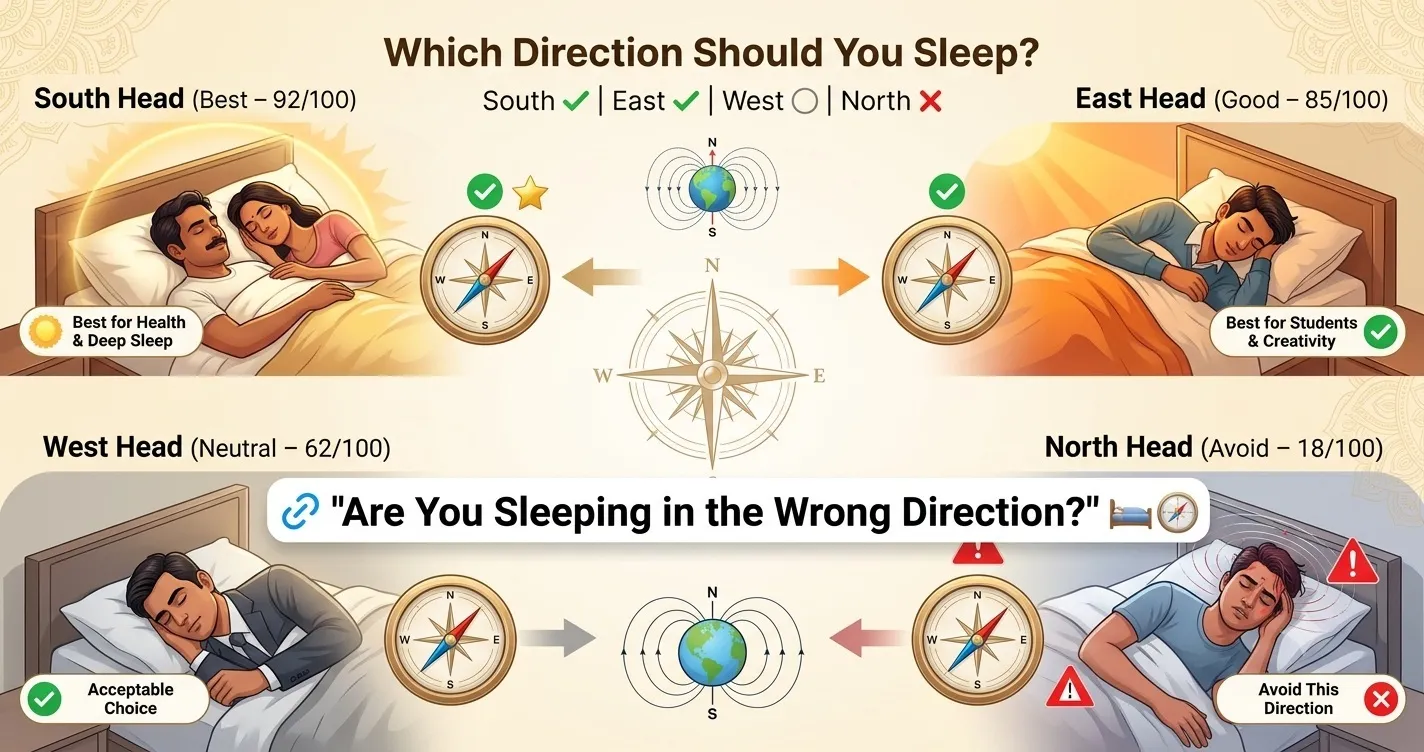
The direction your head points while sleeping is the single most impactful Vastu change you can make in your home — it requires no renovation, no expense and no consultant. It takes five minutes to check and five minutes to correct. And yet it is one of the most consistently ignored Vastu principles in Indian households.
Here is the complete answer — the classical verdict, the scientific explanation, the south versus east debate settled, and exactly what to do based on your specific situation.
All Four Sleeping Directions — Ranked and Scored
| Head Direction | Vastu Verdict | VastuIQ Sleep Score | Best For | Classical Deity |
|---|---|---|---|---|
| South ↓ | ⭐ Best — universally recommended | 92/100 | Adults, couples, elderly, general health | Yama — deep rest, completion |
| East → | ✓ Excellent — second choice | 85/100 | Students, children, creative professionals | Indra — vitality, new beginnings |
| West ← | ◯ Acceptable — neutral | 62/100 | Business owners, those seeking career gains | Varuna — patience, accumulation |
| North ↑ | ✗ Avoid — strongest prohibition | 18/100 | Nobody — no beneficial use case in Vastu | Kubera — wealth (not suited to sleep) |
How to read this table: “Head direction” means where the crown of your head points while lying down — not which way you face. If you lie on your back and your head is nearest the south wall, you are sleeping south-head. This is the correct classical definition and the one used throughout this guide.
The South vs East Debate — Settled
This is the most searched and most debated sleeping direction question in India. Different Vastu sites give different first answers. The confusion has a specific origin: different classical texts emphasise different directions depending on the context, and modern Vastu content authors pick the one that suits their argument without acknowledging the others.
Here is what the texts actually say:
South head (92/100) — the classical first choice for adults: The Mayamata (Chapter 7, “Dampati Griha” — the couple’s room) explicitly prescribes the south-head sleeping position for the master bedroom occupants. The Brihat Samhita (Chapter 53) describes south-head sleeping as producing “nidra sukha” — sleep pleasure — and “arogya” (health). The governing principle is magnetic alignment: the human body’s polarity (positive at the head, negative at the feet) aligns harmoniously with Earth’s magnetic field when the head points south (toward the magnetic south pole’s negative polarity). Opposite poles attract — the resulting electromagnetic alignment is believed to support deep, consolidating sleep.
East head (85/100) — the classical first choice for students and learners: The Manasara (Chapter 7) specifically prescribes east-head sleeping for the “vidya griha” (study room) and for students, describing it as producing “prajna” (wisdom) and “medha” (memory retention). The sun rising in the east creates a consistent early-morning light and circadian signal that supports alert, engaged waking — ideal for those whose primary daily activity requires sharp mental function. East-head sleeping is not a compromise from south — it is a deliberate prescription for a specific life stage and profession.
The reconciliation: South is the best direction for deep, restorative, health-consolidating sleep. East is the best direction for mentally activated, memory-supporting, student-quality sleep. Neither is wrong. They serve different purposes and are prescribed by different classical texts for different contexts. For most Indian adults who are not in full-time study, south is the primary recommendation. For children, students and those in knowledge-intensive professions, east is equally valid and in some texts specifically preferred.
Classical reference: Mayamata (Chapter 7, verse 18) states “Dakshina shirasah shayanam” — “sleep with the head toward the south.” The Manasara (Chapter 9) states “Purva shirasah vidyarthinam” — “students shall sleep with the head toward the east.” Both prescriptions are correct — they apply to different occupants. The Brihat Samhita (Chapter 53) classifies north-head sleeping under “arishta” (inauspiciousness) for residential occupants, stating it disturbs both sleep and health. None of the classical texts recommend north-head sleeping for living persons.
Why North-Head Sleeping Is the Strongest Prohibition in Vastu
Of all the sleeping direction rules, the prohibition against north-head sleeping is the most universally agreed upon across every classical text, every school of Vastu and every modern practitioner. Understanding why helps you take it seriously rather than dismissing it as superstition.
The classical reason — bodies of the deceased
In Hindu tradition, a deceased person is laid with the head pointing north before cremation — the belief being that the soul exits northward toward liberation. Sleeping north-head is therefore associated with the posture of death, not rest. The Brihat Samhita names this the “mrityu shayan” (death posture) when adopted by living persons and associates it specifically with health deterioration and mental disturbance.
The scientific mechanism — electromagnetic repulsion
The human body carries a weak but measurable electromagnetic field, with the head carrying relatively positive polarity. Earth’s magnetic north pole also carries positive polarity. When the head points north during sleep, two like poles face each other — electromagnetically, this creates repulsion rather than alignment. The result is a continuous low-level electromagnetic stress on the body during the hours of deepest rest.
A 2024 study published in Building and Environment (Elsevier) found measurable differences in brain wave activity during sleep between north-south and east-west orientations. A study in the International Journal of Indian Psychology found participants sleeping in the north-south axis reported improved sleep quality and lower blood pressure compared to east-west. While the specific mechanism remains under investigation, the directionality of the effect is consistent with Vastu’s classical prohibition against north-head specifically.
The practical observation
North-head sleepers most commonly report: waking tired despite adequate hours, vivid or disturbing dreams, persistent low-level headaches in the morning, and difficulty achieving the sense of deep rest that sleep is supposed to provide. These are also the symptoms most consistently associated with north-head sleeping in classical Vastu assessments — not abstract spiritual consequences but physically observable sleep quality outcomes.
Want to check more than just your sleeping direction? Your bedroom’s zone placement, colours, mirror position and overall layout all affect sleep quality together. VastuIQ’s AI Floor Plan Analyzer scores your complete bedroom setup from your floor plan. Check your bedroom Vastu free at vastuiq.com
Which Direction Is Right for You — Person-Type Matching
The classical texts do not give one universal prescription — they match sleeping direction to life stage, profession and health status. This is the section most sleeping direction Vastu guides miss entirely.
| Who You Are | Best Head Direction | Why |
|---|---|---|
| Adults — general household | South | Deep, health-consolidating sleep. Yama’s energy supports complete rest and recovery. |
| Couples — master bedroom | South | Mayamata’s explicit prescription for the dampati griha. Both partners’ body polarities align harmoniously with Earth’s field. |
| Elderly occupants | South | Deeper rest quality. Reduced cardiovascular stress during sleep. Classical texts specifically recommend south for older occupants. |
| Children (under 18) | East | Morning solar activation supports growth, learning and cognitive development. Manasara’s student prescription applies. |
| Students and researchers | East | Memory consolidation during east-head sleep is specifically cited in the Manasara. Morning alert waking from circadian solar signal. |
| Creative professionals | East | Morning east light activates creative energy. Writers, artists, designers and innovators benefit from the activated waking quality of east-head sleep. |
| Business owners and traders | South or West | South for deep rest and decision consolidation. West (Varuna’s direction) is associated with accumulated commercial gains in classical Vastu. |
| Those recovering from illness | South strongly preferred | Classical texts specifically note that north-head sleeping delays recovery. South-head alignment supports the body’s natural healing during rest. |
| Spiritual practitioners | East | East-head waking aligns with dawn prayer practices. The morning solar energy activation supports the alert, receptive quality that meditation and prayer require. |
| Guests (short stays) | West acceptable | Guest bedrooms often have limited orientation options. West is neutral and acceptable for short-duration stays. |
Bed Placement Rules — How to Achieve the Right Head Direction
Knowing the correct head direction is only half the answer. The other half is knowing where to place the bed in the room to achieve it. These are the practical placement rules:
To sleep south-head: Bed against the north wall
Place the bed so the headboard is against the north wall of the bedroom. This positions the head at the north wall end of the bed, pointing south. This is the most stable bed position in the room as well — the headboard against a solid north wall provides strong backing energy while the head points toward the stable, earth-element south.
To sleep east-head: Bed against the west wall
Place the bed so the headboard is against the west wall. The head then points east. In an east-facing bedroom, this means the window is at the foot of the bed — which is actually ideal, since morning east light enters at the feet end rather than directly into the sleeping face, providing the circadian signal without disrupting sleep.
Never: Headboard against the south wall
A headboard against the south wall places the head pointing north — the worst sleeping direction. This is one of the most common bed placement errors in Indian homes because the south wall often has the most available uninterrupted wall space. The convenience of the placement conceals its directional problem.
Never: Headboard against the east wall
A headboard against the east wall places the head pointing west — acceptable but suboptimal. More importantly, in east-facing rooms the east wall often has the main window — placing the headboard here blocks the window and positions the sleeper with their head toward an opening rather than a solid wall.
Headboard rules beyond direction
- Always against a solid wall — never floating in the centre of the room or against a glass partition.
- Never under a beam — a structural beam running directly above the sleeping position creates downward pressure energy. If unavoidable, a false ceiling panel below the beam is the standard remedy.
- Never in direct line with the bedroom door — a bed positioned so the feet point directly toward the bedroom door is called the “coffin position” — the classical Vastu prohibition mirrors the cross-cultural architectural principle that a bed aligned with a doorway creates a disturbed, exposed sleep environment.
- Never sharing a wall with a toilet — the wall your headboard rests against should not be the other side of a bathroom. If unavoidable, a copper sheet mounted on the shared wall behind the headboard is the classical remedy.
What to Do If You Cannot Change Your Bed Position
This is the most practically important section for most readers. Many Indian homes — particularly compact 2BHK flats — have bedrooms where the bed position is constrained by door placement, window locations, attached bathroom walls and the room’s dimensions. If you genuinely cannot achieve south-head or east-head sleeping by repositioning the bed, here are the options available:
Option 1 — Switch which end you sleep at
Before assuming the bed cannot be repositioned, check whether simply sleeping at the other end of the existing bed achieves the correct direction. Many couples sleep with the pillow at one end by habit rather than necessity. Moving the pillows to the other end of the bed — without moving the bed at all — can change the head direction from north to south or from west to east. Try this first. It costs nothing and takes thirty seconds.
Option 2 — Rotate the bed 90 degrees
A bed that cannot move along one axis can sometimes be rotated 90 degrees within the same room footprint. A bed positioned horizontally (east-west) often has room to be rotated to vertical (north-south) if the doorway and window positions allow. Sketch the room dimensions before dismissing this option — it works more often than people expect.
Option 3 — Metal strip remedy for unavoidable north-head position
If after genuinely exhausting repositioning options the head must point north, the classical remedy is a copper strip or copper-coloured metal element placed at the headboard end of the bed — specifically between the mattress and the headboard. Copper is the classical north-direction metal (Mercury’s metal), and its placement at the head end is prescribed in the Brihat Samhita as a partial mitigation for unavoidable north-head sleeping. This does not eliminate the directional defect but reduces its impact meaningfully.
Option 4 — Prioritise room reassignment
If the bedroom’s dimensions make correct head direction genuinely impossible regardless of bed rotation, consider whether a room swap is feasible. A bedroom in the southwest zone with space for correct south-head positioning is significantly more valuable from a Vastu perspective than a bedroom with more floor area that forces a north-head position. Room assignment is a higher-order decision than furniture arrangement.
Sleeping Direction for Couples — Specific Rules
When two people share a bed, both partners’ head directions should align. The Mayamata is specific about this — it prescribes south-head sleeping for the couple unit, not just one partner. Where partners have different preferences or professions that might suggest different directions, south takes priority as the master bedroom prescription. East-head sleeping for a partner who is a student or in an intellectually intensive profession is fully compatible with the other partner sleeping south-head only when they are in separate beds or the east-head prescription specifically applies to that partner’s life stage.
For couples sleeping in a shared bed:
- Both partners south-head: The strongest recommendation. Both partners’ electromagnetic fields align with Earth’s field in the same direction, supporting mutual rest quality and relationship harmony.
- Both partners east-head: Excellent for couples in early career stages, students or creative professionals where both partners benefit from the activated, mentally fresh waking quality.
- Partners facing opposite directions: Classical texts consistently advise against this arrangement — it places one partner’s head toward north and the other toward south, giving one partner the best and the other the worst sleeping direction simultaneously.
The Science Behind Sleeping Direction — What Research Actually Shows
Unlike most Vastu principles, sleeping direction has attracted genuine modern scientific interest because the proposed mechanism — Earth’s magnetic field — is physically real and measurable.
Earth’s magnetic field: The geomagnetic field runs approximately north to south, with field strength of 25–65 microteslas at the Earth’s surface. Human blood contains haemoglobin with four iron atoms per molecule. Whether this iron content is sufficient for the body to respond measurably to geomagnetic field orientation during sleep is the core scientific question.
What the studies show: A 2024 study published in Building and Environment (Elsevier — doi: 10.1016/j.buildenv.2024.111669) recorded measurable changes in brain wave activity across different sleeping orientations. Research published in the International Journal of Indian Psychology found north-south sleeping axis participants reported improved sleep quality and reduced blood pressure compared to east-west orientation. The Sleep Foundation references “a small but growing body of evidence” that the direction you sleep in may influence sleep quality, blood pressure and brain activity.
The honest scientific position: The evidence is real but not yet conclusive. The studies are small, the mechanisms proposed are plausible but not definitively proven, and the effect size — while statistically detectable — may be smaller than other sleep quality factors like mattress quality, temperature and light exposure. What the science confirms is that directional sleeping is not pseudoscience — it is a topic where the classical observation and emerging modern research are in the same direction, even if the research is not yet settled.
The practical conclusion: Aligning your sleeping direction with Vastu’s classical prescription — south-head for adults, east-head for students — costs nothing, requires no equipment and has no negative side effects. If the science ultimately confirms what the classical system has prescribed for 1,500 years, you benefit fully. If the effect size turns out to be smaller than the research currently suggests, you have still made a zero-cost improvement to your sleep environment. The risk-reward calculation makes this one of the highest-value Vastu actions available in any home.
Sleeping Direction and the Vastu Bedroom — The Complete Picture
Sleeping direction is the highest-impact individual bedroom Vastu factor — but it functions within a complete bedroom environment that includes zone placement, colours, mirror position and clutter management. Getting the sleeping direction right while sleeping in a northeast zone bedroom with a mirror facing the bed and north-head produces a better result than the north-head alone — but a worse result than all factors correct together.
The complete bedroom Vastu factors in priority order:
- Bedroom zone — Southwest is the correct zone. A bedroom in the northeast with south-head sleeping is better than a northeast bedroom with north-head sleeping but worse than a southwest bedroom with south-head sleeping.
- Sleeping direction — South or east head. This guide’s primary topic. Fix this second if the zone is non-negotiable.
- Mirror placement — No mirror directly reflecting the sleeping couple. Cover dressing table mirrors at night.
- Clutter and broken items — Remove all non-functional items, work equipment and items from previous relationships from the bedroom.
- Colours — Warm, earthy, restful tones. Light pink, warm cream, beige, soft peach for the SW master bedroom.
For the complete bedroom Vastu treatment including zone placement, colours and all placement rules see our Master Bedroom Vastu Guide. For the relationship harmony dimension of sleeping direction — which direction couples should sleep for better harmony — see our Vastu for Relationships Guide.
Frequently Asked Questions — Sleeping Direction as per Vastu
Which direction should head point while sleeping as per Vastu?
South is the universally recommended head direction for sleeping as per Vastu Shastra — prescribed in the Mayamata, Brihat Samhita and most major classical texts for adult occupants in the master bedroom. It scores 92/100 on VastuIQ’s sleep direction model. East is the second-best direction, specifically prescribed for students, children and intellectually active professionals, scoring 85/100. West is neutral and acceptable at 62/100. North is the strongest prohibition in all classical Vastu texts, scoring 18/100 — to be avoided by all living persons regardless of age or profession.
Is sleeping with head towards south good or bad?
Sleeping with the head toward the south is good — it is the highest-scoring and most universally recommended sleeping direction in Vastu Shastra. The classical basis is twofold: the Mayamata’s explicit prescription for south-head sleeping in the master bedroom, and the electromagnetic alignment principle where the head’s positive polarity faces south (attracting Earth’s negative south magnetic polarity) creating harmonious alignment rather than repulsion. South-head sleeping is associated with deep, restorative sleep, good health, financial stability and a sense of groundedness on waking.
Why should we not sleep with head towards north?
Three reasons, classical and scientific. Classically: the north-head posture is the position in which deceased persons are laid before cremation in Hindu tradition — the Brihat Samhita specifically names it “mrityu shayan” (death posture) for living persons and associates it with health deterioration and mental disturbance. Scientifically: the head’s positive electromagnetic polarity facing Earth’s positive north magnetic polarity creates repulsion rather than alignment — a continuous low-level electromagnetic stress during sleep. Practically: north-head sleepers most commonly report waking tired, morning headaches, disturbing dreams and non-restorative sleep — all consistent with both the classical warnings and the electromagnetic mechanism.
Is east-head sleeping better for students?
Yes — the Manasara specifically prescribes east-head sleeping for students and those engaged in learning, describing it as supporting “prajna” (wisdom) and “medha” (memory retention). The scientific alignment is strong: east-facing morning light provides the clearest circadian entrainment signal, helping students wake alert and mentally prepared. The combination of classical prescription and modern circadian science makes east-head sleeping the clear recommendation for children and students. Adults who are not in active study benefit more from south-head’s deeper, more consolidating rest quality.
What if my room layout makes south or east head sleeping impossible?
First, try switching which end of the bed you sleep at before concluding that repositioning is impossible — this solves the problem in many cases without moving the bed at all. If the bed genuinely cannot be repositioned to achieve south or east head, try rotating it 90 degrees within the room. If neither is possible, place a copper strip or copper-coloured metal element between the mattress and headboard as a classical remedy for unavoidable north-head sleeping. As a longer-term solution, consider whether a room swap within the home could provide a bedroom with better orientation options.
Can couples sleep in different directions if they have different Vastu needs?
No — when sharing a single bed, both partners should sleep with their heads in the same direction. The Mayamata prescribes south-head sleeping for the couple as a unit in the master bedroom. If both partners’ professions or life stages suggest different directions (one a student preferring east, one an adult professional benefiting from south), south takes priority as the master bedroom prescription. Sleeping in opposite directions — one partner’s head at each end of the bed — is consistently flagged in classical texts as a disharmonious arrangement that contradicts the couple’s shared energy field.
Does sleeping direction really affect health — is there scientific proof?
The scientific evidence is real but not yet conclusive. A 2024 Elsevier study recorded measurable brain wave differences across sleeping orientations. Research in the International Journal of Indian Psychology found north-south axis sleepers reported better sleep quality and lower blood pressure than east-west sleepers. The Sleep Foundation acknowledges “a small but growing body of evidence” on this topic. The honest position: the classical and modern research point in the same direction, the mechanism (Earth’s magnetic field) is physically real, and the cost of aligning with the classical recommendation is zero. The evidence is sufficient to act on even before the research is fully settled.
Related Vastu Guides
Master Bedroom Vastu — Direction, Bed Placement and Colours — the complete bedroom Vastu guide covering southwest zone placement, bedroom colours and all furniture placement rules that work alongside the sleeping direction guidance in this article.
Can Vastu Help Fix Relationship Problems at Home? — covers the relationship harmony dimension of sleeping direction in detail, including why both partners should sleep in the same head direction and the specific couple-focused bed placement rules.
What Role Does Sunlight and Ventilation Play in Vastu? — the science bridge guide covering how east-facing morning light supports circadian rhythm — directly relevant to why east-head sleeping works for students and the science behind directional sleep effects.
21 Vastu Remedies Without Renovation — covers the copper strip remedy for unavoidable north-head sleeping positions and other bedroom zone remedies referenced in this guide.
Apply This to Your Own Property
Free AI Vastu analysis — room-by-room scores, geo-adaptive for India, UK, UAE and 50+ countries. Detailed report from ₹99.