
What you will learn in this guide
- The single correct direction for a pooja room in any home — and why it never changes with facing direction
- Which direction idols and deities should face — the rule that most people get wrong
- Deity-specific placement rules for Ganesha, Lakshmi, Shiva, Durga, Krishna and more
- Colours, materials and lighting that amplify the pooja room’s spiritual energy
- What to do if your pooja room or mandir corner is already in the wrong zone
Of all the rooms in a home, the pooja room is the one where most Indian families feel the strongest personal conviction — and also receive the most contradictory advice. One relative says the mandir must face east. Another says north. A third says the idol must never face south. A fourth says it depends on which deity. The result is a paralysis that leads many families to place their mandir wherever space is available and hope for the best.
The classical Vastu texts have clear, specific and remarkably consistent guidance on this. The pooja room is not a subject of debate in the Manasara, Mayamata or Brihat Samhita — it is one of the most explicitly and precisely described spaces in all of classical Vastu literature. This guide gives you that guidance directly, without the contradictions, and explains the reasoning behind each rule so you understand what you are applying and why.
The Correct Direction for a Pooja Room — Northeast, Always
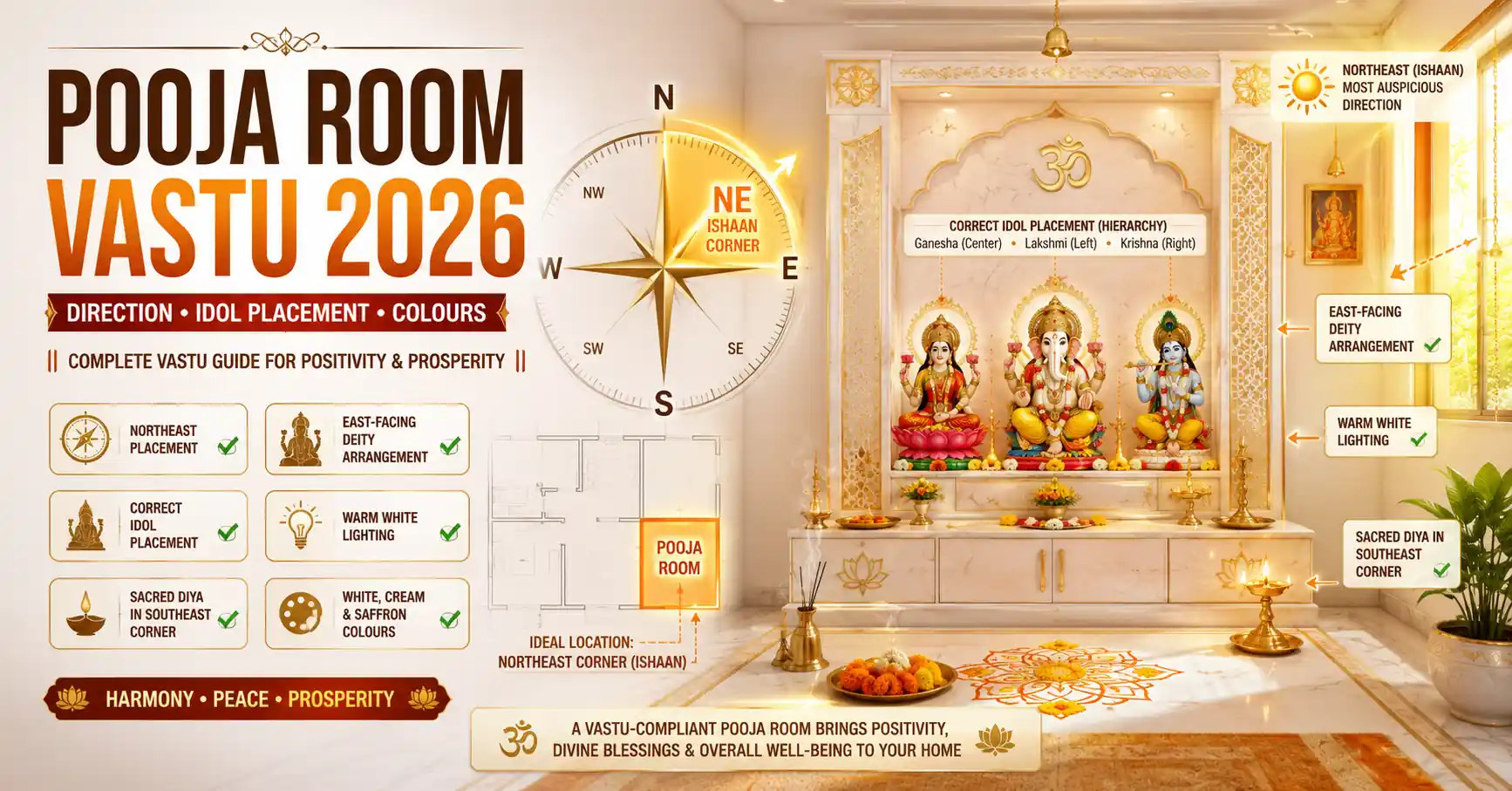
The pooja room belongs in the northeast zone of the home. This rule does not change based on the home’s facing direction. It does not change based on which deity is being worshipped. It does not change based on the size of the home or whether it is a flat or an independent house. Northeast is the Ishaan zone — the corner jointly governed by Ishana (an aspect of Shiva as cosmic ruler) and the water element — and it is the most spiritually charged directional zone in the entire Vastu Purusha Mandala.
Three reasons why northeast is universally the correct pooja room zone:
Elemental alignment. The water element governs the northeast. Water in Vastu represents clarity, purity, wisdom and receptivity — all qualities that support worship, meditation and spiritual practice. A prayer space placed in a zone of clarity and purity is elementally correct. A prayer space placed in the fire zone (southeast) or earth zone (southwest) carries the elemental qualities of those zones — activation and stability respectively — which are less suited to the quality of inner stillness that worship requires.
Solar alignment. The northeast receives the first light of the day — the pre-sunrise and early morning light that enters the home before direct sun reaches any other zone. In Vastu, this first light is considered the most spiritually potent light of the day, the period when the home’s energy is at its most receptive. A pooja room in the northeast is bathed in this light naturally, without any additional arrangement.
Classical prescription. Every major classical text is explicit on this point. The Manasara states that the “devagriha” (deity’s room) belongs in the northeast. The Mayamata describes the northeast as the zone of “divya shakti” (divine energy). The Brihat Samhita prescribes the northeast for the household shrine in all four facing directions without exception.
Classical reference: Manasara (Chapter 7, verse 41) states: “Devagriham Ishanyam sthapayeth” — “The deity’s room shall be established in the northeast.” This is one of the most unambiguous prescriptions in the entire classical Vastu literature. The Mayamata (Chapter 5) reinforces this, describing the northeast as “divya shakti sthana” — the place of divine energy — and specifying that no room carrying waste, fire or heavy storage shall share this zone with the household shrine.
When the Pooja Room Cannot Be in the Northeast — Alternatives and Priorities
In many apartments and compact homes, the northeast zone is already occupied by a fixed room — typically a bedroom or bathroom that cannot be relocated. In these situations, the classical texts offer a priority order for alternative placements:
| Priority | Zone | Suitability | Notes |
|---|---|---|---|
| 1st choice | Northeast (NE) | Ideal — always preferred | Ishaan zone, water element, divine energy |
| 2nd choice | East | Good | Solar energy, Indra’s direction, morning light |
| 3rd choice | North | Acceptable | Kubera’s direction, wisdom energy |
| 4th choice | West | Marginal | Acceptable only when NE, E and N are unavailable |
| Avoid | Southeast | Defect — fire zone | Fire element conflicts with sacred space |
| Avoid | South | Defect — Yama’s direction | Associated with death and endings |
| Avoid strongly | Southwest | Severe defect | Earth zone — heavy, grounding, unsuited to worship |
When the pooja room must occupy a 2nd or 3rd choice zone, the idol facing direction rules (below) become even more important — correct deity orientation partially compensates for a non-ideal room zone.
Idol and Deity Facing Direction — The Rule Most People Get Wrong
This is where the most widespread confusion in pooja room Vastu exists. The question people ask is: “Which direction should the idol face?” The answer requires understanding one critical distinction that most advice skips entirely:
The idol faces outward toward the worshipper. The worshipper faces toward the idol.
These are opposite directions. When we say an idol “faces east,” it means the idol’s face points east — and the worshipper stands to the west of the idol, facing east toward it. The idol’s back is to the west.
This distinction matters because much popular Vastu advice mixes up idol facing direction and worshipper facing direction, producing contradictory guidance. The rules below follow the classical definition: the direction stated is where the idol’s face points, which is also the direction the worshipper faces while praying.
Best idol-facing directions: East or West
The Manasara prescribes east or west as the primary idol-facing directions for household shrines. An east-facing idol (worshipper faces east) aligns the prayer with solar energy — the most classically supported pooja orientation. A west-facing idol (worshipper faces west) is also acceptable and is the second classical choice. Both are found in classical temple architecture as primary orientations.
North-facing idol: Acceptable
An idol facing north (worshipper faces north, toward Kubera’s direction) is acceptable for household shrines and is particularly referenced for Lakshmi and Kubera worship in texts dealing with prosperity-oriented prayer.
South-facing idol: Avoid for most deities
An idol facing south means the worshipper faces south — toward Yama’s direction — while praying. This orientation is avoided for most household deities. The exception is Hanuman, whose south-facing placement is specifically prescribed in classical texts as a protective orientation (facing Yama’s direction as a guardian). A south-facing Hanuman at the entrance or on the south wall of a pooja room is correct — a south-facing Lakshmi, Ganesha or Shiva is not.
Deity-Specific Placement Rules
Beyond the general idol-facing rules, classical Vastu and Agama Shastra texts provide specific guidance for the most commonly worshipped deities in Indian households. These rules cover both the position of the deity within the pooja room and the facing direction.
Ganesha
Ganesha is the first deity in any pooja sequence and the most widely installed household deity. He should face east or north. Place him at the entrance of the pooja room or on the left side of the shrine. Ganesha should never be placed facing south. If only one deity is installed in the home, Ganesha in the northeast zone facing east or north is the single highest-Vastu-compliance arrangement possible.
Lakshmi
Lakshmi governs wealth, abundance and domestic prosperity. Her natural zone alignment is with the north (Kubera’s wealth direction). An east or north-facing Lakshmi idol is preferred. Place Lakshmi on the right side of the main shrine arrangement. Avoid placing Lakshmi in the southeast (fire zone) as the heat element is considered to dry out the water-nourishment energy she represents.
Shiva (Shivling)
The Shivling has specific placement rules that differ from murti-based idols. The Shivling’s “mukha” (face or spout — the side from which water offerings flow) should face north. This means the Shivling is oriented with the spout toward the north wall, and the worshipper approaches from the south or east. A Shivling with the spout facing east is also acceptable. The south-facing spout is the placement to avoid for household shrines.
Durga and Kali
Durga and Kali carry protective, fierce (ugra) energy. Classical texts recommend placing them facing east or west. In a pooja room shared with more peaceful (saumya) deities like Lakshmi and Ganesha, Durga or Kali should be placed on the left side of the arrangement or slightly separate from the central shrine. Their protective energy is best directed outward — toward the entrance of the pooja room rather than toward the interior of the home.
Krishna and Radha
Krishna and Radha are among the most commonly installed household deities in northern and western India. They should face east or north. Place them in the centre or slightly right of the shrine arrangement. The idol should be at eye level when the worshipper is seated — a common error is placing Krishna too high, which requires the worshipper to look up at an uncomfortable angle during prayer.
Ram Darbar (Ram, Sita, Lakshman, Hanuman)
The Ram Darbar arrangement should face east. Hanuman within the arrangement faces outward (toward the worshipper). If a separate Hanuman idol is installed alongside the Ram Darbar, it should face south or east — never north, as Hanuman’s protective function is directionally oriented toward Yama’s southern domain.
Is your pooja room in the correct zone? VastuIQ’s AI Floor Plan Analyzer maps all eight zones of your home and identifies whether your pooja room or mandir corner is correctly placed — along with a full compliance score for every room. Check your home free at vastuiq.com
What Must Never Be in or Adjacent to the Pooja Room
Classical texts are as explicit about what must be excluded from the pooja room zone as they are about what belongs there. The following are direct prescriptions from the Manasara and Mayamata:
- No toilet sharing a wall with the pooja room. A bathroom or toilet on the other side of any wall shared with the pooja room is a significant Vastu defect. Where this exists and cannot be structurally resolved, a lead or copper sheet mounted on the shared wall (pooja room side) is the classical remedy.
- No shoe rack near the pooja room entrance. Footwear carries external, street-level energy and should never be stored near the pooja room. A minimum of one full room’s distance between the shoe storage area and the pooja room is the classical recommendation.
- No broken or damaged idols. The Manasara explicitly states that broken, chipped or damaged idols should not be installed or retained in a household shrine. A cracked idol should be respectfully immersed in flowing water (visarjan) and replaced. Retaining damaged idols is considered “dosh-karak” (defect-causing) for the household.
- No photographs of deceased family members alongside deity idols. Photographs of the departed belong in a separate, respectful space — not mixed with the active deity shrine. Combining the two mixes the energy of ancestral remembrance with active divine invocation, which classical texts identify as an inappropriate blending of energies.
- No storage of non-sacred items inside the pooja room. The pooja room should not double as a storage room for medicines, documents, cash, jewellery or household supplies — a common compromise in compact homes. If space constraints make this unavoidable, keep sacred items on a clearly defined upper shelf and store non-sacred items below, with a physical separator between the two.
- No dark colours in the pooja room. Dark walls (black, dark brown, deep navy) suppress the luminous, open energy the pooja room needs. This is non-negotiable regardless of which zone the room occupies.
Colours for the Pooja Room
The pooja room’s colour should support the qualities of clarity, purity and luminosity that the space is intended to carry. Classical texts do not prescribe a single colour but consistently reference the following as suitable for sacred spaces:
| Colour | Classical Association | Recommended Use |
|---|---|---|
| White | Purity, Saraswati, clarity | Walls and ceiling — most universally recommended |
| Light yellow / cream | Wisdom, Brihaspati, auspiciousness | Walls in homes where yellow feels warm and welcoming |
| Light blue | Vishnu, sky, divine expanse | Accent wall behind the main shrine |
| Saffron / light orange | Agni, tapas, spiritual fire | Accent colour for curtains, decorative borders |
| Light green | Mercury, growth, nature | Suitable for northeast zone rooms where the water-earth connection is strong |
The shrine itself — the wooden or marble mandir cabinet — carries its own material and colour conventions. Teak or sandalwood with natural finishes, white or cream marble, and gold accents are the most classically aligned material choices. Avoid synthetic materials with plastic finishes for the shrine structure itself.
Lighting for the Pooja Room
Light is among the most important elements in a pooja room’s Vastu compliance. Three types of light work together:
Natural light: The northeast zone’s early morning light is the most valuable natural light a pooja room can receive. Do not block the northeast-facing window of the pooja room with curtains, shelving or plants that reduce this light. Open the pooja room to morning light as a deliberate daily practice.
Diya or lamp light: The traditional earthen diya or brass lamp is more than a ritual object — it is a fire element activator within the water-element northeast zone, creating a deliberate and balanced elemental duality in the sacred space. The lamp should be placed in the southeast corner of the pooja room (fire element’s natural position within the room), not directly in front of the idol where it may obstruct the view of the deity.
Artificial lighting: The pooja room should be the brightest room in the home relative to its size. Warm white lighting (3000K to 3500K colour temperature) is preferred over cool white or blue-toned LEDs. Spotlights directed toward the idol from above and slightly in front create the most visually and energetically appropriate illumination for a household shrine.
Pooja Room Vastu for Apartments and Compact Homes
Many urban apartments do not have a dedicated pooja room — they have a mandir corner, shelf or niche within another room. The same Vastu principles apply, with proportional adjustments:
- Place the mandir corner or shelf in the northeast corner of whichever room it occupies — northeast corner of the living room is the most common and most Vastu-compatible arrangement.
- Ensure the mandir corner is at approximately chest or eye height when the worshipper is seated on the floor, or slightly above eye level when standing — never at floor level.
- Maintain a clear, uncluttered space around the mandir corner — at minimum one foot of clear space on either side and a clear line of sight from the room entrance.
- Do not place the mandir on a wall shared with the bathroom, even in a compact flat. If this is genuinely unavoidable, mount a copper or lead sheet on the shared wall behind the mandir.
- A mandir in the bedroom is acceptable only as a last resort. If it must be in the bedroom, place it in the northeast corner of the room, ensure it is covered with a cloth curtain during sleep hours, and never position the bed such that feet point directly toward the deity.
Frequently Asked Questions — Vastu for Pooja Room
Which direction should the pooja room face in Vastu?
The pooja room should be located in the northeast zone of the home — this is the universally prescribed position across all classical Vastu texts including the Manasara, Mayamata and Brihat Samhita. The northeast (Ishaan zone) carries water element energy associated with clarity, purity and divine receptivity. When northeast is not available, east is the second choice, north is the third. Avoid southeast, south and southwest for the pooja room in any home regardless of the overall facing direction.
Which direction should the idol face in a pooja room?
The idol should face east or west — meaning the worshipper faces east or west while praying. East-facing idols (worshipper faces east) are the most classically supported orientation, aligning the prayer with solar energy. North-facing idols are also acceptable. South-facing idols should be avoided for most deities — the exception is Hanuman, for whom south-facing placement is specifically prescribed as a protective orientation in classical texts.
Can the pooja room be in the bedroom?
A pooja room in the bedroom is not recommended but is acceptable as a practical last resort in compact homes. If placed in the bedroom, it must be in the northeast corner of the room, covered with a cloth curtain during sleep hours, and positioned so that neither the bed’s feet point toward the deity nor the worshipper’s back faces the deity while sleeping. A dedicated pooja room or even a separate shelf in the living room northeast corner is preferable to a bedroom mandir in all cases.
Can we keep photos of deceased family members in the pooja room?
Classical Vastu texts advise against placing photographs of deceased family members alongside active deity idols in the main shrine. The energy of ancestral remembrance and the energy of active divine invocation are considered distinct — mixing them in the same space creates an inappropriate blending of intentions. A separate wall or space for remembering the departed — outside the main pooja room — is the classically recommended arrangement.
Which colour is best for a pooja room?
White is the most universally recommended pooja room colour across classical texts — it represents purity, clarity and Saraswati’s energy. Light yellow or cream is the next most favoured, associated with wisdom and auspiciousness. Saffron or light orange works well as an accent colour for curtains or borders. Dark colours — black, dark brown, deep navy — should never be used as primary wall colours in a pooja room regardless of which zone the room occupies.
How many idols can be kept in a home pooja room?
Classical texts do not prescribe a specific maximum number, but consistently emphasise that the pooja room should not feel overcrowded or cluttered. A practical guidance followed in classical temple architecture is to install only the deities that will be worshipped daily with full devotion — installing many idols and then being unable to maintain regular worship for all of them is considered less auspicious than a smaller, consistently maintained shrine. Quality of daily practice matters more than quantity of installed deities.
Related Vastu Guides
These guides connect directly to the topics covered above and are recommended reading for homeowners setting up or correcting a pooja room:
How to Find the Centre of Your Home — Complete Brahmasthan Guide — identifies the northeast zone relative to the home’s central point, essential for correctly locating the pooja room in any floor plan.
Vastu Dosh — Common Defects, Symptoms & Remedies — covers what happens when the northeast zone is occupied by a toilet or kitchen instead of the pooja room, with severity scores and remedies.
21 Vastu Remedies Without Renovation — practical non-structural remedies for pooja rooms placed in less-than-ideal zones, including the copper sheet wall remedy and lighting corrections.
Vastu for Living Room — Furniture, TV & Sofa Direction — covers the northeast corner of the living room as the best location for a mandir shelf in compact apartments where a dedicated pooja room is not available.
Apply This to Your Own Property
Free AI Vastu analysis — room-by-room scores, geo-adaptive for India, UK, UAE and 50+ countries. Detailed report from ₹99.