
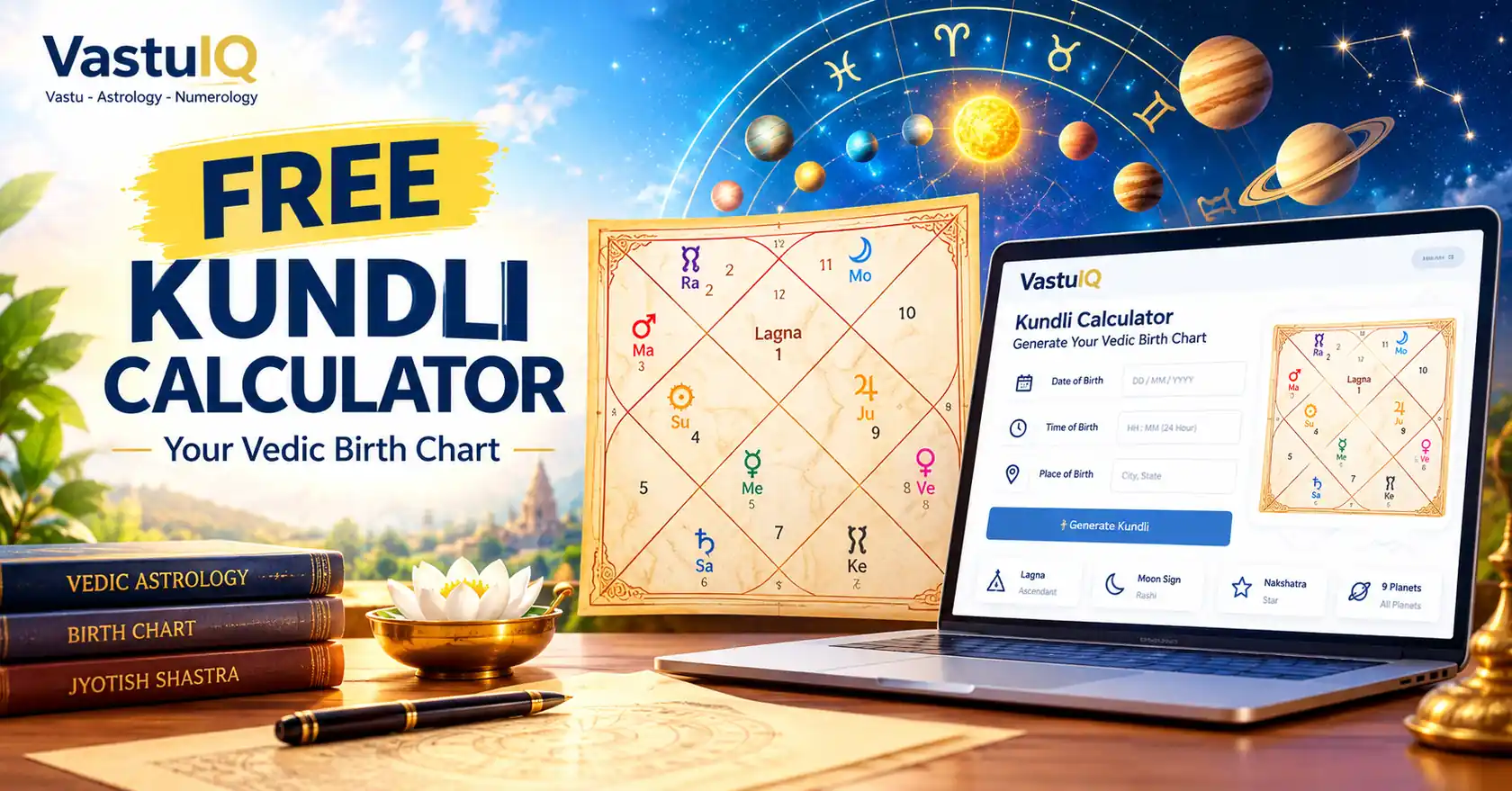
Millions of Indians have checked their “birth chart” online — and a significant portion of them have the wrong chart without knowing it. Western astrology sites calculate planetary positions using the tropical zodiac, which has drifted approximately 24 degrees from the actual sky due to a phenomenon called the precession of the equinoxes. In Vedic astrology — the tradition that governs Indian birth chart reading — planetary positions are calculated using the sidereal zodiac, aligned with the actual fixed stars. The result: your Western “Sun sign,” “Moon sign” and every planetary placement you may have seen on a Western astrology platform can be one or even two zodiac signs away from where those planets actually stood in the sky when you were born. Your real Vedic Kundli, calculated correctly with sidereal Lahiri ayanamsa, is a different — and more accurate — picture of your birth moment.
This guide covers everything about the Vedic Kundli — what it is, how it is correctly calculated, what the 12 houses mean, all 9 planets mapped to life areas, how to read your Lagna, Moon sign and Nakshatra, and how to use VastuIQ’s free Kundli Calculator to generate your real birth chart in under 2 minutes. Every section is written for someone who wants accurate information, not generic astrology content.
🔮 Generate your real Vedic birth chart — free
VastuIQ’s Kundli Calculator uses sidereal Lahiri ayanamsa — the correct standard for Vedic astrology — to generate your real birth chart with all 9 planets placed accurately. Free chart, free Astro Profile. Full PDF report with personality, career, marriage, wealth and health analysis at ₹249.
→ Generate My Free Kundli No signup. Free chart instantly.
What Is a Kundli — Complete Definition
A Kundli (also spelled Kundali) is a Vedic astrology birth chart — a precise map of where the Sun, Moon and seven other planets were positioned across the twelve zodiac signs and twelve houses at the exact moment and location of a person’s birth. The word comes from the Sanskrit “Kundala,” meaning coil or ring — a reference to the circular planetary map that depicts the sky as viewed from the birthplace.
The Kundli is known by different names across India’s linguistic regions — all referring to the same birth chart:
| Name | Region / Language |
|---|---|
| Kundli / Kundali | Hindi — used across North India |
| Janam Patrika / Janampatri | Hindi / Marathi — “birth leaf” or “birth record” |
| Jatakam | Tamil and Telugu — South India |
| Thikuji / Kusthi | Bengali / Kannada |
| Janma Kundali | Sanskrit — classical term used across traditions |
| Vedic Horoscope / Birth Chart | English — used in international contexts |
No two Kundlis are identical — because no two people are born at exactly the same moment in exactly the same place. Even twins born 10 minutes apart in the same hospital can have meaningfully different Kundlis because the Ascendant (Lagna) — the most time-sensitive element of the chart — shifts position approximately every 2 hours.
The Kundli is the foundational document of Vedic astrology. Every subsequent astrological assessment — marriage compatibility, career direction, dosha check, Dasha period analysis, muhurat selection — begins with the Kundli and reads from it. Your Rashi or Nakshatra tells you about one planetary placement; your full Kundli reads all nine planets simultaneously, across all twelve houses, in relation to each other.
Classical reference: The Brihat Parashara Hora Shastra (BPHS) — the foundational text of Vedic astrology — dedicates its opening chapters to the methodology of Kundli construction, specifying the correct calculation of the Ascendant from birth time and location as the primary technical requirement of all subsequent astrological analysis. The Brihat Jataka of Varahamihira similarly establishes the birth chart as the essential starting point of any Jyotish reading. Both texts prescribe sidereal planetary positions — calculated from the actual sky — as the correct foundation for Vedic chart calculation.
Vedic vs Western Birth Chart — Why the Difference Matters
This is the most important thing to understand before generating or reading any birth chart — and the one thing that most Indian users who have used Western astrology platforms have never been told.
The tropical vs sidereal divide
There are two fundamentally different systems for mapping planetary positions onto the zodiac:
Tropical zodiac (used by Western astrology): Anchors the zodiac to the Earth’s seasonal cycle — specifically to the vernal equinox, the moment the Sun crosses the celestial equator in spring. In this system, Aries always begins at the vernal equinox regardless of where the actual constellation of Aries is in the sky. The tropical zodiac follows the seasons, not the stars.
Sidereal zodiac (used by Vedic astrology): Anchors the zodiac to the actual fixed stars — specifically to the star Spica (Chitra Nakshatra) as the reference point. In this system, Aries begins where the actual constellation of Aries is in the sky. The sidereal zodiac follows the stars as they actually appear.
Due to a slow wobble in the Earth’s axis called the precession of the equinoxes, the tropical and sidereal zodiacs have gradually drifted apart over centuries. In 2026, the difference between them is approximately 23.9 degrees — almost an entire zodiac sign (each sign spans 30 degrees).
What this means for your chart
If you have ever read your birth chart on a Western astrology platform — most international apps and websites use the tropical system — every planetary position in that chart is approximately 24 degrees away from where the planet actually stood in the sky when you were born. For a planet near the end of a zodiac sign in the Western chart, this 24-degree shift places it in the previous sign in the Vedic chart. This means your Western “Leo Moon” may be a Cancer Moon in Vedic astrology. Your Western “Sagittarius Ascendant” may be a Scorpio Ascendant.
For Indian astrology — which uses Vedic Jyotish, the sidereal system, for all traditional assessments including marriage compatibility, Manglik dosha, Nakshatra matching and Muhurat selection — only the sidereal chart is the correct reference. The tropical chart used by Western astrology is a different calculation system producing different results, and applying Western chart readings to Vedic assessment questions produces incorrect conclusions.
The ayanamsa — the correction factor
The difference between the tropical and sidereal zodiacs at any given moment in time is called the ayanamsa. The most widely used ayanamsa in Indian Vedic astrology is the Lahiri ayanamsa (also called Chitrapaksha ayanamsa) — officially adopted by the Indian government for the Indian National Calendar and used as the standard by the majority of North Indian Vedic astrologers. VastuIQ’s Kundli Calculator uses Lahiri ayanamsa exclusively — the same standard your family astrologer, your pandit and the government of India use for all official astrological calculations.
Why Birth Time and Place Matter More Than Date Alone
The most consequential input in your Kundli is not your date of birth — it is your time of birth. Many people assume the birth date is the critical variable and treat the time as optional. This is the most common source of inaccurate Kundli readings.
The Lagna shifts every 2 hours
The Lagna (Ascendant) is the zodiac sign rising on the eastern horizon at the exact moment of birth. Because the Earth rotates on its axis, the horizon point moves continuously — completing a full 360-degree rotation in 24 hours. This means a new zodiac sign rises on the eastern horizon approximately every 2 hours (360 degrees ÷ 12 signs ÷ 24 hours = one new sign every 2 hours, though the actual rate varies by sign and location).
The Lagna becomes the 1st house of the Kundli — the anchor from which all 12 houses are counted. Change the Lagna and every house position in the chart changes with it. Two people born on the same date in the same city but 3 hours apart may have Lagnas in completely different zodiac signs — producing charts that look similar in terms of the slower-moving planets (Jupiter, Saturn) but have completely different house structures.
A worked example
Consider two people born on 15 March 1990 in Delhi:
- Person A — born 6:10 AM: Lagna in Aquarius (Kumbha). Mars falls in the 6th house. Venus is in the 2nd house. The chart shows a career-oriented personality with natural communication skills.
- Person B — born 10:10 AM: Lagna in Gemini (Mithuna). Mars now falls in the 10th house — the career house. Venus is in the 6th house. The chart shows a completely different career-relationship dynamic.
Same date. Same city. Four hours apart. Completely different charts — not just in one house but across all 12 simultaneously.
The AM/PM error — the most common Kundli mistake
VastuIQ’s Kundli Calculator specifically flags this: a chart generated from a birth time that is off by 12 hours — entered as 6:10 AM when the actual time was 6:10 PM — can still look entirely convincing. The Moon and slower-moving planets (Jupiter, Saturn) often stay in the same signs regardless of AM or PM on the same date. Nothing looks obviously wrong to a casual reader. But the Lagna and every house built from it are completely different from the real chart. Always verify AM vs PM from a birth certificate or hospital record before generating your Kundli.
What to do without birth time
If your exact birth time is genuinely unavailable after checking birth certificates, hospital records and family records, you can still generate a partial Kundli using an approximate time — but treat the Lagna and all house positions as indicative, not definitive. The planet signs and Nakshatras for the correct birth date are accurate regardless of time (except the Moon, which changes sign approximately every 2.5 days). Use VastuIQ’s free Kundli Calculator with the best available time estimate and note in the Astro Profile that the house layout is approximate.
The 12 Houses in Your Kundli — Complete Reference Guide
The 12 houses are the backbone of any Kundli reading. Each house governs a distinct domain of life — the planets placed within each house colour that domain with their specific energy. Understanding what each house governs is the foundation of reading your own chart.
| House | Sanskrit Name | Governs | Key Life Area | Most Significant Planets |
|---|---|---|---|---|
| 1st (Lagna) | Tanu Bhava | Self, body, personality, general outlook on life | Who you are — physical appearance, temperament, how the world perceives you | Lagna lord, Sun, Mars |
| 2nd | Dhana Bhava | Family, speech, accumulated wealth, food, values | How you communicate and accumulate — financial habits, family dynamics, voice quality | Jupiter, Venus, Mercury |
| 3rd | Sahaja Bhava | Siblings, courage, short journeys, communication, skills | Your drive and initiative — siblings, written communication, hands and arms | Mars, Mercury |
| 4th | Sukha Bhava | Home, mother, property, domestic happiness, emotional foundation | Your roots and security — where you live, relationship with mother, property matters | Moon, Venus, Mercury |
| 5th | Putra Bhava | Children, creativity, intelligence, romance, speculation | Your creative expression — children, artistic ability, love affairs, gut instincts | Jupiter, Sun, Venus |
| 6th | Ari Bhava | Enemies, health, service, debts, litigation | Your daily battles — workplace dynamics, health maintenance, overcoming obstacles | Mars, Saturn, Mercury |
| 7th | Kalatra Bhava | Marriage, spouse, partnerships, open relationships | Your partnerships — the spouse, business partners, how you relate to equals | Venus, Jupiter, Mars |
| 8th | Ayur Bhava | Longevity, transformation, sudden events, inheritance, secrets | Your depths — how you handle crisis, shared resources, hidden matters, life’s transformations | Saturn, Mars, Rahu |
| 9th | Dharma Bhava | Luck, father, religion, philosophy, long journeys, higher learning | Your fortune — spiritual inclinations, father, travel, higher education, life’s guiding philosophy | Jupiter, Sun |
| 10th | Karma Bhava | Career, public reputation, authority, government, social status | Your work and standing — profession, public achievements, relationship with authority | Saturn, Sun, Mercury, Mars |
| 11th | Labha Bhava | Income, gains, social network, elder siblings, aspirations | Your gains — income flow, social connections, fulfilment of desires, elder siblings | Jupiter, Saturn, Moon |
| 12th | Vyaya Bhava | Losses, expenditure, foreign travel, sleep, liberation, hidden matters | Your release — what you spend or lose, foreign connections, spiritual liberation, the subconscious | Saturn, Ketu, Venus |
How to use this table with your chart: Once you have generated your Kundli using VastuIQ’s free calculator, identify which planets are placed in which houses. A planet in a particular house brings its energy into that house’s life domain. Jupiter in the 2nd house amplifies wealth accumulation and family harmony. Saturn in the 7th house brings discipline and delay to marriage. Mars in the 10th house produces career drive and authority. The table above gives you the framework to begin reading your own chart’s most significant placements.
All 9 Planets — The Complete Life-Area Reference Table
Vedic astrology uses 9 classical planets (called Navagrahas — “nine planets” in Sanskrit) — 7 visible celestial bodies plus 2 mathematical points called Rahu and Ketu, the lunar nodes. Each planet governs specific life areas, personality qualities and natural domains. Here is the complete reference:
| Planet | Sanskrit Name | Governs | Strong Placement Produces | Challenged Placement Produces | Best Houses |
|---|---|---|---|---|---|
| Sun ☉ | Surya | Soul, authority, father, government, vitality, career | Leadership, confidence, career success, good relationship with authority figures | Ego issues, authority conflicts, health issues related to heart and eyes, father relationship problems | 1st, 5th, 9th, 10th |
| Moon ☽ | Chandra | Mind, emotions, mother, home, public, nourishment | Emotional stability, strong intuition, nurturing capacity, good relationship with mother and public | Emotional instability, mental anxiety, poor sleep, difficult relationship with mother | 1st, 4th, 7th, 10th |
| Mars ♂ | Mangal / Kuja | Energy, courage, siblings, property, drive, action | Physical vitality, courage, decisive action, strong will, excellent property and sibling relationships | Aggression, impatience, accidents, property disputes, conflict with siblings (and Manglik Dosha when in specific houses) | 1st, 8th, 10th (own sign) |
| Mercury ☿ | Budha | Intelligence, communication, business, skills, education | Sharp intellect, excellent communication, business acumen, skill development, analytical ability | Communication difficulties, learning challenges, nervous system issues, inconsistency in decisions | 1st, 2nd, 6th, 10th |
| Jupiter ♃ | Guru / Brihaspati | Wisdom, wealth, children, teacher, religion, fortune | Wisdom, financial abundance, excellent children, strong spiritual inclination, good fortune, protection from malefics | Overindulgence, misplaced optimism, weight gain, financial excess without discipline | 1st, 5th, 9th, 11th |
| Venus ♀ | Shukra | Love, marriage, beauty, luxury, arts, pleasure, relationships | Beautiful relationships, artistic talent, refined taste, material comfort, harmonious partnerships | Relationship complications, excessive indulgence, difficulty with commitment, reproductive health issues | 4th, 7th, 12th |
| Saturn ♄ | Shani | Discipline, karma, delay, longevity, service, hard work, justice | Exceptional discipline, long-term success through sustained effort, longevity, fairness, mastery through experience | Delays, obstacles, depression, chronic health issues, isolation, difficulty with authority | 3rd, 6th, 11th (own sign) |
| Rahu ☊ | Rahu (North Node) | Ambition, obsession, foreign, unconventional, material desire, illusion | Exceptional material achievement, innovative thinking, foreign connections, ability to break conventional boundaries | Obsessive behaviour, deception, confusion, sudden reversals, health issues of a mysterious or difficult-to-diagnose nature | 3rd, 6th, 10th, 11th |
| Ketu ☋ | Ketu (South Node) | Spirituality, liberation, past life patterns, detachment, mysticism | Spiritual insight, research ability, past-life talents expressed naturally, detachment that enables objectivity | Detachment that creates relationship difficulty, confusion about identity, health issues difficult to diagnose, sudden losses | 9th, 12th (spiritual houses) |
The most important insight from this table: No planet is inherently “good” or “bad” — each has a spectrum from its highest to its most challenging expression. A strong Saturn in the 10th house (career) produces one of the most successful professional placements in Vedic astrology — extraordinary discipline, recognition through sustained effort and a career built to last. A challenged Saturn in the same house produces delays, obstacles and authority conflicts. The chart’s full context — including the sign Saturn occupies, the planets aspecting it and the current Dasha period — determines where on the spectrum it operates.
How to Generate Your Free Kundli — Step by Step
VastuIQ’s Kundli Calculator at vastuiq.com/astrology/kundli-calculator generates your real Vedic birth chart in under 2 minutes. Here is exactly what the tool does and how to use it.
What you need
- Date of birth — day, month, year
- Time of birth — as precise as possible, with AM/PM confirmed. Check your birth certificate or hospital discharge papers.
- Place of birth — city and country (the calculator geocodes this automatically for precise latitude/longitude)
What the free chart gives you
- Real North Indian (diamond-style) birth chart with all 9 planets placed in their correct houses
- Your Lagna (Ascendant) — the zodiac sign rising at your birth moment
- Your Moon sign (Rashi) — the zodiac sign the Moon occupied at birth
- Your Sun sign — where the Sun stood in the sidereal zodiac at birth
- Your Nakshatra — the lunar constellation the Moon occupied, with your Pada (quarter) and ruling deity
- Your Astro Profile snapshot — a personalised overview across 6 life areas (career, marriage, wealth and property, personality, health and life themes) that you can prioritise in order of personal relevance
What the ₹249 full report adds
The paid PDF report goes beyond the chart itself into what every placement means for your specific life — in plain language, not astrological jargon:
- Personality analysis — your core character, natural strengths and shadow tendencies as shown by your Lagna, Sun and Moon combination
- Career direction — the 10th house analysis, Saturn’s placement, your natural professional domains and the directions most aligned with your chart
- Marriage and relationship patterns — the 7th house, Venus placement, relationship quality indicators and what your chart says about your partner type
- Wealth and property — the 2nd, 4th and 11th house assessment of your financial patterns, accumulation style and property timing
- Health outlook — constitutional health indicators and the planetary configurations to be aware of
- Practical remedies — chart-specific upay (remedies) for the most challenging planetary configurations in your chart
Why VastuIQ’s calculation is more precise
Most free online Kundli tools use pre-computed planetary tables — lookup-based systems that introduce errors of 1 to 3 degrees for planets near sign boundaries, and fail entirely on historical timezone quirks. VastuIQ’s calculator uses established ephemeris-based astronomical computation with Lahiri sidereal correction, and correctly handles India’s wartime daylight-saving periods from the 1940s — a complication that trips up many tools for people born between 1942 and 1945 when India briefly observed DST. If you or your parents were born in that period, VastuIQ’s calculator produces a more accurate chart than most alternatives.
🔮 Free Kundli Calculator — Generate Your Chart Now
Real sidereal Vedic birth chart, all 9 planets, Lagna, Moon sign, Nakshatra and personalised Astro Profile — free. Enter your birth date, time and place for an accurate result in under 2 minutes.
→ Generate My Free Kundli
No signup. ₹249 full report available after free chart.
Reading Your Kundli — Lagna, Moon Sign and Nakshatra Explained
Once your chart is generated, the three most immediately useful outputs are your Lagna, your Moon sign and your Nakshatra. Here is what each one means and how to use it.
Your Lagna (Ascendant) — the outer you
The Lagna is the zodiac sign that was rising on the eastern horizon at your exact birth moment. It becomes the 1st house of your chart — and from it, all 12 houses are counted. The Lagna governs your outer personality, physical appearance, natural approach to life and how the world perceives you before knowing you well. It is the mask you wear and the energy you project, as distinct from your inner emotional nature (Moon) or your soul’s core purpose (Sun).
In practice, many people find that their Lagna description matches how others see them more accurately than either their Sun or Moon sign alone. If you have always felt that your Western “Sun sign” description does not quite fit you — this is often because in Vedic astrology, the Lagna (rather than the Sun sign) is the primary personality indicator. When you read your Vedic Lagna description, the fit is frequently much closer.
Your Moon sign (Rashi) — the inner you
The Rashi is the zodiac sign the Moon occupied at the moment of your birth. The Moon changes sign approximately every 2.5 days — making it more time-sensitive than the Sun (which changes sign every 30 days) but less time-sensitive than the Lagna (which changes every 2 hours). Your Moon sign governs your emotional nature, your inner mental world, your intuitive responses and your relationship with your mother and your sense of home and security.
In Vedic astrology, the Moon sign carries more weight than the Sun sign for day-to-day personality and emotional tendencies. This is the opposite of Western astrology’s emphasis on the Sun sign. When Indian people ask “what is your Rashi?” they are asking your Moon sign — the primary indicator of personal temperament in the Vedic system.
Your Rashi also determines your Vimshottari Dasha starting point — the 120-year planetary period system that maps life timing in Vedic astrology. Check your Rashi from VastuIQ’s dedicated Rashi Calculator for the detailed Rashi profile and ruling planet analysis.
Your Nakshatra — the soul pattern
The Nakshatra is one of 27 lunar constellations — a division of the zodiac into 27 equal segments of approximately 13.3 degrees each. Your birth Nakshatra is determined by which of these 27 segments the Moon occupied at birth. Each Nakshatra has a ruling deity, a ruling planet, a specific symbol and a detailed set of personality and life-pattern associations that are considerably more nuanced than the 12 zodiac signs.
The Nakshatra is used in Vedic astrology for: naming the child (the first syllable of the name is traditionally chosen based on the birth Nakshatra), for marriage compatibility (Nakshatra compatibility matching, called Kuta matching, is the primary marriage assessment tool in South Indian tradition), and for timing auspicious events through the Panchang system. Your Nakshatra is also divided into 4 Padas (quarters), each of which corresponds to a navamsha sign and adds further specificity to the Nakshatra’s character.
Check your Nakshatra, Pada, ruling deity and ruling planet from VastuIQ’s dedicated Nakshatra Calculator.
Your Kundli for Marriage — What to Look For
Marriage assessment is the most common reason Indian families consult a Kundli — and it involves a specific set of chart factors that go beyond the general personality reading.
The 7th house — the marriage house
The 7th house in the Kundli is the primary marriage house — it governs the spouse, the quality of the marriage relationship and the native’s natural partnership style. The sign on the 7th house cusp, the planets placed in the 7th house and the condition of the 7th house lord all contribute to the marriage assessment. A strong, unafflicted 7th house with a well-placed 7th lord generally indicates a harmonious marriage. Malefic planets (Saturn, Mars, Rahu, Ketu) in the 7th house create specific marriage challenges — each with its own character.
Venus — the planet of love
Venus governs love, attraction, romantic partnership and marital pleasure. Its placement in the chart by house and sign indicates the native’s relationship style, their concept of beauty and harmony and the quality of romantic connection they naturally generate. A well-placed Venus (in the 4th, 7th or 12th house, or in its own signs Taurus or Libra, or in its exaltation sign Pisces) generally supports a rich and harmonious romantic life.
The Manglik check — Mars in marriage-sensitive houses
If Mars is placed in the 1st, 2nd, 4th, 7th, 8th or 12th house from the Ascendant, Moon or Venus, the person has Manglik Dosha — a specific condition that affects marriage energy and compatibility assessment. For any marriage-purpose Kundli reading, the Manglik status of both partners is checked alongside the general compatibility. Use VastuIQ’s dedicated Manglik Calculator for the precise VASTUIQ Manglik Index score (0–100) with cancellation analysis.
Marriage compatibility — the Guna Milan system
The most widely used marriage compatibility system in North Indian Vedic astrology is Ashtakoot Milan — a 36-point system that assesses 8 factors (Gunas) between two charts, with the Moon sign and Nakshatra as the primary reference points. A score of 18 or above out of 36 is generally considered compatible. For the complete Guna Milan compatibility assessment between two charts, use VastuIQ’s Marriage Compatibility Calculator.
Your Kundli for Career — The Key Indicators
Career assessment from the Kundli focuses primarily on three house-planet combinations:
The 10th house (Karma Bhava): The career house — the house of profession, public reputation and authority. Planets in the 10th house directly colour the professional life with their qualities. Sun in the 10th produces leadership and government connections. Saturn in the 10th produces slow, steady, eventually exceptional career achievement. Mars in the 10th produces entrepreneurial drive and authority roles. The 10th house lord’s placement indicates which life area the career will be most meaningfully connected to.
Saturn’s placement: Saturn is the planet of discipline, sustained effort and long-term professional structure. Its house placement and sign significantly influence the career trajectory — particularly the timing of professional milestones. Saturn rewards patience and penalises shortcuts; its Dasha periods are often the most professionally significant (and sometimes most challenging) of the native’s life.
The Lagna lord’s strength: The strength and placement of the planet that rules the Lagna sign is the primary indicator of overall life vitality and achievement capacity. A strong Lagna lord — in its own sign, exalted sign or a friendly sign with good house placement — underpins success in all domains including career.
The ₹249 VastuIQ Kundli report includes a dedicated career direction section — identifying the professional domains most aligned with your chart, the career-timing periods most significant in your Dasha sequence and the practical directions to consider.
Kundli for Property and Wealth — The 4th and 2nd House Connection
Property purchase and wealth assessment are among the most practically searched Kundli applications in India. The key house-planet indicators:
4th house (property): The house of home, property and real estate. Planets in the 4th house, the sign on the 4th cusp and the condition of the 4th house lord all indicate the native’s relationship with property — ease or difficulty of acquisition, type of home most suited and the timing of property transactions. Jupiter and Venus in the 4th house are particularly auspicious for property. Saturn in the 4th house often indicates delayed property acquisition but secure eventual ownership.
2nd house (accumulated wealth): The house of accumulated resources, savings and financial reserves. A strong 2nd house with benefic planets produces natural wealth accumulation. Jupiter in the 2nd house is one of the most classically auspicious wealth placements — Dhana Yoga (wealth combination) is formed when Jupiter is in the 2nd house with the 2nd lord strong.
11th house (income and gains): The house of regular income flow, gains from all sources and fulfilment of material desires. The 11th house and its lord’s condition significantly affect how readily income arrives and accumulates. Saturn in the 11th house is classically considered one of the strongest income positions in all of Vedic astrology — slow to start, eventually producing steady, large and sustained financial gains.
The Kundli and Vastu connection for property
This is where VastuIQ’s dual-vertical capability is uniquely valuable. Your birth chart indicates your natural relationship with property (4th house), your wealth accumulation pattern (2nd house) and your gain potential (11th house). The Vastu of the home you live in either amplifies or dampens the chart’s property and wealth potential. A person with an excellent 4th house who lives in a home with severe Brahmasthan defects may find their chart’s property promise suppressed by the Vastu environment. Checking both — your Kundli and your home’s Vastu — gives the most complete picture of your property and financial situation. Use VastuIQ’s free Vastu Calculator alongside your Kundli for this combined assessment.
Which VastuIQ Tool to Use for Which Question
VastuIQ’s astrology suite now has 7 live calculators covering every major Jyotish assessment. Here is the complete decision guide:
| Your Question | Best Tool | What It Gives You |
|---|---|---|
| What does my complete birth chart show? | Kundli Calculator | Full sidereal chart, all 9 planets, Lagna, Moon sign, Nakshatra, Astro Profile, ₹249 full report |
| Are our two charts compatible for marriage? | Marriage Compatibility Calculator | 36-point Guna Milan score, Manglik cross-check, compatibility tier |
| Am I Manglik? What is my score? | Manglik Calculator | VASTUIQ Manglik Index 0–100, 3-chart assessment, cancellation analysis, remedies |
| What is my Nakshatra? | Nakshatra Calculator | Nakshatra, Pada, ruling deity, ruling planet, Nakshatra profile |
| What is my Rashi (Moon sign)? | Rashi Calculator | Moon sign, ruling planet, element, quality and Rashi characteristics |
| What is my Lagna (Ascendant)? | Lagna Calculator | Ascendant sign, Lagna lord, personality profile from the Ascendant |
| What are today’s auspicious timings? | Panchang Calculator | Daily Tithi, Nakshatra, Yoga, Karana, Rahu Kaal, Shubh Muhurat |
| What is my home’s Vastu score? | Free Vastu Calculator | Directional compliance score, entrance pada, zone assessment |
| Complete home analysis with floor plan? | AI Floor Plan Analyzer | 25-factor scored home assessment from uploaded floor plan |
| Where is my home’s Brahmasthan? | Brahmasthan Calculator | Exact geometric centre coordinates, zone boundary, defect assessment |
Kundli and Vastu — The Connection Only VastuIQ Makes
VastuIQ is the only platform that integrates Vedic birth chart analysis with Vastu Shastra home assessment — and the connection between the two systems is more direct than most people realise.
Every planet in Vedic astrology has a governing direction in Vastu Shastra:
| Planet | Vastu Direction | Combined Implication |
|---|---|---|
| Sun | East | A strong natal Sun benefits additionally from an east-facing home or east-activated living space |
| Moon | Northwest | A challenged Moon benefits from a clear, well-maintained northwest zone and maximum northeast water element |
| Mars | South and Southeast | Manglik individuals benefit from southeast zone activation and south wall copper elements |
| Mercury | North | A strong Mercury in the chart + clear north zone = amplified intellectual and financial energy |
| Jupiter | Northeast | A well-placed Jupiter benefits maximally from a correctly maintained northeast zone (sacred Ishaan Kona) |
| Venus | Southeast and East | A strong Venus in the 7th house + correctly placed southeast kitchen = harmonious domestic-marriage energy |
| Saturn | West and Southwest | Saturn’s discipline energy is reinforced by the heavy earth quality of the correctly placed southwest master bedroom |
| Rahu | Southwest (defective) | A challenging Rahu in the chart is worsened by southwest zone defects — this zone must be strongly maintained |
| Ketu | Northwest | A spiritual Ketu placement benefits from a well-maintained northwest zone and northeast mandir |
The practical application: after generating your Kundli and identifying your chart’s strongest and most challenged planetary placements, check your home’s corresponding directional zones. If Jupiter is your chart’s most benefic planet and your home’s northeast zone (Jupiter’s Vastu direction) is blocked, cluttered or defective — your chart’s Jupiter promise is being suppressed by the Vastu environment. Correcting the northeast zone allows your chart’s Jupiter energy to express more freely. This is the integrated Vastu-Jyotish approach that VastuIQ uniquely enables.
Frequently Asked Questions — Kundli Calculator
What is a Kundli and why do I need it?
A Kundli is your Vedic astrology birth chart — a precise map of where all 9 planets were positioned at your exact moment and place of birth. It is the foundational document of Vedic astrology — every marriage compatibility check, Manglik assessment, career reading, property timing and Dasha period analysis begins with and reads from the Kundli. Without your Kundli, astrology assessments are based on general Sun-sign or Moon-sign profiles that apply to 1/12 of the population equally — not to you specifically. Your Kundli is unique to your birth moment; it is the specific, personalised starting point for any meaningful astrological guidance.
Can I make my Kundli without birth time?
You can generate a partial Kundli without birth time, but it will be incomplete. The Lagna (Ascendant) and all 12 house positions — which determine which planet governs which life area — require birth time to calculate. Without birth time, only the planets’ zodiac signs (not their house placements) are available, along with the Moon sign and Nakshatra. This gives a partial picture. Check your birth certificate, hospital records or family documents for your birth time before generating your Kundli. If genuinely unavailable, use VastuIQ’s free Kundli Calculator with the best available estimate and treat the house layout as approximate.
What is the difference between Kundli and horoscope?
“Horoscope” is the Western term for a birth chart — it refers to the same concept as Kundli but is calculated using the tropical zodiac rather than the sidereal one. In Indian usage, “horoscope” is sometimes used interchangeably with Kundli, but technically the Kundli is the Vedic sidereal chart while the horoscope is the Western tropical chart. For all Indian astrological purposes — Manglik assessment, Kundli matching, Dasha periods, Nakshatra compatibility — always use the Vedic sidereal Kundli, not a Western horoscope.
What is the difference between Rashi and Nakshatra?
The Rashi is one of the 12 zodiac signs — determined by which sign the Moon occupied at birth. The Nakshatra is one of 27 lunar constellations — a finer division of the same zodiac, determined by which of 27 segments (each approximately 13.3 degrees) the Moon occupied at birth. Every Rashi contains 2.25 Nakshatras. Your Rashi is the broader category; your Nakshatra is the more specific one. Both are based on the Moon’s position. For naming conventions and marriage compatibility (particularly in South Indian tradition), the Nakshatra is used as the primary reference. For day-to-day character and monthly prediction, the Rashi is the primary reference.
Is the Vedic Kundli different from a Western birth chart?
Yes — significantly. The Vedic Kundli uses the sidereal zodiac (aligned with actual stars, Lahiri ayanamsa), while the Western birth chart uses the tropical zodiac (aligned with Earth’s seasons). The two systems differ by approximately 24 degrees in 2026 — meaning every planetary position in a Western chart is approximately 24 degrees away from its Vedic position. For planets near a zodiac sign boundary, this difference places the planet in a different sign entirely in the Vedic system. For Indian astrological purposes — Manglik assessment, Kundli matching, Nakshatra identification — always use the Vedic sidereal chart.
What does Lagna mean in Kundli?
Lagna means Ascendant — the zodiac sign that was rising on the eastern horizon at your exact birth moment. It becomes the 1st house of your Kundli and anchors the positions of all 12 houses. The Lagna governs your outer personality, physical appearance, natural temperament and how others perceive you. It changes approximately every 2 hours as the Earth rotates, making it the most time-sensitive element of your chart and the primary reason birth time is essential for an accurate Kundli. Use VastuIQ’s dedicated Lagna Calculator to identify your Ascendant sign and its detailed characteristics.
Which is more important — Sun sign, Moon sign or Lagna?
In Vedic astrology, all three are important but serve different purposes. The Lagna (Ascendant) describes your outer personality and general life approach — how others see you and how you naturally engage with the world. The Moon sign (Rashi) describes your inner emotional nature, mental patterns and intuitive responses — who you are when you let your guard down. The Sun sign describes your soul’s core purpose and identity — the person you are becoming over your lifetime. Most Vedic astrologers weight the Lagna and Moon sign more heavily than the Sun sign for practical personality and compatibility assessment, which is the reverse of Western astrology’s emphasis on the Sun sign.
How is VastuIQ’s Kundli Calculator different from other free tools?
Three primary differences: calculation methodology (VastuIQ uses established ephemeris-based astronomical computation with Lahiri sidereal correction, producing planet positions accurate to within fractions of a degree — versus the lookup tables with 1 to 3-degree errors common in most free tools); historical timezone handling (VastuIQ correctly handles India’s wartime DST periods in the 1940s, which produce wrong charts for people born in that era on most tools); and integrated tool ecosystem (VastuIQ’s Kundli links directly to the Manglik Calculator, Nakshatra Calculator, Rashi Calculator, Lagna Calculator, Marriage Compatibility Calculator, Panchang Calculator and the Vastu tool suite — giving a complete astrological and Vastu assessment from one platform).
Generate Your Kundli + Explore All Tools
🔮 Free Kundli Calculator — Generate Your Real Vedic Birth Chart
Real sidereal Vedic birth chart with all 9 planets, Lagna, Moon sign, Nakshatra and personalised Astro Profile — free. Full PDF report covering personality, career, marriage, wealth and practical remedies at ₹249.
All VastuIQ astrology tools:
🔴 Manglik Calculator — VASTUIQ Manglik Index score from all 3 charts
❤️ Marriage Compatibility Calculator — 36-point Guna Milan score
🌙 Nakshatra Calculator — Nakshatra, Pada, deity and ruling planet
♈ Rashi Calculator — Moon sign, ruling planet and profile
⬆️ Lagna Calculator — Ascendant sign and personality profile
🗓️ Panchang Calculator — Daily auspicious timings, Rahu Kaal, Muhurat
Manglik Dosha guides:
Manglik Dosha — Complete Guide 2026 — the full hub guide with scoring model and North vs South India variation
What Is Manglik Dosha — Meaning, Effects and Myths — the complete definition guide with all 6 house effects
Manglik Dosha Remedies — Complete Guide by Score — score-tiered remedies from Kumbh Vivah to daily practices
VastuIQ Vastu tools:
🧭 Free Vastu Calculator — home directional compliance score
🏠 AI Floor Plan Analyzer — 25-factor complete home assessment
🏛️ Brahmasthan Calculator — geometric centre and zone mapping
🚪 Pada Calculator — main entrance Vastu score
Apply This to Your Own Property
Free AI Vastu analysis — room-by-room scores, geo-adaptive for India, UK, UAE and 50+ countries. Detailed report from ₹99.