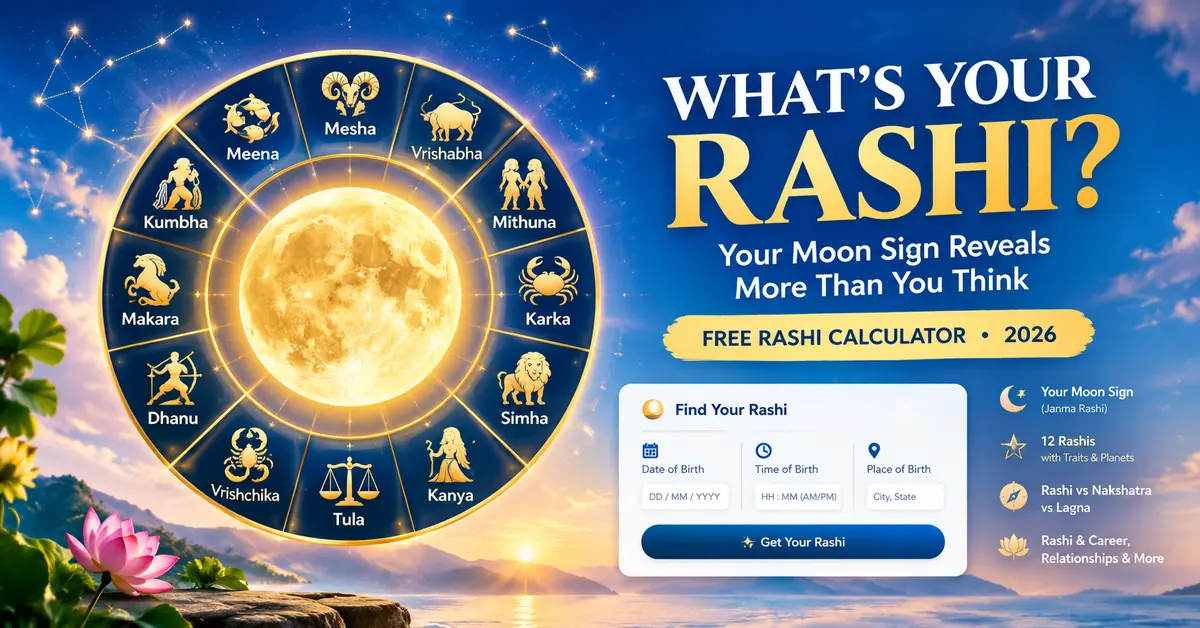
Most people in India know their Sun sign — Aries, Taurus, Gemini — from newspaper horoscopes. What most people do not know is that in Vedic astrology, your Sun sign is considered the least personal of the three primary chart positions. The sign that actually governs your emotional nature, your instincts, your relationship patterns and your compatibility with others is your Rashi — the zodiac sign the Moon occupied at the exact moment you were born.
This guide covers what Rashi is and why it matters, how it differs from Nakshatra and Lagna, all 12 Rashis with their traits and ruling planets, how Moon sign shapes your career and relationships, the Vastu directions linked to your Rashi, and how to find your exact Rashi using VastuIQ’s free calculator in under two minutes.
🌕 Find your Rashi — free
VastuIQ’s free Rashi Calculator finds your exact Moon sign from your date of birth, time and place — using precise sidereal Lahiri ayanamsa calculation. Under 2 minutes, no signup required.
→ Find My Rashi Free Free. Precise sidereal calculation.
What Is Rashi — The Moon Sign in Vedic Astrology
The word Rashi (Sanskrit: राशि) means “heap” or “collection” — referring to a collection of stars forming a zodiac sign. In Vedic astrology, there are 12 Rashis dividing the 360-degree ecliptic into 12 equal sections of 30 degrees each. Unlike Western astrology, which assigns the Sun sign as the primary indicator of personality, Vedic astrology treats the Moon sign (Janma Rashi) as the most important personal indicator.
The reason is rooted in the logic of Vedic cosmology. The Moon moves through the entire zodiac in approximately 27.3 days, spending roughly 2.5 days in each sign. Because it moves fastest of all the primary celestial bodies, it is considered the most personal and sensitive indicator — capturing the precise emotional and instinctive quality of the moment of birth. Your Janma Rashi (birth Moon sign) is whichever of the 12 zodiac signs the Moon occupied at your exact birth moment and location.
This is a sidereal calculation — meaning it uses the actual observable position of the Moon against the fixed star background, not the seasonal tropical position used in Western astrology. In 2026, the sidereal and tropical zodiacs differ by approximately 24 degrees (the ayanamsa). This means your Vedic Rashi will typically be one or two signs earlier than your Western Sun sign — which is why many people discover their Vedic Moon sign is completely different from the Sun sign they have always associated with.
Rashi vs Nakshatra vs Lagna — How the Three Relate
Three primary positions define a Vedic birth chart. Many people confuse them or use the terms interchangeably. They are distinct, serve different purposes and are calculated differently.
| Position | What It Is | Changes Every | Primary Use |
|---|---|---|---|
| Rashi (Moon sign) | Zodiac sign the Moon occupied at birth | ~2.5 days | Emotional nature, compatibility, daily prediction |
| Nakshatra | One of 27 lunar mansions the Moon occupied | ~54 hours | Naming, Kundli matching score, Dasha timing |
| Lagna (Ascendant) | Zodiac sign rising on eastern horizon at birth | ~2 hours | Outer personality, physical appearance, life path |
| Sun sign | Zodiac sign the Sun occupied at birth | ~30 days | Soul purpose, authority, career ambition |
Your Nakshatra sits within your Rashi — each Rashi spans 30 degrees and contains 2.25 Nakshatras. Knowing your Rashi narrows you to one of 12 groups; knowing your Nakshatra narrows you to one of 27 groups within that. The Lagna changes every two hours, making it the most time-sensitive position and requiring accurate birth time. To find your complete Nakshatra, use VastuIQ’s Nakshatra Calculator. For your complete Kundli with all three positions, use the Kundli Calculator.
All 12 Rashis — Part 1: Identity and Ruling Planet
The table below covers the core identity of each Rashi — its Sanskrit name, symbol, ruling planet and element. These four factors together determine the fundamental nature of a Rashi and why people born with the Moon in that sign express the qualities they do.
| Rashi | Sanskrit / Symbol | Ruling Planet | Element |
|---|---|---|---|
| Aries (Mesha) | मेष — Ram | Mars (Mangal) | Fire |
| Taurus (Vrishabha) | वृषभ — Bull | Venus (Shukra) | Earth |
| Gemini (Mithuna) | मिथुन — Twins | Mercury (Budha) | Air |
| Cancer (Karka) | कर्क — Crab | Moon (Chandra) | Water |
| Leo (Simha) | सिंह — Lion | Sun (Surya) | Fire |
| Virgo (Kanya) | कन्या — Maiden | Mercury (Budha) | Earth |
| Libra (Tula) | तुला — Scales | Venus (Shukra) | Air |
| Scorpio (Vrishchika) | वृश्चिक — Scorpion | Mars (Mangal) | Water |
| Sagittarius (Dhanu) | धनु — Archer | Jupiter (Guru) | Fire |
| Capricorn (Makara) | मकर — Sea-goat | Saturn (Shani) | Earth |
| Aquarius (Kumbha) | कुम्भ — Water-bearer | Saturn (Shani) | Air |
| Pisces (Meena) | मीन — Fish | Jupiter (Guru) | Water |
All 12 Rashis — Part 2: Core Traits and Tendencies
The table below covers what each Rashi expresses emotionally and behaviourally — particularly relevant since Rashi is the Moon sign, governing the emotional and instinctive self rather than outward identity.
| Rashi | Core Nature | Key Strength | Key Challenge |
|---|---|---|---|
| Aries | Impulsive, courageous, initiating | Bold action, leadership | Impatience, anger |
| Taurus | Steady, sensual, security-driven | Persistence, loyalty | Stubbornness, possessiveness |
| Gemini | Curious, communicative, versatile | Adaptability, wit | Inconsistency, restlessness |
| Cancer | Nurturing, intuitive, home-oriented | Emotional depth, care | Moodiness, over-sensitivity |
| Leo | Confident, generous, expressive | Charisma, warmth | Pride, need for validation |
| Virgo | Analytical, precise, service-minded | Attention to detail, reliability | Over-criticism, anxiety |
| Libra | Harmonious, fair, relationship-focused | Diplomacy, aesthetic sense | Indecision, people-pleasing |
| Scorpio | Intense, perceptive, transformative | Depth, determination | Jealousy, secretiveness |
| Sagittarius | Philosophical, optimistic, freedom-loving | Vision, enthusiasm | Bluntness, over-commitment |
| Capricorn | Disciplined, ambitious, structured | Endurance, practicality | Rigidity, emotional distance |
| Aquarius | Innovative, humanitarian, independent | Original thinking, social vision | Detachment, unpredictability |
| Pisces | Compassionate, imaginative, spiritual | Empathy, creativity | Escapism, boundary issues |
Why Vedic Astrology Uses Moon Sign — Not Sun Sign
The most common question people ask when they first encounter Vedic astrology is: why does it emphasise the Moon sign when Western astrology emphasises the Sun sign? The answer is both philosophical and practical.
Philosophically, Vedic astrology operates from a consciousness-centred worldview. The Moon governs the mind (manas) — the emotional, instinctive, reactive self that experiences life from moment to moment. The Sun governs the soul’s purpose and outer identity, which is important but relatively fixed and slow-moving. Since life is experienced primarily through the mind, the Moon sign is treated as the more personal, more intimate indicator of how a person actually functions — how they love, how they react under stress, what makes them feel secure or threatened.
Practically, because the Moon moves through one zodiac sign every 2.5 days, two people born in the same month in the same Sun sign can have very different Moon signs — and therefore very different emotional natures. This makes the Moon sign a more differentiating personal indicator than the Sun sign for people-level analysis.
The sidereal vs tropical gap amplifies this for Indian readers specifically. Because Vedic astrology uses the actual sky positions (sidereal) rather than the seasonal calendar positions (tropical), your Vedic Moon sign (Rashi) will almost always be different from the Sun sign you have been reading in Western horoscopes. Many people born under Western “Aries” discover they have a Vedic Moon in Pisces or Aquarius — a completely different set of qualities. This is not an error. It is the result of the two systems using different reference frames, both internally consistent within their own tradition.
Rashi and Kundli Matching — Why Moon Sign Governs Compatibility
The entire Guna Milan system used for marriage compatibility in Vedic tradition is based on Moon sign (Rashi) and Moon Nakshatra comparison — not on Sun signs. When a Pandit or Kundli matching software compares two charts, the first thing checked is the Rashis of both partners.
The most important compatibility check at the Rashi level is the Bhakoot score — one of the 8 Kootas in the Guna Milan system, worth up to 7 points out of 36. Bhakoot measures the moon sign relationship between the two partners: certain Rashi combinations are considered harmonious (1-7, 3-11, 4-10 relationships), while the combinations 2-12, 5-9 and 6-8 are flagged as potentially challenging. A 6-8 Bhakoot Dosha between two Moon signs is one of the most discussed concerns in Indian matchmaking.
Beyond Bhakoot, the Rashi also determines the Nakshatra groupings used for the Nadi and Tara Koota scores. Knowing both partners’ Rashis is therefore the starting point for any serious compatibility assessment. For the complete marriage compatibility guide, see VastuIQ’s Kundli Matching Calculator.
Rashi and Career — Moon Sign Tendencies
Career guidance based on Rashi is not about limiting choices — it is about understanding the natural energy signature your Moon sign brings to any work environment. The Moon governs how you process information, what kind of environment makes you feel secure, and where your instinctive strengths lie.
| Rashi | Natural Career Domain | Work Strength | Work Challenge |
|---|---|---|---|
| Aries | Defence, sports, surgery, entrepreneurship | Fast decision-making | Detail follow-through |
| Taurus | Finance, agriculture, luxury, music | Long-term consistency | Adapting to change |
| Gemini | Media, writing, sales, technology | Multi-tasking, communication | Deep focus on one task |
| Cancer | Healthcare, education, food, hospitality | Empathy, nurturing | Emotional boundaries |
| Leo | Politics, entertainment, management, education | Leadership, inspiration | Sharing credit |
| Virgo | Medicine, accounting, research, editing | Precision, analysis | Delegation and trust |
| Libra | Law, design, diplomacy, HR | Negotiation, fairness | Making fast decisions |
| Scorpio | Research, psychology, investigation, finance | Deep focus, insight | Trust in colleagues |
| Sagittarius | Education, law, travel, publishing | Vision, big-picture thinking | Routine and detail work |
| Capricorn | Government, real estate, engineering, banking | Structure, long-term planning | Spontaneity and play |
| Aquarius | Technology, NGO, science, social work | Innovation, systems thinking | Personal emotional connection |
| Pisces | Arts, spirituality, healing, film | Creativity, intuition | Practical execution |
Career guidance from Rashi alone gives a broad directional tendency. A complete career assessment in Vedic astrology also considers the 10th house (karma/profession), the 10th lord’s placement, and the current Vimshottari Dasha period. Your Kundli report covers all of these in the detailed birth chart analysis.
Rashi and Vastu — Moon Sign Direction Guidance
Vastu Shastra and Vedic astrology share the same planetary system. Each planet rules a direction in Vastu, and since your Rashi is ruled by a specific planet, your birth Moon sign has a corresponding Vastu directional energy that can be aligned with your home or workspace layout.
| Rashi | Ruling Planet | Vastu Direction |
|---|---|---|
| Aries, Scorpio | Mars | South |
| Taurus, Libra | Venus | Southeast |
| Gemini, Virgo | Mercury | North |
| Cancer | Moon | Northwest |
| Leo | Sun | East |
| Sagittarius, Pisces | Jupiter | Northeast |
| Capricorn, Aquarius | Saturn | West |
This directional link means that strengthening the Vastu zone of your ruling planet can indirectly support the energy of your Moon sign. For example, a Cancer Moon (ruled by the Moon, which governs the Northwest in Vastu) benefits from a clear, clutter-free Northwest zone in the home. A Jupiter-ruled Moon (Sagittarius or Pisces) benefits from a well-maintained Northeast — the zone associated with wisdom, clarity and spiritual energy in Vastu. For a complete property analysis that integrates planetary directions with room placement, use VastuIQ’s Vastu Analyzer.
Moon Sign and Daily Life — What Rashi Actually Governs
Understanding what the Moon sign actually governs in practical life helps explain why Vedic daily horoscopes (Rashifal) are based on the Rashi, not the Sun sign. The Moon moves through one new sign every 2.5 days, so the daily planetary transits relative to your Moon sign create the moment-to-moment energetic backdrop of your life.
Emotional responses: The Moon sign determines your instinctive emotional reactions — whether you tend toward warmth and nurturing (Cancer Moon), intensity and privacy (Scorpio Moon), lightness and social engagement (Gemini Moon) or patient steadiness (Taurus Moon). These are not learned behaviours; they are instinctive patterns that emerge under stress, in relationships and in moments of vulnerability.
Relationship needs: In a partnership, the Moon signs of both people reveal what each person needs emotionally to feel secure. A Virgo Moon needs order and reliability; a Sagittarius Moon needs space and intellectual stimulation; a Pisces Moon needs emotional validation and shared imaginative space. Incompatible Moon signs do not mean a relationship cannot work — they mean both people need to consciously bridge a different emotional language.
Daily rhythm and comfort: Your Moon sign describes your natural comfort zone — the environment, pace and type of activity that replenishes you. Fire Moon signs (Aries, Leo, Sagittarius) are energised by action and novelty. Earth Moon signs (Taurus, Virgo, Capricorn) are replenished by routine, physical comfort and tangible results. Air Moon signs (Gemini, Libra, Aquarius) need mental stimulation and social exchange. Water Moon signs (Cancer, Scorpio, Pisces) need emotional depth, quietude and creative or spiritual expression.
Rashifal (daily Moon sign horoscope): When you read a Rashifal — the daily prediction published by Indian astrology platforms — it is always based on the Moon’s transit relative to your birth Rashi. A Rashifal published for “Vrishabha” is for people with Taurus Moon, not Taurus Sun. This is why Vedic daily predictions require knowing your Rashi, not your Western Sun sign.
How to Find Your Rashi — Step by Step
Finding your accurate Rashi requires knowing three pieces of information: your date of birth, your time of birth (as accurate as possible), and your place of birth. The time and place matter because the Moon moves approximately half a degree per hour — meaning that on days when the Moon transitions from one sign to another, a birth a few hours apart can produce a different Rashi.
Using VastuIQ’s free Rashi Calculator takes under two minutes:
- Go to vastuiq.com/astrology/rashi-calculator/
- Enter your date of birth, time of birth and place of birth
- The calculator applies the sidereal Lahiri ayanamsa — the standard used by the Government of India’s Rashtriya Panchang
- Your Janma Rashi (Moon sign), its ruling planet and its element are returned instantly
- No signup required for the basic Rashi result
What if I do not know my exact birth time? If your birth time is unknown, the Rashi Calculator can still give you a result based on the date and place — but be aware that if the Moon was changing signs on your birth date, the result may be uncertain. In this case, the most reliable approach is to check your birth certificate, consult a family member who was present, or request records from the hospital where you were born. A Vedic astrologer can also use a technique called birth time rectification to determine the likely Lagna — and from that, the most probable Rashi — based on life events.
🌕 Find your exact Moon sign
VastuIQ’s free Rashi Calculator gives you your Janma Rashi, ruling planet, element and compatibility notes — based on precise sidereal calculation. Free, instant, no signup.
The 12 Rashis — Individual Profiles
Aries Moon (Mesha Rashi)
Moon in Aries produces an emotionally direct, impulsive and courageous inner nature. People with Aries Moon feel things quickly and intensely — but move on just as fast. They are natural starters, rarely natural finishers. In relationships, they need a partner who can match their energy without being overwhelmed by their directness. The challenge is learning that emotional speed does not always equal emotional depth. Mars rules this sign, bringing heat and drive to the Moon’s naturally receptive nature — creating a person who instinctively leads with action rather than reflection.
Taurus Moon (Vrishabha Rashi)
The Moon is exalted in Taurus — meaning this is considered one of the strongest placements for the Moon in Vedic astrology. Taurus Moon people are emotionally stable, comfort-seeking and deeply loyal. They are slow to anger and slow to forgive. They process emotions through physical senses — good food, beauty, touch and financial security all register as emotional wellbeing for a Taurus Moon. Venus ruling Taurus adds aesthetic refinement and a love of harmony. The challenge is attachment — Taurus Moons hold on to people, places and routines even when change would serve them.
Gemini Moon (Mithuna Rashi)
Gemini Moon produces a quick, intellectually engaged and socially curious emotional nature. These are people who process feelings by talking about them, writing about them or analysing them. They need mental stimulation to feel emotionally satisfied — boredom is a genuine emotional threat. Mercury ruling Gemini gives communicative agility. The challenge is depth: Gemini Moons can describe their emotions with precision while still keeping them at arm’s length. In relationships, they need a partner who engages their mind as much as their heart.
Cancer Moon (Karka Rashi)
The Moon rules Cancer, making this the sign where the Moon feels most at home. Cancer Moon is the most emotionally sensitive, intuitive and nurturing of all 12 Rashis. These people feel everything deeply, remember emotional experiences vividly and build their sense of identity around family, home and belonging. Their greatest strength is empathy; their greatest challenge is emotional boundaries — taking on the feelings of those around them and struggling to separate their own emotional state from the room’s collective mood.
Leo Moon (Simha Rashi)
Leo Moon is emotionally warm, generous and recognition-oriented. The Sun ruling Leo brings a regal quality — Leo Moons instinctively assume a central, visible role. They are emotionally nourished by appreciation, creative expression and leadership. They give generously but need acknowledgement in return. The challenge is ego sensitivity — a Leo Moon who does not receive recognition for their contribution can become emotionally wounded in ways that surprise even those close to them.
Virgo Moon (Kanya Rashi)
Virgo Moon produces an emotionally careful, analytical and service-oriented inner nature. People with this Moon sign process emotions through analysis — they want to understand why they feel what they feel before they can move through it. Mercury ruling Virgo gives precision to emotional expression. Virgo Moons show love through acts of service — helping, improving, organising. The challenge is self-criticism: when stressed, Virgo Moons turn their analytical precision inward, producing a harsh internal voice that rarely applies the same standard to others.
Libra Moon (Tula Rashi)
Libra Moon is emotionally harmonious, relationship-oriented and aesthetically sensitive. Venus ruling Libra gives a genuine need for beauty and balance in the emotional environment. These people are at their best in partnership and at their worst in conflict — they will often suppress their own needs to avoid disruption. The challenge is the indecision that comes from always seeing both sides: Libra Moons can remain in unsatisfying situations for longer than is helpful because the discomfort of deciding feels greater than the discomfort of staying.
Scorpio Moon (Vrishchika Rashi)
The Moon is considered debilitated in Scorpio — which does not mean weak, but intense and uncomfortable in a way that produces depth. Scorpio Moon people feel emotions with extraordinary depth and power. They are perceptive, private, fiercely loyal and capable of profound transformation — but only after significant internal struggle. Mars ruling Scorpio brings determination and heat to the already intense Moon. The challenge is trust: Scorpio Moons are rarely fully vulnerable, even with those they love most. When they do trust, it is absolute — and a betrayal of that trust is rarely forgiven.
Sagittarius Moon (Dhanu Rashi)
Sagittarius Moon produces an emotionally optimistic, philosophically inclined and freedom-seeking inner nature. Jupiter ruling Sagittarius gives expansiveness and faith — these people genuinely believe things will work out, and this optimism is one of their most attractive qualities. They need space — emotional, physical and intellectual — to feel comfortable. The challenge is commitment: Sagittarius Moons can mistake the initial excitement of something new for a sign that the thing is right for them, then feel trapped once the novelty fades.
Capricorn Moon (Makara Rashi)
Capricorn Moon is emotionally disciplined, responsible and cautious. Saturn ruling Capricorn adds structure and seriousness to the Moon’s emotional nature — producing people who may seem cool or reserved but who are actually deeply committed once trust is established. They express care through reliability: showing up consistently, providing practical support, building long-term security. The challenge is emotional expression — Capricorn Moons often struggle to articulate feelings in the moment, which can make partners feel they are not emotionally present even when they are.
Aquarius Moon (Kumbha Rashi)
Aquarius Moon is emotionally independent, intellectually engaged and socially idealistic. Saturn rules Aquarius, but the energy here is less restrictive than Capricorn — more innovative and humanitarian. These people are moved by collective causes and global thinking. They feel most alive in groups and communities rather than in one-on-one intensity. The challenge is personal intimacy: Aquarius Moons can be deeply committed to humanity in the abstract while struggling to be emotionally available to one specific person.
Pisces Moon (Meena Rashi)
Pisces Moon is the most empathetic and spiritually attuned of the 12 Rashis. Jupiter ruling Pisces brings compassion, intuition and a porous boundary between self and other. These people absorb the emotional atmosphere around them the way Cancer does — but where Cancer nurtures, Pisces dissolves. They are creative, imaginative and deeply feeling. The challenge is groundedness: Pisces Moons can drift into emotional overwhelm, fantasy or avoidance when the practical demands of life feel too heavy. Regular solitude, creative expression and spiritual practice are not luxuries for a Pisces Moon — they are emotional necessities.
Rashi and Manglik Dosha — the Moon Sign Connection
Manglik Dosha is assessed from three chart positions: the Lagna (Ascendant), the Moon sign (Rashi) and the Venus position. Many families check only the Lagna for Manglik Dosha and miss the Moon sign assessment entirely. A person is considered Manglik from the Moon sign when Mars occupies the 1st, 2nd, 4th, 7th, 8th or 12th house counted from the Rashi (Moon sign) in the birth chart.
This Moon-sign-based Manglik assessment is one of the factors that VastuIQ’s Manglik Calculator evaluates as part of its scoring model. For a complete Manglik assessment from all three reference points, use the Manglik Calculator.
Frequently Asked Questions — Rashi Calculator
What is the difference between Rashi and Rashifal?
Rashi is your birth Moon sign — a fixed position determined by the Moon’s location at the time you were born and it does not change. Rashifal is the daily, weekly or monthly prediction generated by observing how current planetary transits interact with your birth Rashi. Your Rashi is the input; the Rashifal is the output based on what the planets are doing now relative to that fixed position.
Is my Vedic Rashi the same as my Western zodiac sign?
Almost certainly not. Western astrology uses the tropical zodiac, aligned to the seasons. Vedic astrology uses the sidereal zodiac, aligned to the actual positions of the fixed stars. In 2026, these two systems differ by approximately 24 degrees — roughly one zodiac sign. Your Vedic Moon sign (Rashi) will typically be one or two signs earlier than your Western Sun sign. This is expected and correct within the Vedic system.
Can I find my Rashi without knowing my exact birth time?
Yes, in most cases. The Moon spends approximately 2.5 days in each sign, so for most birth dates the Rashi is the same regardless of the time of day. The exception is when the Moon is changing signs on your birth date — in that case, a few hours’ difference in birth time could change your Rashi. The Rashi Calculator will flag this situation when it arises and tell you which two signs are possible.
Which Rashis are most compatible for marriage?
In Vedic astrology, compatibility is not assessed at the Rashi level alone — the full Guna Milan system considers all 8 Kootas, including Nakshatra-level analysis. However, at the Rashi level, the Moon sign relationship matters for the Bhakoot Koota score. The 2-12, 5-9 and 6-8 Rashi relationships are flagged as potential challenges. Fire signs (Aries, Leo, Sagittarius) generally harmonise with each other and with Air signs (Gemini, Libra, Aquarius). Earth signs (Taurus, Virgo, Capricorn) harmonise with Water signs (Cancer, Scorpio, Pisces). For a complete compatibility score, use the Kundli Matching Calculator.
What does it mean if the Moon was changing signs when I was born?
When the Moon is at the junction of two signs at the time of birth — called a Rashi Sandhi — the native may express qualities of both signs, and classical texts suggest some sensitivity around this placement. In practice, the key is to obtain as accurate a birth time as possible. If two possible Rashis are returned, a Vedic astrologer can use other chart indicators — the Lagna and its planetary pattern — to determine which Rashi fits best.
Does Rashi change over a lifetime?
No. Your Janma Rashi (birth Moon sign) is fixed at birth and does not change. What changes are the Moon’s transits over your birth Rashi and through your chart — these create the day-to-day and month-to-month variations captured in Rashifal predictions. The Vimshottari Dasha system also creates major life phase changes, but these are planetary periods layered on top of the fixed birth chart, not changes to the Rashi itself.
Is Rashi used in naming ceremonies?
The naming syllable in Vedic tradition is determined by the Nakshatra and Pada, not directly by the Rashi — though the Rashi and Nakshatra are related (each Rashi contains 2.25 Nakshatras). The Naam Nakshatra system prescribes the starting syllable for a child’s name based on their birth Nakshatra and which Pada (quarter) of that Nakshatra the Moon occupied. Knowing the Rashi helps identify the correct Nakshatra range, but the precise syllable comes from the Nakshatra-Pada level. Use the Nakshatra Calculator for naming syllable guidance.
What is the most auspicious Rashi for the Moon?
In classical Vedic texts, the Moon is considered exalted (strongest) in Taurus (Vrishabha) and debilitated (most challenged) in Scorpio (Vrishchika). The Moon is in its own sign — comfortable and self-expressing — in Cancer (Karka). A full Moon in Taurus is considered one of the most auspicious lunar positions in the calendar. However, the overall strength of the Moon in a chart is also modified by the houses it occupies, the planets it associates with and the Nakshatra it falls in — the Rashi alone does not fully determine lunar strength.
Apply This to Your Own Property
Free AI Vastu analysis — room-by-room scores, geo-adaptive for India, UK, UAE and 50+ countries. Detailed report from ₹99.