
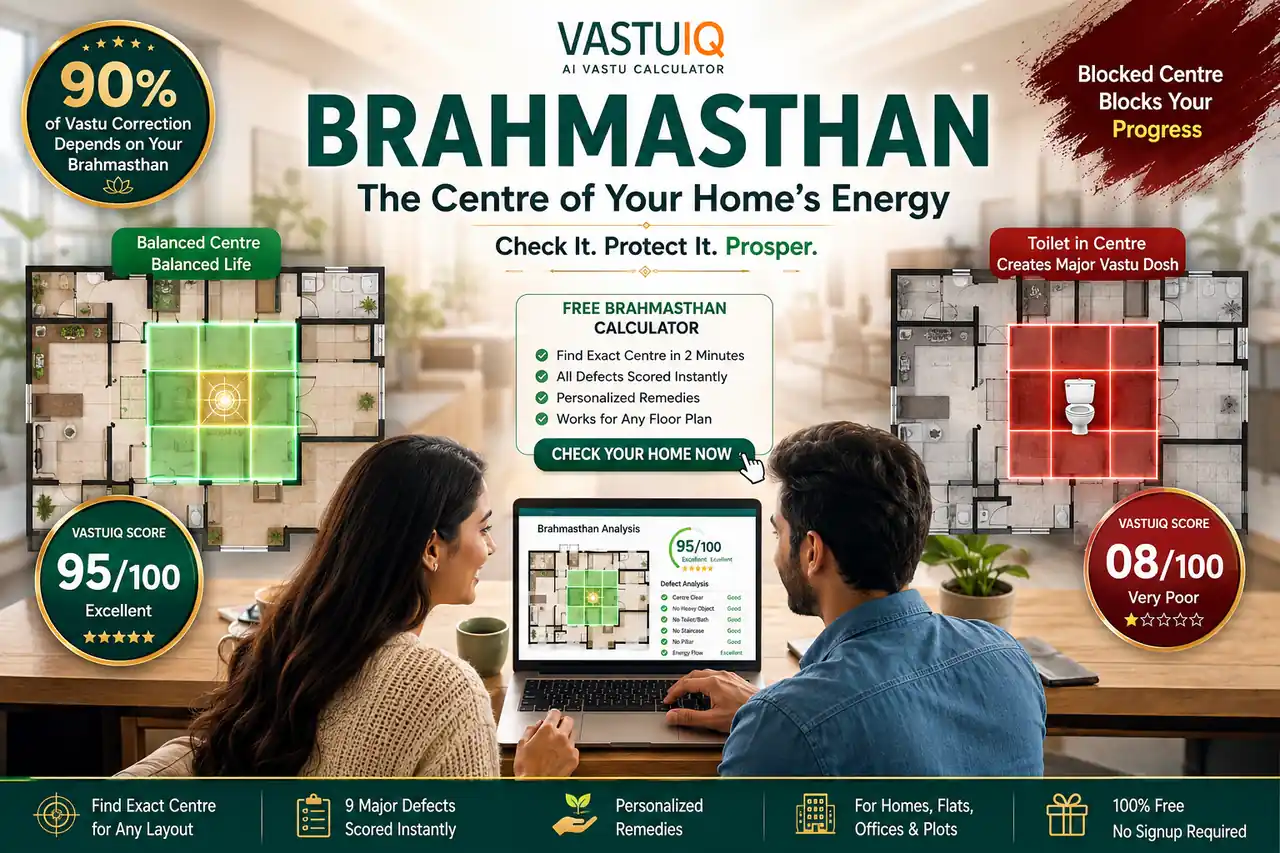
One Vastu principle above all others: if the Brahmasthan — the geometric centre of your home — is correctly placed and unobstructed, it accounts for nearly 90 percent of your home’s Vastu correction on its own. Conversely, a blocked, obstructed or defective Brahmasthan undermines every other Vastu remedy you apply, regardless of how correct the rest of the home is. A perfectly placed kitchen, a southwest master bedroom and a clear northeast zone cannot compensate for a toilet, pillar or staircase sitting at the exact centre of the home.
This guide covers everything about the Brahmasthan in Vastu — what it is, how to find it precisely (including for L-shaped and irregular floor plans), all 9 major defects with individual scores and symptoms, the complete remedy system, what to keep and what to avoid, and applications for apartments, offices and multi-floor homes.
⚡ Check your Brahmasthan before reading further
Most people read about Brahmasthan defects without ever checking whether their home has one. The check takes 2 minutes and requires only your floor plan dimensions.
→ Open Free Brahmasthan Calculator No registration. Free. Works for all layout types.
What Is Brahmasthan in Vastu Shastra — Complete Definition
The word Brahmasthan comes from two Sanskrit roots: “Brahma” (Lord Brahma — the creator deity, governing the space element Akasha) and “Sthan” (place or zone). Literally: the place of Brahma. In Vastu Shastra, it refers to the exact geometric centre of any built structure — home, office, plot or room — and is considered the most energetically significant zone in the entire property.
Classical texts describe the Brahmasthan using three consistent metaphors:
- Prana nabhih — the navel of the life force. Just as the human navel is the point through which life-sustaining energy first entered the body (via the umbilical cord), the Brahmasthan is the point through which cosmic prana enters and distributes to all eight directional zones of the home.
- Nabhi sthal — the navel point. The Vastu Purusha (the cosmic being whose body maps onto the floor plan) has his navel at the geometric centre. The Brihat Samhita describes the Brahmasthan as the Vastu Purusha’s most sensitive anatomical point — the point whose condition most directly determines the wellbeing of the entire body.
- Marmasthan — the vital spot. In Ayurvedic medicine, marma points are the body’s vital energy junctions — points where multiple energy channels converge and where trauma has the most systemic effect. The Brahmasthan is the home’s primary marma — its central vital junction where all eight directional energy channels meet.
The Brahmasthan is not simply a point — it is a zone. Classical texts define it as the central 1/9th of the total floor area — the central cell in the 3×3 grid (Manduka Mandala) laid over the floor plan. In a 900 sq ft home, the Brahmasthan zone is 100 sq ft. In a 1,500 sq ft home, it is approximately 167 sq ft. The zone must be kept open, unobstructed and free of permanent heavy structures.
Classical reference: The Manasara (Chapter 9, “Vastu Vidya”) states: “Brahmasthane shunyam nityam raksheta” — “The Brahmasthan shall always be kept empty and protected.” The Mayamata (Chapter 5) describes it as “prana nabhih grihasya” — “the navel of the home’s life force.” The Brihat Samhita (Chapter 53) names it as the single most important zone in any residential assessment — more significant than the entrance direction, the kitchen zone or the bedroom placement taken individually.
Why the Brahmasthan Must Be Open — Classical Reasoning and Modern Science
The classical prescription to keep the Brahmasthan open is one of the most universally consistent rules across all Vastu texts — and one of the most well-supported by modern building science. Understanding why makes it easier to apply, and harder to accidentally violate.
The energy distribution function
In Vastu’s framework, prana (life force) enters the home primarily through the main entrance and secondarily through all openings — windows, ventilators and doors. Once inside, this prana circulates outward from the Brahmasthan to all eight directional zones. The Brahmasthan is the distribution centre — the hub from which all spokes radiate. A blocked Brahmasthan does not simply affect the central zone: it prevents adequate prana from reaching any zone, because all eight channels originate at the centre.
This is why a Brahmasthan defect is uniquely severe. A northeast toilet defect affects the northeast zone. A southwest zone problem affects authority and stability. But a Brahmasthan defect affects all eight zones simultaneously — because the hub that feeds them all is compromised. A Brahmasthan with a toilet at the centre is, in the Vastu system, like a clogged artery at the heart — every downstream organ suffers regardless of its own individual condition.
The courtyard tradition — historical Indian architecture got this right
Traditional Indian residential architecture universally included an open central courtyard — the “chowk” or “aangan” — at the geometric centre of the home. The most sophisticated examples include:
- Nalukettu (Kerala traditional homes) — a four-wing structure built around a central open-sky courtyard, the “madhyam” or centre, kept open to sky, light and rain
- Chettinadu mansions (Tamil Nadu) — often with multiple open courtyards aligned on the central axis, the innermost at the geometric centre
- Guttumane (Karnataka traditional homes) — central courtyard with Tulsi plant in a raised platform at the exact geometric centre
- Haveli architecture (Rajasthan, Gujarat) — central courtyard (chowk) open to sky, around which all rooms were arranged
This was not simply spiritual preference. The open central courtyard served specific building-science functions: it improved cross-ventilation through the entire home (air entered from the open northeast and exited upward through the central sky-opening), it distributed natural light to interior rooms that would otherwise have no light access, and in hot Indian climates it created a convective cooling effect — warm air rising through the central opening drew cooler air inward from the shaded exterior.
Modern sustainable architecture has rediscovered this principle — central atria in office buildings, passive solar courtyards in sustainable homes — for exactly these ventilation and light distribution functions. The classical Vastu prescription to keep the Brahmasthan open is simultaneously a spiritual directive and a sound bioclimatic design principle. An open courtyard or centre brings all kind of riches and prosperity to occupants if followed accordingly Vastu.
The Akasha element
The Brahmasthan governs the Akasha (space/ether) element — the fifth and most expansive of the five classical elements. Akasha is associated with sound, expansion and the quality of consciousness that allows all other elements to exist and interact. When the Brahmasthan is open, the Akasha element can freely express its expansive, distributing quality. When it is blocked by a heavy structure, the space element is compressed — and the specific human experience of a compressed Akasha zone is the feeling that “everything is stuck,” that no situation seems to have room to develop or expand, that solutions to problems are not emerging despite effort.
How to Find the Brahmasthan — All Layout Types
Accurately locating your Brahmasthan is the foundation of everything that follows. An approximate location is not sufficient — placing a remedy or checking for defects at the wrong point defeats the entire purpose. Here is the precise method for each layout type.
Rectangular or square floor plan — 2 minutes
- Measure your home’s total interior length (north-south dimension) from wall to wall
- Measure your home’s total interior width (east-west dimension) from wall to wall
- Divide each measurement by 2
- The Brahmasthan point is: (length ÷ 2) from the north wall AND (width ÷ 2) from the east wall
- The Brahmasthan zone boundary extends (length ÷ 6) in each direction from the centre point
Example: Home 36 ft × 24 ft. Brahmasthan point: 18 ft from north wall, 12 ft from east wall. Zone boundary: 6 ft radius from this point (36 ÷ 6 = 6).
L-shaped floor plan — use the calculator
For L-shaped flats, the visual midpoint of the floor plan is not the actual geometric centre. The correct Brahmasthan for an L-shape is the weighted centroid — which shifts toward the larger section of the L. A 5-to-8-foot error in Brahmasthan location is common when using the visual midpoint method for L-shaped layouts. This error is large enough to place the assessed Brahmasthan in a completely different room from where it actually falls.
T-shaped and irregular layouts
T-shaped homes (main bar + extension) and irregular polygons require the polygon centroid formula — different geometric calculation methods that account for the weight of each section. These cannot be accurately calculated without either advanced geometry or a purpose-built tool.
🏛️ Free Brahmasthan Calculator — All Layout Types
Rectangular, L-shaped, T-shaped or irregular — enter your dimensions and get the exact Brahmasthan coordinates and zone boundary in under 2 minutes. Works for homes, flats, offices and plots in any country.
→ Find My Brahmasthan Free
PDF report with floor plan diagram available
For the complete step-by-step guide to finding the Brahmasthan manually for all four layout types — including worked examples with real measurements — see our dedicated guide: How to Find the Centre of Your House — Complete Brahmasthan Guide.
The Complete “What to Keep and What to Avoid” Table
This is the most searched Brahmasthan question — people want a clear, definitive list. Here it is.
| Item / Element | Status | VastuIQ Score | Reason |
|---|---|---|---|
| Open floor — clear passage or living area | ✅ Best | 100/100 | Akasha element fully expressed — prana distributes freely to all 8 zones |
| Open sky / skylight above Brahmasthan | ✅ Excellent | 100/100 | Classical ideal — the traditional courtyard directly above the centre |
| Lightweight seating — single chair or cushion | ✅ Good | 88/100 | Movable, minimal footprint — does not obstruct energy distribution |
| Meditation or prayer space (no permanent structure) | ✅ Good | 92/100 | The Brahmasthan’s Akasha energy actively supports meditative consciousness |
| Small Tulsi plant (ground-rooted, not potted) | ✅ Auspicious | 90/100 | Specific classical prescription — Tulsi rooted in Brahmasthan purifies prana distribution |
| Brahma yantra or Vastu Purusha yantra | ✅ Excellent | 94/100 | Classical remedy item — specifically prescribed for Brahmasthan activation and protection |
| Diya or lamp (permanently lit) | ✅ Good | 88/100 | Light at the Brahmasthan activates Akasha element and signals the zone’s sacred status |
| Light pastel colours on floor or ceiling | ✅ Good | 85/100 | White, cream, pale yellow — Akasha element colours amplify the zone’s expansive quality |
| Lightweight coffee table (movable) | ◯ Acceptable | 72/100 | Movable, minimal weight — acceptable if Brahmasthan zone is otherwise unobstructed |
| Dining table (lightweight, movable) | ◯ Acceptable | 68/100 | If the flat layout places dining in the centre, acceptable with lightweight table |
| Large sofa or heavy L-shaped sofa | ⚠ Caution | 55/100 | Weight and immobility begin to compress Akasha element — relocate if possible |
| Almirah, wardrobe or heavy bookshelf | ⚠ Avoid | 40/100 | Heavy, permanent earth-element furniture suppresses Akasha — always relocate |
| Mirror facing the Brahmasthan | ⚠ Avoid | 38/100 | Disrupts and amplifies chaotic energy at the distribution centre — creates unpredictability |
| Water fountain or water feature | ⚠ Avoid | 35/100 | Water element in Akasha zone creates elemental conflict — associated with stomach health issues |
| Heavy potted trees or large plants | ⚠ Avoid | 38/100 | Root energy and earth weight compress Akasha — small Tulsi acceptable, large trees not |
| Bedroom wall or dedicated room | ✗ Defect | 30/100 | Structural wall creates permanent Akasha blockage — and bedroom sleep energy conflicts with distribution function |
| Beam crossing Brahmasthan overhead | ✗ Defect | 28/100 | Overhead pressure element directly over the distribution centre — compresses downward energy |
| Generator, lift, AHU or mechanical equipment | ✗ Severe | 22/100 | Mechanical vibration and noise energy at the distribution point — disrupts all 8 zone connections |
| Staircase | ✗ Severe | 08/100 | Continuous movement energy + structural weight at the distribution centre — all zones suffer |
| Kitchen / cooking stove | ✗ Severe | 12/100 | Fire element at Akasha zone — elemental conflict + associated with health instability for all occupants |
| Structural column or pillar | ✗ Severe | 18/100 | Permanent compression of Akasha element — cannot be removed, requires peripheral compensation remedies |
| Toilet or bathroom | ✗ Most Severe | 08/100 | Waste energy at prana distribution point — most damaging single Brahmasthan condition |
| Well or underground water body | ✗ Severe | 15/100 | Underground water below the distribution centre creates downward energy drain — wealth and health implications |
| Septic tank | ✗ Most Severe | 10/100 | Waste + underground position — compounds downward drainage with waste energy at the home’s centre |
Brahmasthan Vastu Dosh — All 9 Defects With Symptoms and Scores
A Brahmasthan Vastu dosh is any condition that blocks, pollutes or compresses the central zone. Each defect type produces specific observable patterns in the lives of the home’s occupants — not abstract spiritual consequences but physically identifiable life-area disruptions that classical texts and experienced practitioners consistently associate with each defect type.
| Defect | VastuIQ Score | Severity | Observable Symptoms | Permanent? |
|---|---|---|---|---|
| Toilet / bathroom | 08/100 | Extreme | Recurring health issues, financial drain that cannot be plugged despite income, persistent feeling of negativity throughout home | Yes — partial remedies only |
| Septic tank (below ground) | 10/100 | Extreme | Similar to toilet but compounded by underground position — health issues, deep financial loss, digestive health in occupants | Yes — partial remedies only |
| Kitchen / cooking area | 12/100 | Very High | Health instability across all household members, digestive issues, short-temperedness, domestic friction related to food and nourishment | Yes without renovation |
| Staircase | 08/100 | Extreme | Mental instability, financial inconsistency, stress without identifiable cause, career disruptions | Yes — cannot relocate |
| Structural column or pillar | 18/100 | Very High | Stagnation across all life areas simultaneously, digestive health issues, sense that problems cannot be solved despite correct effort | Yes — load-bearing |
| Beam crossing overhead | 28/100 | High | Overhead pressure energy — headaches, decision-making difficulties, oppressive feeling in the home’s common areas | Yes — structural |
| Bedroom or dedicated room | 30/100 | High | Relationship confusion, unclear life direction for the occupant using that room, difficulty separating work and rest | Yes without demolition |
| Well or underground water | 15/100 | Very High | Wealth draining downward — income that does not accumulate, financial leakage without identifiable cause | Yes — underground |
| Heavy furniture cluster | 40/100 | Moderate | Stagnation in specific life areas, reduced energy and enthusiasm in occupants, slower progress on goals | No — move it today |
The critical insight from this table: Only the last defect — heavy furniture — is immediately correctable without structural work. Every other Brahmasthan defect is permanent once constructed. This is why Brahmasthan assessment must happen before construction or purchase — not after. Check any property’s Brahmasthan using VastuIQ’s free calculator before purchase — enter the floor plan dimensions and identify the centre coordinates in 2 minutes.
Toilet in the Brahmasthan — Most Severe Vastu Defect
A toilet at the Brahmasthan is the single most severe defect in VastuIQ’s entire scoring model — 08/100, equal to a staircase at the centre. The classical logic is direct: the Brahmasthan is the prana distribution point. A toilet introduces waste energy — the energetic opposite of prana — at the home’s most sensitive energy junction. Every drop of prana that should distribute outward to all eight zones is contaminated at its source point before it can reach any room in the home.
A toilet or bathroom located in the center of the house represents one of the most significant Vastu flaws, as it contaminates the central energy area with waste and stagnant negativity, thereby depleting prosperity from all directions.
Non-structural remedies for Brahmasthan toilet
These remedies cannot eliminate the defect — a toilet at the Brahmasthan is a permanent structural condition. They reduce its daily impact from extreme to high severity, improving the score from 08/100 to approximately 25–30/100:
- Keep the toilet lid always closed when not in active use — the single most important daily habit for a Brahmasthan toilet. An open toilet lid at the centre of the home is dramatically worse than a closed one
- Sea salt bowl inside the bathroom, changed weekly — rock salt absorbs waste energy at the source. Replace every 7 days without fail
- Copper Vastu Devta plate face-up on the bathroom floor — specifically prescribed in classical Vastu for toilet-in-defective-zone situations
- Maximum ventilation — extractor fan running during and after use — physical removal of waste air energy immediately after use
- Bright warm lighting inside the bathroom at all times — light is prana; maintaining maximum light at the Brahmasthan bathroom partially compensates for the waste energy
- Fresh fragrance maintained inside the bathroom at all times — air freshener, essential oil diffuser or camphor — olfactory prana quality improvement
- Peripheral compensation — activate all 8 surrounding zones maximally — see the remedy section below for the full peripheral compensation system
Is your bathroom at or near the Brahmasthan? Confirm your exact Brahmasthan location using the free calculator — many people assume their bathroom is in the northeast zone when it is actually closer to the centre than they realise.
Pillar in the Brahmasthan — The Hidden Construction Defect
Structural columns placed at or near the geometric centre of a home are among the most common and least visible Brahmasthan defects in Indian builder apartments. Many 2BHK and 3BHK flats include a structural column within the central zone — placed by the structural engineer for load-distribution reasons — without any consideration of its Vastu implications.
A lot of current buildings have a secret column built into their dividing walls towards the centre, which can be a source of a serious Vastu defect.
The pillar defect is uniquely subtle because the column is often embedded within a wall rather than freestanding — making it invisible to a casual room walkthrough. The structural drawing reveals it; the room inspection often does not.
How to check for a hidden column at the Brahmasthan: Identify the exact Brahmasthan coordinates from the calculator. Compare those coordinates against the structural/architectural drawing of your flat — specifically looking at wall thickness in that zone. A wall significantly thicker than standard (more than 230mm in a zone where 150mm walls are typical) may contain a load-bearing column. Knocking the wall at the Brahmasthan coordinate point — if the sound is dense and solid rather than hollow — indicates a column within.
Remedies for pillar at Brahmasthan
- Paint the column in the same light colour as the surrounding walls — visual integration reduces the energetic emphasis on the obstruction
- Place a Brahma yantra at the base of the column — classical remedy for structural obstruction at the Brahmasthan
- Wrap the column in copper foil at the Brahmasthan height (eye level) — copper’s elemental quality partially compensates for the Akasha compression
- Place four copper pyramid corners at the column’s four faces — classical Vastu remedy for column energy redirection
- Maximum lighting around the column — light at the obstruction reduces the compression effect
- Apply the peripheral compensation strategy — see below
Kitchen and Staircase in the Brahmasthan — Remedies
Kitchen at the Brahmasthan
Fire element at the Akasha zone is a severe elemental conflict. A kitchen located precisely in the center of the house is regarded as a significant Vastu flaw, as it disrupts the fundamental energy of the home and is associated with health, financial, and emotional problems. The introduction of intense heat sources causes the core to overheat, resulting in a conflict between the elements of fire, space, and earth.
Remedies for a kitchen at the Brahmasthan:
- Always face east while cooking — the cooking direction correction is the highest-impact available action
- Place copper pyramid arrows on the southeast kitchen wall pointing toward the southeast — “virtual shifting” the kitchen’s elemental energy toward the correct Agni zone
- Use orange, terracotta and copper-toned accessories throughout — fire element colours reinforce the cooking function’s own energy
- Place a copper or brass octagonal pyramid on the kitchen counter near the stove
- Keep the kitchen meticulously clean and eliminate all clutter — a cluttered Brahmasthan kitchen compounds both defects simultaneously
- Apply peripheral compensation — activate all surrounding zones
Staircase at the Brahmasthan
A staircase in the middle of the house is like having a hole pierced in your heart — it may result in a stressful life. The Brahmasthan needs to remain open and light; stairs introduce weight, vertical disruption and constant movement that stagnate energy.
Remedies for a staircase at the Brahmasthan:
- Install a convex mirror at the base of the staircase facing upward — redirects the upward movement energy
- Keep the under-stair space completely clear and brightly lit — no storage, no dark corners
- Place a Brahma yantra under the first step of the staircase
- Ensure maximum lighting throughout the staircase — every step well-lit
- Apply peripheral compensation strategy across all 8 surrounding zones
Brahmasthan Remedies — The Complete System
When the Brahmasthan defect is permanent — toilet, pillar, staircase, kitchen — the most comprehensive available remedy system is peripheral compensation. This strategy, referenced in advanced Vastu practice but never fully explained in mainstream content, works by maximally activating all eight zones surrounding the Brahmasthan so that each zone generates its own energy as independently and powerfully as possible — compensating for the reduced distribution from the obstructed centre.
The peripheral compensation system — all 8 surrounding zones
| Zone | Peripheral Activation Action | Why This Zone |
|---|---|---|
| Northeast | Tulsi plant, open window, diya, clear of clutter | Sacred zone — maximum activation here partially compensates for centre blockage |
| North | Green plants on north wall, clear of heavy furniture, clean north window | Kubera’s wealth zone — independent activation maintains financial energy flow |
| Northwest | Jasmine or white flowers, light and airy | Air element zone — movement energy compensates for centre’s stillness |
| West | Areca palm or round-leafed plant, calm blue-grey accent | Varuna’s patience zone — stability from the west compensates for central disruption |
| Southwest | Heaviest furniture here, earth tones, stable and consolidated | Earth element zone — grounding the home’s periphery when the centre is disturbed |
| South | Snake plant or upright structured plant, clear wall | Yama’s discipline zone — structure at the south compensates for central chaos |
| Southeast | Bright lighting, orange or copper accents, clean and active | Agni zone — fire element activation at the periphery compensates for fire conflict at centre |
| East | Maximum east window opening, morning light access, jade plant or aloe vera | Solar vitality zone — morning prana entry from east compensates for reduced central distribution |
Direct Brahmasthan remedies (for all defect types)
- Brahma yantra / Vastu Purusha yantra: The most specifically prescribed classical remedy for Brahmasthan defects. A consecrated copper yantra dedicated to Lord Brahma placed at or as close to the Brahmasthan as structurally possible. Available from classical Vastu suppliers and puja stores.
- Copper pyramid grid: A set of copper pyramids placed at the four quadrant points surrounding the Brahmasthan defect — specifically used for column and heavy obstruction remediation.
- Maximum lighting at Brahmasthan: If the defect is immovable, ensure the immediate surroundings of the Brahmasthan have the highest light level in the entire home. Light is prana — compensating for reduced natural prana distribution with maximum artificial light is the most universally applicable Brahmasthan remedy.
- Rock salt placement: For toilet and septic defects — sea salt bowl immediately outside the bathroom door, changed weekly.
- Colour correction: Light pastel colours — white, cream, pale yellow — in the zones immediately surrounding the Brahmasthan. Avoid dark, heavy colours in the central zone and surrounding areas.
Activating a Clear Brahmasthan — What to Place and Practise
If your Brahmasthan is correctly open and unobstructed — first, confirm this using the free calculator to ensure the zone is genuinely clear, not approximately clear — here is how to actively amplify its positive potential:
Physical activation
- Keep the floor clean and clear daily — the Brahmasthan zone should be the most consistently maintained area of the home. Sweep or mop the central area every morning. Classical Vastu practice prescribes daily floor purification at the Brahmasthan as the single most impactful daily household maintenance action.
- Place a Brahma yantra on the floor — a small copper yantra of Lord Brahma placed face-up on the floor at the exact Brahmasthan coordinate is the most auspicious structural addition to a clear centre.
- Light a diya at the Brahmasthan every evening — a ghee lamp at the geometric centre of the home activates Akasha element energy and signals conscious tending of the home’s primary energy point.
- Light pastel colours on surrounding floor and ceiling — white, cream or pale yellow on the ceiling directly above the Brahmasthan amplifies the expansive Akasha quality upward.
Colour for the Brahmasthan zone
The Brahmasthan’s governing element is Akasha (space) — its classical colours are white, pale yellow and light cream. These colours signal expansiveness, openness and clarity — the three qualities the Brahmasthan must embody. Avoid dark red, dark brown, black or heavy grey in or immediately around the central zone — these earth and water element colours compress the Akasha quality exactly when it needs maximum expansion.
Meditation at the Brahmasthan
Many people perform meditation in the centre to connect themselves with a cosmic orbit, hence it is a breathing space within the premises. If the Brahmasthan is open, it is the most powerful meditation point in the home — Akasha element energy supports the quality of expanded, receptive consciousness that meditation cultivates. Sitting in silent meditation at the geometric centre of a clear, well-maintained home for even 10 minutes daily is considered one of the most potent Brahmasthan activation practices in classical Vastu.
Brahmasthan in Apartments and Multi-Floor Homes
Individual flat Brahmasthan vs building Brahmasthan
Every flat has its own Brahmasthan — the geometric centre of that individual flat’s floor plan. The building’s overall Brahmasthan (centre of the entire building footprint) is a separate consideration. For personal Vastu assessment, use your flat’s dimensions only — exclude corridors, common areas and spaces outside your unit’s walls.
Multi-floor homes — which floor matters most
In a duplex or triplex home, each floor has its own Brahmasthan. The ground floor Brahmasthan carries the highest energetic weight — it is closest to the earth’s energy field and most directly connected to the home’s foundation. Upper floor Brahmasthans are assessed separately and their alignment checked: if the ground floor Brahmasthan is at coordinates (18 ft from north, 12 ft from east) and the first floor Brahmasthan falls at the same coordinates — the home has good vertical Brahmasthan alignment. A toilet on the first floor directly above a clear ground floor Brahmasthan creates an overhead contamination defect even though the ground floor centre itself is clear.
Compact 1BHK and studio apartment Brahmasthan
In a 450 sq ft studio flat, the Brahmasthan zone (1/9th of total area) is approximately 50 sq ft — a 7×7 foot square. Despite its small physical size, it carries identical energetic significance to the Brahmasthan of a 2,000 sq ft home. The most common compact flat Brahmasthan condition is heavy furniture clustering — sofas, dining tables and storage placed in the central area by default because it is the most logistically convenient position. Use the calculator to confirm the exact zone, then remove all heavy items from it as the single highest-impact compact flat Vastu action.
For a complete flat assessment beyond the Brahmasthan — all 8 zones scored, entrance pada, northeast condition and prioritised remedies — upload your floor plan to VastuIQ’s AI Floor Plan Analyzer. Works for any flat in any country. Analyze my floor plan free at vastuiq.com →
Brahmasthan in Offices and Commercial Spaces
The Brahmasthan principle applies with equal force to commercial spaces — offices, shops, factories and warehouses. If in the Brahmasthan there is some perforation, toilet, septic tank, shaft, kitchen, or elevator constructed, there will always be a shortage of staff in the office. The commercial Brahmasthan defect symptoms differ from residential ones:
| Brahmasthan Defect | Commercial Symptom | Residential Symptom |
|---|---|---|
| Toilet at centre | Staff turnover, revenue inconsistency, client trust issues | Health issues, financial drain across all areas |
| Pillar at centre | Growth stagnation, expansion blocked despite correct strategy | Life area stagnation, digestive health |
| Lift or elevator at centre | Constant staff movement and instability, inability to retain key people | Restlessness, inability to settle in the home |
| Staircase at centre | Operational chaos, financial inconsistency, key decisions reversed repeatedly | Mental instability, financial inconsistency |
| Generator or heavy machinery | Productivity disruption, mechanical breakdowns affecting operations | Noise and vibration energy affecting all zones |
What the office Brahmasthan should have: Open workstation area or collaboration space (not enclosed offices), maximum natural light from a skylight or ceiling opening if possible, a clear, unobstructed central aisle, a small Brahma yantra or Vastu Purusha yantra placed on the floor at the exact geometric centre. A conference room at the periphery of the Brahmasthan zone (not at its exact centre) is acceptable — meeting energy suits the central zone when it does not involve permanent structural enclosure.
Brahmasthan and the Vastu Purusha Mandala — Understanding the Grid
The Brahmasthan is defined within the classical grid systems laid over any floor plan — understanding these grids clarifies why the Brahmasthan zone is sized as it is and how it relates to the surrounding directional zones.
The 3×3 Manduka Mandala
The simplest classical grid divides the floor plan into a 3×3 matrix of 9 equal squares. The central square (1 of 9, or approximately 1/9th of total area) is the Brahmasthan — governed by Lord Brahma. The surrounding 8 squares correspond to the 8 directional deities. This is the grid VastuIQ’s scoring model uses for zone assignment and Brahmasthan boundary calculation.
The 8×8 Paramashayika Mandala and 9×9 Paramashayika
The more detailed classical grids use 64 (8×8) or 81 (9×9) equal squares. In the 8×8 grid, the four central squares (a 2×2 cluster in the middle) constitute the Brahmasthan — governed by Brahma with four surrounding squares governed by Aryama, Vivasvan, Mitra and Prithvidhara (the four supporting deities of the central zone). In the 9×9 grid, the single central square is Brahma’s seat with 8 surrounding squares as his immediate zone. The larger grid systems are used for detailed room-level and pada-level analysis by advanced practitioners.
Practical application
For most homeowners and flat owners, the 3×3 grid provides sufficient precision — the central 1/9th zone is the Brahmasthan target area. The exact geometric centre point within this zone is the highest-priority location for both defect assessment and remedy placement. VastuIQ’s calculator identifies both the precise centre point and the 1/9th zone boundary — giving you the complete picture for both assessment and remedy work.
Frequently Asked Questions — Brahmasthan Vastu
What is Brahmasthan in Vastu Shastra?
The Brahmasthan is the geometric centre of any home, flat, office or plot — the exact point equidistant from all structural boundaries. In Vastu Shastra, it is the seat of Lord Brahma (creator deity) and the governing zone of the Akasha (space) element. It is described as the “prana nabhih” (navel of the life force) — the distribution centre from which cosmic energy radiates to all eight directional zones. Classical texts unanimously prescribe that the Brahmasthan be kept open, clean and free of permanent heavy structures. Its condition is described as accounting for nearly 90 percent of a home’s total Vastu correction.
How do I find the Brahmasthan in my house?
For a rectangular home: measure total length and total width, divide each by 2. The intersection point is your Brahmasthan. For an L-shaped, T-shaped or irregular floor plan: use VastuIQ’s free Brahmasthan Calculator — the visual midpoint of non-rectangular layouts is not the accurate geometric centre, and the error can be 5 to 8 feet. The calculator applies the weighted centroid formula for all layout types and gives the exact coordinates plus the full 1/9th zone boundary in under 2 minutes.
What happens if the Brahmasthan is blocked?
A blocked Brahmasthan prevents prana from distributing to any of the home’s eight directional zones — because all eight energy channels originate at the centre. The result is a pattern of “simultaneous stagnation” — problems in multiple life areas at once (health, finances, relationships, career) that resist resolution despite correct individual efforts. The specific symptom pattern depends on what is blocking the Brahmasthan: toilet and septic blocks produce health and financial drain; columns produce stagnation and digestive health issues; kitchens produce health instability; staircases produce mental and financial inconsistency.
What should not be in the Brahmasthan?
Never in the Brahmasthan: toilet or bathroom (most severe — 08/100), septic tank (extreme — 10/100), kitchen or cooking stove (very high defect — 12/100), staircase (extreme — 08/100), structural column (very high — 18/100), well or underground water body (very high — 15/100), generator or heavy machinery (severe — 22/100), heavy furniture like almirah or large sofa (avoid — 40/100), water fountain (avoid — 35/100), mirror facing the centre (avoid — 38/100), large potted trees (avoid). See the complete table in this guide for all 24 items with individual scores.
What is the remedy for toilet in Brahmasthan?
Six non-structural remedies for a toilet at the Brahmasthan: (1) Keep toilet lid always closed when not in use — the most important daily habit. (2) Rock salt bowl inside the bathroom, changed weekly. (3) Copper Vastu Devta plate face-up on the bathroom floor. (4) Maximum ventilation — extractor fan during and after use. (5) Bright lighting maintained inside the bathroom at all times. (6) Apply peripheral compensation — activate all 8 surrounding zones maximally using the system in this guide. These remedies improve the score from 08/100 to approximately 25–30/100. Full elimination requires structural relocation.
Can we keep pooja room in Brahmasthan?
The pooja room is the only dedicated room that is acceptable and indeed auspicious in the Brahmasthan — with one important condition: it must have no permanent enclosing walls that obstruct energy flow, or the walls must be minimally substantial (glass partitions or lightweight screens are acceptable). A permanently walled, enclosed pooja room at the Brahmasthan creates the same structural Akasha compression as any other enclosed room. An open prayer platform, a Brahma yantra on the floor, or a small altar without enclosing walls at the Brahmasthan is specifically prescribed in classical Vastu as the most auspicious Brahmasthan use.
What is the Brahmasthan in a flat or apartment?
Every flat has its own Brahmasthan — the geometric centre of that individual flat’s floor plan, calculated from the outer boundary walls of the unit only (excluding shared corridors and common areas). The building’s overall Brahmasthan is separate from your flat’s Brahmasthan. In a compact 1BHK flat (typically 450–700 sq ft), the Brahmasthan zone is approximately 50–78 sq ft — physically small but energetically as significant as in a large home. Use VastuIQ’s free calculator with your flat’s interior dimensions to find it precisely.
Is it bad to have a pillar in the centre of the house?
Yes — a structural column or pillar at the Brahmasthan is a significant defect (18/100 on VastuIQ’s model, −25 points from the home’s baseline score). The column permanently compresses the Akasha element at the home’s distribution centre. It cannot be removed without rebuilding the structure. Non-structural remedies (Brahma yantra at the column base, copper foil wrap at Brahmasthan height, copper pyramid corners, maximum surrounding lighting) partially mitigate the defect — typically improving the score by 8–12 points. Buyers should check for central columns from the RERA structural drawing before purchase, as they are invisible from casual room inspection.
How large is the Brahmasthan zone?
The Brahmasthan zone is defined as the central 1/9th of the total floor area. In a 900 sq ft home, the zone is 100 sq ft (approximately a 10×10 foot square). In a 1,500 sq ft home, approximately 167 sq ft. In a 450 sq ft studio flat, approximately 50 sq ft (approximately 7×7 feet). The exact geometric centre point is the highest-priority location within this zone — for both defect assessment and remedy placement. The zone boundary extends (total length ÷ 6) in each direction from the centre point for a rectangular home.
What colour is best for the Brahmasthan?
White, pale yellow and light cream are the most auspicious colours for the Brahmasthan floor and ceiling, corresponding to the Akasha element’s expansive, open quality. These colours signal space and clarity. Avoid dark red, dark brown, heavy grey or black in or immediately around the central zone — these earth and water element colours compress the Akasha quality. If the Brahmasthan is in a corridor or open living area, a light-coloured geometric floor pattern (circular or star motif in cream and gold) at the exact centre coordinates is the most classically prescribed aesthetic treatment.
Can I meditate in the Brahmasthan?
Yes — and it is specifically recommended. The Brahmasthan’s Akasha element energy actively supports meditative and contemplative consciousness. Sitting in quiet meditation at the geometric centre of a clear, well-maintained home connects the practitioner to the home’s primary cosmic energy junction. Classical practitioners describe the Brahmasthan as the home’s “cosmic orbit” connection point — the place where the individual home’s energy field most directly connects to the broader cosmic energy field. Even 10 minutes of silent sitting at the Brahmasthan daily is considered a meaningful spiritual practice with measurable effects on the home’s overall energy quality.
Does the Brahmasthan matter in an office or commercial space?
Yes — with commercial-specific symptom patterns. A toilet at a commercial Brahmasthan produces staff turnover and revenue inconsistency. A lift or elevator at the commercial Brahmasthan produces constant staff movement and inability to retain key employees. A staircase produces operational chaos and repeated strategic reversals. The office Brahmasthan should ideally be an open workstation or collaboration area — never an enclosed cabin, lift shaft, toilet block or stairwell. A Brahma yantra placed at the exact geometric centre of the office floor is the most commonly prescribed commercial Brahmasthan activation measure.
What is peripheral compensation for Brahmasthan defects?
Peripheral compensation is the advanced Vastu strategy for permanent Brahmasthan defects — when the centre cannot be corrected structurally. The approach: maximally activate all eight surrounding zones independently, so each zone generates its own elemental energy as powerfully as possible without depending on central distribution. Northeast activated with Tulsi and open window. North cleared and planted with green money plant. South structured with upright snake plant. Southwest loaded with heaviest furniture. East opened for maximum morning light. West calmed with areca palm. Northwest lightened with jasmine. Southeast kept bright with copper accents. Taken together, these 8 peripheral zone activations partially compensate for the blocked central distribution — typically improving total household energy score by 15–25 points despite the permanent Brahmasthan defect.
Related Guides and Tools
🏛️ Free Brahmasthan Calculator — Use It Now
The fastest way to apply everything in this guide to your actual home. Enter your dimensions, get your Brahmasthan coordinates, confirm whether there is a defect and download a PDF floor plan diagram showing the zone. 2 minutes. Free. Works for all layout types.
Complete guides related to this topic:
How to Find the Centre of Your House — Complete Manual Calculation Guide — the step-by-step calculation method for all four layout types with worked examples and the L-shaped weighted centroid explanation in full detail.
Vastu Dosh — All 12 Defects Scored and Remedied — the complete defect scoring system covering Brahmasthan defects alongside all other major Vastu defects including northeast zone, entrance pada and southwest zone issues.
Vastu for Staircase — Direction, Shape and Steps — the dedicated staircase guide covering the Brahmasthan staircase defect (08/100) with specific scored remedies and the step count and rotation rules.
21 Vastu Remedies Without Renovation — the complete non-structural remedy toolkit covering all Brahmasthan remedies including Brahma yantra placement, copper pyramid system and peripheral compensation in full detail.
Vastu for New Construction — Complete Checklist — covers the Brahmasthan column check as Stage 3 of the construction checklist — the most critical pre-concrete structural Vastu decision.
Vastu Tips for Home — Complete 2026 Guide — the VastuIQ hub page covering all major Vastu factors with the complete blog library and tool links.
Other free tools:
🧭 Free Vastu Calculator — check your entrance pada score in 2 minutes
🏠 AI Floor Plan Analyzer — complete 25-factor home assessment from your floor plan
🔢 Numerology Calculator — check house number compatibility
Apply This to Your Own Property
Free AI Vastu analysis — room-by-room scores, geo-adaptive for India, UK, UAE and 50+ countries. Detailed report from ₹99.