
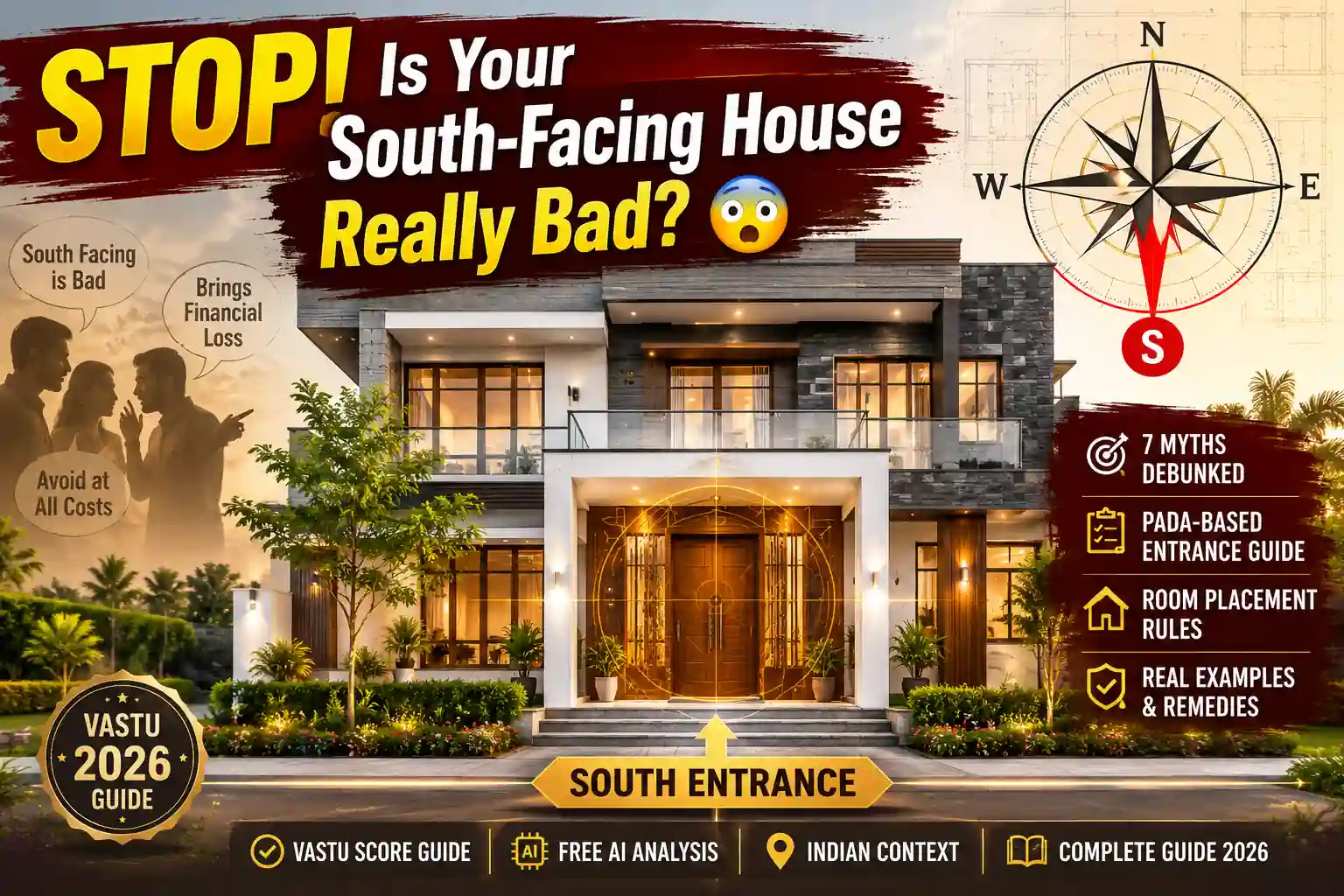
What you will learn in this guide
- Why “south facing is always bad” is one of the most damaging myths in Vastu
- Which of the 9 south wall padas are genuinely auspicious — and which to avoid
- Room-by-room placement rules specific to south-facing homes
- Real scored examples from 2BHK flats and independent houses
- Non-structural remedies if your south-facing entrance is in a defective pada
Walk into any property broker’s office in India and say the words “south facing plot.” Watch what happens. The broker will pause, lower their voice slightly, and say something like: “Sir, south facing toh thoda avoid karte hain.” Every buyer within earshot will nod. And a perfectly good property — often priced 10 to 15 percent below market precisely because of this fear — will sit unsold for months.
This guide exists to correct that. The fear of south-facing homes is not Vastu — it is a misreading of Vastu that has calcified into folk wisdom and spread via word of mouth for decades. The classical texts do not say south-facing is always bad. They say south-facing requires more care. That is a fundamentally different statement.
By the end of this guide you will know exactly how to assess a south-facing property the correct way — using pada position, room placement, and zone mapping — and whether a specific south-facing home deserves its reputation or is being unfairly dismissed.
The 7 Biggest Myths About South Facing Homes — Debunked
These seven beliefs are stated as fact across Indian real estate conversations daily. Every single one is either a misquotation of classical Vastu or a complete invention.
Myth 1 — South facing is always inauspicious
The Brihat Samhita does not say this. What it says is that south-facing homes with entrances in poor pada positions carry specific risks — and that those risks can be mitigated. The Manasara specifically lists two auspicious entrance positions on the south wall. A direction cannot be universally bad when the same text that warns about it also prescribes good positions within it.
Myth 2 — Lord Yama governs the south, making it a direction of death
Yama does govern the south in the Vastu Purusha Mandala — but he governs justice, dharma and discipline, not death. His presence in the south means the south wall carries the energy of accountability and boundaries, not mortality. Misidentifying his domain is the root of this myth. Many successful business owners, lawyers and administrators live in south-facing homes — Yama’s influence on professional discipline is part of why.
Myth 3 — South-facing homes cause financial loss
This is true for specific pada positions — Pada 1 (Pitru zone) on the south wall is a genuine defect associated with financial strain. But it is not true for the direction itself. A south-facing home with the entrance in Pada 4 (Vitatha zone) scores 78/100 on VastuIQ’s Directional Compliance scale. That is a good score — better than a north-facing home with an entrance in Pada 1 (Roga zone), which scores 42/100.
Myth 4 — South-facing homes receive too much sun and are hot
This is a climate observation, not a Vastu principle. In India’s northern latitudes, south-facing rooms do receive more afternoon sun in summer. However, this is an architectural and ventilation matter — addressed with appropriate window sizing, shading, and cross-ventilation — not a Vastu defect. Classical texts were written for the entire subcontinent, including regions where south-facing warmth is a comfort, not a problem.
Myth 5 — A south-facing home cannot be made Vastu-compliant
Incorrect. A south-facing home with the entrance in Pada 4, rooms placed correctly (master bedroom in SW, kitchen in SE, living room in S/SE, puja room in NE), and an unobstructed northeast zone can score 80+ on VastuIQ’s full compliance model. “Vastu-compliant” is not a direction — it is a score derived from multiple factors.
Myth 6 — You should never buy a south-facing property
If every south-facing buyer followed this advice, a massive segment of Indian housing stock would be permanently devalued. The practical effect is the opposite of wisdom — it creates a supply of underpriced south-facing properties that informed buyers snap up, while uninformed buyers overpay for north-facing homes regardless of their actual Vastu score. Knowledge is the advantage here.
Myth 7 — South-facing is only acceptable for commercial properties
This is partially a misreading of the Manasara, which notes that south-facing entrances with certain pada positions suit Kshatriya (warrior/protector) energies — which some modern practitioners have conflated with “commercial use only.” The classical text does not restrict south-facing homes to commercial use. It identifies different energy qualities for different pada positions and suggests which types of occupants benefit most from each.
The South Wall Pada System — Complete Scoring for All 9 Positions
This is the single most important section of this guide. The south wall, like all walls in Vastu analysis, is divided into 9 equal padas counted from the southwest corner toward the southeast corner. Your entrance pada determines the primary energy quality of your home — and the actual Vastu verdict on your property.
How to find your south wall pada: Measure the interior width of your south wall. Divide by 9 to get each pada’s size. Measure from the southwest corner to the centre of your main door. Divide by pada size and round up. For the full step-by-step calculation method with worked examples, see our Pada System Complete Guide.
| Pada | Deity / Energy | Vastu Verdict | VastuIQ Score |
|---|---|---|---|
| 1 | Pitru — Ancestral debt | Avoid strongly | 28/100 |
| 2 | Dwarika — Obstruction | Avoid | 38/100 |
| 3 | Sugriva — Moderate energy | Acceptable | 58/100 |
| 4 | Vitatha — Dharma, stability | Best position | 78/100 |
| 5 | Pushpdant — Strength | Good | 74/100 |
| 6 | Asura — Effort required | Acceptable | 55/100 |
| 7 | Shosha — Absorption | Weak | 42/100 |
| 8 | Papayakshma — Decay | Avoid | 32/100 |
| 9 | Rogah — Disease (SE corner) | Avoid strongly | 25/100 |
Summary: Pada 4 (Vitatha) is the only truly auspicious entrance position on the south wall. Pada 5 is acceptable. Padas 3 and 6 are borderline — livable but not ideal. Padas 1, 2, 8 and 9 are genuine defects. The extreme corners of the south wall (Padas 1 and 9) are the most problematic positions across all four directions — these should be avoided in any new construction or renovation.
Not sure which pada your south-facing entrance falls in? VastuIQ’s free Vastu Analyzer takes your facing direction and entrance position and returns a full Directional Compliance score in under two minutes — no registration required. Check your south-facing home free at vastuiq.com
Room-by-Room Placement Guide for South-Facing Homes
Getting the entrance pada right is the highest-impact single factor. But the full Vastu score of a south-facing home also depends on where each room sits relative to the compass. South-facing homes have specific placement advantages that are rarely discussed — the southwest and southeast zones, often ignored in north-facing guides, are among the strongest zones in a south-facing layout.
Master bedroom — Southwest (SW)
The southwest zone governs stability, weight and permanence — it is the earth element zone in the Vastu Purusha Mandala. The master bedroom belongs here in any property, but in a south-facing home the SW zone is directly accessible from the south entrance, making it a natural placement. The head of the bed should face south or east. Avoid the northeast corner for the master bedroom entirely.
Kitchen — Southeast (SE)
Southeast is the fire element zone (Agni corner). In a south-facing home, the SE zone is adjacent to the entrance wall, making a properly placed SE kitchen both Vastu-correct and practically convenient. The cooking platform should be on the east wall of the kitchen, with the cook facing east while preparing food. Gas or induction hob on the southeast wall is the ideal position.
For a detailed treatment of kitchen Vastu including platform placement, gas direction and colours, see our Kitchen Vastu Direction Guide.
Living room — South or Southeast
In a south-facing home, the living room naturally occupies the south or southeast zone near the entrance. This works well — the living room is a social space and benefits from the dynamic energy of the south wall. Keep the northeast corner of the living room clear. Sofa should ideally face north or east. Television on the southeast or south wall is fine; avoid placing it on the northeast wall.
Children’s bedroom — Northwest (NW) or West
The northwest zone suits younger occupants and guests — its air element energy supports movement, study and social activity. In a south-facing home, the NW and west zones are the most distant from the entrance, giving children’s bedrooms natural separation from the main entry zone. Study desk should face north or east regardless of which room the child uses.
Puja room — Northeast (NE)
The northeast (Ishaan) zone is the water element zone and the most spiritually charged corner in any Vastu assessment. This rule does not change with facing direction — the puja room belongs in the northeast regardless of whether the home is north, south, east or west facing. Keep the northeast zone light, open and uncluttered. Never place a toilet, store room or heavy furniture in the NE zone of a south-facing home.
Bathroom and toilet — Northwest or West
The northwest is the safest zone for toilets in any property. In a south-facing home, avoid placing toilets in the northeast (most damaging Vastu defect in any direction), southeast (damages fire/health energy) or southwest (undermines earth/stability). A toilet in the NW or west with proper waterproofing and ventilation scores neutrally on VastuIQ’s zone compliance model.
Staircase — South, Southwest or West
The staircase should ideally be in the south, southwest or west zones of a south-facing home — never in the northeast or centre (Brahmasthan). Clockwise rotation (rising from left to right as you face the stairs) is preferred. For a complete treatment of staircase placement rules see our Vastu Blog.
Worked Examples — Real South-Facing Properties Scored
Example 1: 2BHK South-Facing Flat, 21-foot south wall, Pune
Each pada = 21 ÷ 9 = 2.33 feet
Door centre is 8.75 feet from SW corner: 8.75 ÷ 2.33 = 3.75 → Pada 4 (Vitatha — Auspicious)
Room layout: Master bedroom SW ✓ | Kitchen SE ✓ | Living room S/SE ✓ | Toilet NW ✓ | NE zone open ✓
Overall VastuIQ Score: 82/100 — High compliance. Entrance and room placement both correct. This is a genuinely good Vastu score for any direction, not just south-facing.
Example 2: Independent House, South-Facing, 27-foot south wall, Bengaluru
Each pada = 27 ÷ 9 = 3 feet
Door centre is 4 feet from SW corner: 4 ÷ 3 = 1.33 → Pada 2 (Dwarika — Obstruction)
Room layout: Master bedroom SW ✓ | Kitchen NW ✗ | Toilet SE ✗ | NE zone partially blocked ✗
Overall VastuIQ Score: 44/100 — Significant defects. The Pada 2 entrance combined with kitchen in NW and toilet in SE produces compounding defects. This is the profile that gives south-facing homes their poor reputation — but note that the problem is not the direction, it is the combination of a weak pada and incorrect room placement.
Example 3: 3BHK South-Facing Apartment, 18-foot south wall, Zirakpur
Each pada = 18 ÷ 9 = 2 feet
Door centre is 9 feet from SW corner: 9 ÷ 2 = 4.5 → Pada 5 (Pushpdant — Good)
Room layout: Master bedroom SW ✓ | Kitchen SE ✓ | Study room NW ✓ | Toilet W ✓ | NE open ✓
Overall VastuIQ Score: 76/100 — Good compliance. Pada 5 slightly below Pada 4 but room placement is strong, lifting the overall score. A solid south-facing property at a significant price advantage over equivalent north-facing flats in the same development.
Remedies for South-Facing Homes with Defective Pada Positions
If your south-facing entrance is in a problematic pada — especially Padas 1, 2, 8 or 9 — and you cannot move the door structurally, the following non-structural remedies reduce the defect severity in VastuIQ’s scoring model. None of these require demolition. All are referenced in classical texts for south-facing entrance defects.
- Lead metal strip under the doormat — The Brihat Samhita specifically prescribes lead at the threshold for south-facing homes with Pitru energy (Pada 1). Lead is the metal of Saturn and Yama — placing it at the boundary point neutralises the ancestral debt energy before it enters the home. Available at most metal hardware suppliers in sheets of 1–2mm thickness.
- Hanuman idol above the south entrance facing outward — The most universally recommended protective remedy for south-facing homes regardless of pada position. Hanuman faces south (Yama’s direction) and acts as an energetic boundary. The idol should face outward, not inward.
- Bright entrance lighting — South entrances tend to receive afternoon sun, but the entrance area should be kept brightly lit at all times, including at night. Light energy at the threshold raises the entrance zone’s Vastu quality and partially compensates for a weak pada.
- Red or maroon entrance door colour — The south wall is governed by fire and Mars energy. A door in the red-maroon spectrum is directionally aligned and signals correct elemental correspondence. Avoid blue, black or white for south-facing main doors.
- Raised threshold of 3–4 inches — Creates an energetic filter at the boundary. Referenced in the Manasara for defective pada positions on south walls. Particularly recommended for Padas 1 and 9.
- Keep the southwest zone heavy and grounded — South-facing homes benefit from having the SW corner loaded with weight — heavy furniture, the master bedroom, stored items. This grounds the earth element and compensates for the instability associated with weak south entrances.
Classical reference: Manasara (Chapter 9, verse 23) states that a south-facing entrance in the Vitatha pada (Pada 4 of the south wall) brings “dhana labha” — financial gain — to the occupants. The Brihat Samhita (Chapter 53) prescribes specific threshold materials for south-facing entrances in adverse pada positions to neutralise Pitru energy. These are not modern additions — south-facing guidance has been explicitly codified in Vastu texts for over 1,500 years.
South-Facing Properties for NRI Buyers
For Indian families purchasing property outside India — in the UK, UAE, USA, Canada or Australia — the south-facing rules described in this guide apply with one important adjustment: magnetic declination. In most international locations, magnetic south differs from true geographic south by several degrees. VastuIQ’s platform automatically applies location-specific magnetic declination corrections when you enter your country, ensuring the pada calculation and room placement scoring is accurate for your actual property location rather than applying Indian rules directly to an overseas property.
NRI buyers also frequently face south-facing properties in markets like Dubai and London where the concept of “facing direction” is determined differently from Indian builder conventions. If you are unsure whether your overseas property is genuinely south-facing by Vastu standards, VastuIQ’s AI Floor Plan Analyzer reads your floor plan image and determines the facing direction automatically from the plan layout, regardless of which country the property is in.
Frequently Asked Questions — South Facing House Vastu
Is south facing house good or bad in Vastu?
South facing is neither universally good nor bad — it depends primarily on which pada the main entrance is in. A south-facing home with the entrance in Pada 4 (Vitatha zone) scores 78/100 on VastuIQ’s Directional Compliance model, which is a strong score. The same home with the entrance in Pada 1 (Pitru zone) scores 28/100 — a genuine defect. The direction sets the context; the pada determines the actual outcome. This is why the blanket advice to avoid south-facing homes is not based on classical Vastu — it collapses a nuanced system into a single binary verdict.
Which pada is best for south facing house?
Pada 4 of the south wall — governed by Vitatha (dharma and stability energy) — is the only truly auspicious position for a south-facing entrance. Pada 5 (Pushpdant) is acceptable and scores 74/100. Padas 3 and 6 are borderline. Pada 1 (Pitru) is the most severe defect on the south wall and should be avoided in any new construction. The target zone for a south-facing entrance is the centre to centre-right of the south wall (counting from the southwest corner).
What should be in front of a south facing house?
A south-facing home ideally has open space, a road or a park to its south — this is called a “Veedhi shoola” check in classical Vastu. A road running directly into the south entrance (T-junction facing south) is considered a defect because it sends directed energy straight into the home. Where possible, the entrance should be slightly offset from any directly facing road. A compound wall of appropriate height on the south boundary is considered protective for south-facing plots in the Manasara.
Can south facing house be good for business owners?
Yes — and in fact, the Manasara specifically notes that south-facing entrances with certain pada positions carry Kshatriya (leadership, authority, discipline) energy, making them well-suited for business owners, military personnel, lawyers and administrators. Yama’s governing energy in the south is associated with justice, discipline and accountability — qualities that support professional success. Several successful entrepreneurs and business leaders have south-facing homes or offices with correctly placed south entrances.
How do I check if my south facing home is Vastu compliant?
The fastest method is to use VastuIQ’s free Vastu Analyzer at vastuiq.com/free-vastu-analyzer — enter your facing direction, entrance position on the south wall (left, centre or right), and the tool returns your Directional Compliance score with a detailed breakdown of which factors help and hurt your score. For a complete room-by-room analysis including kitchen, bedroom, bathroom and zone mapping, upload your floor plan to VastuIQ’s AI Floor Plan Analyzer for a full compliance report.
Is a south facing flat in an apartment building assessed differently?
The south-facing assessment for a flat is made on your individual flat’s south wall — not the building’s overall south face. This matters in apartment buildings where some flats on the south side have their main door on a corridor wall (effectively an east or west entrance), not on the building’s south face. Before applying the south-wall pada rules in this guide, confirm that your flat’s actual entrance wall faces south using a compass from inside your flat. VastuIQ’s AI Floor Plan Analyzer handles this correctly — it identifies the entrance wall from the floor plan rather than assuming the building’s overall facing direction.
Related Vastu Guides
These guides connect directly to the topics covered above and are recommended reading for south-facing homeowners and buyers:
Pada in Vastu Shastra — How to Find Your Door’s Pada Position — the complete guide to calculating your entrance pada with real measurements and worked examples for all four walls.
Vastu for Kitchen Direction — Why the SE Rule Matters — full kitchen Vastu guide including platform placement, cooking direction and colours, directly relevant to the SE kitchen placement in south-facing homes.
Master Bedroom Vastu — Direction, Bed Placement & Colours — complete bedroom Vastu guide for SW placement and sleeping direction rules that apply to south-facing homes.
How to Find the Centre of Your Home — Complete Brahmasthan Guide — essential companion guide for identifying and protecting the central zone, directly relevant to staircase and heavy furniture placement in south-facing homes.
Apply This to Your Own Property
Free AI Vastu analysis — room-by-room scores, geo-adaptive for India, UK, UAE and 50+ countries. Detailed report from ₹99.