
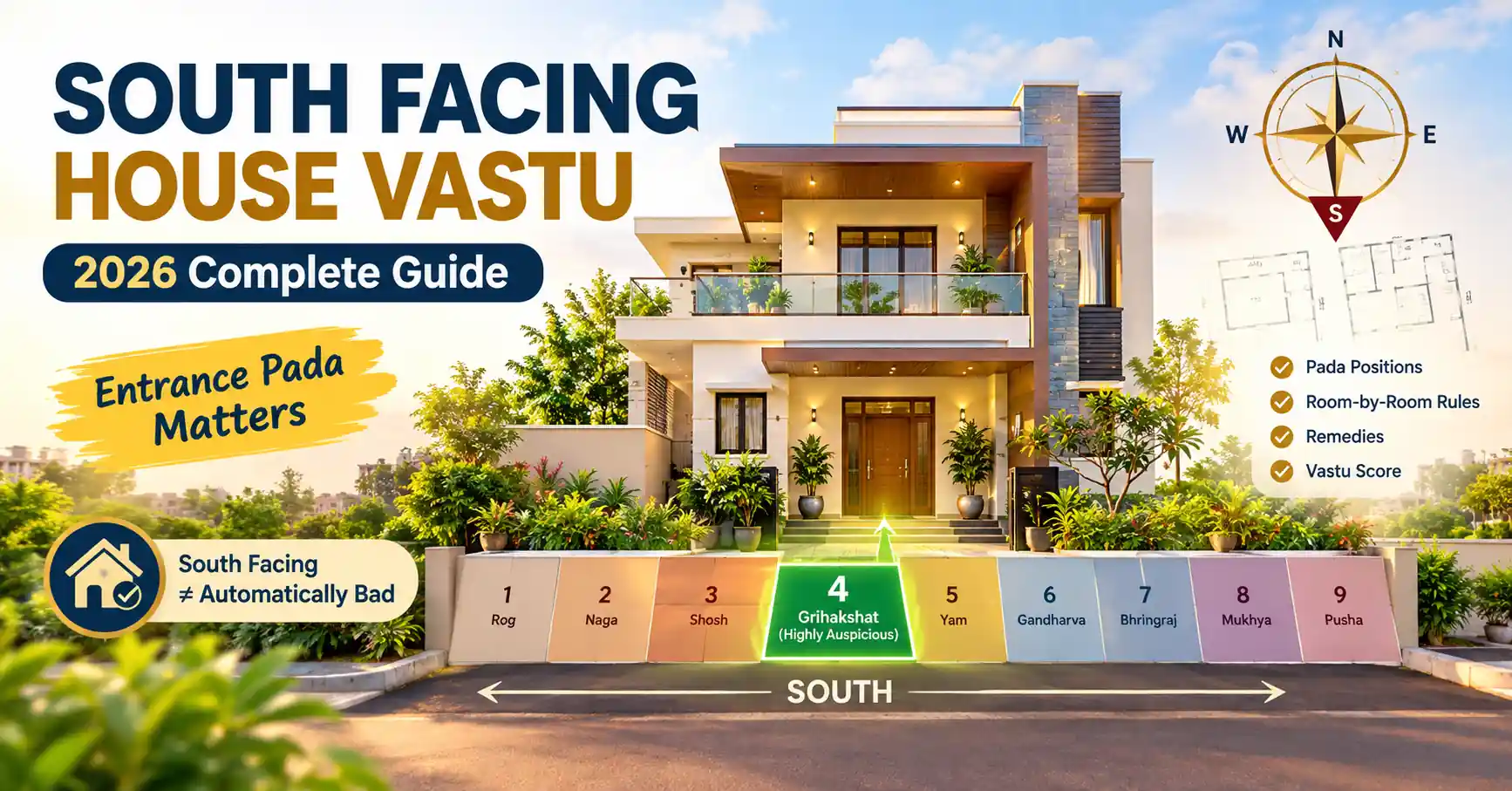
If you tell an Indian homebuyer that the property they are considering is south facing, nine times out of ten they will hesitate. Some will walk away without a second look. The south facing direction has a reputation in Indian real estate that borders on folklore — feared, avoided, and almost universally misunderstood. Here is the truth that most Vastu articles will not tell you: south facing is not inherently bad. The direction of your house’s facing is only one variable. The variable that actually determines whether your south facing entrance scores well or poorly in Vastu is the pada position of your door — and most people have never heard of it.
This guide covers everything about south facing house Vastu — why the direction got its reputation, what classical texts actually say, how the pada system works for south facing entrances, which pada positions are genuinely problematic and which are fine, room-by-room placement rules for south facing homes, practical remedies, and how to get your property’s actual Vastu score rather than a direction-based generalisation.
🏠 Check your south facing property’s actual Vastu score
VastuIQ’s AI Vastu Analyzer gives your property a room-by-room score — not a direction-based generalisation. Works for south facing homes in India, UK, UAE and 50+ countries. Free analysis in under 2 minutes.
→ Analyze My Property Free Free. No signup required.
Why South Facing Has a Bad Reputation — And Why It Is Incomplete
The south facing direction in Vastu Shastra is associated with Yama — the lord of death and dharma in Hindu cosmology — and with the fire element in its most intense form. Classical texts including the Manasara and the Brihat Samhita do advise caution with south facing properties, and certain south facing entrance positions are genuinely unfavourable in the Vastu framework. This is where the reputation comes from, and it is not entirely wrong.
What the reputation misses is the crucial distinction between the direction a house faces and the pada position of the entrance within that direction. A south facing house does not have a single entrance position — it has nine possible entrance positions along the south wall, each governed by a different deity and carrying a completely different Vastu quality. Some of those positions are genuinely problematic. Others are neutral. And one — the Grihakshat pada (4th pada from the east end of the south wall) — is considered highly auspicious by classical Vastu texts and is associated with wealth and prosperity.
Many of India’s most successful business families, politicians and prominent properties are south facing. The difference between a south facing property that works well and one that does not is almost always the entrance placement — not the direction itself.
How a House Gets Its Facing Direction
A house faces the direction of its main entrance — the primary door through which residents enter and exit daily. If your main door opens onto the south, your house is south facing. This is determined by standing inside the main door and looking outward: the direction you face is the direction your house faces.
Common sources of confusion:
- The road direction: If your house sits on a south-facing road (a road running along the south of your plot), your main entrance typically faces south — but this depends on how the plot and entrance are oriented, not the road alone.
- The plot orientation: A south facing plot does not automatically mean a south facing house. The entrance can be positioned on any wall of the plot.
- Flats and apartments: In a multi-storey building, the flat’s facing is determined by the direction the flat’s main door faces — not the building’s main entrance direction.
- Corner plots: Corner plots touching two directions require careful pada analysis of both available entrance walls before deciding which direction to prioritise.
If you are uncertain of your property’s facing direction, the most reliable method is to use a compass at the main entrance. Stand at the door facing outward and take a reading. The direction shown is your house’s facing direction. VastuIQ’s Vastu Analyzer will prompt you for this as part of the analysis process.
The Pada System — The Key to Understanding South Facing Vastu
The pada system divides each wall of a property into 9 equal sections (padas), each governed by a specific deity. For a south facing property, the south wall is the primary wall — and the position of the main entrance within this wall determines the Vastu quality of the entrance far more precisely than the direction alone.
The 9 padas of the south wall are counted from east to west (left to right when facing the south wall from outside). Each pada has a presiding deity, a Vastu quality and a specific effect on the residents.
| Pada | Deity | Vastu Quality | Effect on Residents |
|---|---|---|---|
| 1st (Vitatha) | Vitatha | Unfavourable | Financial losses, legal disputes |
| 2nd (Grihakshat) | Grihakshat | Auspicious | Wealth, prosperity, positive energy |
| 3rd (Yama) | Yama | Highly unfavourable | Health problems, early death fears in classical texts |
| 4th (Gandharva) | Gandharva | Neutral to positive | Creative energy, arts, social life |
| 5th (Mrigha) | Mrigha | Unfavourable | Anxiety, mental unrest |
| 6th (Pitra) | Pitra | Highly unfavourable | Ancestral problems, family conflicts |
| 7th (Dauvarika) | Dauvarika | Neutral | Average results, no specific harm |
| 8th (Sugriva) | Sugriva | Neutral to positive | Good for business activity |
| 9th (Pushpadanta) | Pushpadanta | Unfavourable | Obstacles in growth, slow progress |
The practical takeaway: A south facing house with its main door in the 2nd pada (Grihakshat) position scores well in Vastu. The same house with its door in the 3rd pada (Yama) position is genuinely problematic. This is why blanket statements about south facing being “bad” or “good” are not useful — the pada position is the deciding factor.
To determine which pada your entrance falls in, you need the exact measurement of your south wall and the position of the main door within it. VastuIQ’s Vastu Analyzer calculates this automatically when you input your floor plan dimensions and entrance position.
South Facing House — Room-by-Room Vastu Rules
Regardless of the entrance pada position, certain room placement principles apply to all south facing properties. These are based on the elemental and directional energies of the 8 directions and the centre, which do not change based on the facing direction of the house.
Main Entrance
As covered above, the entrance pada position is the single most important Vastu factor for a south facing home. The 2nd pada (Grihakshat) is the ideal position. If your entrance is not in this position and you are constructing or renovating, repositioning the entrance is the highest-impact Vastu intervention possible. If repositioning is not feasible, remedies are available (covered below).
Master Bedroom
The master bedroom in a south facing house should ideally be placed in the southwest zone. The southwest is governed by the earth element and by Nirrti — the deity of strength and stability. Placing the master bedroom here grounds the energy of the primary couple in the home and supports financial stability and health. The bed within this room should be positioned so the head points south or west during sleep — classical texts and modern Vastu both support this as the optimal sleep direction. Avoid the northeast for the master bedroom in any house, but especially in south facing homes where northeast is already the energy-receiving direction and should be kept light and open.
Kitchen
The kitchen in a south facing house should be placed in the southeast zone — this is the Agni (fire) corner and is considered the ideal position for the kitchen in all house types. A south facing house naturally has its southeast zone accessible from the south entrance side, which makes correct kitchen placement more achievable than in some other facing directions. The cooking platform should be positioned so the cook faces east while cooking. Avoid placing the kitchen in the northeast (disrupts the zone’s water energy) or the southwest (conflicts with earth energy and can cause financial instability).
Living Room
The living room works best in the north or east zone of a south facing house. The north is governed by Mercury and is associated with wealth, communication and social energy — making it ideal for the main gathering space. If the living room must be on the south side (near the entrance), keep it well-lit and uncluttered. Heavy furniture, dark colours and blocked windows on the south side of the living room compress the energy of the entrance zone.
Pooja Room
The pooja room (prayer room) in a south facing house belongs in the northeast zone — this rule holds regardless of the house’s facing direction. The northeast is governed by Jupiter and Ishana (the divine) and is considered the zone of spiritual clarity and higher wisdom. The northeast should never have heavy construction, toilets, storage or a kitchen above it. Keep it as open and clean as possible. If a dedicated pooja room is not feasible, a pooja corner in the northeast or east of the living room is the next best option.
Children’s Bedroom
Children’s bedrooms work well in the west or northwest zone of a south facing house. The west is associated with Saturn — discipline, structure and study. The northwest is associated with the Moon and Vayu (wind) — supporting movement, growth and social development. Both are appropriate for children depending on their age and what quality is most needed. Avoid placing children’s bedrooms in the southeast (fire energy can create restlessness) or the southwest (too heavy and stabilising for growing children).
Study Room or Home Office
The study or home office in a south facing house is best positioned in the west, north or east zone. The person studying or working should face east or north — east for academic study and creative work, north for business and financial work. Avoid facing south while studying or working, as the south direction in Vastu is associated with completion and endings rather than new learning and growth.
Guest Bedroom
Guest bedrooms work best in the northwest zone. The northwest is governed by Vayu (the wind deity) and is associated with movement and transience — qualities that align well with the temporary nature of guest stays. A guest bedroom in the southwest or northeast is less suitable: southwest is for the senior-most couple, and northeast should remain as open and spiritually clear as possible.
Bathroom and Toilet
Toilets in a south facing house should be placed in the northwest or west zone where possible. The south and southeast zones are acceptable for toilets (the fire element can manage the toilet’s heavy energy) but are not ideal. The most problematic toilet placements in any house — including south facing — are in the northeast (severely disrupts spiritual and prosperity energy) and the Brahmasthan (centre of the home). These placements are the ones that most commonly produce the negative effects that people incorrectly attribute to south facing direction in general.
South Facing House Vastu — Summary Placement Table
| Room | Best Zone | Avoid |
|---|---|---|
| Main Entrance | 2nd pada of south wall | 3rd pada (Yama), 6th pada (Pitra) |
| Master Bedroom | Southwest | Northeast, Southeast |
| Kitchen | Southeast | Northeast, Southwest, North |
| Living Room | North or East | Southwest (too heavy) |
| Pooja Room | Northeast | South, Southwest, Southeast |
| Children’s Room | West or Northwest | Southwest, Southeast |
| Study / Office | West, North or East | South-facing desk direction |
| Guest Room | Northwest | Southwest, Northeast |
| Toilet / Bathroom | Northwest or West | Northeast, Brahmasthan |
South Facing House Vastu — What to Keep Open and What to Avoid
Keep the northeast open and light. The northeast (Ishanya) corner of any home — regardless of facing direction — should be kept as open, clean and unobstructed as possible. This is especially important in south facing homes because the north and east walls are the primary energy-receiving walls. Heavy construction, underground water tanks below ground level in the northeast are acceptable; overhead water tanks, heavy storage or toilets in the northeast are among the most impactful negative Vastu placements.
Avoid extended southwest construction. The southwest should be the highest and heaviest part of the structure — meaning it should not be open, cut or lower than the rest of the home. A southwest cut (when the southwest corner of the plot or structure is reduced or missing) is one of the most serious Vastu defects and is associated with instability in the senior couple’s relationship, finances and health. In south facing plots, southwest cuts sometimes occur when road cuts are made for visibility — this should be avoided wherever possible in site selection.
Water bodies and the north or east. Underground water tanks, bore wells, swimming pools and water features belong in the north, northeast or east zones. In a south facing home, placing a water feature near the south entrance — while visually appealing — is a Vastu imbalance, bringing the water element into the fire and earth energy zone of the south.
Trees and the south wall. Tall trees on the south side of a south facing property are actually considered positive in Vastu — they provide a natural screen for the south’s intense afternoon sun and symbolically protect the south wall. Trees on the north or east side should be smaller and should not block morning light from entering the home.
Vastu Remedies for South Facing Houses
If your south facing home has an unfavourable entrance pada position or other Vastu defects, structural changes are not the only option. Classical Vastu and its modern application both recognise a range of remedies that can mitigate — though not fully neutralise — unfavourable placements.
Entrance Pada Remedies
If the entrance is in an unfavourable pada position (particularly the 3rd Yama or 6th Pitra pada):
- Place a Swastika symbol or Om symbol above the main door threshold — classical texts recommend these as protective markers for challenging south entrances.
- Install a Vastu pyramid or copper strip at the entrance threshold to redirect energy flow.
- Keep the entrance area exceptionally clean, well-lit and welcoming — compensating for the pada weakness with maximum positive energy at the doorstep.
- Avoid dark colours (black, dark grey, dark blue) for the main door in a south facing home. Red, orange, brown and earthy tones are more aligned with the south direction’s elemental nature.
- If structurally feasible, repositioning the main door to the 2nd pada position is the most effective long-term remedy and worth serious consideration during any renovation.
Northeast Zone Remedies
If the northeast has a toilet, kitchen or heavy storage:
- Place a crystal or Sphatik ball in the northeast to restore clarity to the zone.
- Keep a small water element (a clean bowl of water changed daily, or a small indoor fountain) in the northeast to support the zone’s water energy.
- Remove clutter from this zone immediately — storage reduction in the northeast has an outsized positive effect.
General South Facing Remedies
- Red colour on the south wall — a red door or red accents on the south-facing exterior wall support the south’s fire and Mars energy.
- Lead metal objects — placing small lead items (a lead pyramid, lead strip under the south entrance) is a classical Vastu remedy for south facing entrances in unfavourable pada positions.
- Hanuman image or Mangal yantra — Mars governs the south direction, and Hanuman (associated with Mars energy in the Vastu-Jyotish overlap) placed on the south wall is a widely used remedy.
- Salt remedy — keeping a bowl of sea salt in the south zone and replacing it monthly is a simple energy-clearing remedy for heavy south energy.
Remedies reduce the impact of unfavourable placements but do not eliminate them entirely. A professional Vastu assessment that scores the property comprehensively — rather than applying generic directional rules — gives you the most accurate picture of what needs attention and what is already working. Use VastuIQ’s Vastu Analyzer for a scored room-by-room analysis of your south facing property.
South Facing House in Flats and Apartments
For flat buyers, the south facing direction question arises differently. In an apartment building, each individual flat has its own facing direction determined by the direction its main door opens toward — not the direction the building faces. A flat whose front door faces south is a south facing flat, regardless of which way the building’s lobby faces.
For south facing flats, the pada analysis applies to the flat’s entrance door position within the south wall of that flat. Measuring the exact pada requires knowing the total width of the south wall of the flat and the position of the door within it. In a standard 3BHK flat, this measurement is straightforward and can be done with a tape measure and compass.
Additional considerations for south facing flats that differ from independent houses:
- You cannot modify the entrance position in most apartments — making the pada analysis a pre-purchase checklist item rather than a post-purchase remedy option.
- The floor level matters: south facing flats on higher floors receive more direct afternoon sunlight through south-facing windows, which can increase heat load and needs to be managed through window treatment.
- Common areas (lobby, staircase, lift) on the south side of the building can partially buffer the south energy before it reaches the flat — a positive factor not present in independent houses.
For a complete Vastu checklist before purchasing any flat — including direction, pada, northeast zone, kitchen placement and Brahmasthan check — see VastuIQ’s guide on Vastu for Flats and Apartments.
South Facing House Vastu Score — What to Expect
When VastuIQ analyses a south facing property, the overall Vastu score is not determined by the facing direction alone. The scoring model considers:
- Entrance pada position — the highest-weighted single factor for south facing homes
- Northeast zone condition — open and light vs. obstructed or heavy
- Kitchen placement — southeast ideal, northeast worst
- Master bedroom placement — southwest ideal
- Toilet placement — northwest acceptable, northeast problematic
- Brahmasthan condition — centre of home open vs. obstructed
- Southwest condition — heavy and closed vs. open or cut
A south facing home with a 2nd pada entrance, southeast kitchen, southwest master bedroom and open northeast can score 80–90 out of 100 — well within the range that Vastu practitioners consider positive and supportive. A south facing home with a 3rd pada entrance, northeast toilet and southwest cut can score below 50 — and in that case, the south facing direction is one of several compounding factors, not the sole cause of the low score.
This is why the VastuIQ score model exists: to replace directional generalisations with a precise, weighted, multi-factor assessment of what is actually working and what needs attention in a specific property.
🏠 Get your south facing home’s actual Vastu score
Stop guessing based on direction alone. VastuIQ’s AI Vastu Analyzer scores your specific property — room by room, zone by zone, entrance pada included. Free analysis. Detailed report from ₹99.
Frequently Asked Questions — South Facing House Vastu
Is a south facing house always bad in Vastu?
No. The direction alone does not determine whether a home is Vastu-positive or negative. The pada position of the main entrance — specifically whether it falls in the 2nd (Grihakshat), 3rd (Yama), 6th (Pitra) or another pada of the south wall — is the primary determinant. A south facing home with a 2nd pada entrance can score very well. The generalisation that south facing is bad comes from the fact that the most problematic padas (3rd and 6th) are among the most commonly occurring entrance positions in south facing homes — not from the direction itself being inherently negative.
Which pada is best for a south facing main door?
The 2nd pada (Grihakshat) is the most auspicious entrance position for a south facing home in classical Vastu texts. It is associated with Grihakshat — a deity connected to prosperity and positive household energy. The 4th pada (Gandharva) is neutral to positive. The 8th pada (Sugriva) is acceptable. The 3rd pada (Yama) and 6th pada (Pitra) are the most problematic and should be avoided wherever possible in construction or entrance repositioning.
Can I buy a south facing flat if the entrance is in the wrong pada?
This depends on the severity of the pada position and the condition of the rest of the flat’s Vastu. If the entrance is in the 3rd or 6th pada and the northeast is also obstructed, the combined effect is significant and remedies alone may not be sufficient. If only the entrance pada is unfavourable but the rest of the flat scores well (open northeast, southeast kitchen, southwest master bedroom), remedies at the entrance threshold can reduce the impact meaningfully. A scored analysis of the specific flat before purchase gives you the clearest picture. Use VastuIQ’s Vastu Analyzer with the flat’s floor plan to get a room-by-room score before deciding.
Does the south facing direction affect financial prosperity?
In classical Vastu, financial prosperity is primarily governed by the north zone (ruled by Kubera, the deity of wealth), the northeast zone (entry of positive energy) and the strength of the main entrance. A south facing home with a well-placed entrance and an open, clear north and northeast zone can support financial prosperity effectively. The south facing direction itself is associated with Yama (dharma, justice, completion) — not with financial loss. Financial difficulty in south facing homes is more accurately attributed to specific defects like a 3rd pada entrance or a blocked northeast than to the south direction as a whole.
What colour should the main door be in a south facing house?
Red, orange, earthy brown and warm wood tones are the most aligned colours for a south facing main door — they support the fire and Mars energy of the south direction. Silver and white are also acceptable. Avoid black, dark blue and dark grey for the south facing main door — these bring water and Saturn energy into a direction that is already associated with fire and heat, creating an elemental conflict in Vastu terms.
Should I avoid buying a south facing plot?
Not necessarily. If the plot allows you to position the main entrance in the 2nd pada of the south wall, the south facing plot can support a Vastu-positive home. Before purchasing, verify that the plot’s dimensions allow for correct pada placement — this requires knowing the total width of the south boundary and calculating where the 2nd pada falls. Corner plots that face south and east simultaneously offer more entrance positioning flexibility and are generally more forgiving than pure south facing plots. A narrow south facing plot where the main door is forced into the 3rd pada by the building’s footprint is a genuine concern that should factor into the purchase decision.
Is south facing good for commercial properties?
South facing entrances for commercial properties are assessed differently from residential ones. The south direction is associated with visibility, reputation and the marketplace in some Vastu traditions — and many successful shops, showrooms and business premises have south facing entrances. For commercial properties, the 2nd, 4th and 8th padas of the south wall are generally considered workable. The 3rd (Yama) and 6th (Pitra) padas remain the ones to avoid. VastuIQ’s Vastu Analyzer covers commercial property analysis as well as residential.
How does a south facing house compare to north facing in Vastu?
North facing is generally considered the most favourable direction in Vastu Shastra because the north is governed by Kubera (wealth) and by the water element — and the most auspicious north facing entrance padas (4th and 5th, governed by Kubera himself) are among the central padas of the north wall, making them more commonly occurring in typical construction. This is why north facing has the reputation it does. However, the gap between a well-placed south facing entrance and a poorly placed north facing entrance is significant — a north facing home with its door in a problematic pada can score lower than a south facing home with an ideal 2nd pada entrance. Direction preference without pada analysis is an incomplete framework. For the complete north facing guide, see VastuIQ’s North Facing House Vastu guide.
Apply This to Your Own Property
Free AI Vastu analysis — room-by-room scores, geo-adaptive for India, UK, UAE and 50+ countries. Detailed report from ₹99.