
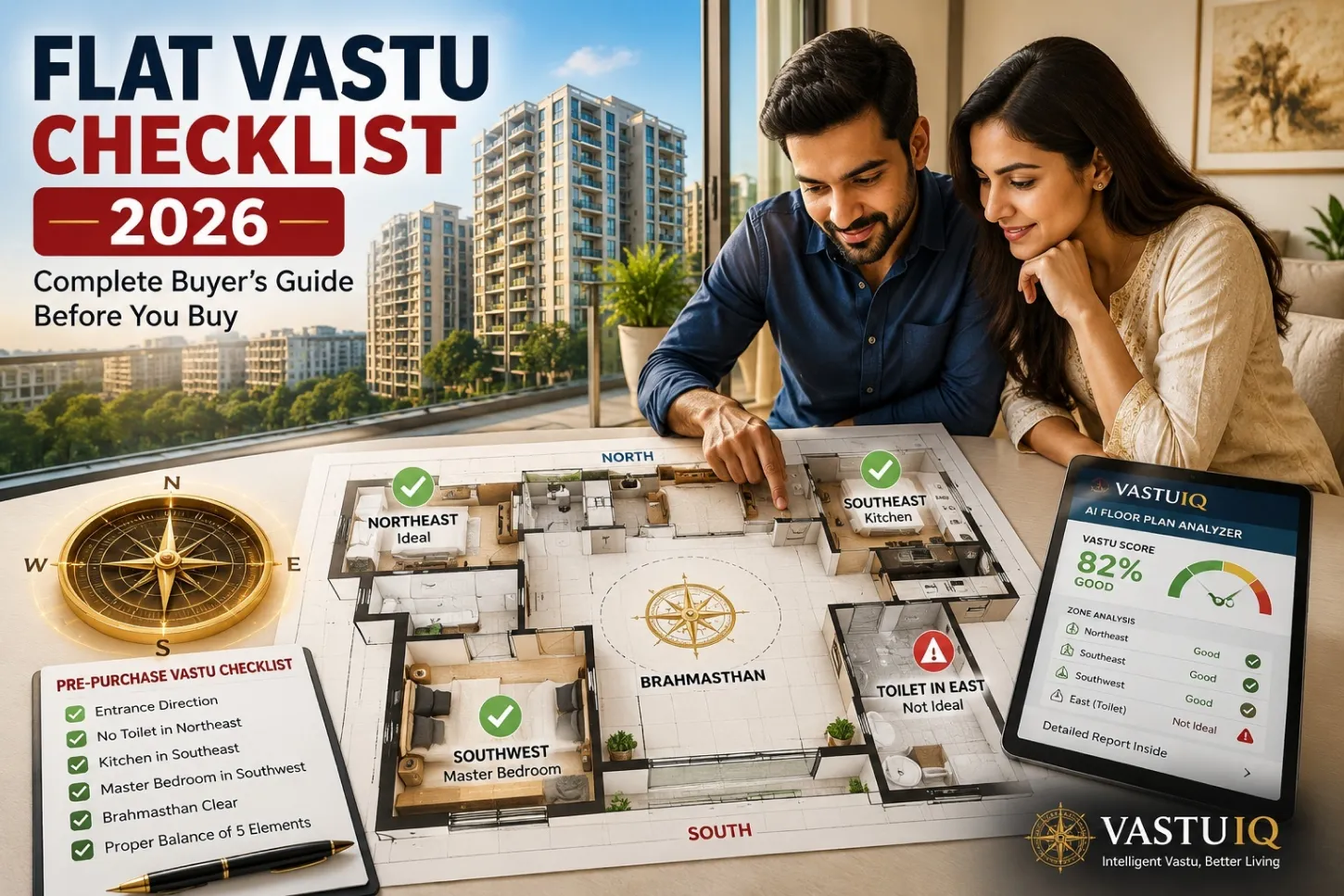
Most Indian flat buyers ask about Vastu for apartments before purchasing. Very few know how to actually check it correctly from a builder’s floor plan brochure — before they sign the agreement and hand over the token.
This matters more for flats than for independent houses. In an independent house, Vastu defects discovered after possession can sometimes be corrected with structural changes. In a flat, the walls are fixed. The toilet that sits in the northeast is staying there. The kitchen that faces the wrong zone is not moving. The only option after possession is non-structural remedies — which help, but do not fully replace getting it right before you buy.
This guide gives you the complete framework: how to determine your flat’s facing direction, the eight checks every flat buyer should run before booking, the most common defects found in Indian builder flats, floor and number Vastu, and how to analyse any floor plan using AI without visiting the site.
Why Vastu for Flats Is Different from Independent Houses
Classical Vastu Shastra was originally written for ground-level structures where the owner had complete control over orientation, design and layout. An apartment unit presents a fundamentally different context:
- Your flat’s entrance direction may differ from the building’s overall facing direction
- You share walls with neighbours on multiple sides
- Structural changes are almost never possible post-purchase
- The builder determines room placement, not you
The result is that pre-purchase Vastu analysis is far more valuable for flat buyers than for independent house owners. A ₹70 lakh flat purchase made without Vastu assessment can result in occupying a defective space for years, while the same analysis done before booking costs a fraction and could change the decision entirely.
Step 1: How to Determine Your Flat’s Facing Direction
The most common mistake flat buyers make is using the building’s overall orientation — determined by which way the main lobby or compound entrance faces — as the Vastu direction for their flat. This is incorrect.
The correct method:
- Go to the front door of your specific flat unit — not the building lobby
- Stand inside the flat at the main door and face outward as if exiting
- Hold your phone compass flat at waist height, away from metal and electrical panels
- Wait for the needle to settle — the direction you are facing is your flat’s Vastu facing direction
- Mark North on your floor plan accordingly — this is the foundation for all zone analysis
For under-construction flats: Ask the builder or site engineer for the compass orientation, or use Google Maps satellite view to identify which direction the flat entrance opens toward. Most builder brochures also include a site plan with a compass indicator.
Step 2: The Eight Pre-Purchase Vastu Checks
Once you have the facing direction and the floor plan, run these eight checks before booking. In VastuIQ’s analysis of apartment floor plans across Indian cities, these eight parameters account for over 85% of Vastu compliance score variation between flats at similar price points.
Check 1: No toilet in the northeast zone
The single most important check. The northeast (Ishan zone) should be open, a prayer room, or a light living area. A toilet here is a severe defect with no fully effective non-structural remedy. This is the most common defect VastuIQ finds in Indian builder flats — present in approximately 31% of plans analysed.
Check 2: Kitchen in southeast or northwest
Southeast is ideal (Agni/fire zone). Northwest is acceptable. Kitchen in the northeast, southwest, or Brahmasthan centre is a significant defect — very common in layouts where builders place kitchens for plumbing convenience rather than Vastu compliance.
Check 3: Master bedroom in southwest
The southwest is the earth and stability zone — correct for the head of household. In a north-facing flat, southwest is back-left. In a south-facing flat, it is front-left. This is present as a defect in approximately 44% of flats analysed — the most common zone defect after northeast toilet.
Check 4: Entrance direction and pada position
Confirm the entrance faces an auspicious direction (north, northeast or east preferred) and that its position on the wall is in the correct section. North Pada 1 and south Pada 1 are the worst entrance positions despite the house facing those directions in general.
Check 5: Brahmasthan is open
The geometric centre of the flat should not have a structural column, toilet, or heavy fixed element. In standard rectangular flats, the living room or dining area typically occupies the centre — this is correct.
Check 6: Regular shape — no extreme cuts
Rectangular and square flats are ideal. L-shaped or T-shaped flats have missing corners. A missing northeast corner is the most problematic; a missing southwest corner is also significant. Check the floor plan outline carefully before making a viewing decision.
Check 7: Balcony in north or east
North and east balconies allow auspicious directional energy to flow in and maximise beneficial morning light. South or southwest balconies are less favourable and bring afternoon heat. Present as a defect in approximately 38% of flats — though this is the most easily remedied with heavy planters.
Check 8: No beam over bed or dining area
Structural beams directly over the sleeping or eating zone are a Vastu defect. Check the flat’s ceiling in person or ask the builder about beam positions in the slab drawings.
VastuIQ’s AI Floor Plan Analyzer checks all eight automatically from a single uploaded floor plan image. Get your analysis at vastuiq.com/ai-vastu-floor-plan-analyzer
Most Common Vastu Defects in Indian Builder Flats
After analysing hundreds of apartment floor plans across Indian cities — Chandigarh, Mohali, Mumbai, Bengaluru, Pune, Delhi, Chennai and Hyderabad — VastuIQ’s data shows consistent defect patterns driven by builder prioritisation of plumbing convenience and carpet area maximisation over Vastu compliance.
| Defect | How Common | Severity | Remedy Available? |
|---|---|---|---|
| Toilet in northeast | 31% of flats | High | Partial remedy only |
| Kitchen not in SE or NW | 28% of flats | High | Colour and directional remedy |
| Master bedroom not in SW | 44% of flats | Medium | Furniture repositioning |
| Missing northeast corner (L-shape) | 19% of flats | Medium | Yantra and mirror remedy |
| Entrance in inauspicious pada | 23% of flats | Medium | Threshold and symbolic remedy |
| Balcony in south or southwest | 38% of flats | Low | Heavy planter remedy |
| Brahmasthan obstruction | 12% of flats | Medium | Furniture relocation |
Which Floor Is Best for Vastu in an Apartment Building?
Classical Vastu texts were written for ground-level structures and do not specifically address multi-storey towers. Contemporary Vastu practitioners apply the five-element framework to floor selection as follows:
- Ground floor: Most grounded, connected to earth element. Best for elderly residents, those seeking stability, families with young children. Privacy and security are practical considerations.
- 1st to 3rd floor: Generally considered optimal — good air flow, some elevation, still connected to earth energy. Most families are well-suited here.
- 4th to 8th floor: Increasing Vayu (air and movement) energy. Suitable for professionals, entrepreneurs and young couples who value career dynamism over stability.
- 9th floor and above: Air and space element dominant. Suited for those who value freedom, travel and mobility. Less grounding energy — not recommended for those seeking long-term stability or retirement living.
Does the Flat Number Matter? Vastu Numerology for Apartments
In Vastu Numerology, your flat number carries a specific energy determined by reducing it to a single digit. Add all the digits until you reach 1–9.
Examples: Flat 402 → 4+0+2 = 6 (Venus energy — harmony and relationships). Flat 35 → 3+5 = 8 (Saturn energy — discipline and long-term results). Flat 14 → 1+4 = 5 (Mercury energy — growth and communication).
General compatibility:
- Number 1: Leadership, new beginnings — good for first-time buyers starting a new chapter
- Number 3: Family joy and creativity — excellent for families with children
- Number 5: Growth and dynamism — good for career-focused residents
- Number 6: Harmony and relationships — excellent for couples
- Number 4: Hard work and obstacles — assess carefully against your personal numbers
- Number 8: Saturn’s influence — karmic, requires patience; can be excellent for certain Life Paths
VastuIQ’s Numerology Compatibility tool calculates your flat number’s compatibility with your personal birth numbers automatically — essential for a complete pre-purchase assessment.
Is a Corner Flat Better for Vastu?
Yes — corner flats are generally preferred in Vastu because they have more open sides, receive natural light and ventilation from two directions, and have fewer shared walls.
The most auspicious corner flat position is on the northeast corner of the building’s floor plate — benefiting from both north and east directional energy. The southwest corner flat is the least preferred as it concentrates the heaviest earth energy without the benefit of openings on the auspicious north or east sides.
A middle flat flanked on both sides has more restricted energy flow, but if the internal layout is Vastu-compliant, this limitation is largely overcome by correct room placement.
Vastu for Rented Flats — What You Can Fix Without Structural Changes
If you are already in a rented flat with Vastu defects, these non-structural adjustments have the highest impact without requiring any landlord permission:
- Change sleeping direction: Move the bed so your head points south or east. The single highest-impact zero-cost Vastu adjustment. Simply repositioning the bed changes the sleeping direction without any structural work.
- Cooking direction: Rearrange the stove so you face east while cooking — even moving a portable gas stove achieves this partially.
- Northeast zone: Keep the northeast corner of your flat completely clean, open and well-lit. Place a small Tulsi plant or water feature here. Never store heavy items in the northeast.
- Sea salt: Place a bowl of sea salt in the northeast bathroom if present — change weekly. One of the most effective non-structural remedies for this common defect.
- Mirror correction: Remove or angle any mirror that reflects the bed. Cover at night if fixed in position.
VastuIQ generates non-structural remedy recommendations specifically for rented properties — filtering out any suggestions requiring structural changes or landlord permission. Start your free analysis here.
How to Compare Multiple Flats on Vastu Before Buying
When evaluating shortlisted flats, systematic Vastu comparison prevents the common mistake of choosing based on price or location while overlooking critical compliance differences. A flat that scores 80/100 on Vastu at ₹5,000 per sqft provides a dramatically better long-term living environment than one scoring 52/100 at ₹4,500 per sqft — the Vastu discount rarely justifies the defect.
VastuIQ’s Compare Vastu tool allows side-by-side comparison of two properties simultaneously, showing scores for each Vastu category. When using comparison results, prioritise the flat with higher scores on parameters that are hardest to correct post-purchase — entrance direction and toilet position are the two most important.
NRI Flat Buyers: Remote Vastu Assessment
For NRIs evaluating Indian flats from the UK, UAE, USA, Canada or Australia, remote Vastu assessment is entirely feasible using VastuIQ’s tools. The process: ask the builder or local contact to WhatsApp the floor plan brochure, upload the image to VastuIQ’s AI Floor Plan Analyzer, receive the full PDF report by email within minutes. Payment via Razorpay supports international cards.
Multiple NRI buyers across VastuIQ’s user base have used this process to evaluate Tricity properties (Mohali, Chandigarh, Zirakpur, Panchkula) and other Indian city apartments without travelling to India for a site visit.
FAQ — Vastu for Apartments and Flats
How do I check Vastu of a flat before buying?
Get the builder floor plan, determine your flat’s entrance direction using a compass at the flat’s main door, and upload the floor plan to VastuIQ’s AI Floor Plan Analyzer. The tool maps all rooms to Vastu zones and checks the eight critical parameters automatically. Priority checks: no toilet in northeast, kitchen in southeast or northwest, master bedroom in southwest, and clear Brahmasthan at the flat’s geometric centre.
Is a north east facing flat good for Vastu?
Yes — a northeast-facing flat entrance is considered the most auspicious of all directions in Vastu Shastra. Northeast combines north’s wealth energy (Kubera) and east’s health energy (Indra and Surya) in one direction. Northeast-facing flats are associated with divine blessings, spiritual clarity, health and prosperity simultaneously. The entrance position within the northeast wall (which pada) also matters for scoring.
Is a south facing flat bad Vastu?
No — south facing is not inherently bad Vastu. This is one of the most widespread Vastu myths in India. A south-facing flat with the entrance in Pada 4 of the south wall and correct internal room layout can score 70+ on VastuIQ’s compliance scale. South-facing flats are often available at a discount due to buyer avoidance driven by this myth — creating genuine value for informed buyers who run proper analysis first.
Does the flat number matter for Vastu?
Yes — your flat number carries numerological energy that interacts with the spatial Vastu of the property. The flat number reduces to a single digit (add all digits), and each digit carries different planetary energy. VastuIQ’s free Numerology Compatibility tool calculates whether your flat number’s energy aligns with your personal birth numbers — a complete two-axis assessment combining spatial Vastu and numerological compatibility.
Can I check Vastu of a flat without visiting the site?
Yes — VastuIQ’s AI Floor Plan Analyzer allows you to upload a builder floor plan image and receive a complete Vastu compliance report without a site visit. This is particularly useful for under-construction properties and for NRI buyers evaluating Indian properties remotely. The analysis takes under 5 minutes from upload to PDF report download.
Can Vastu affect the resale value of a flat?
Yes — in the Indian residential market, Vastu compliance measurably affects buyer demand. North and east-facing flats with no northeast toilet command a 5–15% premium in most urban markets. South-facing properties are often discounted despite being structurally equivalent due to Vastu misconceptions. A VastuIQ Vastu Compliance Certificate can serve as a marketing asset for sellers in a competitive listing market.
Apply This to Your Own Property
Free AI Vastu analysis — room-by-room scores, geo-adaptive for India, UK, UAE and 50+ countries. Detailed report from ₹99.