
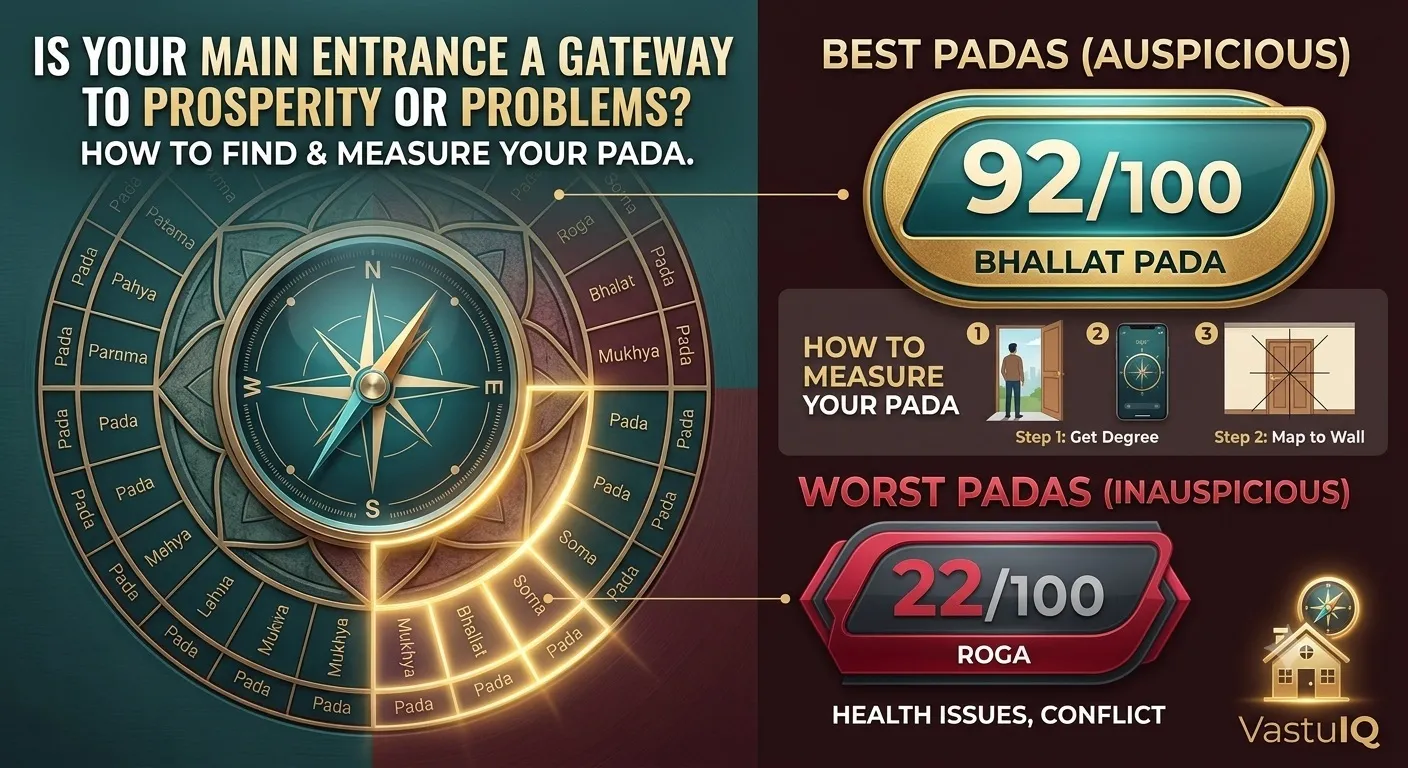
Here is the most consequential Vastu fact that most Indian homeowners have never been told: the direction your home faces is the least important part of your main entrance Vastu. The pada position — which of the 32 precise zones your main door falls in on the entrance wall — accounts for 45 to 50 percent of your home’s total Vastu score and is more important than whether your home faces north, south, east or west. A north-facing home in the wrong pada scores 22 out of 100. A south-facing home in the right pada scores 78 out of 100. The south-facing home wins — by a significant margin.
Every major Vastu platform explains this 32-pada system in theory. VastuIQ is the only platform in India that calculates it — instantly, from your inputs, for any direction. This guide covers everything about the vastu pada system — the complete definition, how to find and measure your pada, all 32 padas scored with effects and remedies, direction-by-direction best-pada guides and exactly how to use the free Pada Calculator to check your home in under 2 minutes.
⚡ Check your pada before reading further
Most people read about Vastu padas without ever checking which pada their own main door falls in. The check takes 90 seconds — you only need a compass app and your home’s facing direction. VastuIQ’s Pada Calculator is the only free tool in India that identifies your exact pada position and score instantly.
→ Open Free Pada Calculator No registration. Free. Works for all directions.
What Is a Pada in Vastu Shastra — Complete Definition
The word pada comes from Sanskrit, meaning “step,” “foot” or “division.” In Vastu Shastra, a pada is one of the 32 precise energy zones that divide the outer perimeter of any built structure. These 32 padas are the outermost layer of the Vastu Purusha Mandala — the classical energy grid that maps divine energy across a home’s floor plan.
Understanding the structure requires knowing the four layers of the Vastu Purusha Mandala:
- Brahma Vithi — the innermost zone at the geometric centre (Brahmasthan), governed by Lord Brahma
- Deva Vithi — the second inner ring, governed by divine deities of the interior zones
- Manushya Vithi — the third ring, associated with human activity zones
- Paishacha Vithi — the outermost ring, where the 32 padas sit, each governed by a specific celestial deity
The 32 padas occupy the Paishacha Vithi — the outermost perimeter of the mandala. Since the main entrance of any home is always constructed in this outermost zone (the exterior wall), every main door necessarily falls within one of these 32 padas. The deity governing that pada determines the specific quality of energy that enters the home through the main door — and therefore the dominant energy pattern in the occupants’ lives.
The mathematics of the 32-pada system:
- The full 360° perimeter of a home is divided into 32 equal zones
- Each pada covers exactly 11.25° (360° ÷ 32 = 11.25°)
- 8 padas per cardinal direction (north, south, east, west) = 32 total
- Each pada has a specific name, governing deity, elemental quality and energetic effect
- Of the 32 padas, 10 are considered auspicious, the remaining 22 range from neutral to severely inauspicious
Classical reference: The Manasara (Chapter 10, “Dwara Lakshana” — the science of door placement) specifies all 32 pada positions with their governing deities and prescribes which are acceptable for main entrance placement. The Mayamata (Chapter 12) confirms the pada system as the primary determinant of entrance energy quality, stating: “Dvara-pada guna-doshaabhyam grihe sukham dukham tatah” — “From the quality or defect of the entrance pada, happiness or sorrow in the home proceeds.”
Why Pada Matters More Than Facing Direction
This is the insight that changes how every homeowner thinks about Vastu — and the one that no mainstream Vastu guide states clearly enough. The facing direction of your home (north, south, east or west) is the context. The pada position of your main door is the result. The context shapes what is possible; the pada determines what actually happens.
Here is the scored comparison that proves this:
| Home Facing | Pada Position | Pada Name | VastuIQ Score | Verdict |
|---|---|---|---|---|
| North-facing | N1 (first pada on north wall) | Roga | 22/100 | ✗ Severe defect — health and financial drain |
| North-facing | N3–N4 (centre zone) | Mukhya / Bhallat | 92/100 | ⭐ Excellent — wealth and prosperity |
| South-facing | S3–S4 (centre zone) | Vitatha / Gruhakshat | 74–78/100 | ✓ Strong — fame and financial growth |
| South-facing | S1 (first pada on south wall) | Yama | 28/100 | ✗ High defect — obstacles and delays |
| East-facing | E3–E4 (centre zone) | Jayant / Indra | 88–92/100 | ⭐ Excellent — authority and wealth |
| East-facing | E1 (first pada on east wall) | Shikhi | 18/100 | ✗ Very high defect — fire risk, financial loss |
| West-facing | W3–W5 (centre-right zone) | Sugreev / Pushpadant / Varun | 78–85/100 | ✓ Strong — steady growth and stability |
| West-facing | W8 (last pada on west wall) | Asura | 22/100 | ✗ Severe defect — authority conflicts |
The conclusion from this table is unambiguous: a south-facing home in Vitatha pada (74–78/100) scores significantly higher than a north-facing home in Roga pada (22/100). The conventional wisdom — “always buy north or east facing” — is incomplete. What matters is the pada, not the direction alone. And the pada is what VastuIQ’s free Pada Calculator identifies instantly.
This is also why so many Indian homebuyers who “got the north-facing flat they wanted” are puzzled when Vastu outcomes do not improve — they checked the direction but never checked the pada. The direction told them the context was right. The pada told them nothing, because they never measured it.
How to Find Your Pada — Complete Step-by-Step Method
There are two methods for finding your pada: the compass degree method (precise, recommended) and the wall measurement method (physical, for those without a compass app). Both are explained below.
Method 1 — Compass Degree Method (recommended)
Each pada occupies exactly 11.25° of the 360° perimeter. The compass degree ranges for all 32 padas are fixed:
- Stand at your main entrance door facing outward (facing away from your home, toward the outside world).
- Open your compass app and note the degree reading. This is your entrance facing degree.
- Match the degree to the pada table — each pada spans 11.25°, starting from 0° (True North) and progressing clockwise. For example: 0°–11.25° = Pada 1 (Roga in the NW-N transition zone on some scales, or mapped to the first pada of the north wall depending on the mapping system used). The complete degree-to-pada mapping is in the master table in H2 5 below.
- Enter your degree reading into VastuIQ’s free Pada Calculator — it matches your degree reading to the correct pada name, deity, score and effects automatically. This eliminates the manual degree-mapping step entirely.
Important note on magnetic vs true north: Compass apps by default show magnetic north, which differs from true north by your location’s magnetic declination. In most parts of India, this difference is small (0° to 2°) and rarely shifts the pada assignment. However, for properties near large steel structures, power lines or in areas with high local magnetic interference, the compass reading may be affected. Take readings at three points — just inside the door, at the door threshold and just outside — and use the average.
Method 2 — Wall Measurement Method
- Measure the total length of your entrance wall from corner to corner in feet.
- Divide by 8 — this gives you the width of one pada in feet.
- Starting from the correct corner for your wall direction (NE corner for north walls, SE corner for south walls, NE corner for east walls, SW corner for west walls), measure to the centre of your main door.
- Divide the door-centre distance by the pada width and round up — this gives your pada number (1 through 8) for that wall.
Example: North-facing home with entrance wall 36 feet wide. Each pada = 36 ÷ 8 = 4.5 feet. Door centre is 14 feet from the NE corner. Pada = 14 ÷ 4.5 = 3.1 → round up to Pada 3 = Mukhya pada (N3). Score: 92/100. Excellent.
The apartment pada measurement — different from independent homes
This is the most commonly misunderstood aspect of pada measurement. In an apartment building, the building itself may face north while your flat’s main door opens onto an east-facing corridor. These are two different pada measurements:
- Building pada: The pada of the building’s primary entrance (lobby) — relevant for the building’s overall energy
- Flat pada: The pada of your individual flat’s main door — relevant for your personal home’s energy, and the one that matters for your Vastu assessment
Always measure your pada at your flat’s own main entrance door, facing outward from your flat into the corridor. The building’s street-facing direction is irrelevant for your personal pada score. Two flats in the same building on different sides can have completely different pada scores.
🧭 Free Pada Calculator — Get Your Score in 90 Seconds
India’s only dedicated Vastu Pada Calculator. Enter your compass degree or facing direction — get your exact pada name, governing deity, VastuIQ score and specific effects instantly. No manual counting, no diagrams, no guesswork.
→ Calculate My Pada Free
Works for homes, flats, shops and offices in any direction
Free Pada Calculator — India’s Only Dedicated Tool
VastuIQ’s Pada Calculator at vastuiq.com/pada-calculator is the only free, dedicated pada calculation tool available in India. Every other Vastu platform describes the 32-pada system — none of them calculate it automatically from user inputs. Here is exactly what the tool does and how to use it.
What the Pada Calculator gives you
- Exact pada identification — your pada name (Mukhya, Bhallat, Roga etc.) from your compass degree or direction input
- VastuIQ pada score — your entrance’s score out of 100 based on pada position and facing direction
- Governing deity — which celestial being governs your pada and what energy they govern
- Key effects — the specific life-area effects associated with your pada (wealth, health, authority, obstacles, conflicts etc.)
- Remedy guidance — for defective padas, specific actionable remedies including door colour, threshold metal, placement items and directional corrections
- Auspicious rating — clear auspicious / neutral / inauspicious classification for your pada
How to use the Pada Calculator — step by step
- Open the calculator at vastuiq.com/pada-calculator on your phone or computer
- Enter your facing direction — either select your cardinal direction (N/S/E/W) or enter the exact compass degree reading from your phone’s compass app at the main entrance
- Enter the door position on the wall — either select left/centre/right zone or enter the measurement from the correct corner
- Get your result instantly — pada name, score, deity, effects and remedies displayed immediately
- Download the PDF report — the detailed pada report includes the complete remedy plan for your specific pada position
Why a dedicated pada tool matters
The 32-pada system requires cross-referencing a compass degree reading, a wall position measurement, a deity table and a scoring model simultaneously — a process that takes 10 to 15 minutes manually with a printed diagram and frequently produces errors. The most common manual error is using the building’s facing direction rather than the door’s compass reading, producing a pada assessment that is wrong from the first step. VastuIQ’s calculator eliminates all manual steps, uses your precise compass degree input and returns an accurate result in under 90 seconds.
No other free tool in India does this. VastuIQ’s Pada Calculator is genuinely unique — making it the only destination for anyone searching “vastu pada calculator” in any variation.
All 32 Padas — Complete Scored Master Table
This is the most comprehensive 32-pada reference table published anywhere — all padas with direction, compass degrees, governing deity, VastuIQ score, key effect and remedy flag. Save this page for permanent reference.
| # | Pada Name | Direction | Compass Degrees | Deity | VastuIQ Score | Key Effect | Remedy? |
|---|---|---|---|---|---|---|---|
| 1 | Shikhi (Ish) | NE→E transition | 45°–56.25° | Shikhi (fire) | 18/100 | Risk of fire accidents, financial loss, sudden danger | Yes |
| 2 | Parjanya | East (E1) | 56.25°–67.5° | Parjanya (rain deity) | 25/100 | Wasteful expenditure, grief, poverty tendency | Yes |
| 3 | Jayant | East (E2) | 67.5°–78.75° | Jayant (Indra’s son) | 88/100 | Success, wealth, victory, strong social reputation | No |
| 4 | Indra (Mahendra) | East (E3) | 78.75°–90° | Indra (king of gods) | 92/100 | Power, authority, government connections, prosperity | No |
| 5 | Surya | East (E4) | 90°–101.25° | Surya (sun god) | 32/100 | Short-temperedness, aggression, diminished male energy | Yes |
| 6 | Satya | East (E5) | 101.25°–112.5° | Satya (truth deity) | 28/100 | Dishonesty tendency, broken promises, relationship rifts | Yes |
| 7 | Bhrisha | East (E6) | 112.5°–123.75° | Bhrisha | 22/100 | Irrational anger, marital discord, potential divorce | Yes |
| 8 | Akash | SE→S transition (E7) | 123.75°–135° | Akash (sky) | 20/100 | Theft risk, accidents, financial loss, government trouble | Yes |
| 9 | Agni (Pusha) | SE (S1) | 135°–146.25° | Agni (fire god) | 35/100 | Fire-related energy, conflict tendency, financial instability | Yes |
| 10 | Pusha | SE (S2) | 146.25°–157.5° | Pusha (nourishment deity) | 42/100 | Moderate — digestive health, nourishment-related effects | Partial |
| 11 | Vitatha | South (S3) | 157.5°–168.75° | Vitatha | 78/100 | Immense prosperity, excellent problem-solving, growth | No |
| 12 | Gruhakshat | South (S4) | 168.75°–180° | Gruhakshat | 74/100 | Fame, wealth, particularly auspicious for business and factories | No |
| 13 | Yama | South (S5) | 180°–191.25° | Yama (god of death) | 28/100 | Obstacles, delays, health concerns, fear and depression | Yes |
| 14 | Gandharva | South (S6) | 191.25°–202.5° | Gandharva (celestial musician) | 22/100 | Financial instability, relationship friction, artistic temperament | Yes |
| 15 | Bhringraj (Mriga) | SW→S (S7) | 202.5°–213.75° | Mriga (deer deity) | 18/100 | Major defect — loss, grief, enemies multiplied | Yes — severe |
| 16 | Pitra | SW (SW1) | 213.75°–225° | Pitra (ancestral spirits) | 15/100 | Worst pada in SW — ancestral curses, deep financial loss, grief | Yes — severe |
| 17 | Dauwarik | SW (SW2) | 225°–236.25° | Dauwarik (doorkeeper) | 18/100 | Stagnation, blocked growth, chronic obstacles | Yes — severe |
| 18 | Sugreev | West (W1) | 236.25°–247.5° | Sugreev | 80/100 | Money, stability, steady material growth | No |
| 19 | Pushpadant | West (W2) | 247.5°–258.75° | Pushpadant (flower-toothed) | 82/100 | Wealth increase, prosperity, financial abundance | No |
| 20 | Varun | West (W3) | 258.75°–270° | Varun (water deity) | 85/100 | Increase in luck, happiness, cosmic order energy | No |
| 21 | Asura | West (W4) | 270°–281.25° | Asura (demon) | 22/100 | Authority conflicts, fear of powerful people, bad luck | Yes |
| 22 | Shosha | NW→W (W5) | 281.25°–292.5° | Shosha | 18/100 | Drying of resources — wealth loss, health drain, unimaginable loss | Yes — severe |
| 23 | Paapyakshma | NW (NW1) | 292.5°–303.75° | Paapyakshma | 15/100 | Disease, grief, accumulation of misfortune, chronic illness | Yes — severe |
| 24 | Roga | NW (NW2) | 303.75°–315° | Roga (disease deity) | 22/100 | Fear of conflicts, fights, enmity, health problems | Yes |
| 25 | Naga | NW→N (NW3) | 315°–326.25° | Naga (serpent deity) | 28/100 | More enemies in relatives, hidden conflicts, instability | Yes |
| 26 | Mukhya | North (N1) | 326.25°–337.5° | Mukhya (chief deity) | 92/100 | Gain of male progeny, prosperity, ancestral blessings, wealth | No |
| 27 | Bhallat | North (N2) | 337.5°–348.75° | Bhallat (deity of abundance) | 92/100 | Abundant wealth, maximum prosperity, ancestral grace | No |
| 28 | Soma | North (N3) | 348.75°–360°/0° | Soma / Kubera (moon, wealth) | 88/100 | Wealth, progeny, spiritual upliftment, Kubera energy | No |
| 29 | Bhujang (Sarpa) | North (N4) | 0°–11.25° | Bhujang (serpent) | 32/100 | Enmity with son, family conflict, serpent-energy instability | Yes |
| 30 | Aditi | NE→N (N5) | 11.25°–22.5° | Aditi (mother of gods) | 28/100 | Wickedness in women of household, domestic disharmony | Yes |
| 31 | Diti | NE (NE1) | 22.5°–33.75° | Diti (mother of asuras) | 22/100 | Poverty tendency, wealth depletion, financial reversal | Yes |
| 32 | Shikhi / Ish (NE2) | NE (NE2) | 33.75°–45° | Ish / Shikhi | 18/100 | Danger, sorrow, loss and fire — same as E-side Shikhi | Yes |
Key summary from this table: Of the 32 padas, 10 score 74/100 or above (Jayant, Indra, Vitatha, Gruhakshat, Sugreev, Pushpadant, Varun, Mukhya, Bhallat, Soma). These are the only padas where no remedy is needed. The remaining 22 padas range from moderately defective to severely inauspicious and require either structural repositioning (before construction) or remedy application (for existing homes). Check which of these your home falls in using VastuIQ’s free Pada Calculator.
Best Padas for Each Direction — The Definitive Guide
For each cardinal direction, 3 of the 8 padas are strongly auspicious, 2 to 3 are moderately defective and 2 to 3 are severely inauspicious. Here is the direction-by-direction breakdown with specific guidance for homebuyers and home builders.
North-facing homes — 3 auspicious padas out of 8
| Pada | Name | Score | Verdict | Key Effect |
|---|---|---|---|---|
| N1 (NW→N) | Naga | 28/100 | ⚠ Defect | Hidden conflicts, enemies in relatives |
| N2 (N1) | Mukhya | 92/100 | ⭐ Best | Wealth, ancestral blessings, male progeny |
| N3 (N2) | Bhallat | 92/100 | ⭐ Best | Maximum prosperity, abundant wealth |
| N4 (N3) | Soma | 88/100 | ⭐ Excellent | Wealth, Kubera energy, spiritual growth |
| N5 (N4) | Bhujang | 32/100 | ⚠ Caution | Family conflict, enmity with son |
| N6 (N5) | Aditi | 28/100 | ⚠ Defect | Domestic disharmony |
| N7 (N6) | Diti | 22/100 | ✗ Inauspicious | Poverty tendency, wealth depletion |
| N8 (N7) | Shikhi/Ish | 18/100 | ✗ Severe | Danger, sorrow, fire risk |
For north-facing homes: Target padas N2, N3 and N4 (Mukhya, Bhallat, Soma) — scores 88–92/100. Avoid N7 and N8 (Diti and Shikhi) at all costs. The best north-facing entrance positions the door in the right-of-centre zone of the north wall when standing outside facing the home.
South-facing homes — 2 auspicious padas out of 8
| Pada | Name | Score | Verdict | Key Effect |
|---|---|---|---|---|
| S1 | Agni/Pusha | 35/100 | ⚠ Moderate defect | Fire energy, conflict tendency |
| S2 | Pusha | 42/100 | ⚠ Borderline | Digestive, nourishment effects |
| S3 | Vitatha | 78/100 | ⭐ Auspicious | Immense prosperity, problem-solving |
| S4 | Gruhakshat | 74/100 | ⭐ Auspicious | Fame, wealth, excellent for business |
| S5 | Yama | 28/100 | ⚠ Defect | Obstacles, delays, health concerns |
| S6 | Gandharva | 22/100 | ✗ Inauspicious | Financial instability, relationship friction |
| S7 | Mriga | 18/100 | ✗ Severe | Major loss, grief, multiplied enemies |
| S8 | Pitra | 15/100 | ✗ Most Severe | Ancestral curses, deep financial loss |
For south-facing homes: S3 (Vitatha) and S4 (Gruhakshat) are the two strong south padas — scoring 78/100 and 74/100 respectively. Both are fully auspicious and require no remedies. A south-facing home in Vitatha pada is a better Vastu result than most north-facing homes in defective padas. Avoid S7 (Mriga) and S8 (Pitra) — the most severely inauspicious padas in the south direction. The entire southwest zone (Pitra, Dauwarik) is the most damaging entrance direction in Vastu Shastra and should be avoided regardless of pada.
East-facing homes — 2 auspicious padas out of 8
| Pada | Name | Score | Verdict | Key Effect |
|---|---|---|---|---|
| E1 | Shikhi | 18/100 | ✗ Severe | Fire risk, accidents, major financial loss |
| E2 | Parjanya | 25/100 | ✗ Inauspicious | Wasteful expenditure, grief, poverty |
| E3 | Jayant | 88/100 | ⭐ Excellent | Success, wealth, victory, social reputation |
| E4 | Indra | 92/100 | ⭐ Best | Power, authority, government connections |
| E5 | Surya | 32/100 | ⚠ Caution | Aggression, short-temperedness |
| E6 | Satya | 28/100 | ⚠ Defect | Dishonesty, broken promises |
| E7 | Bhrisha | 22/100 | ✗ Inauspicious | Marital discord, divorce risk |
| E8 | Akash | 20/100 | ✗ Severe | Theft, accidents, government trouble |
For east-facing homes: E3 (Jayant) and E4 (Indra) are the two gold-standard east padas — scores 88–92/100. These two padas produce the strongest possible Vastu entrance outcomes for residential properties. The northeast corner of the east wall (E1 Shikhi) is the most common mistake for east-facing homes — many people assume the northeast-leaning entrance is the most auspicious position, but E1 Shikhi scores only 18/100. The correct east entrance is in the centre-right zone of the east wall, not toward the northeast corner.
West-facing homes — 3 auspicious padas out of 8
| Pada | Name | Score | Verdict | Key Effect |
|---|---|---|---|---|
| W1 | Sugreev | 80/100 | ⭐ Auspicious | Money, stability, material growth |
| W2 | Pushpadant | 82/100 | ⭐ Auspicious | Wealth increase, financial abundance |
| W3 | Varun | 85/100 | ⭐ Excellent | Luck, happiness, cosmic order |
| W4 | Asura | 22/100 | ✗ Inauspicious | Authority conflicts, bad luck |
| W5 | Shosha | 18/100 | ✗ Severe | Drying of resources, massive loss |
| W6 | Paapyakshma | 15/100 | ✗ Most Severe | Disease, grief, chronic misfortune |
| W7 | Roga | 22/100 | ✗ Inauspicious | Fights, conflicts, health problems |
| W8 | Naga | 28/100 | ⚠ Defect | Hidden enemies, instability |
For west-facing homes: W1, W2 and W3 (Sugreev, Pushpadant, Varun) score 80–85/100 — making the west direction’s auspicious pada cluster one of the strongest available. A west-facing home in Varun pada (85/100) outperforms most north and east-facing homes in mediocre padas. Avoid W5 and W6 (Shosha, Paapyakshma) — the northwest transition zone is consistently the most defective cluster in the entire 32-pada system.
Worst Padas and Their Remedies
When a home’s main entrance falls in a severely inauspicious pada and structural repositioning is not possible, remedies can reduce the defect’s impact — typically improving the score by 10 to 20 points. Here are the most defective padas and their specific remedies.
Roga pada (NW zone, 22/100) — disease and conflict energy
Symptoms: Recurring health issues in household members, domestic conflicts, enmity developing in relationships, persistent financial friction.
Remedies:
- Install a bright warm-white light directly above the main entrance — maximum brightness, always on from dusk to midnight
- Place a lead or iron strip beneath the entrance doormat — lead is the classical threshold metal for defective northwest-zone entrances
- Hang a Hanuman image above the entrance facing outward — specifically prescribed for Roga pada protection
- Place a rock salt bowl just inside the entrance door, changed weekly
- Paint the door a deep maroon or dark red — Mars energy at the entrance counteracts Roga’s disease associations
Shikhi / Ish pada (NE→E transition, 18/100) — fire and loss energy
Symptoms: Risk of fire accidents or sudden losses, financial reversals, danger-related anxiety in household.
Remedies:
- Place a copper Ganesha above the entrance facing outward — fire-controlling deity energy at the entrance
- Install a water feature (small bowl of water with a floating diya) just inside the entrance on the northeast side — water element counteracts Shikhi’s fire energy
- Keep fresh flowers at the entrance always — never dried flowers at a Shikhi pada entrance
- Use blue or green as accent colours at the entrance threshold — water element colours counteract fire element pada
Pitra pada (SW, 15/100) — most severe defect
Symptoms: Deep financial loss, ancestral karma activation, grief without clear cause, persistent obstacles across multiple life areas simultaneously.
Remedies:
- This is the most severely defective pada — partial remedies provide some relief but structural change is strongly recommended if at all possible
- Perform Pitru Tarpan or ancestral puja on Amavasya monthly — specifically addresses the ancestral energy activated by this pada
- Place a brass wire or brass threshold strip across the entire entrance — classical Vastu remedy for southwest-facing entrances
- Place a large Hanuman image above the entrance, facing outward, as the primary protective element
- Consult a Vastu practitioner for personalised high-severity remedy protocol — Pitra pada is beyond standard remedy depth
Paapyakshma pada (NW, 15/100) — chronic illness energy
Symptoms: Chronic illness in household members, persistent grief, accumulation of negative karma, health deterioration without clear medical cause.
Remedies:
- Maximum ventilation and light at the entrance — the most important first step for any NW defective pada
- Copper strip beneath the doormat — copper’s purifying energy is the primary threshold remedy for NW defective padas
- Neem or Tulsi plants immediately beside the entrance — natural purification at the defective energy intake point
- Monthly salt water floor wash of the entire entrance area — sea salt in warm water mopped weekly at the threshold
Mriga / Bhringraj pada (SW→S, 18/100) — loss and grief
Symptoms: Multiplied enemies, financial loss, grief, emotional difficulty.
Remedies:
- Brass threshold strip across entrance
- Lead strip beneath doormat
- Bright entrance light always on
- Hanuman protection above door
For a complete personalised remedy plan based on your specific pada position, use the free Pada Calculator — the tool provides direction-specific remedies matched to your exact pada score.
North-Facing House Pada — Complete Guide
The north-facing home is widely considered the most auspicious in Indian Vastu — but this is only true when the entrance falls in one of three specific padas. A north-facing home in the wrong pada is significantly worse than a south or west-facing home in the right pada. Here is everything a north-facing homeowner needs to know.
The 3 auspicious north padas — target these:
- Mukhya (N2, 92/100): The highest-scoring north pada and one of the highest-scoring padas in the entire system. Governed by the “chief deity” — brings wealth, ancestral blessings, male progeny and social authority. The ideal north-facing entrance is in this pada.
- Bhallat (N3, 92/100): “The deity of abundance” — equal score to Mukhya. Specifically associated with maximum material prosperity and ancestral grace. Equally excellent as Mukhya; either is the ideal north entrance position.
- Soma (N4, 88/100): Governed by Soma/Kubera — wealth, progeny and spiritual upliftment. Moon energy at the entrance. Slightly lower than Mukhya and Bhallat but still an excellent north entrance position.
The 2 padas to avoid at all cost in north direction:
- Diti (N7, 22/100): Poverty tendency, wealth depletion. A north-facing entrance near the northeast transition zone.
- Shikhi/Ish (N8, 18/100): The extreme northeast corner of the north wall — the most commonly mistaken position. Many people assume the northeast-leaning north entrance is most auspicious because “northeast is sacred.” Shikhi scores 18/100 — it is one of the most defective entrances in the system.
How to position correctly for a new north-facing construction: Measure the total north wall length. The auspicious zone (Mukhya + Bhallat + Soma) covers the centre-right 3/8ths of the north wall when standing outside facing the home. Position the door centre within this zone. The left quarter and right quarter of the north wall (toward the northwest and northeast corners respectively) should be avoided for the main entrance.
South-Facing House — Why It Is Not Always Bad Vastu
The fear of south-facing homes is the single most widespread Vastu misconception in Indian real estate. It costs homebuyers significant money — they reject sound south-facing properties in correct padas and overpay for north-facing properties in defective padas. Here is the complete, honest assessment.
The myth: “South-facing homes are always bad Vastu.”
The fact: South-facing homes in Vitatha (S3) or Gruhakshat (S4) pada are fully auspicious, with scores of 78/100 and 74/100 respectively. These scores are higher than the majority of north, east and west-facing homes that are in mediocre or defective padas.
Who specifically benefits from Vitatha (S3) and Gruhakshat (S4) padas:
- Vitatha (S3, 78/100): Associated with “immense prosperity and excellent problem-solving abilities.” Particularly beneficial for professionals who work in complex problem-solving fields — lawyers, doctors, consultants, engineers. The prosperity association is broad and consistent across classical texts.
- Gruhakshat (S4, 74/100): Associated with “fame, wealth and particularly auspicious for factories and commercial properties.” The commercial Vastu community consistently rates Gruhakshat as the top south-facing pada for business premises. Residential occupants benefit from the fame and wealth associations.
The south-facing padas that are genuinely problematic: S7 (Mriga, 18/100), S8 (Pitra, 15/100) and the SW cluster (Dauwarik, Gandharva) are severely inauspicious. The blanket “south facing is bad” rule conflates these genuinely defective south padas with the auspicious S3 and S4 padas — a generalisation that is factually wrong and financially costly for homebuyers who reject good south-facing properties based on it.
Check any south-facing property’s pada before rejecting it — use VastuIQ’s free Pada Calculator to confirm whether the entrance falls in the auspicious S3/S4 zone or in a genuinely defective pada. This one check could save you from a costly and incorrect decision.
Pada for Apartment Flats — Specific Guidance
Apartment pada measurement has nuances that independent home pada measurement does not. These specific apartment considerations are the most commonly mishandled aspects of pada assessment for urban Indian homeowners.
The building direction vs flat door direction problem
The most common apartment pada error: measuring the compass direction of the building’s street-facing wall and calling that the flat’s facing direction. In a multi-tower housing complex, the building may face north but individual flats on the west wing have doors facing east, west or south depending on corridor orientation. The building’s street direction has no relevance to an individual flat’s pada assessment.
Always measure at your flat’s main entrance door — facing outward from your flat into the corridor. This is the correct measurement point for apartment pada assessment, regardless of which direction the building faces or which floor the flat is on.
Corner flats and wrap-around entrances
Corner flats sometimes have entrance doors that face a diagonal direction — northeast, southeast, southwest or northwest. These intermediate directions still fall within the 32-pada system — each of the four intermediate directions has 2 padas assigned to it in the full 360° mapping. The Pada Calculator handles these intermediate directions correctly from the compass degree input.
High-rise apartments above the ground floor
The pada system applies identically regardless of floor level. A flat on the 15th floor with a north-facing entrance in Mukhya pada scores exactly the same as a ground floor flat with the same orientation. Pada energy is directional, not elevation-dependent. Use the same measurement method at your flat’s entrance regardless of which floor you are on.
Shared corridor entrances
In some apartment configurations, the flat’s main door opens onto a shared corridor that then opens to the building lobby — the flat’s entrance pada is measured at the flat’s own door, not at the lobby entrance. Each unit in the corridor has its own compass direction and its own pada, even though they share the same corridor.
🏢 Apartment owners — check your flat’s actual pada
The building’s facing direction is not your flat’s pada. Stand at your main entrance door, face outward, take a compass reading and enter it into the Pada Calculator. Your result may be completely different from what the building’s street orientation suggests.
Pada for Shop and Office Entrance
The 32-pada system applies with equal validity to commercial entrances — shops, offices, factories, warehouses and any other built structure. The commercial pada assessment differs from residential in one important way: the type of activity in the space influences which padas are most beneficial.
Best padas for shops and retail businesses
Gruhakshat (S4, 74/100): Classical texts specifically cite Gruhakshat as “particularly auspicious for factories and commercial properties.” The fame and reputation associations of Gruhakshat align well with retail businesses that need footfall and brand recognition.
Varun (W3, 85/100): The cosmic order and commerce associations of Varun are specifically aligned with commercial activity — patience, fair exchange and transactional prosperity. A west-facing shop in Varun pada is considered one of the most auspicious commercial entrance configurations.
Pushpadant (W2, 82/100): Flower-toothed deity of abundance — commercial associations of this pada include good customer relationships and steady revenue flow. Excellent for any consumer-facing business.
Best padas for offices and professional services
Indra (E4, 92/100): Power, authority and government connections — specifically excellent for professional services firms, legal practices, government contractors and organisations that benefit from authoritative positioning.
Mukhya (N2, 92/100): “Chief” pada — authority and leadership associations make this ideal for corporate offices, leadership organisations and professional practices.
Jayant (E3, 88/100): Victory and social reputation — ideal for marketing agencies, PR firms, consultancies and any business where reputation and network are primary assets.
The commercial pada mistake to avoid
Many commercial properties have southwest-facing entrances (Pitra, Dauwarik) or northwest defective-zone entrances (Paapyakshma, Shosha) — configurations specifically associated in classical Vastu with staff shortages, revenue instability and persistent obstacles despite correct strategy. Checking the commercial entrance pada before signing a lease is as important as checking the Brahmasthan and kitchen zone. VastuIQ’s free Pada Calculator works for commercial entrances identically to residential ones.
Pada Remedies — When You Cannot Move the Door
Structural repositioning of a main entrance door — moving it from a defective pada to an auspicious one — requires significant carpentry or construction work and may not be possible in a rented property, an apartment or a recently purchased home. When the door cannot be moved, these remedies apply:
Universal entrance remedies for any defective pada
| Remedy | How to Apply | Score Improvement | Suitable For |
|---|---|---|---|
| Bright light above entrance | Warm-white LED at maximum brightness, on dusk to midnight daily | +5 to +8 points | All defective padas |
| Toran above door frame | Mango leaf or marigold toran on adhesive hook above the entrance | +4 to +6 points | All defective padas |
| Ganesha above door facing outward | Copper or brass Ganesha mounted above the door on the outside | +5 to +8 points | All defective padas |
| Copper strip under doormat | Thin copper strip under entrance doormat at threshold | +4 to +6 points | North, NE, E defective padas |
| Lead / iron strip under doormat | Lead or iron strip under doormat at threshold | +4 to +6 points | South, SW, W, NW defective padas |
| Direction-appropriate door colour | Green for north, saffron for east, red/maroon for south, blue/grey for west | +6 to +10 points | All directions — colour reinforces direction energy |
| Threshold salt wash | Salt water mopped at entrance threshold weekly | +3 to +5 points | All defective padas — especially NW cluster |
| Diya at entrance every evening | Ghee lamp at entrance from dusk, daily | +4 to +6 points | All defective padas |
The direction-specific threshold metal rule
Classical Vastu prescribes different metals for the entrance threshold depending on the wall direction — because each direction’s governing deity responds to a specific elemental metal:
- North entrance: Copper strip — Mercury’s metal for Kubera’s wealth direction
- East entrance: Gold or copper — solar metal for Indra’s solar direction
- South entrance: Lead or iron strip — heavy metals for Yama’s earth direction
- West entrance: Silver or iron — Varuna’s water-metal combination
- Northwest entrance (defective): Iron strip — Saturn’s metal for the most challenging northwest pada cluster
When to consider structural repositioning
If all of the following are true, structural repositioning of the main entrance is worth considering seriously:
- The pada score is below 25/100
- The home is owned (not rented)
- The occupants have been in the property for over 12 months with persistent negative patterns
- VastuIQ’s AI Floor Plan Analyzer confirms the entrance defect as the primary scoring factor
In these cases, moving the door by as little as 2 to 4 feet — shifting from a defective pada to the adjacent auspicious pada — can be accomplished by a carpenter in one day at minimal cost and produces the highest-impact Vastu improvement available for the property.
Frequently Asked Questions — Vastu Pada
What is a pada in Vastu Shastra?
A pada is one of the 32 precise energy zones that divide the outer perimeter of any built structure in Vastu Shastra. The full 360° perimeter is divided into 32 equal zones of 11.25° each, with 8 padas per cardinal direction. Each pada is governed by a specific celestial deity and carries a specific energy quality that determines the type of energy entering the home through the main entrance. Of the 32 padas, 10 are auspicious, and the pada position of the main entrance door accounts for 45 to 50 percent of a home’s total Vastu score.
How do I find which pada my main door is in?
Two methods: (1) Compass degree method — stand at your main entrance facing outward, take a compass reading on your phone, enter the degree into VastuIQ’s free Pada Calculator at vastuiq.com/pada-calculator — your pada is identified instantly. (2) Wall measurement method — measure the entrance wall length, divide by 8 to get one pada width, measure from the correct corner to the door centre and divide to get your pada number. For apartments, always measure at your individual flat’s entrance door, not at the building’s lobby.
How many padas are auspicious in Vastu Shastra?
Of the 32 total padas, 10 are considered auspicious and require no remedies: Jayant (E3), Indra/Mahendra (E4), Vitatha (S3), Gruhakshat (S4), Sugreev (W1), Pushpadant (W2), Varun (W3), Mukhya (N2), Bhallat (N3) and Soma (N4). These 10 padas score 74/100 or above on VastuIQ’s model. The remaining 22 padas range from moderately defective to severely inauspicious.
Is a south-facing house always bad Vastu?
No — this is one of the most costly misconceptions in Indian real estate Vastu. South-facing homes in Vitatha pada (S3, 78/100) and Gruhakshat pada (S4, 74/100) are fully auspicious and require no remedies. These scores are higher than the majority of north and east-facing homes in mediocre padas. The south-facing homes that are genuinely problematic are those in S7 (Mriga), S8 (Pitra) or the SW cluster — not the entire south direction. Always check the pada before accepting or rejecting a south-facing property.
What is Mukhya pada in Vastu?
Mukhya pada (N2) is the most auspicious pada in the north direction and one of the highest-scoring padas in the entire 32-pada system — scoring 92/100 on VastuIQ’s model. Governed by “Mukhya” — the chief deity — it is associated with wealth accumulation, ancestral blessings, male progeny and social authority. In compass degree terms, it occupies approximately 326.25° to 337.5°. North-facing homes should target their entrance in the Mukhya or adjacent Bhallat pada for maximum Vastu benefit.
What is Bhallat pada in Vastu?
Bhallat pada (N3) scores 92/100 — equal to Mukhya and one of the two best north-facing entrance positions. Governed by “Bhallat,” the deity of abundance, it is specifically associated with maximum material prosperity and ancestral grace in classical texts. It occupies approximately 337.5° to 348.75° in compass degree terms. For a new north-facing construction, positioning the door centre in the Bhallat pada zone produces the strongest north-facing Vastu result available.
What is Roga pada in Vastu and what is its remedy?
Roga pada is one of the northwest-direction padas scoring 22/100 — associated with the deity of disease, health conflicts and domestic friction. It occupies approximately 303.75° to 315° in compass degree terms. Remedies: bright warm-white light above the entrance, lead or iron strip beneath the doormat, Hanuman image above door facing outward, rock salt bowl just inside the entrance changed weekly, and deep maroon or red door colour. These remedies improve the score from 22/100 to approximately 35–40/100 — meaningful partial improvement but full elimination requires door repositioning.
Can I check my vastu pada online for free?
Yes — VastuIQ’s free Pada Calculator at vastuiq.com/pada-calculator is India’s only dedicated online pada calculator. Enter your compass degree reading or select your facing direction and door position, and get your exact pada name, VastuIQ score, governing deity, key effects and specific remedies instantly. No registration required. The tool is free to use and works for homes, flats, shops and offices in any direction.
Which pada is best for east-facing main door?
For east-facing homes, Jayant (E3, 88/100) and Indra/Mahendra (E4, 92/100) are the two best padas. Indra pada is the highest-scoring east entrance position — specifically associated with power, authority and government connections, making it particularly strong for professionals and entrepreneurs. Jayant pada is equally excellent for social reputation and victory in endeavours. Both padas are in the centre zone of the east wall. Avoid E1 (Shikhi, 18/100) — the northeast corner of the east wall — which many people mistakenly target as the most auspicious east entrance position.
What is the difference between direction and pada in Vastu?
The facing direction (north, south, east, west) is the broad context of your home’s orientation. The pada is the precise energy sub-zone within that direction where your main door falls. Each direction has 8 padas — so a “north-facing home” could have any of 8 different energy qualities at its entrance, ranging from 18/100 (Shikhi) to 92/100 (Mukhya, Bhallat). The pada determines the actual energy outcome — the direction alone tells you only which of the four broad energetic contexts you are in, not which quality of energy is entering your home. This is why the pada check is always more important than the direction check.
How does the VastuIQ Pada Calculator work?
The VastuIQ Pada Calculator at vastuiq.com/pada-calculator takes your compass degree reading or direction-and-position inputs and maps them to the corresponding pada in the 32-pada system. It then returns: the exact pada name, the governing deity, the VastuIQ score (out of 100), the key effects associated with that pada, an auspicious/inauspicious classification and specific remedy guidance if the pada is defective. The calculation uses the standard 11.25° per pada mapping starting from True North, with automatic magnetic declination reference for Indian locations. It is the only free, dedicated pada calculation tool available in India.
Related Guides and Tools
🧭 Free Pada Calculator — Check Your Entrance Pada Now
India’s only dedicated Vastu Pada Calculator. Know your exact pada position, score, effects and remedies in 90 seconds. Works for homes, flats, shops and offices in any direction. No registration required.
Related VastuIQ tools:
🧭 Free Vastu Calculator — complete home Vastu score including pada, all zones and full report
🏠 AI Floor Plan Analyzer — upload your floor plan for complete 25-factor analysis
🏛️ Brahmasthan Calculator — find your home’s exact geometric centre
🔢 Numerology Calculator — check house number compatibility
Complete related guides:
Main Door Vastu — Direction, Colour, Pada Score and Complete Guide — the complete main entrance guide covering pada position, door colour rules, threshold metals and all entrance Vastu factors.
5 Vastu Mistakes New Homebuyers Make — Mistake 1 is ignoring the pada system entirely. This guide explains exactly how pada checking fits into the homebuying process.
Brahmasthan Vastu — Free Calculator + Complete Guide — the other primary Vastu factor after pada position: the geometric centre of your home and its condition.
Vastu for Rental Property — What Tenants Can Do — includes the pre-renting pada check as a key step in evaluating any rental property before signing.
Vastu Tips for Home — Complete 2026 Guide — the VastuIQ hub page with all major Vastu factors and the complete blog and tool library.
Apply This to Your Own Property
Free AI Vastu analysis — room-by-room scores, geo-adaptive for India, UK, UAE and 50+ countries. Detailed report from ₹99.