
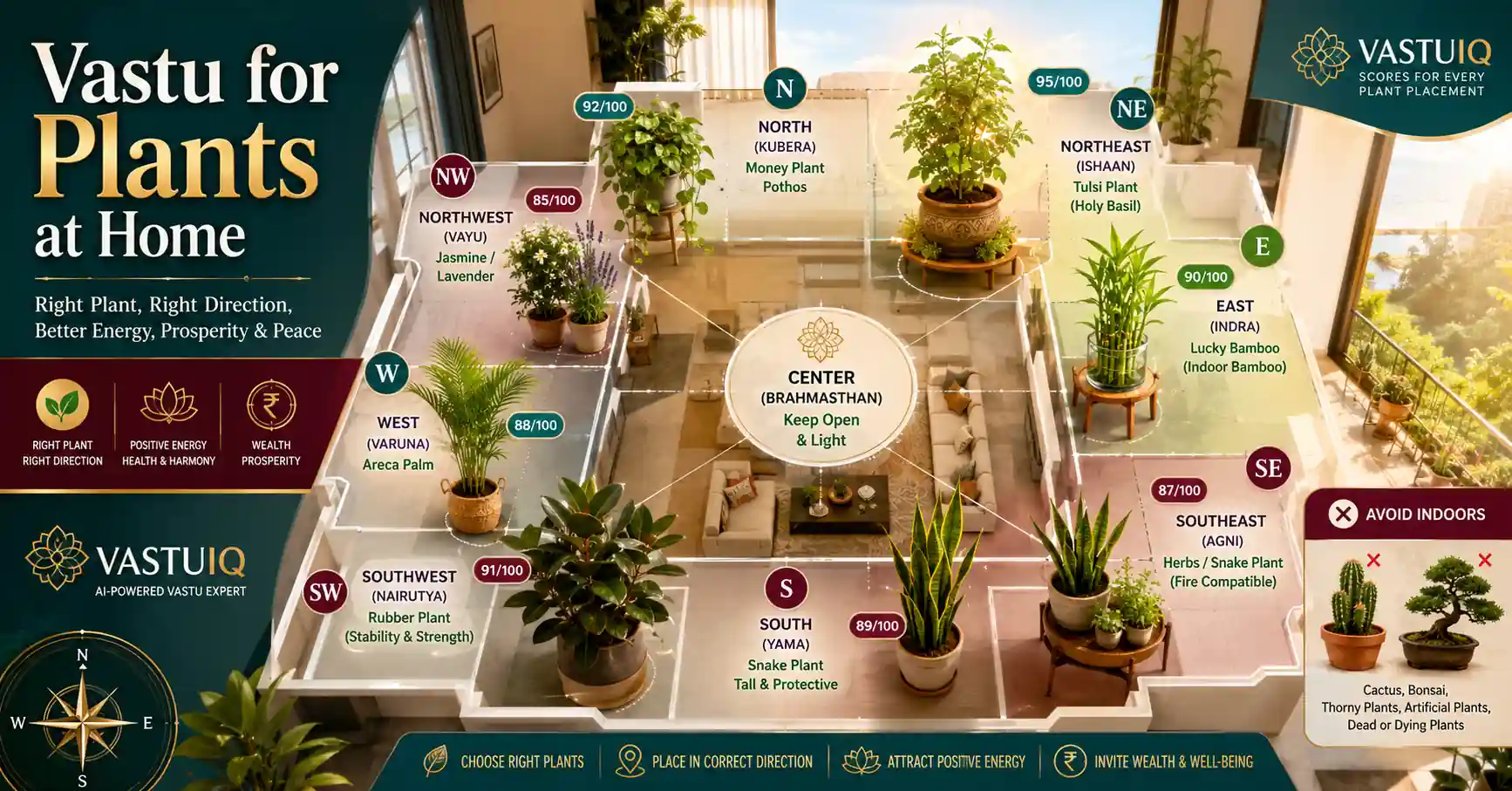
Most Indian homes make two plant Vastu mistakes simultaneously — and both are undoing each other. The first: keeping thorny plants indoors. The second: placing auspicious plants in the wrong directional zone. A Tulsi plant in the southeast (fire zone) instead of the northeast (water zone) is not simply suboptimal — it places a water-element sacred plant in the most elementally conflicting zone possible. The plant’s beneficial energy and the zone’s elemental energy directly oppose each other. The result is not the purification and spiritual clarity that Tulsi is supposed to provide — it is an elemental friction that is subtler but just as real as placing a kitchen in the northeast.
This guide covers vastu for plants completely — the correct plant for every directional zone, why direction matters as much as plant choice, the plants that must never enter your home, the bedroom plant truth that science and Vastu both confirm, and the one plant maintenance rule that most people break daily without realising it.
Why Plant Placement Direction Matters — The Elemental Logic
In Vastu Shastra, every plant carries a specific elemental energy — determined by its leaf shape, sap quality, growth pattern, root depth and the energy it transmits to its surroundings. This elemental energy either harmonises with or conflicts with the elemental quality of the directional zone where the plant is placed. This is precisely the same logic that governs room placement — a kitchen (fire element) in the northeast (water element) creates elemental conflict. A fire-energy plant in the water zone creates the same conflict at a smaller scale.
The eight directional zones and their elemental correspondences for plant placement:
- Northeast (Ishaan): Water element — clarity, spiritual energy. Needs water-element plants: Tulsi, peace lily, water-associated greenery. Avoid fire-energy plants (cacti, red flowering plants).
- North (Kubera): Water-Mercury element — wealth, intelligence, commerce. Needs green, leafy, trailing plants: money plant, bamboo, lucky bamboo, green ferns.
- East (Indra): Solar vitality element — health, growth, morning energy. Needs plants that respond to morning sunlight: bamboo, banana (outdoor), jade plant, neem (outdoor).
- Southeast (Agni): Fire element — transformation, cooking energy. Needs warm-energy, fire-compatible plants: marigold (outdoor), red hibiscus (outdoor), herbs like rosemary and thyme.
- South (Yama): Earth-Mars element — discipline, stability. Snake plant, tall plants that provide structured energy. Outdoor palms.
- Southwest (Nairutya): Earth element — stability, weight. Needs sturdy, heavy plants: large rubber plants, heavy-leafed plants. Thorny plants conditionally acceptable here outdoors — the only zone where cactus is not damaging.
- West (Varuna): Water-Saturn element — patience, commerce. Areca palm, jasmine (outdoor), plants with round leaves.
- Northwest (Vayu): Air element — movement, social energy. Jasmine, lavender, lightly fragrant plants that carry the air element quality.
Classical reference: The Brihat Samhita (Chapter 54, “Vriksha Ayurveda” — the science of trees and plants) specifically prescribes which trees and plants belong in which directional zones of a compound, stating that plants placed in alignment with their elemental zone “vardhayanti griha sukham” — increase the home’s happiness and prosperity — while plants placed against their elemental zone “nashayanti griha shaktim” — destroy the home’s energy strength.
Master Vastu Plant Placement Table — All 8 Zones
This is the complete zone-by-zone plant placement guide. Find your home’s directional zones using a compass app, then match the zone to the recommended plants below. For precise zone boundaries, use VastuIQ’s free Brahmasthan Calculator — it identifies all 8 directional zones from your home’s dimensions.
| Zone | Direction | Best Vastu Plant | Why This Plant | VastuIQ Score | Avoid Here |
|---|---|---|---|---|---|
| Northeast (Ishaan) | NE | Tulsi (Holy Basil), Peace Lily | Water element plants in water-element zone — purification and spiritual clarity | 92/100 | Cactus, red flowering plants, thorny plants |
| North (Kubera) | N | Money Plant, Lucky Bamboo, Green Fern | Mercury/wealth energy amplified by green, trailing, growth-oriented plants | 88/100 | Dried plants, dead plants, thorny plants |
| East (Indra) | E | Bamboo, Jade Plant, Aloe Vera | Solar vitality zone — plants that respond to morning sunlight and carry growth energy | 85/100 | Heavy-leafed dark plants, cactus indoors |
| Southeast (Agni) | SE | Marigold (outdoor), Rosemary, Thyme | Fire element zone — warm-energy herbs and fire-coloured flowers outdoors | 78/100 | Tulsi (water-fire conflict), water features, blue-flowering plants |
| South (Yama) | S | Snake Plant, Tall Palms (outdoor) | Earth-Mars zone — structured, upright plants reinforce discipline energy | 75/100 | Trailing plants, hanging plants |
| Southwest (Nairutya) | SW | Rubber Plant (large), Heavy Palms | Heaviest earth zone — large, heavy-leafed plants reinforce earth element weight | 80/100 | Water plants, trailing plants, Tulsi |
| West (Varuna) | W | Areca Palm, Jasmine (outdoor) | Water-Saturn zone — patient, round-leafed plants suit Varuna’s cosmic order energy | 78/100 | Thorny plants, fast-growing aggressive plants |
| Northwest (Vayu) | NW | Jasmine, Lavender, White Flowers | Air element zone — fragrant, light, air-associated plants carry Vayu’s moving energy | 80/100 | Heavy, immovable plants (conflict with air element mobility) |
The universal rule above all others: A thriving, well-watered, healthy plant in a slightly wrong zone is better than a dead or dying plant in the perfect zone. Plant health determines plant energy — direction refines it. A wilting Tulsi in the northeast scores lower than a thriving peace lily in the northeast. A dying money plant in the north is worse than removing it entirely. Direction matters second; plant health matters first.
Not sure which zone is northeast in your home? VastuIQ’s free Brahmasthan Calculator identifies all 8 directional zones from your floor plan dimensions — so you can place your Tulsi, money plant and bamboo in exactly the right zones. Find your home’s zones free at vastuiq.com →
The 8 Most Auspicious Vastu Plants — Direction, Score and Classical Basis
These are the most beneficial plants in Vastu Shastra for Indian homes — each with the correct directional zone, VastuIQ placement score, elemental reason and the classical or practical basis for their recommendation.
1. Tulsi (Holy Basil) — VastuIQ Score in NE: 92/100
Correct zone: Northeast, or northeast-facing windowsill inside the home.
Why: Tulsi is the most sacred plant in classical Indian Vastu — the Brihat Samhita specifically names it as “griha pavani” (home purifier) and prescribes its placement in the northeast Ishaan zone. Its elemental quality is water-spiritual — cool, purifying, receptive — perfectly matched with the northeast zone’s water element and divine energy. Tulsi has also been demonstrated to release phytochemicals that measurably improve indoor air quality, reduce airborne pathogens and create a slight cooling effect in its immediate environment — all consistent with the northeast zone’s classical prescription for health and clarity.
Care and ritual: Light a ghee diya next to the Tulsi every evening at dusk (Sandhya kala). This combination of Tulsi’s living prana and the diya’s fire energy is one of the most potent daily Vastu practices available in any home. Water the Tulsi every morning, preferably before sunrise.
What to avoid: Never place Tulsi in the southeast (fire zone — elemental conflict), never place it inside a bedroom, and never place it on the ground floor directly below a toilet on the floor above.
2. Money Plant (Pothos / Epipremnum aureum) — VastuIQ Score in N: 88/100
Correct zone: North zone or northeast — trailing along the north wall.
Why: Money plant is specifically prescribed for the north zone in Vastu — green, trailing, fast-growing and vigorous, it amplifies Mercury’s wealth and intelligence energy in Kubera’s direction. The plant’s climbing, trailing growth pattern also carries the progressive, upward energy that wealth accumulation requires. A healthy, well-watered money plant in the north zone is one of the most consistently cited non-structural wealth Vastu improvements available.
Bedroom rule: Money plant is one of the exceptions to the “no plants in bedroom” rule — it performs CAM photosynthesis, releasing oxygen at night rather than CO2, making it both Vastu-acceptable and scientifically sound in the bedroom when placed in the north or east wall area.
What to avoid: A wilting or yellowing money plant in the north zone has the opposite effect of a healthy one — it signals declining wealth energy. Replace or revive immediately. Never place money plant in the south or southeast zone.
3. Bamboo (Lucky Bamboo / Dracaena sanderiana) — VastuIQ Score in E: 85/100
Correct zone: East or north zone.
Why: Bamboo carries the wood element’s upward growth energy — the element most aligned with the east zone’s solar vitality and the north zone’s Mercury intelligence. Lucky bamboo arranged in specific stem counts carries additional numerological significance: 2 stems for love, 3 for happiness, 5 for health, 7 for prosperity, 8 for wealth, 9 for general good fortune. Classical Vastu texts reference bamboo specifically as “vamsha” — a symbol of lineage continuity, flexibility and structural strength simultaneously.
Water vs soil: Lucky bamboo grown in clear water with a few small stones is the preferred Vastu form — the water element reinforces the plant’s placement in the north or east zone. Change the water weekly and ensure the roots remain submerged.
What to avoid: Dried or yellowing bamboo must be replaced immediately — dead bamboo is one of the most inauspicious plant conditions in Vastu. Never place bamboo in the southwest zone.
4. Peace Lily (Spathiphyllum) — VastuIQ Score in NE: 88/100
Correct zone: Northeast or north zone.
Why: The peace lily’s white flowers and water-loving nature make it perfectly matched with the northeast’s water element and north’s Mercury energy. It is one of the few plants that releases oxygen at night (CAM photosynthesis pathway), making it one of the only flowers that is both Vastu-acceptable and scientifically recommended for bedroom placement — specifically in the north or east section of the bedroom. Its white flowers carry Akasha (space element) purity, amplifying the northeast zone’s spiritual clarity.
Air quality note: Peace lily is one of NASA’s highest-rated indoor air purifying plants — it removes formaldehyde, benzene and acetone from indoor air. This practical air quality benefit aligns precisely with the northeast zone’s classical prescription for health and clarity.
5. Snake Plant (Sansevieria / Mother-in-Law’s Tongue) — VastuIQ Score in S: 80/100
Correct zone: South, southeast or east zone.
Why: The snake plant’s sharp, upright, structured leaves carry a protective, boundary-setting energy that classical Vastu associates with the south zone’s Yama-discipline quality. It is also the most oxygen-productive indoor plant at night (the highest CAM photosynthesis output of any common houseplant), making it one of the best choices for bedroom placement despite its south-zone primary assignment — place it in the east section of the bedroom for best results.
What to avoid: Some sources prescribe the snake plant for the southeast, which is acceptable due to its protective fire-compatible energy. Never place it in the northeast — its sharp leaf structure conflicts with the northeast’s receptive, soft water energy.
6. Aloe Vera — VastuIQ Score in E: 82/100
Correct zone: East or north zone, with morning sunlight access.
Why: Aloe vera carries healing energy — its cooling, soothing, medical properties make it aligned with the east zone’s Indra-health direction. It is also a CAM photosynthesis plant, releasing oxygen at night, and is one of the few plants that is Vastu-acceptable in the bedroom (specifically near an east window). Classical Vastu texts reference aloe vera (kumari) for its purifying properties and prescribe it in the eastern zone of the home or garden.
Practical note: Aloe vera requires direct sunlight — the east window is ideal. A struggling, leggy aloe vera grown in insufficient light loses both its practical benefits and its Vastu energy quality.
7. Rubber Plant (Ficus elastica) — VastuIQ Score in SW: 80/100
Correct zone: Southwest, south or west zone.
Why: The rubber plant’s large, dark, heavy leaves carry earth element energy — the heaviness and weight that suits the southwest zone perfectly. It is one of the few plants whose size and leaf mass make it appropriate for the earth zones. Classical Vastu texts prescribe large-leafed, heavy plants in the southwest to reinforce the earth element’s stability and grounding quality. Keep the rubber plant well-pruned — an unpruned rubber plant that grows too tall creates excessive yang energy in the home.
8. Areca Palm — VastuIQ Score in W: 82/100
Correct zone: West, east or living area (north zone).
Why: The areca palm carries flowing, gentle, social energy — perfectly suited to the west zone’s Varuna patience quality and the north-facing living room’s social reception function. It is one of the most effective natural humidifiers among indoor plants (releasing up to 1 litre of moisture into indoor air per day), which aligns with the water-element zones it suits. One of the highest air-purifying plants on NASA’s Indoor Air Quality study list — removes xylene and toluene from indoor air.
Plants You Must Never Keep Indoors — The Complete Avoid List
These plants are specifically identified in classical Vastu texts or through consistent modern Vastu practice as energetically damaging when kept inside the home. Each has a specific reason — not superstition, but elemental and energetic logic that the classical system applies consistently.
| Plant | VastuIQ Indoor Score | Why to Avoid Indoors | Acceptable Outdoors? |
|---|---|---|---|
| Cactus (all species) | 15/100 indoors | Thorns create “Virya” — cutting energy — that promotes conflict, sharp speech and domestic friction. Associated with argument energy in all living areas. | Yes — SW or W outdoor zone only |
| Bonsai (all species) | 22/100 indoors | “Stunted growth” energy — symbolically and energetically associated with suppressed growth in career, finances and family expansion. The deliberate restriction of a living plant’s natural energy is considered an inauspicious energy signal in the home. | Acceptable in outdoor gardens only |
| Tamarind tree | 12/100 in compound | Specifically named in classical Vastu texts as highly inauspicious in the home compound. Associated with obstacles, sourness (literally and energetically) and misfortune. Classical texts name it explicitly among trees to avoid in residential plots. | Not recommended near residential compounds |
| Peepal tree (indoors) | 18/100 indoors | The Peepal carries extremely powerful divine energy — considered the abode of multiple devas. This energy is too intense and unstable for confined indoor spaces. Classical texts prescribe Peepal for temple compounds and public spaces, not private homes. Outdoors in a large garden is acceptable. | Yes — large outdoor garden, not compound |
| Mehendi (Henna) plant | 28/100 indoors | Used in funeral and mourning rituals in some traditions, creating an association with grief energy. Keep outside on south or southwest-facing balcony or patio if desired. | Yes — SW or S outdoor zone |
| Cotton plant | 20/100 indoors | Associated with shrouds and funerary use in classical Indian tradition. The cotton plant’s energy is specifically associated with endings and departure rather than the growth and abundance a home’s energy should support. | Agricultural use only |
| Milk-sap plants (Euphorbia species) | 25/100 indoors | Plants that emit white milky latex sap when cut — crown of thorns, euphorbia tirucalli — are considered carriers of toxic, sharp energy both literally (the sap is often skin-irritating) and energetically. Avoid indoors. | Avoid near children’s areas |
| Dried flowers and decorations | 20/100 anywhere indoors | Dried plant matter carries “mrityu prana” — death life force — the energy of a once-living thing that has ceased to grow. No living energy is transmitting, only the residual energy of decay. Far preferable to remove entirely than to keep as decor. | Not recommended anywhere indoors |
| Artificial / plastic plants | 28/100 anywhere indoors | Artificial plants carry no prana — they are imitation energy with no life force. They neither harm actively nor help. In Vastu terms they are energetically empty — an imitation of growth that carries no growth energy. Remove and replace with real plants or clear the space entirely. | Not recommended anywhere |
| Touch-me-not (Mimosa pudica) | 22/100 indoors | The plant’s characteristic reaction — shrinking from touch — is considered an energetic signal of diminishing, retreating energy. Associated with avoiding contact and diminishing vitality. Keep away from home interiors. | Garden curiosity only |
The Cactus Question — Settled Once and For All
Cactus is one of the most debated plants in Indian Vastu discussions. Most competitor guides give a blanket “avoid” without nuance. Here is the complete, accurate picture.
Indoors — clearly avoid (15/100). Cactus thorns create what classical Vastu calls “Virya” energy — sharp, cutting, aggressive energy that promotes conflict, sharp speech and domestic friction. This is the same principle behind Vithishula (road arrow energy aimed at a house) — pointed, directed energy creates tension wherever it is aimed. Inside a living space, cactus thorns are constantly projecting this cutting energy into the rooms where family members spend their daily lives. The specific associations are: domestic arguments, difficulty in relationships, tension in professional communication, and disturbed sleep when the cactus is in or near the bedroom.
Outdoors in the southwest or west — conditionally acceptable (58/100). The southwest and west zones’ heavy earth and water-Saturn energies can absorb the cactus’s aggressive Virya without allowing it to penetrate the home’s interior energy field. In these positions, the cactus’s thorns serve the protective function that its energy is designed for — facing outward, away from the home’s living zones, creating a protective energetic barrier between the home and the boundary of the plot. This is the only context where cactus placement is not damaging in Vastu.
On a southwest-facing terrace or balcony — acceptable (62/100). A cactus on an outdoor terrace facing southwest is a reasonable protective placement and does not create the interior conflict energy that an indoor cactus produces.
The bottom line: Remove all cacti from the interior of your home — from living rooms, bedrooms, bathrooms, kitchens and entrances. If you want to keep cacti, place them on the south or southwest-facing outdoor terrace or garden. This completely resolves the cactus Vastu concern without requiring you to discard the plants.
Bedroom Plants — The Science-Vastu Bridge
The conventional Vastu advice on bedroom plants is “avoid plants in the bedroom.” This is mostly correct but incomplete — and the incompleteness matters because millions of Indian urban homeowners live in compact flats where the bedroom is also the main living space and where keeping plants that improve air quality is genuinely beneficial.
Why most plants are not suitable for bedrooms: Standard photosynthesis runs in reverse at night — without sunlight to drive the photosynthesis cycle, most plants switch to standard cellular respiration, consuming oxygen and releasing carbon dioxide. In a closed bedroom, a large number of non-CAM plants can measurably reduce oxygen levels during sleep hours. This is the Vastu prohibition’s practical basis — plants that reduce the air quality during sleep hours directly undermine the rest quality that the bedroom exists to support.
The CAM photosynthesis exception: Several common houseplants use Crassulacean Acid Metabolism (CAM) photosynthesis — a water-conserving photosynthetic pathway that reverses the typical cycle, allowing the plant to absorb CO2 and release oxygen at night. These plants are the exceptions to the bedroom plant prohibition — both scientifically (they improve rather than reduce bedroom air quality at night) and from a Vastu perspective (they carry their beneficial energy without the CO2 trade-off).
| Plant | Night Oxygen Release? | Vastu Bedroom Score | Best Placement in Bedroom |
|---|---|---|---|
| Snake Plant (Sansevieria) | Yes — highest CAM output | 78/100 | East or south section of bedroom |
| Aloe Vera | Yes — CAM photosynthesis | 75/100 | East window area |
| Money Plant | Yes — partial CAM | 80/100 | North or east wall, trailing upward |
| Peace Lily | Yes — CAM photosynthesis | 82/100 | Northeast corner of bedroom |
| Orchid | Yes — CAM photosynthesis | 72/100 | East window — needs morning light |
| Spider Plant | Partial night oxygen | 68/100 | North section, hanging |
| Regular ficus, pothos (large) | No — CO2 at night | 35/100 | Not recommended in bedroom |
| Cactus | Yes (CAM) but thorns | 15/100 | Never in bedroom |
Vastu bedroom plant rules:
- Keep only CAM photosynthesis plants in the bedroom
- Place bedroom plants in the north or east section of the room — never in the southwest sleeping zone directly beside the bed
- Maximum 1 to 2 plants in the bedroom — the bedroom is a rest space, not a plant nursery
- Never place any plant directly on the headboard side of the bed or directly facing the sleeping position
- A wilting or dying plant in the bedroom is worse than no plant — remove immediately
Room-by-Room Vastu Plant Guide
Beyond directional zones, different rooms in the home have specific plant requirements based on their function, the energy they need to support and the practical environmental conditions they provide.
Entrance and main door
Best plants: Tulsi (in pot beside or near the entrance on the northeast side), money plant (trailing up the northeast side of the entrance), jade plant (beside the entrance door — south side is acceptable), peace lily (for apartment entrances with limited light).
Avoid: Cactus anywhere near the entrance (cutting energy aimed at whoever enters), thorny roses at the entrance gate (rose thorns project inward), dried flower arrangements in entrance vases.
Living room
Best plants: Areca palm (north zone of the living room), lucky bamboo (north or east corner), peace lily (northeast corner), rubber plant (southwest corner — for stability and grounding in the largest social space). The living room can support more plants than any other room — its social function benefits from the vitality and air quality that a well-maintained plant collection provides.
Avoid: Cactus in the living room (promotes argument energy in the primary social space), bonsai on the coffee table (stunted growth energy in the home’s primary wealth and social zone), dead or wilting plants anywhere visible.
Kitchen
Best plants: Kitchen herb garden on the east windowsill — rosemary, thyme, coriander, basil (not Tulsi, which belongs specifically in the northeast away from cooking). Herbs in the kitchen carry fire element energy and are specifically suited to the southeast kitchen zone. The east window’s morning light makes it the ideal kitchen herb garden location.
Avoid: Large decorative plants in the kitchen — the cooking zone’s fire element energy is active and conflicting enough without adding water-element plants to the mix. Avoid Tulsi in the kitchen entirely — it is sacred and should not be exposed to cooking smoke, meat preparation or the energetic busyness of a working kitchen.
Study or home office
Best plants: Bamboo or lucky bamboo (north or east of the study desk — Mercury’s intelligence direction), small jade plant (northeast corner — for mental clarity and focus), rosemary (in a small pot on the desk — research shows rosemary’s aroma measurably improves memory retention and cognitive function).
Avoid: Heavy, large plants that dominate the space — a study requires focused, concentrated energy, not the expansive social energy that large decorative plants carry.
Bathroom
Best plants: Fern (in the north or east section of the bathroom — high humidity lovers that carry water element energy aligned with the bathroom’s function), spider plant, peace lily. Bathrooms in the northwest or west zone can benefit from plants that reinforce the air and water elements — their growth signals that the zone is actively maintained rather than neglected.
Avoid: Tulsi in or near the bathroom — the sacred plant should not be adjacent to waste and water drainage zones. Artificial plants in the bathroom are particularly pointless in a high-humidity environment where real plants thrive easily.
Balcony
Best approach: A balcony’s Vastu plant recommendation depends on its facing direction — a northeast-facing balcony gets Tulsi and peace lily, a north-facing balcony gets money plant and bamboo, a southeast-facing balcony gets marigold and hibiscus, a south or southwest-facing balcony can accommodate cactus and succulents safely. The balcony is the best place for plants that are not suitable for the home interior — it provides the light they need while keeping their energy at the home’s perimeter rather than within the living zones.
The Dead Plant Rule — The Severity Scale Nobody Talks About
The plant health rule in Vastu is more nuanced than “keep plants healthy.” Here is the complete severity scale — from most beneficial to most damaging — for any plant in any location:
| Plant Condition | VastuIQ Energy Rating | Action Required |
|---|---|---|
| Thriving, lush, actively growing | 100% benefit — maximum prana output | Maintain — daily water, appropriate light |
| Healthy, stable, not growing rapidly | 85% benefit — steady prana | Maintain — check for growth triggers (fertiliser, repotting) |
| No plant in that zone | Neutral — 0 points either way | Consider adding a zone-appropriate plant |
| Slightly wilting, recoverable | −10 points — mild negative energy | Immediate care — water, light adjustment within 24 hours |
| Yellowing, struggling | −20 points — moderate negative energy | Revive or replace within 48 hours |
| Wrong plant in wrong zone (but healthy) | −15 to −30 points | Relocate to correct zone — do not discard |
| Artificial or plastic plant | −28 points — empty imitation energy | Remove and replace with real plant or nothing |
| Dead plant — still in pot | −45 points — decay energy active | Remove within 48 hours — do not delay |
The critical insight from this scale: a dead plant in the perfect zone is worse than no plant. A dead Tulsi in the northeast scores worse than an empty northeast corner. Remove dead plants within 48 hours — every hour a dead or dying plant remains in the home, its decay energy is actively transmitting. This is not a guideline — it is the most urgent plant Vastu action available in any home at any time.
Tulsi — The Most Important Plant in Vastu Shastra
Tulsi (Ocimum tenuiflorum — Holy Basil) deserves its own dedicated section because no other plant in Vastu Shastra carries as many specific prescriptions, as many classical citations or as strong a cultural and energetic significance in Indian homes. It is the plant that Vastu, Ayurveda and modern research all agree on simultaneously — and the one plant whose placement, care and ritual practice most directly affect the home’s daily energy quality.
The classical prescription
The Brihat Samhita names Tulsi as the most auspicious plant for residential compounds, prescribing it in the northeast zone and north-facing garden area. The Ayurvedic texts (Charaka Samhita, Ashtanga Hridayam) document its medical properties — antibacterial, antiviral, adaptogenic — all consistent with its classical Vastu role as a home health and purification plant.
Correct placement rules
- Primary placement: Northeast zone of the home — outdoors if possible, on the northeast-facing balcony or in a pot on the northeast windowsill if outdoor space is not available
- Secondary placement: North zone or north-facing window — also acceptable and recommended for flats without northeast outdoor access
- Height: The Tulsi pot should be at waist height or higher — never on the ground level where shoes and feet energy are nearby
- Pot material: Clay or terracotta pot is the classical prescription — copper pot is also acceptable for elevated energy. Avoid plastic pots for the Tulsi specifically
- Facing: The Tulsi plant itself should ideally face east — so the plant receives morning solar energy in the growth direction
Daily Tulsi care ritual
The combination of daily morning watering and evening diya lighting next to the Tulsi is the most consistently referenced daily Vastu household practice in classical texts. This is not merely ceremonial — the act of daily, intentional care for a living sacred plant establishes a conscious, active relationship between the household and its primary energy purifier. A Tulsi that is watered consistently and given daily attention thrives and transmits at full beneficial capacity. A Tulsi that is watered occasionally and neglected loses its energetic potency even when it remains technically alive.
What must never be done near Tulsi
- Never cut Tulsi on Sunday, Ekadashi, or during eclipse periods — classical Vastu and Ayurvedic texts both flag these timings
- Never place Tulsi directly adjacent to a toilet or waste area
- Never place Tulsi in the kitchen where cooking smoke reaches it
- Never allow the Tulsi to flower and go to seed without pruning — a flowering Tulsi that is neglected past its seed stage loses its primary leaf-prana energy. Prune regularly to maintain the plant in its active growing phase
Vastu Plants for Flats and Apartments — Practical Guide for Urban Indians
The majority of VastuIQ’s users live in apartments — compact 2BHK and 3BHK flats with limited outdoor space, restricted sunlight and no garden. The classical Vastu plant prescriptions were developed for independent homes with compounds. Here is the practical adaptation for urban flat living.
The northeast balcony challenge: Many apartment flats have balconies on one side only — and it may not be the northeast. Identify which direction your balcony faces (compass app, standing at the balcony railing facing outward) and use the zone-appropriate plants for that direction from the master table above. A southwest-facing balcony gets rubber plant and succulents. A north-facing balcony gets money plant and lucky bamboo. Work with what you have directionally rather than placing any plant on any balcony.
Limited sunlight solutions: Several excellent Vastu plants thrive in low to medium indirect light — ideal for apartments with limited direct sunlight:
- Money plant — extremely tolerant of low light, thrives in north-zone indirect light
- Peace lily — specifically prefers indirect light, wilts in direct sun
- Snake plant — one of the most light-tolerant houseplants, suitable for dim northeast corners
- Lucky bamboo in water — no soil needed, tolerates low light, can be placed anywhere in the north or east zone
- Pothos varieties — grow readily in low light, suitable for north zone trailing placement
Corridor and landing plants: In apartment buildings, the space just outside the flat’s main door (landing or corridor) is technically outside the flat’s Vastu zone — but plants here still influence the energy entering through the main entrance. A small Tulsi or money plant on the northeast side of the corridor just outside the main door is beneficial, space-permitting and lease-allowing. A fragrant plant (jasmine, lavender in a pot) at the corridor entrance improves the entry energy even before the main door is opened.
Frequently Asked Questions — Vastu for Plants
Which plants are lucky as per Vastu Shastra?
The luckiest plants as per Vastu Shastra are Tulsi (Holy Basil) in the northeast zone (92/100), money plant in the north zone (88/100), peace lily in the northeast (88/100), lucky bamboo in the east or north zone (85/100) and aloe vera in the east zone (82/100). Each plant is “lucky” in the specific zone where its elemental energy aligns with the directional energy — the same plant in the wrong zone loses much of its beneficial effect. Tulsi in the northeast is the single most consistently recommended plant in all of Vastu Shastra for Indian homes.
Can we keep cactus at home as per Vastu?
Not inside the home — cactus thorns create “Virya” (cutting energy) that promotes domestic conflict, sharp communication and tension in living spaces. Cactus scores 15/100 indoors in VastuIQ’s model. However, cactus is conditionally acceptable outdoors in the southwest or west zone — facing the plot’s exterior boundary — where the earth element zones can absorb its aggressive energy and redirect it as protective energy facing outward. The rule: remove all cacti from interior rooms and relocate to the southwest-facing outdoor terrace or garden.
In which direction should Tulsi be kept as per Vastu?
Tulsi should be placed in the northeast zone (Ishaan direction) — the most sacred and beneficial zone in Vastu Shastra, governed by water element and divine energy. Northeast scores 92/100 for Tulsi placement. If the northeast has no outdoor or window access, the north zone (88/100) is the next best placement. Place the pot at waist height or above on the northeast windowsill or balcony, in a clay or copper pot, facing east for morning solar energy. Light a ghee diya next to the Tulsi every evening.
In which direction should money plant be kept as per Vastu?
Money plant should be placed in the north zone — Kubera’s wealth direction — trailing along the north wall or climbing upward on the north side (88/100). The northeast zone (88/100) is equally acceptable. The money plant is specifically associated with Mercury’s commercial and intellectual energy in the north zone. Keep the money plant healthy, well-watered and actively growing — a wilting money plant in the north zone produces the opposite of its intended effect and should be revived or replaced immediately.
Which plants should not be kept at home as per Vastu?
Six plants to specifically avoid indoors: cactus (Virya/cutting energy — 15/100 indoors), bonsai (stunted growth symbolism — 22/100), tamarind tree (classical inauspiciousness — 12/100), cotton plant (funerary association — 20/100), milk-sap plants like euphorbia (toxic energy — 25/100), and mehendi/henna (mourning association — 28/100 indoors). Additionally: dried flower arrangements (decay energy — 20/100), artificial plants (empty energy — 28/100) and dead or dying plants of any species (decay energy — worst of all — −45 points). A dead plant in the home is worse than any wrong-zone plant placement.
Can we keep plants in the bedroom as per Vastu?
Most plants are not recommended for bedrooms because they release CO2 at night during standard respiration. However, several plants use CAM (Crassulacean Acid Metabolism) photosynthesis and release oxygen at night, making them both scientifically sound and Vastu-acceptable for bedrooms: snake plant (78/100 in bedroom), aloe vera (75/100), money plant (80/100), peace lily (82/100) and orchid (72/100). Place bedroom plants in the north or east section of the room, never beside the bed directly. Maximum 1 to 2 plants in the bedroom — it is a rest space, not a plant nursery.
Which plants release oxygen at night as per Vastu?
Five plants that release oxygen at night through CAM photosynthesis and are simultaneously Vastu-acceptable: snake plant (highest oxygen output at night), aloe vera, money plant, peace lily and orchid. These are the only plants recommended for bedroom placement in both Vastu Shastra and environmental science. Snake plant is the most practical choice — it tolerates low light, requires minimal care and has the highest night-oxygen output of any common houseplant.
Is bamboo plant good as per Vastu?
Yes — bamboo and lucky bamboo are among the most auspicious Vastu plants for Indian homes. Place bamboo in the east zone (85/100) or north zone (82/100). Lucky bamboo grown in water in the north or east zone amplifies wealth and growth energy. The number of bamboo stalks carries numerological significance: 3 for happiness, 5 for health, 7 for prosperity, 8 for wealth. Change the water weekly and ensure the roots remain submerged. Replace immediately if the bamboo yellows or dries — dead bamboo is one of the most inauspicious plant conditions in Vastu.
Which direction should plants face as per Vastu in a north facing house?
For a north-facing home: place money plant and lucky bamboo along the north wall (wealth zone — 88/100), Tulsi and peace lily in the northeast corner (spiritual and health zone — 92/100), bamboo or jade plant near east-facing windows (solar vitality zone — 85/100), and areca palm or rubber plant in the living room’s southwest corner for stability. A north-facing home has excellent plant Vastu potential — the north and northeast zones receive the indirect light that most indoor Vastu plants prefer, and Kubera’s wealth direction in the north is specifically amplified by green, growing plants.
Related Vastu Guides
Vastu Colours for Home — Room-by-Room Guide — plant colours and pot colours can reinforce or conflict with the directional colour prescriptions in each zone. This guide covers the complete colour system that plant pot and flower colour should align with.
Sunlight and Ventilation in Vastu — Science and Classical Guide — the complete science-Vastu bridge on morning light and its role in health and home energy, directly extending the plant placement science in this guide.
21 Vastu Remedies Without Renovation — plants are among the most accessible non-structural Vastu remedies. This guide covers the full remedy system including how plants function within the broader remedy framework.
Vastu Tips for Home — Complete 2026 Guide — the VastuIQ hub page with all major Vastu factors and the complete tool library.
Apply This to Your Own Property
Free AI Vastu analysis — room-by-room scores, geo-adaptive for India, UK, UAE and 50+ countries. Detailed report from ₹99.